 Up
until now, nowhere have Whites been more successful in blurring Black
history, than with the Celts/Gaul's. Of course there was no shortage of
Whites declaring that they were White people.
Up
until now, nowhere have Whites been more successful in blurring Black
history, than with the Celts/Gaul's. Of course there was no shortage of
Whites declaring that they were White people. Etruria |
Roman Empire |
Holy Roman Empire |
Modern Italy
Up
until now, nowhere have Whites been more successful in blurring Black
history, than with the Celts/Gaul's. Of course there was no shortage of
Whites declaring that they were White people.
According to Diodorus Siculus - who was a Greek historian of the 1st century B.C. (Or at least White people claiming to quote him).
The Gaul's are tall of body with rippling muscles and white of skin and their hair is blond, and not only naturally so for they also make it their practice by artificial means to increase the distinguishing color which nature has given it. For they are always washing their hair in limewater and they pull it back from the forehead to the nape of the neck, with the result that their appearance is like that of Satyrs and Pans since the treatment of their hair makes it so heavy and coarse that it differs in no respect from the mane of horses. Some of them shave the beard but others let it grow a little; and the nobles shave their cheeks but they let the moustache grow until it covers the mouth.
{Strange isn't it, why there are no similar "Supposed" racial descriptions of the Black Peoples of that time? Oh yes forgot, EVERYONE was White!}
The "Supposed" quote from Diodorus Siculus is particularly strange when taken in historical context (1st century B.C.).
The Germanic peoples were one of the LATE arriving White peoples into Europe. Migrating Germanic peoples spread throughout Europe in Late Antiquity ( about 300-600 A.D.) and the Early Middle Ages. It is thought that the invading Germanic peoples forced the Celts to leave (what is now Germany) and relocate to Southern Europe - (Italy and France). Germanic languages became dominant along the Roman borders, Austria, Germany, Netherlands, Belgium, England, but in the rest of the (western) Roman provinces, the Germanic immigrants adopted Romance dialects.
The migration period peoples that would coalesce into a "German"
ethnicity are the Saxones (Saxons), Frisii (Netherlands, Germany),
Franci (the Franks), Thuringii (central Germany), Alamanni (Bavarii
Czech Republic, Bohemia, Austria, Bavaria).. By the 800s, the territory
of modern Germany had been united under the rule of Charlemagne,
although much of what is now Eastern Germany remained Slavonic-speaking
(Veleti).
Then of course; there were the White DNA studies.
Let us revisit some of the old theory's: "Studies of the DNA in populations across Europe suggest that haplogroups I (about 25% of the European population) may be the only survivor of Palaeolithic times. The two main White European haplogroups in modern times, R1b in Western Europe, and R1a in Eastern Europe, originated in Central Asia and are thought to have arrived through the Eurasian steppes with the Indo-Arian migrations. Their earliest presence in Europe probably coincides with the Yamna culture (3500 - 2200 B.C.) in modern Ukraine (Russia). Haplogroup J2 has been linked to the migration from the Near East, notably by the Minoan (Black) Greeks and the Phoenician colonization."
Haplogroup R1a is found today across a large swathe of Asia and Europe and may have originated in South or Central Asia. R1a is most common among Pakistanis, Northern Indians, Russians, Ukrainians and the Kyrgyz and Altai peoples of Central Asia. In Europe R1a is the most common group in Slavic peoples and is also very common in Scandinavia. The presence of R1a in the British Isles is in the main due to Norse Viking ancestry, although Anglo-Saxons and Danes will have carried a smaller proportion there and there is a rare English-specific subgroup. It has been hypothesised that haplogroup R1a was carried to Europe by the Kurgan culture (White people), who domesticated the horse.
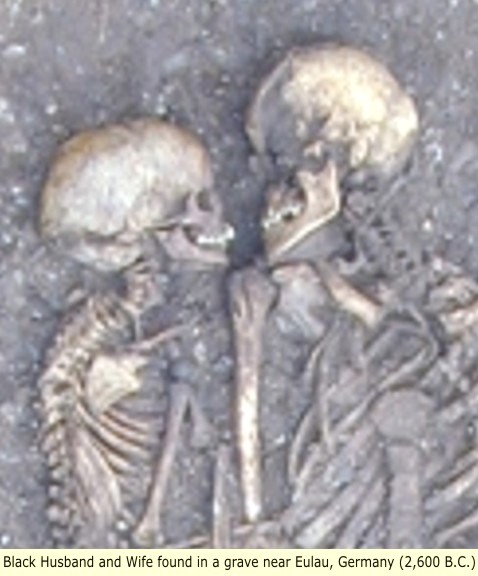
In 2005 four multiple burials were discovered near Eulau, Germany. The 4,600-year-old graves contained groups of (Black) adults and children buried facing each other. Skeletal and artifactual evidence and the simultaneous interment of the individuals suggest the supposed families fell victim to a violent event.
Genetic analysis of four bodies found in a 4,600-year-old grave shows that they belonged to a mother, a father and their two sons, who were buried together in one another's arms. The neolithic remains, which belong to a man aged between 40 and 60, a woman aged between 35 and 50, and boys aged 4 to 5 and 8 to 9, provide the earliest firm evidence for the existence of nuclear family units.
They may also bear witness to an ancient massacre: they were interred along with nine others in four graves, and many of the bodies show signs of a violent end. One female had a stone projectile head embedded in a vertebra, another had a fractured skull, and others had cut-marks on their hands and forearms consistent with self-defence. Most of the dead were children or women, and only one of the bodies belonged to a man in his prime. It is likely that these people were murdered in a raid by a rival tribe, before the survivors returned to bury their dead. A second grave may also hold a less conventional family unit: it contains the bodies of an infant girl, two brothers aged 4 to 5 and 7 to 9, and a woman aged between 30 and 38.
DNA tests show that the other two boys were probably brothers, and although the woman could not have been their mother, she is thought to have been a paternal aunt or stepmother. The baby's body has been too badly preserved for a family relationship to be established.
Wolfgang Haak, of the University of Adelaide, who led the research, said that in each grave, the bodies were arranged in positions that appear to have been symbolic of their relationships. In the case of the nuclear family, the man and woman were placed face-to-face with arms and hands linked, and the two boys were also facing one another. This is unusual for graves from this period, known as the Corded Ware Culture after its typical pots decorated with twisted cords.
 |
|
|
As would be expected, finding Black people with the R1a gene has thrown White genetics into a tailspin. (It was long thought that haplogroup "R" was a White clade, introduced into Europe with the Kugan (White people) migrations from Central Asia which started at about 1,500 B.C.). Therefore a NEW theory was needed!
The NEW theory: "Haplogroup R1a is common in many parts of Eurasia and is frequently discussed in human population genetics and genetic genealogy. One sub-clade (branch) of R1a, currently designated R1a1a, is much more common than the others in all major geographical regions. R1a1a, defined by the SNP mutation M17, is particularly common in a large region extending from South Asia and Southern Siberia to Central Europe and Scandinavia.
Currently, the R1a family is defined most broadly by the SNP mutation M420. The recent discovery of M420 resulted in a reorganization of the known family tree of R1a, in particular establishing a new paragroup (designated R1a*) for lineages which are not in the R1a1 branch leading to R1a1a.
R1a and R1a1a were once believed to have originated somewhere within Eurasia, thought to be in the area from Eastern Europe to South Asia. But the most recent studies indicate that South Asia is a more likely region of origin than Europe."
The earliest known farming culture in Central Europe, the Linear Pottery Culture found in the Derenburg Meerenstieg graveyard, Germany.
Male haplogroups found in the graveyard.
Y-DNA haplogroups - "F" - M89 and "G2a3" - M201, P287, S126 (L30)
Female haplogroups found in the graveyard.
MtDNA haplogroups - HV, H, N1a, N1a1a1, N1a1b, N1a, T, T2, K, W, J, V.
 |
Many modern scholars describe the historical Celts as a diverse group of tribal societies in Iron Age Europe. Proto-Celtic culture formed in the Early Iron Age in Central Europe (the Hallstatt period, named for the site in present-day Austria). By the later Iron Age (the La Tène period), Celts had expanded over a wide range of lands: as far west as Ireland and the Iberian Peninsula, as far east as Galatia (central Anatolia), and as far north as Scotland.
So let us trace the origins of the Hallstatt culture.
It begins with the "Corded Ware" culture
The Corded Ware culture receives its name "Corded Ware" from the frequent use of decorative cord impressions on the pots, which differed from the earlier Pit-Comb Ware culture, Single Grave from its burial custom, and Battle Axe from its characteristic grave offering to males, a stone battle axe (which was by this time an inefficient weapon, but still a traditional status symbol).
 |
The Corded Ware culture is an enormous European archaeological horizon that begins in the late Neolithic (Stone Age), flourishes through the Copper Age and finally culminates in the early Bronze Age, developing in various areas from about 3200 B.C. to 2300 B.C. It represents the introduction of metal into Northern Europe. Corded Ware culture is commonly associated with the Indo-European family of languages.
Corded Ware culture was the culmination of an interaction of opposing tendencies in the area of the North European Plain (between Denmark and Kiev) and between the expansionism in eastern Europe and the local sedentism of farmers in the west. The traditional view of this pottery representing a series of pan-European migrations from the steppe region of southern Russia has been abandoned. Also, Corded Ware Culture communities are now seen as sedentary agriculturalists.
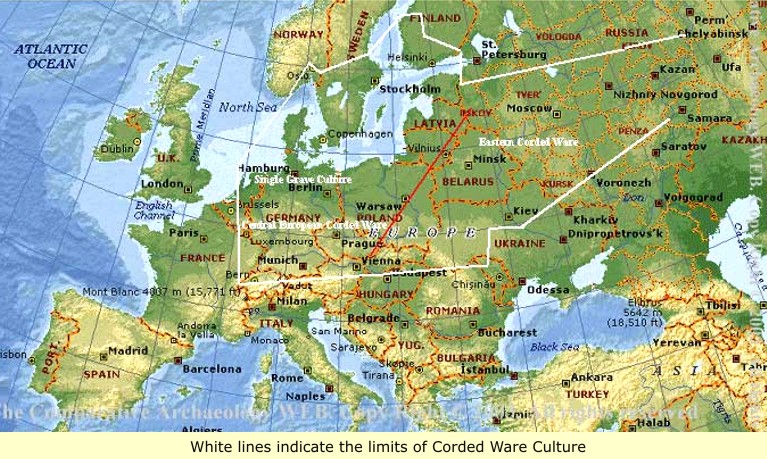 |
Corded Ware ceramic forms in single graves develop earlier in Poland than in western and southern Central Europe. Contemporary development of non-ceramic Corded Ware burial rites in the western parts have been explained as a spread of Corded Ware cultural traits through a wide-spanning communication network rather than through migration, suggesting the existence of an "A-Horizon" in the 28th century B.C, to be understood as a number of connecting forms within different regional contexts.
It spread to the Lüneburger Heide and then further to the North European Plain, Rhineland, Switzerland, Scandinavia, the Baltic region and Russia to Moscow, where the culture met with the pastoralists (animal herders) considered indigenous to the steppes (white people). On most of the immense, continental expanse the culture is clearly intrusive.
 The
Bell-Beaker culture ca. 2800 – 1900 B.C, is the term for a widely
scattered cultural phenomenon of prehistoric western Europe starting in
the late Neolithic or Chalcolithic running into the early Bronze Age.
The term was coined by John Abercromby, based on their distinctive
pottery drinking vessels.
The
Bell-Beaker culture ca. 2800 – 1900 B.C, is the term for a widely
scattered cultural phenomenon of prehistoric western Europe starting in
the late Neolithic or Chalcolithic running into the early Bronze Age.
The term was coined by John Abercromby, based on their distinctive
pottery drinking vessels.
Beaker culture is defined by the common use of a pottery style — a beaker with a distinctive inverted bell-shaped profile found across the western part of Europe during the late 3rd millennium B.C. The pottery is well-made, usually red or red-brown in colour, and ornamented with horizontal bands of incised, excised or impressed patterns. The early Bell Beakers have been described as "International" in style, as they are found in all areas of the Bell Beaker culture. These include cord-impressed types, such as the "All Over Corded" (or "All Over Ornamented"), and the "Maritime" type, decorated with bands filled with impressions made with a comb or cord. Later characteristic regional styles developed.
It has been suggested that the beakers were designed for the consumption of alcohol and that the introduction of the substance to Europe may have fueled the beakers' spread. Beer and mead content have been identified from certain examples. However, not all Beakers were drinking cups. Some were used as reduction pots to smelt copper ores, others have some organic residues associated with food, and still others were employed as funerary urns. Beakers may have been a special form of pottery with a ritual character.
Many theories of the origins of the Bell Beakers have been put forward and subsequently challenged. The Iberian peninsula has been argued as the most likely place of Beaker origin. The oldest AOO shards have so far been found in northern Portugal. Bell Beaker is often suggested as a candidate for an early Indo-European culture or, more specifically, an ancestral proto-Celtic or proto-Italic (Italo-Celtic) culture. The Kurgan hypothesis initially proposed by Marija Gimbutas derived the Beakers from east central European cultures that became "kurganized" by incursions of Steppe Tribes (White people). Her general proposition is supported, though with modifications, by archaeologists J. P. Mallory, and David Anthony.
Note: The "Kurgan hypothesis" traces the migrations of White people from Central Asia into Europe.
The Unetice Culture, is the name given to an early Bronze Age culture, preceded by the Beaker culture and followed by the Tumulus culture. The eponymous site is located at Únětice, northwest of Prague. It was named after finds in Aunjetitz, Bohemia and is now focused around the Czech Republic, southern and central Germany, and western Poland. It grew out of beaker roots. It is dated from 2300-1600 B.C. (Bronze A1 and A2 in the chronological schema of Paul Reinecke). The Sky Disc of Nebra is associated with the Unetice culture.
The 3,600-year-old Sky Disc of Nebra, was uncovered in 1999 and surfaced in 2002 when German grave robbers tried to sell it on the international market.
 |
The enigma of a priceless Bronze Age disc seems to have been solved by a Hamburg scientist who has identified it as one of the world's first astronomical clocks. The 3,600-year-old Sky Disc of Nebra, which surfaced four years ago when German grave robbers tried to sell it on the international market, shows that Bronze Age man had a sophisticated sense of time.
"We have been dramatically underestimating the prehistoric peoples," said Harald Meller, chief archaeologist of Saxony-Anhalt, where the disc was found.
The bronze disc is about 30cm in diameter, has a blue-green patina and is inlaid with a gold sun, moon and 32 stars. Robbers using metal detectors found it in 1999 alongside a pile of bronze axes and swords in a prehistoric enclosure on top of a hill in deep forest 112 miles (180km) southwest of Berlin.
The Nebra settlement is close to Europe's oldest observatory in Goseck. The site appears to have had deep spiritual significance in the Bronze Age. From the hill it is possible to see the sun set at every equinox behind the Brocken, the highest mountain peak of the Harz range. And there are about 1,000 barrows, burial grounds for warriors and princes, in the nearby forests.
Since police tracked down the thieves in Switzerland in 2002, archaeologists and astronomers have been trying to puzzle out the disc's function. Ralph Hansen, an astronomer in Hamburg, found that the disc was an attempt to co-ordinate the solar and lunar calendars. It was almost certainly a highly accurate timekeeper that told Bronze Age Man when to plant seeds and when to make trades, giving him an almost modern sense of time.
Herr Hansen first tried to explain the thickness of the moon on the disc. "The crescent on the Sky Disc of Nebra seems to be equivalent to a four-day moon," he said.
He consulted the 7th and 6th century B.C. mul-apin collection of Babylonian documents in the British Museum. It appears that the users of the 3,600- year-old clock made similar calculations. The disc was used to determine when a 13th month should be added to the lunar year, which has shorter months than the solar year. Herr Maller said: "Probably only a very small group of people understood the clock."
But the knowledge was somehow lost, and scientists say that the
clock would have been used for only about 300 years. Herr Maller said:
"In the end, the disc became a cult object."
The 32-centimeter disc and weighs approximately 2 kilograms is decorated with gold leaf symbols that clearly represent a crescent moon, a circle that was probably the full moon and starts. A cluster of seven dots has been interpreted as the Pleiades constellation as it appeared 3,600 years ago, scattered other stars and three arcs, all picked out in gold leaf from a background rendered violet-blue -- apparently by applying rotten eggs. The formations on the disc are clearly based on previous astrological observations and that astronomical knowledge was tied to a mythological-cosmological worldview right from the beginning.
Although an earlier impression of the cosmos dating from 2400 B.C
has been found in Egypt, The painting was found in the burial chamber
in the pyramid of the Egyptian pharaoh Unas, which is decorated with
stars.
The Tumulus culture dominated Central Europe during the Middle Bronze Age (ca. 1600 B.C. to 1200 B.C.). It was the descendant of the Unetice culture. Its heartland the area previously occupied by the Unetice culture besides Bavaria and Württemberg. It was succeeded by the Late Bronze Age Urnfield culture. As the name implies, the Tumulus culture is distinguished by the practice of burying the dead beneath burial mounds (tumuli).
 |
The Trundholm sun chariot is a late Bronze Age artifact discovered in Denmark. The sculpture was discovered in 1902 in the Trundholm moor in West Zealand County on the northwest coast of the island of Zealand in Denmark. The sculpture has been dated to the 18th to the 16th century B.C. It has been interpreted as a depiction of the sun being pulled by a mare.
The Urnfield culture (c. 1300 BC - 750 BC) was a late Bronze Age culture of central Europe. The name comes from the custom of cremating the dead and placing their ashes in urns which were then buried in fields. The Urnfield culture followed the Tumulus culture and was succeeded by the Hallstatt culture. As there are no written sources, the languages spoken by the bearers of the Urnfield culture are unknown. Some scholars consider them to be the ancestors of the Celts. Urnfield material is found in some of the areas where later people were to be called "Kelt" or "Galatoi" by classical authors (who had never been there). As we do not know how processes of ethnogenesis work or how long they last, and whether a common material culture is always associated with social and political unity, this is highly contested.
The Hallstatt culture was the predominant Central European culture from the 8th to 6th centuries B.C. (European Early Iron Age), developing out of the Urnfield culture of the 12th century B.C. (Late Bronze Age) and followed in much of Central Europe by the La Tène culture. By the 6th century B.C, the Halstatt culture extended for some 1000 km, from the Champagne-Ardenne in the west, through the Upper Rhine and the upper Danube, as far as the Vienna Basin and the Danubian Lowland in the east, from the Main, Bohemia and the Little Carpathians in the north, to the Swiss plateau, the Salzkammergut and to Lower Styria. It is named for its type site, Hallstatt, a lakeside village in the Austrian Salzkammergut southeast of Salzburg. The culture is commonly linked to Proto-Celtic and Celtic populations in its western zone and with pre-Illyrians in its eastern zone.
Lichtenstein Cave
The Lichtenstein Cave is an archaeological site near Dorste, Lower Saxony, Germany. The cave is 115 meters long and was discovered in 1972. Finds include the skeletal remains of 21 females and 19 males from the Bronze Age, about 3000 years old. In addition, about 100 bronze objects (ear, arm and finger rings, bracelets) and ceramic parts from the Urnfield Culture were found. Both mitochondrial DNA and Y-chromosome DNA tests were conducted on the skeletons and published by the University of Göttingen. Mitochondrial haplogroups found included 17 from H, 5 from T2, 9 from U5b and 5 from J*. Y-chromosome
DNA - Out of the 19 males represented in the cave, 15 yielded the full
12 tested STR values, with twelve showing haplotypes related to I2b2
(at least four lineages), two to R1a (probably one lineage), and one to
R1b predicted haplogroups. As we can see from the Lichtenstein Cave results, the Black populations of ancient Central and Eastern Europe were quite diverse. |
They were driven West and south, by incoming Albino Germanic tribes, who themselves were being chased out of Asia by the Huns of Mongolia. The Huns were a group of nomadic people who migrated into Europe c. AD 370, and built up an enormous empire in Europe. The Huns had a language of their own; but very little of it has survived, and its relationships have been the subject of debate for centuries.
It is thought by many, that the Huns may have stimulated the "Great Migration" a contributing factor in the collapse of the western Roman Empire. They formed a unified empire under Attila the Hun, who died in 453; their empire broke up the next year. Their descendants, or successors with similar names, are recorded by neighboring populations to the south, east, and west as having occupied parts of Eastern Europe and Central Asia roughly from the 4th century to the 6th century. Variants of the Hun name are recorded in the Caucasus until the early 8th century.
The Migration Period, also called the Barbarian Invasions (and in German: Völkerwanderung 'migration of peoples'), was a period of human migration that occurred during roughly 300–700 A.D. in Europe, marking the transition from Late Antiquity to the Early Middle Ages. These movements were catalyzed by profound changes within both the Roman Empire and the so-called "barbarian frontier". Migrating peoples during this period included the Huns, and the Albino Germanic tribes: Goths, Vandals, Avars, Bulgars, Alans, Suebi, Frisians, and Franks, among other Germanic and Slavic tribes.
Thus the Huns forced "MOST" Whites out of their ancestral lands in Asia, and into Europe: causing death and displacement for the native Blacks in Europe.
 |
 |
 |
The University of Calgary: Applied History Research Group - The End of Europe's Middle Ages
Origins of the Ottoman Empire
Pressured out of their homes in the Asian steppes by the Mongols, the Turkish tribes converted to Islam during the eighth and ninth centuries. By the tenth century, one of the Turkish tribes, the seljuk , had become a significant power in the Islamic world and had adopted a settled life that included Islamic orthodoxy, a central administration, and taxation. However, many other Turkish groups remained nomadic and, pursuing the gazi tradition, sought to conquer land for Islam and to acquire war booty for themselves. This led them into conflict with the Seljuk Turks, and to pacify the nomadic tribes, the Seljuks directed them to the eastern domain of the Byzantine Empire, Anatolia. The tribe known as the Ottomans arose from one of the smaller emirates established in northwestern Anatolia after 1071. The dynasty was named for Osman (1259-1326), who began to expand his kingdom into the Byzantine Empire in Asia Minor, moving his capital to Bursa in 1326.
 With
the coming of the White Turks, now Blacks in Anatolia, Arabia, the
Middle East, and North Africa, would be killed and displaced - and many
who survived would be "Absorbed": creating a new "Sub-Race" of
"Brown-Skinned" Turks, who often call themselves Arabs: vis-à-vis their
Islamic religion. They are now the ruling elite in North Africa, the
middle East, and Arabia.
With
the coming of the White Turks, now Blacks in Anatolia, Arabia, the
Middle East, and North Africa, would be killed and displaced - and many
who survived would be "Absorbed": creating a new "Sub-Race" of
"Brown-Skinned" Turks, who often call themselves Arabs: vis-à-vis their
Islamic religion. They are now the ruling elite in North Africa, the
middle East, and Arabia.
Conversely: the Black Asians would themselves be "Absorbed" by the remaining Central Asian Albinos and Mongol Albinos: Producing the modern Asian. In 1218, Genghis Khan - one of these now "Whitenized" Asians, sent a trade mission to the Turk Qutb ud-Dīn Muhammad I (who by 1205 had conquered the remaining parts of the Great Seljuq Empire, proclaiming himself Shah (king): he called himself "Khwarezm-Shah"), but at the town of Otrara (a Central Asian town that was located along the Silk Road near the current town of Karatau in Kazakhstan) the governor there, suspecting the Khan's ambassadors to be spies, confiscated their goods and executed them. Genghis Khan demanded reparations, which the Shah refused to pay. Genghis Khan then sent a second, purely diplomatic mission, they too were murdered. Genghis retaliated with a force of 200,000 men, launching a multi-pronged invasion, his guides were Muslim merchants from Transoxania. During the years 1220–21, Bukhara, Samarkand, Herat (all Central Asian cities), Tus (Susa), and Neyshabur (Persian cities) were razed, and the whole populations were slaughtered. (This represented the first wholesale slaughter of Black Persians).
The advance into Europe continued with Mongol invasions of Poland, Hungary and Transylvania. When the western flank of the Mongols plundered Polish cities, a European alliance consisting of the Poles, the Moravians, the Christian military orders of the Hospitallers, Teutonic Knights and the Templars assembled sufficient forces to halt the Mongol advance at Legnica, but only briefly. The Hungarian army, their Croatian allies and the Templar Knights were beaten by Mongols at the banks of Sajo River on April 11, 1241. After their victories over European Knights at Legnica and Muhi, Mongol armies quickly advanced across Bohemia, Serbia, Babenberg Austria and into the Holy Roman Empire. But before Batu's forces could continue into Vienna and northern Albania, he received news of Ogedei's death in December 1241. As was customary in Mongol military tradition, all princes of Genghis's line had to attend the kurultai to elect a successor. Batu and his western Mongol army withdrew from Central Europe the next year.
 |
BLACK/ALBINO ADMIXTURE IN THE NORTHThe material below by Norse historian Jenny Jochens contains all of the self serving nonsense typical of Albino presented history; not the least of which is the Albino delusion that healthy Black people would want the attributes of a compromised Albino. It is presented only as a way to explain what little diversity there still is in modern Icelanders. |
The Viking Age was a period in European history
spanning the late 8th to late 11th centuries. Scandinavian (Norse)
Vikings explored Europe by its oceans and rivers through trade and
warfare. The Vikings also reached Iceland, Greenland, Newfoundland, and
Anatolia. Additionally, there is evidence to support the Vinland legend
that Vikings reached farther west to the North American continent. The
Vikings who invaded western and eastern Europe were chiefly pagans from
Denmark, Norway and Sweden.
The Sagas of Icelanders—many of which are also known as family sagas—are prose histories mostly describing events that took place in Iceland in the 10th and early 11th centuries, during the so-called Saga Age. They are the best-known specimens of Icelandic literature. Noted Norse historian Jenny Jochens makes use of these Sagas in her essay:
Race and Ethnicity in the Old Norse World (excerpts)
by Jenny Jochens
from Viator, Volume 30, UCLA, 1999
Quote: Tacitus (the Roman historian) attributed the uniform physical characteristics of the Germanic tribesmen--blue eyes, reddish hair, and large stature--to their lack of intermarriage with other peoples. While Tacitus' observations may have remained accurate for several more centuries, Northern Europeans eventually began to display a greater variety of physical traits reflecting genetic changes associated with migratory movements. By the Saga Age, swarthy complexions and features were not unknown in the North, but they were considered aesthetic faults. "Geirmundar ßáttr heljarskins" tells of Geirmundr and Hámundr, twin sons of a minor 9th century Norwegian king who were born with skin so dark they were called heljarskin--Hel-Skin; Black as Hel. The term "svartr" (black) is commonly ascribed in the sagas to people with dark coloring, contrasted with "hvítr" (white) for those of fair complexion and features. These terms do not refer to race in the modern sense--black Africans were never described as svartr, but as blámenn (blue men). Note: (No effort is made to substantiate the claim). Still, the svartr/hvítr distinction shows an early attunement to physical differences based on coloring. The Anglo-Saxons from earliest times had been intermarrying with Celts, introducing genes for dark hair and swarthy coloring into Germanic bloodlines. These characteristics were gradually brought to Norway by the traffic in captive women.
A greater mixing of the genetic pool took place in early
Iceland, which became a veritable melting pot of Scandinavian and
Celtic settlers. Throughout this process, literary references make it
clear that Nordic peoples considered Celts to be dark, and thought of
themselves as fair by contrast. As Norsemen came into increasingly
greater contact with Celts, the byname hvíti (the White) became common.
This byname was probably not bestowed on fair-featured Norwegians by
Celts, but rather indicated self-awareness of light complexion as a
noteworthy trait on the part of the Norse themselves. The sagas and
especially Landnámabók show that the byname hvíti often passed from
father to son and tended to run in families--presumably applying to
fair- complected Norwegians who lived or traded with darker-skinned
people for several generations. Svartr, "Black" or "the Black," was a
common byname in early Iceland, usually referring to people of pure or
mixed Celtic blood. Although a significant percentage of the settlers
of Iceland were of Celtic extraction, they generally adopted Norse
names. Moreover, Norse/ Icelandic slaveholders often gave their Celtic
thralls (serf or slave) Norse names--including the proper name, Svartr.
The names Hvíti and Svartr thus came to be associated with not just
shades of coloring, but also social status. Two sagas mention settlers
named Svartr who are clearly not thralls, but both are described as
unpleasant and violent.
The sagas contain many examples of a perceived connection
between dark features and Celtic origins, as well as a general aversion
to such looks. In general, Celts were considered to be ugly because
they were dark. Typical is the serving maid's description of Kormák the
skald as "svartr or ljótr"--dark and ugly. These adjectives were
applied so often to people of Celtic extraction that they became
bynames and then proper names. While Svartr/svarti served mainly to
designate the darkness of "the other" with whom the Norse settlers
shared their new homeland, the name Ljótr (Ugly/the Ugly) incorporates
an aesthetic judgment, if not a sense of hostility. Both names
continued down through the generations after the Settlement, confirming
that dark, Celtic features were inherited and that they continued to be
noticed. Dark features in women apparently met with less disapproval
than in men. No women are known to have been given svartr-names,
although several women of Celtic origin with the name Ljót appear in
the lore. This greater acceptance may be related to the fact that
Nordic men had no apparent qualms about interbreeding with (and indeed
marrying) Celtic women. Dark featured men were more feared and
(especially in early Iceland) competed with Nordic men for the
relatively small supply of females.
ORKNEY (an archipelago in northern Scotland).
If Iceland offers a melting pot in which a majority of Norse immigrants received infusions from a minority of Celtics, the reverse obtains in Orkney, but on a lesser scale. Here a Norse minority intruded into a mass of native people--probably Picts--of darker hues. Conquered by Vikings (875), the islands were long dominated by the Norse. Icelandic authors dealt with this Norse presence in the archipelago in Orkneyinga saga.
CONCLUSION
Despite their fundamental dislike of dark features, Norwegians were
able to overlook the difference between themselves and Celts which they
considered minor. Mingling successfully with the natives on the western
islands, they accepted people from these areas in the new society they
established in Iceland. In the process they produced the Icelandic
population who displayed their ancestors' distinctive traits epitomized
in the contrast between dark and blond. During the Icelandic
colonization of Greenland sexual contacts did not occur between the
Norse and the Inuit, perhaps simply because of the great distance that
separated the two. Maintaining existence separate from the Inuit may
have been further conditioned by the Norse experience in the New World.
In Vinland the Greenlanders encountered Indians and or Inuit
immediately. The exchanges--mainly of an economic nature--were
initially friendly but quickly turned hostile and persuaded the Norse
to return home. Aggravating the situation was the demography of the
Norse contingent. More an expedition than a colony, it contained too
few women, as the following statement from Eiríks saga reveals: "There
was deep division between the men on account of the women, for the
unmarried men fell afoul of the married, which led to serious
disturbances''. Judging from the sagas, the Norse did not permit close
contact with the natives who, on their side, made an effort to meet the
intruders. Norse men may not have sought sexual encounters with local
women because the Indians of the New World--as the Inuit in
Greenland--were of strikingly different physique. Although the Norse
had accommodated the differences of the Celtic people, the alterity of
the Inuit and Indians was too great.
In all likelihood, the sight of the aborigines appears to have
generated revulsion in the Norse. The term skrælingjar which designated
the populations of both Greenland and Vinland is hardly flattering,
since it suggests wizened and dried-up features. In a face-to-face
encounter m Vinland the natives were described as "dark (svartir, in a
variant version: small [smáir]) and evil-looking men with rough hair on
their heads: they had large eyes and broad cheekbones". In Vinland
sexual frustration and reproductive needs were not enough to overcome
the Norse bias. With insufficient imported or native women, the
colonists finally abandoned their experiment in the New World. This
later failure to mix with peoples of pronouncedly distinctive physical
traits should not obscure the achievement that Norse and Celts had
earlier overcome their visible and audible differences. The
rapprochement had started on the Bntish Isles and was practiced by both
sides.
Celts taken as slaves by Vikings and brought to Iceland had
little choice but to accept the conditions enforced upon them, but
others came voluntarily. They willingly gave up their identity
epitomized by their Celtic names and took on Norse names: at best a
part of their old selves was preserved in nicknames that may have
seemed unimportant to themselves but were bestowed by their masters who
thus identified them in the new world of Iceland. Together with their
names they also abandoned their native language and learned Norse, a
language so different from their own that perfection may only have been
achieved by the new generation.
On the other hand, Norse men who arrived in small groups were eager to enlist a labor force sufficient for the colossal work of extracting a livelihood from the empty land and its stubborn resources. They imported Celtic slaves and welcomed free Celts on their own, often giving or selling land to them. Favoring their own blond appearance, however, the Norse were unable to hide their discomfort--perhaps tinged with an element of fear--prompted by the dark complexion of the foreigners to whom they attributed distinctive names and unflattering epithets. Since the Norse brought only few women from Norway, female slaves from the Celtlc world were valued both for their physical labor and sexual services.
In the beginning free Celts tended to associate wnh each other, and
Celtic men may have preferred to marry women of their own. but slave
women were in no position to refuse their sexuality to their Norse
masters. Nameless Celtic slaves and named but single men from Norway
initiated the inter-mingling and produced a portion of the first cohort
of native Icelanders, some of whom displayed the dark characteristics
of their Celtic mothers. In the following generations men and women
married with little concern for ethnic origin.
The adaptability of the original Celts and the corresponding
receptivity of the Norse reduced racial and ethnic tension and produced
in Iceland a culture remarkable for its homogeneity, but forged by a
population which was and has remained more varied than elsewhere in the
North, at least until the middle of this century. Although on a smaller
scale and with fewer physical varieties than Rome, medieval Iceland
nonetheless offers an illustration of the subtext of biological
diversity among the ancient Romans which is lurking beneath Tacitus's
perception concerning the homogeneity of the Germanic tribes cited at
the beginning of this essay.
 |
 |
 |
 |
 |
Related material - The British Isles |
Click here for the Celts in Britain: Click >>> |
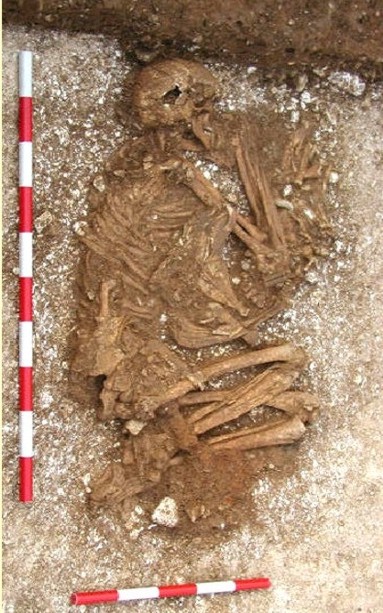
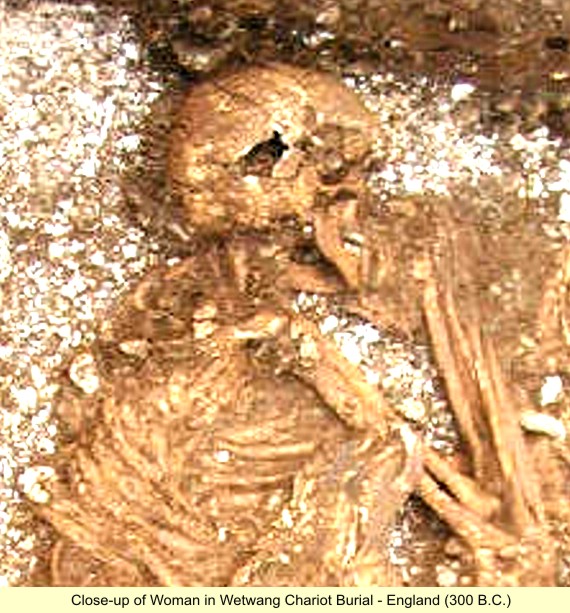
In March 2001 an Iron Age grave was discovered in the village of Wetwang in East Yorkshire, England. It was found during the construction of a small housing development by Hogg the Builders of York. The grave was then excavated by a team of archaeologists from The Guildhouse Consultancy and the British Museum, and funded by English Heritage. The excavation showed that the grave was that of a woman who had died over 2,300 years ago and was buried with a chariot.
 |
 |
 |
 |
 |
The ivory bangle lady came from a group of graves excavated in 1901, on what would have been the approaches to the Roman city of Eboracum, modern York. The burials were dated to the second half of the fourth century AD, and many had rich grave goods.
She was buried with items including jet and elephant ivory bracelets, earrings, beads and a blue glass jug. She also had a rectangular piece of bone, which is thought to have originally been mounted in a wooden box, which was carved to read, "Hail, sister, may you live in God'.
 |
 |
The grave goods and skeletal remains of the Ivory Bangle Lady were studied by the archaeology department of the University of Reading. The university's Dr Hella Eckardt said a study of the skull's size and facial features along with analysis of the chemical signature of the food and drink she had consumed led to their conclusion that she was of high status and of African origin.
Dr Eckardt said: "Multi-cultural Britain is not just a phenomenon of more modern times. "Analysis of the 'Ivory Bangle Lady' and others like her, contradicts common popular assumptions about the make up of Roman-British populations as well as the view that African immigrants in Roman Britain were of low status, male and likely to have been slaves." Story from BBC NEWS. (Note; that in this BBC story, "Africans" the ORIGINAL settlers of the British Isles, are referred to as "IMMIGRANTS"). Another fine example of how Whites use their media to falsify history.
Examination of the skeleton indicated that the man was local to the area and aged about 30 when he died. Radiocarbon dating suggests that he died around 2300 B.C, making his death roughly contemporary with the Amesbury Archer and the Boscombe Bowmen buried 3 miles away in Amesbury. He came to be known as an archer because of the stone wrist-guard and a number of flint arrowheads buried with him. In fact, several of the arrowheads' tips were located in the skeleton's bones, suggesting that the man had been killed by them.
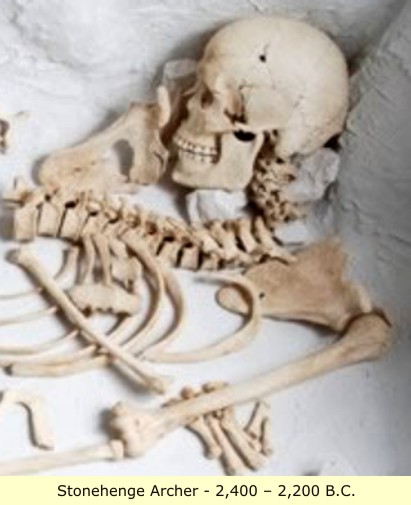 |
Note difference in Nasal bridge between a Black man and a Caucasian. |
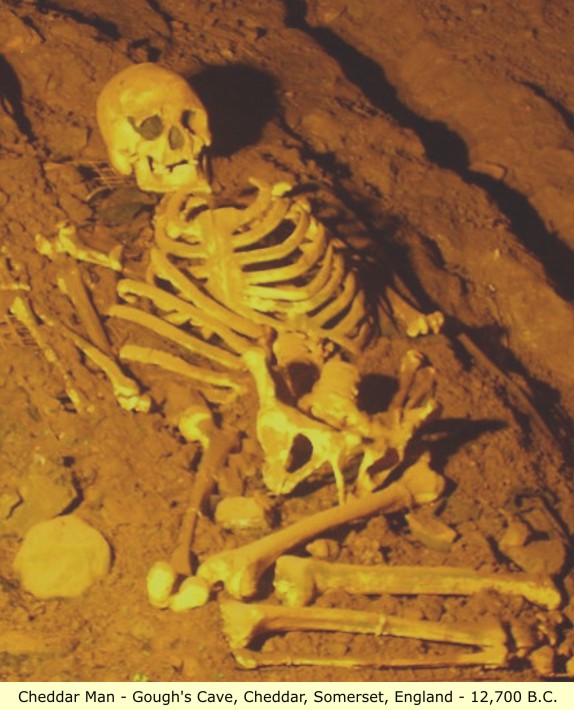
Gough's Cave is located in Cheddar Gorge, a deep
canyon on the southern edge of Somerset's Mendip Hills, in Cheddar,
Somerset, England. The cave is 90 metres (295 ft) deep and is 2.135
kilometres (1.33 mi) long, and contains a variety of large chambers and
rock formations. It contains the Cheddar Yeo, the largest underground
river system in Britain. In 1903 the remains of a human male, since
named Cheddar Man, were found a short distance inside Gough's Cave. He
is Britain’s oldest complete human skeleton, having been dated to
approximately 7150 BCE Re-tested: New date 12,700 B.C. There is
a suggestion that the man died a violent death, perhaps related to
cannibalism, although this has not been proven. In 2007 a carving of a
mammoth, estimated to be 13,000 years old, was also found in the cave.
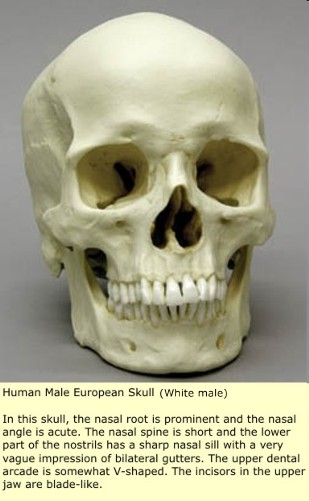
Skull comparison: White Male (above). Black Male - Cheddar Man.
|
 |
In the 1980s, excavations uncovered accumulations of human and animal bones and artefacts that appeared to be much older even than Cheddar Man. The discoveries caused a sensation when it was realised many human remains bore a pattern of cut marks compatible with cannibalism. However, researchers were perplexed by the radiocarbon dating results. Although the remains seemed to represent a single occupation level in the sediments, the remains appeared to be a thousand years different in age. "We had these apparently cannibalised human bones and artefacts and animal remains with signs of butchery. They all looked like they should be part of a consistent population pattern," said Chris Stringer, head of human origins at London's Natural History Museum. "Even some re-fits of bones which seemed to be from the same individual were giving different ages."
Since those tests were carried out, there have been significant advances in radiocarbon dating technology, particularly to reduce contamination in the samples. This allows more accurate dating of archaeological materials. When the bones were sent to be re-tested at the Oxford Radiocarbon Accelerator Unit, the remains fell into a much narrower age range, converging on 14,700 years ago. The latest results were a much better fit with the archaeological findings. Members of the Ancient Human Occupation of Britain (AHOB) project now think the bones from Gough's Cave could have accumulated over just two or three human generations.
These results confirm the site's great antiquity and suggest human hunters re-colonised Britain at a time of rapid climate warming. 24,000 years ago, an ice sheet extended over much of Britain. Beyond that ice sheet, in southern Britain and much of northern France, the environment resembled a polar desert. Evidence suggests these inhospitable conditions kept people out of north-west Europe for more than 9,000 years. But human groups were able to retreat to ice-free areas (refugia) in southern France, Iberia (Spain) and elsewhere. After the Ice Age peaked, humans bounced back, expanding from the southern refugia to re-colonise northern Europe.
To summarize what we know of the ancient Black people of Europe, and their DNA haplogroups.
DNA results for the original people of Europe
Black Eastern Europeans - mainly Y-dna haplogroup "I" Black Central Europeans - Mtdna haplogroups H, T2, U5b, J*. Black Central Europeans - Y-dna haplogroups I2b2, R1a, R1b. Paglicci 23 - the name for human remains found in Paglicci Cave in Apulia, Italy that have been dated to 28,000 years Before Present, the Mtdna is "H" - the same that is found in the Lichtenstein Cave. Ötzi the Iceman - a well-preserved natural mummy of a man from about 3300 B.C. The mummy was found in September 1991 in the Schnalstal glacier in the Ötztal Alps, near Hauslabjoch on the border between Austria and Italy - is Mtdna "K". In England - Cheddar Man is the name given to the remains of a human male found in Gough's Cave in Cheddar Gorge, Somerset, England. The remains date to approximately 12,700 B.C. It is Britain’s oldest complete human skeleton - his Mtdna is U5 - also found in the Lichtenstein Cave. |
(Just another White Lie)
We were probably all "taken-in" by the White mans claims that DNA study could clearly define who-was-who in ancient history. And knowing the White mans track record of lying about such matters, we all just naturally assumed that the DNA of ancient Blacks in Europe, Asia, North Africa, the Middle East, and the Americas was already done, but Whites simply wouldn't release it, or would release it, while calling it something else.
Well, we were partially right: the DNA of ancient Blacks in Europe, Asia, North Africa, the Middle East, and the Americas is already done, but Whites simply wouldn't release it, or release it, while calling it something else.
But the White mans claims that DNA study could clearly define who-was-who in ancient history is a BUST! As we can see from the data above: that which we were told were the "White" haplogroups; like R1 and R2, are instead, indisputably "Black" haplogroups. As always; all roads lead "Back" to the Black man.
There is a chart of Modern White European Y-DNA which clearly shows that there is NO uniquely "White" haplogroups; but rather, all White DNA is derived from Black haplogroups. But since this page is already very long: in order to save space, we are providing a link to the chart, instead of placing it on this page.
Note: the chart has live links to the sources used for the chart. It is interesting and amusing; to read the conclusions drawn, and why they were drawn. It truly gives insight into the minds of these fabricators. Click here for the chart <<Click>>
Haplogroup U, appearing about 55,000 - 60,000 years ago, is one of the oldest branches descending from haplogroup R. Haplogroup U has extremely broad geographic distribution, ranging from Europe and North Africa to India and Central Asia. Frequencies of haplogroup U range from 10-30% in these populations.
The wide distribution of haplogroup U is primarily due to its antiquity, with its appearance immediately following that of haplogroup R, after “the Out of Africa” exit. Subsequent migrations in turn gave birth to numerous subclades linked to specific geographic distributions. Currently, nine main subgroups (U1-U9) have been identified within haplogroup U, some of which have been widely analyzed by population geneticists and anthropologists.
Phylogeography of U
Subhaplogroup U2 is subdivided into five subclades: U2a, U2b, U2c, U2d, and U2e (“e” means European). Subclades U2a-d are all typical of the Indo-Pakistani region, and are found in 8-9% of the total population. These subclades appeared from 35,000 to 40,000 years ago.
Subhaplogroup U7 is also prevalent in South Asia. Frequencies among South Asian populations include 12% of the population in Gujarat (western India), 5% in Pakistan, and about 2% in India. This subhaplogroup is also common in the Near East, found in 10% of Iranians.
Subhaplogroup U6 is typical of North Africa and appears to have originated in the Near East about 40,000 years ago, and subhaplogroup U5 is typical of Europe. Despite the difference in their geographic distributions U5 and U6 are strikingly similar to one another. It has been postulated that the two populations harboring the U6 and U5 mitochondrial DNA variants were living in the same broad geographic area of southwestern Asia when they were affected by an event that led to their expansion and relocation. There was a change in climate conditions about 43,000 years ago which allowed humans to enter the Levant and then Europe and North Africa. Thus, while U5 took part in the first settlement of Europe by modern humans, U6 (and a subclade of M, called M1) entered North Africa giving rise to the so called “Back to Africa” expansion (Back migrations are completely unproven). This scenario reinforces the idea that the first cultures in North Africa and Europe had a common source.
Moreover, the subclade U5b has been identified as a marker (together with H1, H3 and V) that characterizes the dynamics of late glacial dispersal in Europe (and other regions). In fact, after the last Ice Age passed (about 13,000 years ago) hunter-gatherer populations, which took refuge in a few areas of Southern Europe including the Iberian Peninsula (Spain and Portugal), gradually repopulated much of central and northern Europe, as well as northern Africa by crossing the Strait of Gibraltar. However, the U5b subclade is found also in northern Nordic countries. A particular variation within this subclade known as U5b1b defines 27% of Swedish Saami, 40% of Finnish Saami, and 57% of Norwegian Saami peoples.
Subhaplogroup U8 can be further subdivided into the subclades U8a and U8b. The oldest U8a lineages in Europe were found among the Basques supporting the idea that Basques could have participated in the demographic re-expansion that took place after the last Ice Age (see above). U8b includes the cluster K that was initially identified as an independent haplogroup.
NEWS FLASH! - THE ALBINOS FINALLY ADMIT THAT THEY ARE NOT NATIVE EUROPEANS - BLACK PEOPLE ARE! Article: The findings, detailed today (April 23) in the journal Nature Communications, were drawn from several skeletons unearthed in central Europe that were up to 7,500 years old. "What is intriguing is that the genetic markers of this first pan-European culture, which was clearly very successful, were then suddenly replaced around 4,500 years ago, and we don't know why," said study co-author Alan Cooper, of the University of Adelaide Australian Center for Ancient DNA, in a statement. "Something major happened, and the hunt is now on to find out what that was." (That is of
course a lie, they know very well what happened: their people - Albinos
from central Asia - invaded circa 2,500 B.C.) "We have established that the genetic foundations for modern Europe were only established in the Mid-Neolithic, after this major genetic transition around 4,000 years ago," study co-author Wolfgang Haak, also of the Australian Center for Ancient DNA, said in a statement. "This genetic diversity was then modified further by a series of incoming and expanding cultures from Iberia and Eastern Europe through the Late Neolithic."
Click here for link to Livescience article Click here for link to the study at Nature Communications
|
The ancestors of the people who built Stonehenge travelled west across the Mediterranean before reaching Britain, a study has shown. Researchers compared DNA extracted from Neolithic human remains found across Britain with that of people alive at the same time in Europe. The Neolithic inhabitants were descended from populations originating in Anatolia (modern Turkey) that moved to Iberia before heading north. They reached Britain in about 4,000BC. Details have been published in the journal Nature Ecology & Evolution. The migration to Britain was just one part of a general, massive expansion of people out of Anatolia in 6,000BC that introduced farming to Europe. Before that, Europe was populated by small, travelling groups which hunted animals and gathered wild plants and shellfish. One group of early farmers followed the river Danube up into Central Europe, but another group travelled west across the Mediterranean. DNA
reveals that Neolithic Britons were largely descended from groups who
took the Mediterranean route, either hugging the coast or hopping from
island-to-island on boats. Some British groups had a minor amount of
ancestry from groups that followed the Danube route.
When the researchers analysed the DNA of early British farmers, they found they most closely resembled Neolithic people from Iberia (modern Spain and Portugal). These Iberian farmers were descended from people who had journeyed across the Mediterranean. From Iberia, or somewhere close, the Mediterranean farmers travelled north through France. They might have entered Britain from the west, through Wales or south-west England. Indeed, radiocarbon dates suggest that Neolithic people arrived marginally earlier in the west, but this remains a topic for future work. In addition to farming, the Neolithic migrants to Britain appear to have introduced the tradition of building monuments using large stones known as megaliths. Stonehenge in Wiltshire was part of this tradition. Although Britain was inhabited by groups of "western hunter-gatherers" when the farmers arrived in about 4,000BC, DNA shows that the two groups did not mix very much at all. The British hunter-gatherers were almost completely replaced by the Neolithic farmers, apart from one group in western Scotland, where the Neolithic inhabitants had elevated local ancestry. This could have come down to the farmer groups simply having greater numbers. "We don't find any detectable evidence at all for the local British western hunter-gatherer ancestry in the Neolithic farmers after they arrive," said co-author Dr Tom Booth, a specialist in ancient DNA from the Natural History Museum in London. "That doesn't mean
they don't mix at all, it just means that maybe their population sizes
were too small to have left any kind of genetic legacy." Co-author
Professor Mark Thomas, from UCL, said he also favoured "a numbers game
explanation".
Professor Thomas said the Neolithic farmers had probably had to adapt their practices to different climatic conditions as they moved across Europe. But by the time they reached Britain they were already "tooled up" and well-prepared for growing crops in a north-west European climate. The study also analysed DNA from these British hunter-gatherers. One of the skeletons analysed was that of Cheddar Man, whose skeletal remains have been dated to 7,100BC. He was the subject of a reconstruction unveiled at the Natural History Museum last year. DNA suggests that, like most other European hunter-gatherers of the time, he had dark skin combined with blue eyes. Genetic analysis shows that the Neolithic farmers, by contrast, were paler-skinned with brown eyes and black or dark-brown hair. ^ PURE ALBINO LIES ^
Reference this scientific study instead of Albino lies.Please note: Byzantium/Anatolia/The Eastern Roman Empire/Asia Minor: are all the SAME place = Anatolia. Which the Albino Turks from Asia took from the Black Eastern Roman Empire in 1453 A.D.
Towards the end of the Neolithic, in about 2,450BC, the descendants of the first farmers were themselves almost entirely replaced when a new population - called the Bell Beaker people - migrated from mainland Europe. So Britain saw two extreme genetic shifts in the space of a few thousand years. Prof Thomas said that this later event happened after the Neolithic population had been in decline for some time, both in Britain and across Europe. He cautioned against simplistic explanations invoking conflict, and said the shifts ultimately came down to "economic" factors, about which lifestyles were best suited to exploit the landscape. Dr Booth explained: "It's difficult to see whether the two [genetic shifts] could have anything in common - they're two very different kinds of change. There's speculation that they're to some extent population collapses. But the reasons suggested for those two collapses are different, so it could just be coincidence." |
Who are these modern White (Albino) Europeans?
The Germanics:
Encyclopedia:
|
 |
The Slavs are the largest ethnic and linguistic group of peoples in
Europe belonging to the Indo-European linguistic family. It is
estimated that the Slavs number over 300 million in the world. They are
usually classified in three main divisions. The West Slavs include the
Poles, the Czechs, the Slovaks, and the Wends (also known as Lusatians)
and other small groups in East Germany. The South Slavs include the
Serbs, the Croats, the Slovenes, the Macedonians, the Montenegrins, the
Bosniaks, and the Bulgars. The East Slavs, the largest group, include
the Great Russians, Ukrainians, and Belorussians (or White Russians).
Origins
Ethnically the Slavs possess little unity, for they have mixed for
centuries with other peoples, including Turko-Tatars, Finnic peoples,
Germans, Mongols, Greeks, and Illyrian tribes. The Bulgarians are not
of Slavic origin. The obscure beginnings of the Slavs have given rise
to several theories, all of which include as a possible place of origin the area of the Polesie marshes in Galicia (region spanning southeastern Poland and western Ukraine ).
The ancestors of the Slavs were Neolithic tribes who occupied this
territory a few centuries before the Christian era. (The Albinos will
not venture into their origins before this time, as that would surely
lead to Central Asia and Albinohood).
Bibliography
See K. Jazdzewski, Atlas to the Prehistory of the Slavs (tr., 2 vol.,
1948—49); J. S. Roucek, ed., Slavonic Encyclopaedia (4 vol., 1949,
repr. 1969); F. Dvornik, The Slavs (1956) and The Slavs in European
History and Civilization (1962, repr. 1986); S. H. Cross, Slavic
Civilization through the Ages (1963); A. P. Vlasto, The Entry of the
Slav
s into Christendom (1970); M. A. Gimbutas, The Slavs (1971).
Because the Turks are now a predominately Mulatto people, no efforts
are made to hide their origins. Therefore all Albino sources will
freely admit that Turks were an Asian People.
Greeks and Romans were a Black and Mulatto people comprised of the
Original Black Europeans and the first Central Asian Albinos to reach
Europe, circa 1200 B.C. Modern Albinos have nothing to do with these
people, as they were the victims of the marauding Albinos from Central
Asia. But modern Albinos do falsely claim that the Hellenes of Greece
were Albinos. The Greek historian Herodotus clearly explains the
Hellenes were only "partly Albino" thusly:.
Book 1 – CLIO
[1.58] The Hellenic race has never, since its first origin, changed its speech. This at least seems evident to me. It was a branch of the Pelasgic, which separated from the main body, and at first was scanty in numbers and of little power; but it gradually spread and increased to a multitude of nations, chiefly by the voluntary entrance into its ranks of numerous tribes of barbarians.
Please visit the "Additional Material Area" for many more photographs of each civilization, and related material <Click> |
| < Back | Home | Next > |