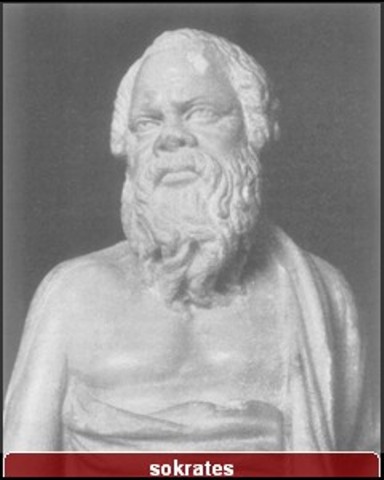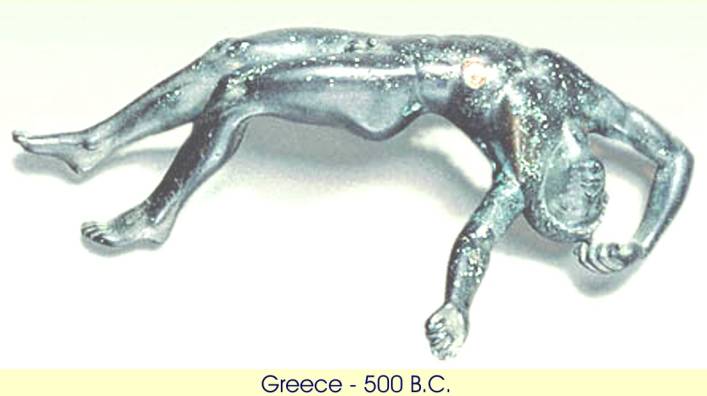
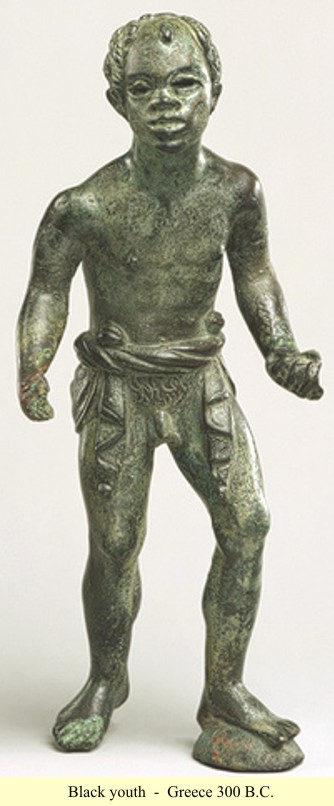
With the exit of the "Sea People", the Eurasian invaders are now in a quandary. They have taken it, but they don't know how to use it, or how to maintain it. After all, they are still illiterate nomads. There follows a period known as the Greek "Dark Ages" - the conventional time-frame for this period is from 1,200 to 750 B.C. By the end of this period, Greeks seem to have figured things out - they emerge as a Black, White, and Mulatto society, and the Whites apparently have continued their expansion.
|
| Note: It is said that the Greek Dark Ages were a time of Ionian settlement; and a consolidation into an alliance called the Ionian League. It is also said that the Archaic Period of Greece began with a sudden and brilliant flash of art and philosophy on the coast of Anatolia. And that the first Greek science was devised by the Milesian School of philosophy: (Miletus was an ancient city on the western coast of Anatolia, that after being sacked by the Anatolian Carians, was later resettled extensively by the Ionian Greeks - about 1000 B.C.). If that is true, then much of the science and knowledge of the original Black Greek civilization, must have been destroyed by the wars of the White invasion, and was subsequently learned by Whites in Anatolia, from the Blacks there - who had a similarly advanced Black civilization - and then re-introduced into Greece by the White Greeks from Anatolia. |
 |
 |
 |
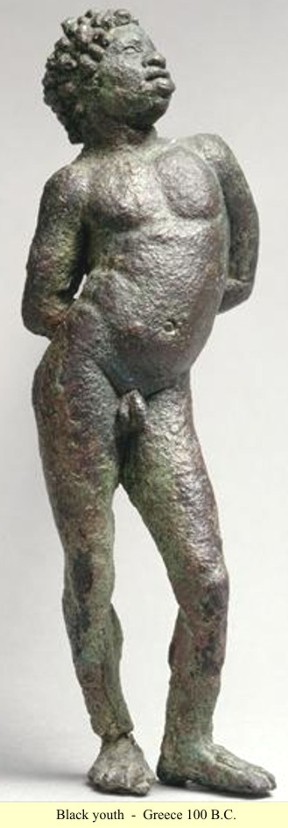 |
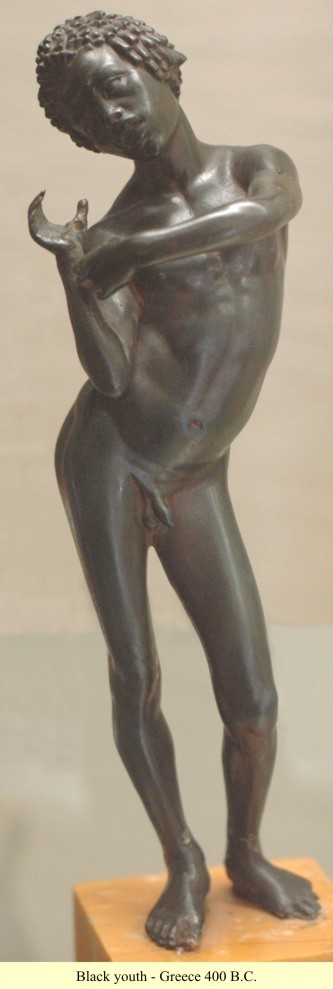 |
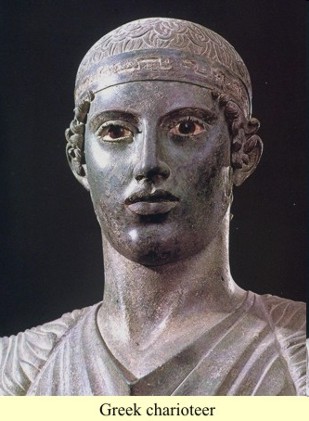
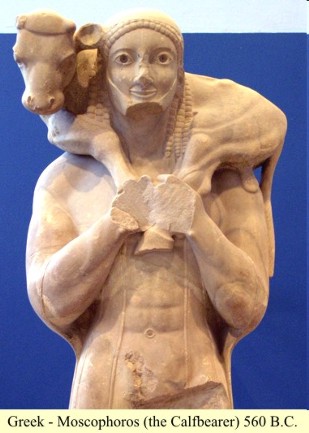
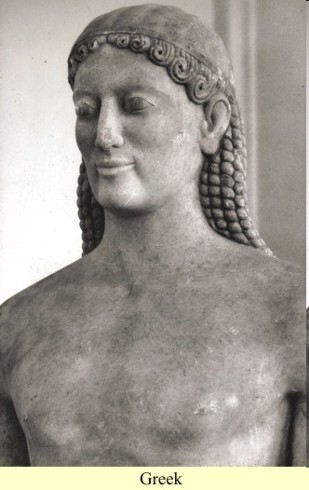
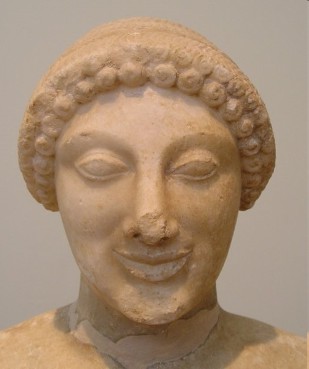
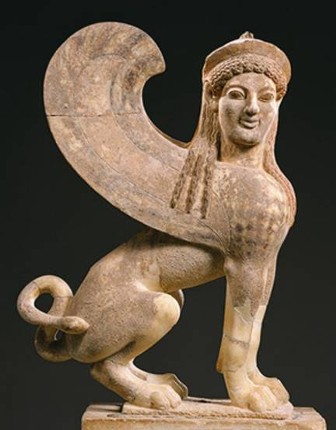
Please note, the statues above demonstrate their authenticity by either showing paint residue or "Natural" aging.
Ancient Greek sculptureMostly marble and bronze were used in Greek sculpture. Although it was initially thought that Greek statues were mostly unadorned white marble, by the early 19th century the systematic excavation of ancient Greek sites brought forth a plethora of sculptures with traces of multicolored surfaces. Some of these traces are still visible to the naked eye even today, though in most examples the remaining color has faded or disappeared entirely once the statues were exposed to light and air. In spite of this overwhelming evidence for painted statues, influential art historians such as Johann Joachim Winckelmann so strongly opposed the idea of painted Greek sculpture that proponents of painted statues were dismissed as eccentrics and their views largely dismissed for several centuries. It wasn't until published findings by German archaeologist Vinzenz Brinkmann in the late 20th century and early 21st century that painted Greek sculptures became an established undeniable fact. Using high intensity lamps, ultraviolet light, special cameras, plaster casts and certain powdered minerals, Brinkmann was able to scientifically prove that the entire Parthenon, including the actual structure as well as the statues, was in fact painted. He furthermore was able to reveal the pigments of the original paint and has created several painted replicas of Greek statues that are currently on tour throughout the world. Also in the collection, are replicas of works from other Greek and Roman sculptures showing that the practice of painting sculpture was widespread and in fact the normative practice rather than the exception in Greek and Roman culture. Museums to host the exhibit include the Glyptothek Museum in Munich, the Vatican Museum, and the National Archaeological Museum in Athens among others. The collection made its United States debut at Harvard University in the Fall of 2007. |
 |
 |
 |
 |
 |
 |
 |
 |
 |
The Albino people of today, who are invaders from Central Asia in the modern era: Germanics, Slavs, and Turks; are degenerate fakers of history, so as to make it appear that they participated in the making of Western History. To this end they not only lie and make up false history, they also create fake artifacts of every kind. Here are some things to look out for with the Bronzes.
 |
 |
 |
 |
 |
 |
 |
 |
 |
 |
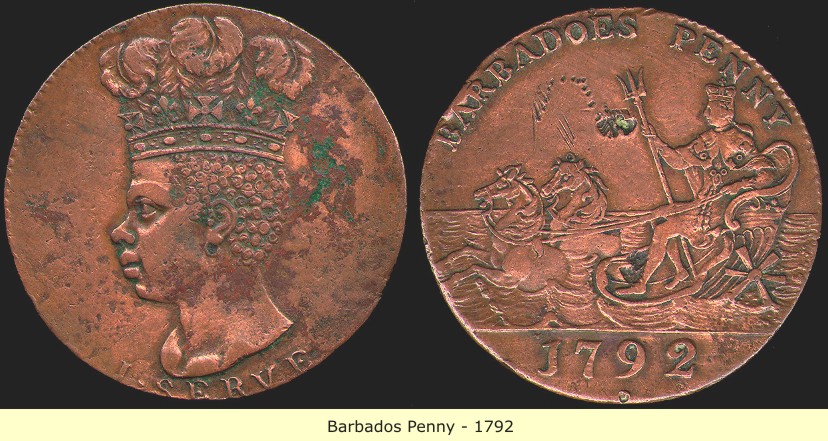 |
For those who have wondered; Which type of Albino is responsible for this fantasy world of Albino B.S. they pass of as history? From the comments below, it is clearly Albino institutions, where we expect truth, but instead find the lair of liars who feel that they must protect Albinos by perpetuating the lies. The Smithsonian's National Museum of American History Comment: Barbados Pennies, 1788 and 1792. These lying idiots are suggesting that the producer of the coin, put a crown on the head of a Slave, for a coin to be used by Albino Slave masters. The stupidity is breathtaking - they are not even thinking of how violently offended degenerates would be TODAY. So back then, if their history was TRUE, the producer would have been put to death for the sacrilege! The King at that time was George III, and of course, AS USUAL, the king with his crown on his head, is on the coin.
Notre Dame University Comments: There is no consensus on which side is the obverse. Pridmore considers the portrait the obverse while Krause-Mishler refers to the pineapple side as the obverse. As the portrait is not a royal image and the coin is known as the "Pineapple" copper I have called the pineapple side the obverse. This is what Pridmore identifies as Barbados no. 13, identified by the die break behind the portrait. Provenance: Donated to Notre Dame in 1887 as part of a 2,300 item coin collection (see: The Notre Dame Scholastic, vol. 21 (September 1887) 45. Louis Jordan, also of Notre Dame University: In 1788, at about the same time as some of the newly formed American states were coining coppers, a penny size copper, was minted in England for Barbados. The token is thought to have been privately commissioned by Phillip Gibbs, a local plantation owner. The obverse depicts the national symbol, a pineapple, with the legend "Barbadoes Penny" and the date 1788. The reverse displays a bust of an African wearing a plumed crown and the legend "I serve". The University of Notre Dame du Lac is a Catholic research university located adjacent to South Bend, Indiana, in the United States. The school was founded on November 26, 1842, by Father Edward Sorin, CSC, who was also its first president. Edward Frederick Sorin, C.S.C. (February 6, 1814 – October 31, 1893), a priest of the Congregation of Holy Cross, was the founder of the University of Notre Dame in Indiana and of St. Edward's University in Austin, Texas. Sorin was born February 6, 1814, at Ahuillé, near Laval, France. Notre Dame goes to the old standby that All Blacks, everywhere in the world, were recent Africans and therefore Slaves, or used to be Slaves. Sure hope their Black students and former students get counseling. |
 |
 |
 |
In the United States today, there are patriotic Americans in the seats of American government, who realizing that the country is endangered by the lies of the Trump administration, routinely try to sneak the truth out to the American public by way of “Leaks”.
We can't help but wonder if perhaps that same sort of thing is happening with the appearance of “Authentic” portraits such as this one, of the son of King George III: Prince Adolphus Frederick, Duke of Cambridge.
 |
Clearly, this explains why there are absolutely no “Color” portraits of Prince Adolphus in the Royal Portrait Gallery in London, just these black and white “Lithographs. Could that be a good “Tell” as to which people they are misrepresenting as Albinos or making Fake Albino portraits of?
 |
But a bigger question is “How did it Survive” - why wasn't it destroyed? The answer may be that the current people, the forgers and liars, did not have access to this portrait. Prince Adolphus was also Viceroy of Hanover in his brothers names, this portrait was probably of Hanoverian provenance, and that is what saved it from destruction.
The Kingdom of Hanover (German: Königreich Hannover) was established in October 1814 by the Congress of Vienna, with the restoration of George III to his Hanoverian territories after the Napoleonic era. It succeeded the former Electorate of Brunswick-Lüneburg (known informally as the Electorate of Hanover), and joined with 38 other sovereign states in the German Confederation in June 1815. The kingdom was ruled by the House of Hanover, a younger branch of the House of Welf, in personal union with the United Kingdom of Great Britain and Ireland until 1837, before being conquered by Prussia in 1866 and transformed into a Prussian province. Along with the rest of Prussia, Hanover became part of the German Empire upon unification in January 1871. Briefly revived as the State of Hanover in 1946, the state was subsequently merged with some smaller states to form the current state of Lower Saxony in West Germany, later Germany.
 |
 |
 |
 |
 |
 |
 |
 |
 |
 |
 |
 |
 |
 |
 |
 |
Fyi - Ivory is always said to be like TEETH, that is only partly true.
Ivory is made of "Dentin" the material of teeth that is UNDER the enamel.
Thus Ivory is much "SOFTER" than teeth.
 |
 |
 |
One of the great Myths/Fallacies created by Whites, is the notion of the White Greek Athlete. As Herodotus tells us in Book 1 - CLIO; the Whites were tribes of barbarians who were granted voluntary entrance into the ranks of Hellenes. Since participation in the Olympic games was a great honor, bestowed only onto the finest, the chances are that the pitiful Albinos were not even allowed to participate in those games.
 |
 |
 |
 |
 |
 |
 |
 |
 |
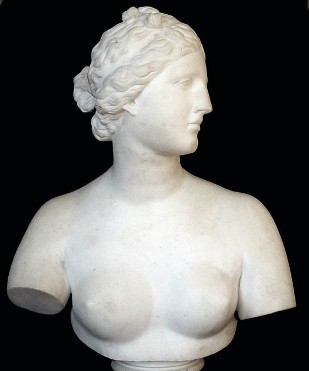
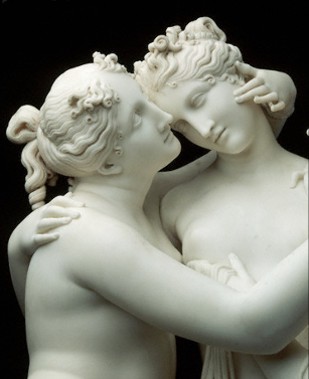
Just making the point that the ancient Greeks were not as taught, and quite different from the modern people. The modern image of ancient Greece, is derived from sculpture made long after the ancient Greeks were no more. |
 |
Click here for images of all the peoples of the ancient Persian, and then Greek Empires: Click >>> |
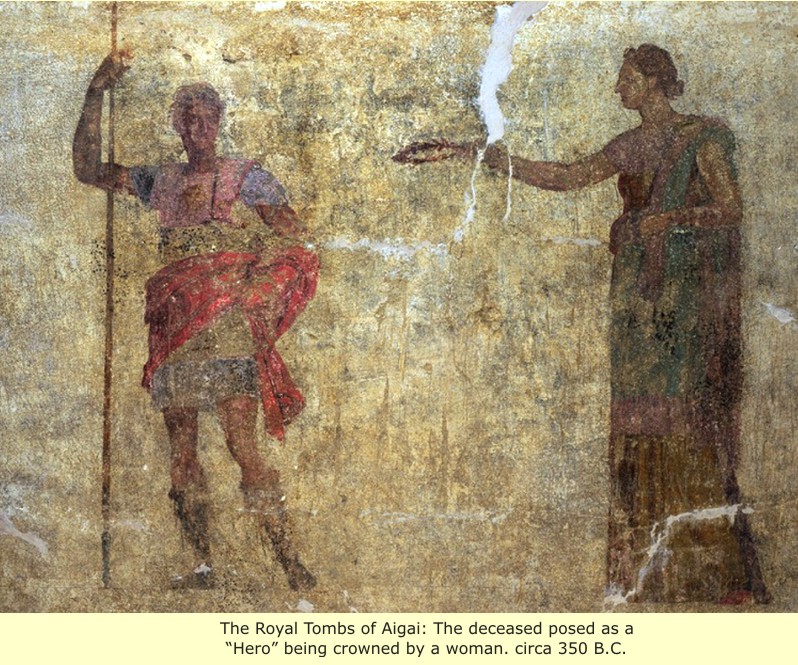
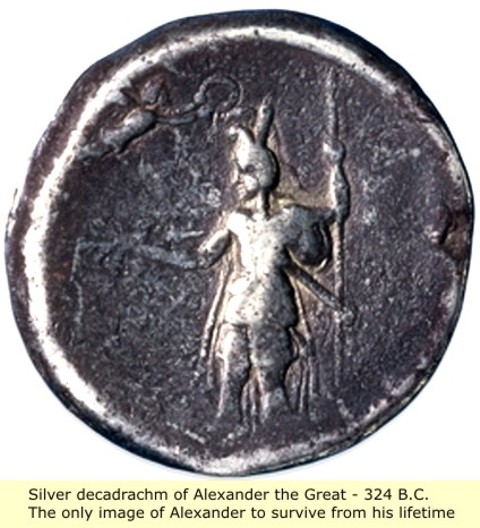
Out of the fray of wars, emerges Alexander of Macedon. Alexander the Great's father Philip, was the brother of King Perdiccas III of Macedon, which is in northern Greece. In 359 B.C, King Perdiccas died. His young son Amyntas was expected to succeed him, with his uncle Philip as his regent, but Philip usurped his nephew's throne, making himself King Philip II. He proved to be a strong ruler, and in a few decades he conquered most of Greece.
Philip's wife was Olympias, daughter of King "Neoptolemus I" of Epirus, in modern Albania. Their son Alexander was born in 356 B.C. Alexander also had a younger sister, Cleopatra (not the famous Greek queen of Egypt). Alexander and his father, did not get along well at all, Philip often made fun of him because he had a high voice. When Philip was stabbed and killed by his male lover, Alexander ascended to the throne. In 330 B.C, Alexander defeated the Persian Empire and made that Empire his own.
 |
 |
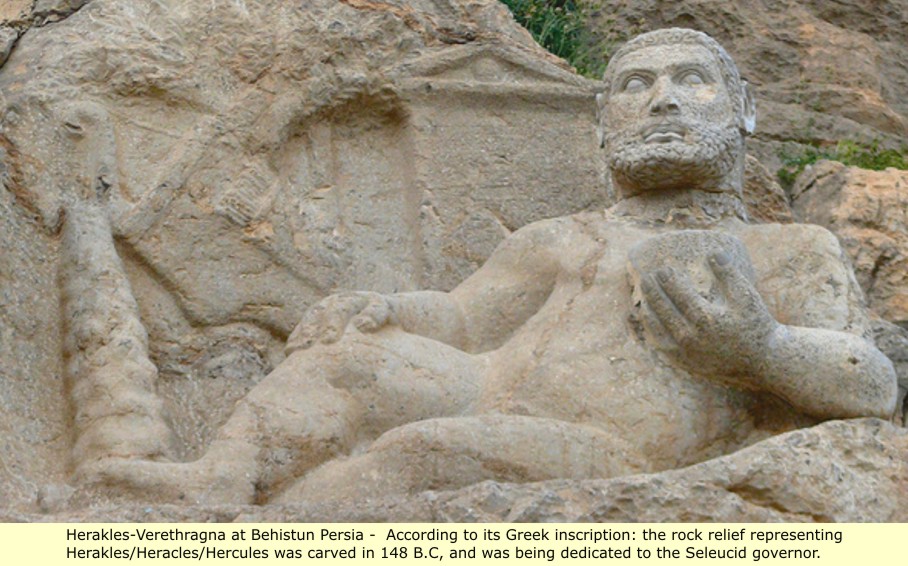
With the end of the Persian Achaemenian Empire, southern Mesopotamia and Persia were partitioned by Alexander into the satrapy of Babylonia in the south, while the northern part of Mesopotamia was joined with Syria into another satrapy. It is not known how long this division lasted, but by the death of Alexander the Great in 323 B.C, northern Mesopotamia was removed from Syria and made a separate satrapy. One of his generals, Seleucus (later Seleucus I Nicator), received the satrapy of Babylonia to rule. Seleucus thus became the ruler of a large empire, stretching from modern Afghanistan to the Mediterranean Sea. Interestingly, even as late as 148 B.C, the Greek pantheon of Gods was still of Black Gods.
 |
The wealth, culture and technology, that is acquired from the conquered civilizations, will be absorbed by the Greeks to form, what is commonly called the "classical Greek culture". This culture will later be absorbed by the next great European civilization, The Romans.
 |
 |
The classical period conventionally ends at the death of Alexander the Great in 323 B.C, and the fragmentation of his empire, which was divided among the "Diadochi" his successors: they were the rival generals, family and friends of Alexander the Great. This marks the beginning of the Hellenistic period.
Roman Greece came into being, following the Roman victory over the Macedonian's by the Roman general Quintus Caecilius Metellus, who defeated Andriscus of Macedon, the last Ancient King of Macedon in 148 B.C. Then the Corinthians were defeated at the Battle of Corinth in 146 B.C. However, some Greek poleis managed to maintain a partial independence and avoid taxation. The Aegean islands were added to this territory in 133 B.C. Athens and other Greek cities revolted in 88 B.C, but the peninsula was crushed by the Roman general Sulla. The Roman civil wars devastated the land even further, until Augustus organized the peninsula as the province of Achaea in 27 B.C, after which, Greek history and Roman history become intertwined.
AristotleAristotle (384 – 322 B.C.), was a Greek philosopher and polymath, a student of Plato and teacher of Alexander the Great. His writings cover many subjects, including physics, metaphysics, poetry, theater, music, logic, rhetoric, linguistics, politics, government, ethics, biology, and zoology. Together with Plato and Socrates (Plato's teacher), Aristotle is one of the most important founding figures in Western philosophy. Aristotle's writings were the first to create a comprehensive system of Western philosophy, encompassing morality, aesthetics, logic, science, politics, and metaphysics.
|
At the turn of the "modern Era" (year "0" A.D.) The Mongol Huns chased the Dravidian Albino Germanic's and Slav's out of Asia.
We have no good single source to explain the expulsion of the Albino Germanic's and Slav's from Central Asia.
Consequently several sources must be referenced:
See: The Roman historian Jordanes, his book on the history of the Goths, called "Getica" (circa 551 A.D.)
See: The Byzantine historian Zosimus (491-518), his book "Historia Nova"
See: The historian Priscus (circa 450 A.D.)
See: Ammianus Marcellinus (325–391) a fourth-century Roman historian.
Note: excerpts from those sources are in the "Eastern Europe" page (Main menu).
Six hundred years later, another group of Mongols chased the last of the Dravidian Albinos out of Asia - The Turks.
We do not have a good single source for the expulsion of the Germanic's and Slav's, but the following is a good, not overly complicated, source for the Turks.
 |
|
|
Click here to visit this page at Calgary University
 |
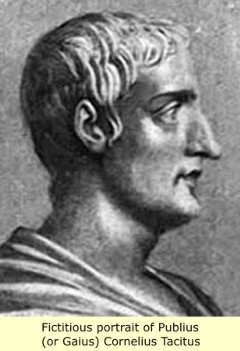
At about 100 A.D. a new people from Central Asia began to encroach on Roman territory, these were the Germanic's. Here is what "Cornelius Tacitus" (who was likely a Celt, 56 - 117 A.D.) had to say about them: He was a senator, and a historian of the Roman Empire: We quote from his book, The Germania (Latin: De Origine et situ Germanorum, literally Concerning the Origin and Situation of the Germanics).
Cornelius Tacitus, Germany and its TribesThe Germans themselves I should regard as aboriginal, and not mixed at all with other races through immigration or intercourse. For, in former times, it was not by land but on shipboard that those who sought to emigrate would arrive; and the boundless and, so to speak, hostile ocean beyond us (the north Sea), is seldom entered by a sail from our world. And, beside the perils of rough and unknown seas, who would leave Asia, or Africa, or Italy for Germany, with its wild country, its inclement skies, its sullen manners and aspect, unless indeed it were his home? In their ancient songs, their only way of remembering or recording the past, they celebrate an earth-born god, Tuisco, and his son Mannus, as the origin of their race, as their founders. The name Germany, on the other hand, they say, is modern and newly introduced, from the fact that the tribes which first crossed the Rhine and drove out the Gauls, and are now called Tungrians, were then called Germans. Thus what was the name of a tribe, and not of a race, gradually prevailed, till all called themselves by this self-invented name of Germans, which the conquerors had first employed to inspire terror. For my own part, I agree with those who think that the tribes of Germany are free from all taint of inter-marriages with foreign nations, and that they appear as a distinct, unmixed race, like none but themselves. Hence, too, the same physical peculiarities throughout so vast a population. All have fierce blue eyes, red hair, (classic Albinism), huge frames, fit only for a sudden exertion. They are less able to bear laborious work. Heat and thirst they cannot in the least endure; to cold and hunger their climate and their soil inure them. |
When Constantine became the sole Roman Emperor in 324 A.D, Christianity became the leading religion of the empire. After the death of Constantine in 337, two of his sons, Constantius II and Constans took over the leadership of the empire. Constans, ruler of the western provinces, was like his father, a Christian. In 341, he decreed that all pre-Christian Graeco Roman worship and sacrifice should cease; warning those who still persisted in practising ancient Graeco-Roman polytheism with the threat of the death penalty.
Lay Christians took advantage of new anti-Graeco-Roman polytheism laws by destroying and plundering the temples. Temples that survived were converted into Christian churches: the Pantheon is the most notable example, having once been a temple to all the gods and later, removing the statues of the so-called 'pagan' gods and replacing them with Christian saints, becoming a church in honor of their own one god. Many of the buildings in the Roman Forum were similarly converted, preserving the structures if not their original intent.
Later on, the emperor Julian the Apostate attempted to reverse the process of Christianization and bring back the native forms of polytheism, but his death in Persia caused the empire to once again fall under the power of Christian control, this time permanently.
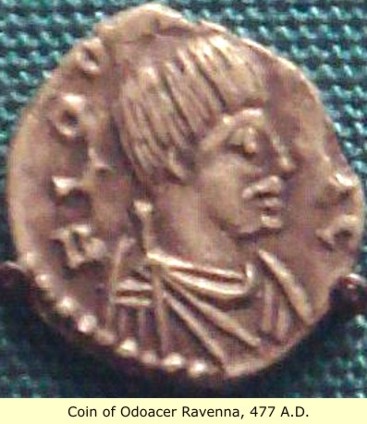
The decline of the Roman Empire was a slow process, which occurred over a period of over 350 years. Beginning at about 100 A.D. and culminating on September 4, 476, when Romulus Augustus, the last Emperor of the Western Roman Empire, was deposed by Odoacer, a Germanic chieftain.
Though by appearance, Odoacer was probably a Celt/Gaul: they being the original people of Germany. With the actual true (White) Germaic's following. Note that Odoacers hair stands straight up, White peoples hair cannot do that naturally. (Laugh at the example if you will, but the point still holds true, also note Vercingetorix's hair).
Today's descendants of the Germanic, Slav, and Turk Albinos from Central Asia, have so confused and obfuscated history with their false accounts and fake artifacts, that it is impossible at this time, to say definitively what the hierarchy of ancient western Rome was like, (from artifacts, we know that the Eastern Empire was ruled by Blacks). What little that we do have of artifactual evidence, suggests that like the Eastern Empire, the Western Empire was also ruled by Blacks. This painting of unknown provenance and period, may well be fanciful, but we feel that it accurately depicts the hierarchy of the Western Roman Empire.
 |
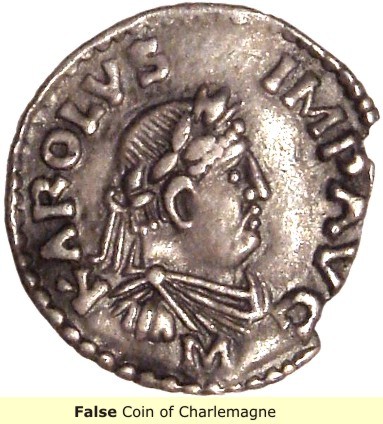
Rome's replacement "The Holy Roman Empire" was a realm that existed for about a millennium in West and Central Europe: ruled by a Holy Roman Emperor. Charlemagne (meaning Charles the Great; possibly 742 – 28 January 814 - King of the Franks). He expanded the Frankish kingdom (France) into an empire that incorporated much of Western and Central Europe. During his reign, he conquered Italy and was crowned Imperator Augustus by Pope Leo III on 25 December 800 A.D. This temporarily made him a rival of the Byzantine Emperor in Constantinople. His rule is also associated with the Carolingian Renaissance, a revival of art, religion, and culture through the medium of the Catholic Church. Through his foreign conquests and internal reforms, Charlemagne helped define both Western Europe and the Middle Ages.
He is numbered as Charles I in the regnal lists of Germany (where he is known as Karl der Große), the Holy Roman Empire, and France. He was crowned Emperor of the Romans in 800 A.D. and was then the forerunner of the Holy Roman Emperors, largely because he had inaugurated the tradition of imperial coronation by the Pope of the Catholic Church. This continued as a significant institution in the Holy Roman Empire until the 16th century. In a decree following the 1512 Diet of Cologne, the name was officially changed to Holy Roman Empire of the German Nation. Charlemagne's policy of "renovatio Romanorum imperii" (reviving the Roman Empire) remained at least in theory, as the official position of the Empire until its end in 1806.
Was Charlemagne a Black man? At this point there is no way to know - and that information is not likely to be forthcoming. But it appears that contrary to what Whites say, the Franks were probably a "Native" NOT Germanic people. As such, Charlemagne would have indeed, probably been a Black man. But because Whites have so interwoven European history with lies, there are really no safe assumptions, and no safe place to start.
As to the false Coin: In 1861, Charlemagne's tomb was opened by scientists who reconstructed his skeleton and estimated it to be measured 74.9 inches (190 centimeters). A modern study based on the dimensions of his tibia estimate his height as 1.84 m. This puts him in the 99th percentile of tall people of his period given that average male height of his time was 1.69 m. The width of the bone suggest he was gracile not robust in body build. So at least one thing we know for sure: that COIN image is NOT of Charlemagne. But what's new, Whites routinely use fake artifacts to bolster their lies. Charlemagne was actively and personally involved in wars into distant lands throughout his 46 year reign - Fat guys don't get around like that! So whoever decided to falsely use that coin, didn't even know the history of the man.
But there is no ambiguity about Charlemagne's successor as Holy Roman Emperor: Otto I, he was most certainly a Black man!
 |
 |
 Otto I, the Great (23 November 912 in Wallhausen – 7 May 973 in Memleben), son of Henry I the Fowler and Matilda of Ringelheim, was Duke of Saxony, King of Germany, King of Italy, and "the first of the Germans to be called the emperor of Italy" according to Arnulf of Milan. While Charlemagne had been crowned emperor in 800, his empire had been divided amongst his grandsons, and following the assassination of Berengar of Friuli in 924, the imperial title had lain vacant for nearly forty years. Otto succeeded his father as king of the Saxons in 936, on February 2, 962, Otto was crowned Emperor of what would later become the Holy Roman Empire.
Edith of England (910 – 26 January 946), also spelt Eadgyth or Ædgyth, was the daughter of Edward the Elder, King of England and Ælfflæd. Her paternal grandparents were Alfred the Great, King of Wessex, and his wife Ealhswith. (The obvious corollary is that Edith came from a long line of Black British royalty).
| Click Here for more on Black British Royalty: Click >>> |
In order to seal an alliance between two Saxon kingdoms, her half-brother, King Athelstan of England, sent two of his sisters to Germany, instructing the Duke of Saxony (later Otto I, Holy Roman Emperor) to choose whichever one pleased him best. Otto chose Edith and married her in 929. The remaining sister Algiva or Adiva was married to a "king near the Jupiter mountains" (the Alps). The precise identity of this sister is debated. She may have been Eadgifu of England, who married King Charles III of France, or another sister otherwise unknown to history.
As queen, Eadgyth undertook the usual state duties of a Queen: when she turns up in the records it is generally in connection with gifts to the state's favoured monasteries or memorials to female holy women and saints. In this respect she seems to have been more diligent than her now widowed and subsequently sainted mother-in-law Queen Matilda whose own charitable activities only achieve a single recorded mention from the period of Eadgyth's time as queen. There was probably rivalry between the Benedictine Monastery of St Maurice founded at Magdeburg by Otto and Eadgyth in 937, a year after coming to the throne and Matilda's foundation at Quedlinburg Abbey, intended by her as a memorial to her husband, the late King Henry I. Like her brother, Athelstan, Edith was devoted to the cult of Saint Oswald and was instrumental in introducing this cult into Germany after her marriage to the emperor. Her lasting influence may have caused certain monasteries and churches in Saxony to be dedicated to this saint.
Eadgyth died at a relatively young age. Her tomb is located in the Cathedral of Magdeburg, Germany. A lead coffin inside a stone sarcophagus with her name on it was found and opened in 2008 by archaeologists during work on the building. An inscription recorded that it was the body of Eadgyth, reburied in 1510. It was examined in 2009, then brought to Bristol, England, for tests in 2010. Professor Mark Horton of Bristol University said that "this may prove to be the oldest complete remains of an English royal."
Edith and Otto's children were: 1. Liutgarde, married Conrad the Red, 2. Liudolf, Duke of Swabia (930-September 6 957)
| Click Here for medieval Christian frescos from northern Greece: Click >>> |
Major Germanic Peoples: English, Norwegians, Danes/Denmark, Franks/France, Goths/Spain, Saxons, Finni, Flemish, Icelanders, Frisians, Gall, Batavians, Calucones, Dutch, Helisii, Ingvaeones (North Sea Germans), Irminones (Elbe Germans), Istvaeones (Rhine-Weser Germans), Jutes, Juthungi, Lombards or Langobardes, Ostrogoths, Teutons, Vagoth, Vandals, Vangiones, Vargiones, Varini, Varisci, Vinoviloth, Viruni, Visburgi, Visigoths, Vispi.(Pretty much all of Modern Europe, isn't it).
|
The "Dark Ages" is a term referring to the perceived period of both cultural and economic deterioration as well as disruption that took place in Western Europe following the decline of the Roman Empire: the phrase was first recorded in 1602. Originally, the term characterized the bulk of the Middle Ages as a period of intellectual darkness between the extinguishing of the light of Rome, and the Renaissance or rebirth from the 14th century onwards.
The concept of a Dark Age originated with the Italian scholar Petrarch (Francesco Petrarca) in the 1330s, and was originally intended as a sweeping criticism of the character of Late Latin literature. Petrarch regarded the post-Roman centuries as "dark" compared to the light of classical antiquity. Later historians expanded the term to refer to the transitional period between Roman times and the High Middle Ages, including not only the lack of Latin literature, but also a lack of contemporary written history, general demographic decline, limited building activity and material cultural achievements in general. Popular culture has further expanded on the term as a vehicle to depict the Middle Ages as a time of backwardness, extending its pejorative use and expanding its scope.
Just as the Hellenes and Romans were an illiterate nomadic people, when they first entered Black Europe over a thousand years earlier. And just as they struggled to learn the ways and technologies of civilization, so it was also for the Germanic's. And just as before, there was a "Dark Ages" of regression, while they learned the ways of civilization.
But unlike the Hellenes, the Germanic's did NOT attribute their inheritance of civilization to the rightful benefactor (albeit an unwilling benefactor), the Black ancients. They perhaps ignorantly, perhaps racistly, attributed it to the Classical Greeks. Though somewhat eclipsed by technology today, the sense of a legacy was strongly felt by post-Renaissance European elite, who saw themselves as the spiritual heirs of Greece. As late as 1939 Will Durant could write "excepting machinery, there is hardly anything secular in our culture that does not come from Greece," and conversely "there is nothing in Greek civilization that doesn't illuminate our own".
Had it remained just a sense of debt to the ancient Greeks, the world would have been a much better place today. But it did not, the Germanic's not having any history of their own, decided to make one up, with the Hellenes and Romans as the base. They decided that they were the descendants of the Hellenes and Romans, but since they were White skinned, Blue-eyed, Blond haired, and the Hellenes and Romans were not. They decided to create statues and other artifacts depicting Hellenes and Romans as such.
Then, perhaps as a "Snowballing" effect, they decided that ALL ancient civilizations must be White like them also: soon White Egyptian artifacts began to appear (exclusive of the legitimate Greek and Roman period type). Then ancient Europeans, Mesopotamian's, Hebrews, and Persians became White. Then with their success in wars of expansion and colonization, they decided that because they were so great, then everyone previous of any consequence must also have been White - and the requisite artifacts thus appeared. (All this from a people who just a few hundred years earlier, couldn't figure out why it was a bad idea to shit in the same places that you took your drinking water from).
Under the heading "Better late than Never" mainstream White media, in the form of "The Guardian" known until 1959 as The Manchester Guardian (founded 1821), a British national daily newspaper: for reasons unknown, has decided to acknowledge the obvious: Greece and Rome were NOT Albino societies or cultures, and decided to do a newsstory on it, Thursday 11 July 2013.
Click here for link to the original newsstory
(Note: The pictures associated with the newsstory are often incorrect).
The next, and final wave of White Asians, the Turks, continued their migrations into Europe, North Africa, and Western Asia, well into the modern era. And just like the previous Whites, they were bent on conquest. And just like the Germanic's, having no history, they decided to create a place in history for themselves. Thus they became the descendants of the Berbers, Egyptians, Mesopotamian's, Persians, Phoenicians, and Arabs - and oh yes, the Hebrews, vis-à-vis the Khazar Turks.
Interestingly though, Turks in Turkey proper, are taught something quite different. In the Turkish Nations creation myth (a modern country with a creation myth?). From tomes: a large or scholarly book, produced by the Ministry of Education in 1932; Turks are taught that at the dawn of history, their ancestors, led by a mythical gray she-wolf, started migrating outwards from the heart of Central Asia. As the numbers of their people swelled and droughts dried the traditional grazing lands on the steppe, some of them, they are told, even crossed the Bering Strait into the Americas. Presumably becoming the American Indians. In his later years, Mustafa Kemal Ataturk (the founder of the modern Turkey nation), himself adopted a creed known as the "Sun Theory", which depicts the Turks as the mother race of all mankind, and proposed that all human languages are descendants of one proto-Turkic primal language. (Note: though the theory may sound outlandish, there is justification, and anecdotal evidence, for believing that at least the "North American Indian" was a Turk mulatto).
Mustafa Kemal Ataturk, taught that the Turks discovered the America's fifty years before Christopher Columbus. The proof of this assertion, he told journalist, was that the Turks and Caicos Islands in the Caribbean, had obviously been named by Turks, especially since their capital was called Grand Turk. (The islands are in fact named after a fez-shaped cactus).
Under the heading "This is Backwards": Just as Albino media seems reconciled to the fact that the truth of Greece and Rome will get out. They seem determined to continue to pass-off the Turks and Turk mulattoes, of North Africa, Arabia, Middle-East, and West Asia, as original people: rather than the recent invaders that they are. Obviously this serves to continue the myth that the original people of those areas were other than Black Africans. But unfortunately for those purveyors of falsehood, many 19th century writers had already acknowledged, and wrote about the Turk conquest and rule over parts of Europe, Arabia, the Middle East, North Africa, etc. Needless to say, the primary subject matter of these books is of no interest to us, and may in fact be contrary to our position.
Prince Michael's Kingdom: A Review of the Epochs of Creation, and of the Bible History by Charles R. Harvey (1880) Link to book
The Christian Observer [Afterw.] the Christian Observer and Advocate by
Anonymous Author (1867) Link to Book
A chronological, geographical and historical view of the ancient and modern world, from the earliest period to 1850 (1851) Link to Book
The Christian guardian - and Church of England magazine (1833) Link to Book
Who are these modern White (Albino) Europeans?
The Germanics:
Encyclopedia:
|
 |
The Slavs are the largest ethnic and linguistic group of peoples in Europe belonging to the Indo-European linguistic family. It is estimated that the Slavs number over 300 million in the world. They are usually classified in three main divisions. The West Slavs include the Poles, the Czechs, the Slovaks, and the Wends (also known as Lusatians) and other small groups in East Germany. The South Slavs include the Serbs, the Croats, the Slovenes, the Macedonians, the Montenegrins, the Bosniaks, and the Bulgars. The East Slavs, the largest group, include the Great Russians, Ukrainians, and Belorussians (or White Russians).
Origins
Ethnically the Slavs possess little unity, for they have mixed for centuries with other peoples, including Turko-Tatars, Finnic peoples, Germans, Mongols, Greeks, and Illyrian tribes. The Bulgarians are not of Slavic origin. The obscure beginnings of the Slavs have given rise to several theories, all of which include as a possible place of origin the area of the Polesie marshes in Galicia (region spanning southeastern Poland and western Ukraine ). The ancestors of the Slavs were Neolithic tribes who occupied this territory a few centuries before the Christian era. (The Albinos will not venture into their origins before this time, as that would surely lead to Central Asia and Albinohood).
Bibliography
See K. Jazdzewski, Atlas to the Prehistory of the Slavs (tr., 2 vol., 1948—49); J. S. Roucek, ed., Slavonic Encyclopaedia (4 vol., 1949, repr. 1969); F. Dvornik, The Slavs (1956) and The Slavs in European History and Civilization (1962, repr. 1986); S. H. Cross, Slavic Civilization through the Ages (1963); A. P. Vlasto, The Entry of the Slav
s into Christendom (1970); M. A. Gimbutas, The Slavs (1971).
Because the Turks are now a predominately Mulatto people, no efforts are made to hide their origins. Therefore all Albino sources will freely admit that Turks were an Asian People.
Greeks and Romans were a Black and Mulatto people comprised of the Original Black Europeans and the first Central Asian Albinos to reach Europe, circa 1200 B.C. Modern Albinos have nothing to do with these people, as they were the victims of the marauding Albinos from Central Asia. But modern Albinos do falsely claim that the Hellenes of Greece were Albinos. The Greek historian Herodotus clearly explains the Hellenes were only "partly Albino" thusly:.
Book 1 – CLIO
[1.58] The Hellenic race has never, since its first origin, changed its speech. This at least seems evident to me. It was a branch of the Pelasgic, which separated from the main body, and at first was scanty in numbers and of little power; but it gradually spread and increased to a multitude of nations, chiefly by the voluntary entrance into its ranks of numerous tribes of barbarians.
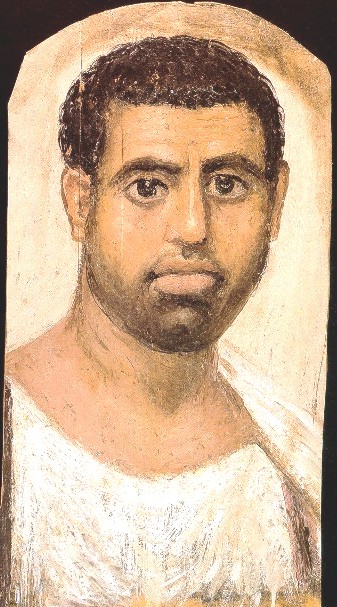
One of the great successes's of the Albino people, has been their success in writing Blacks out-of-History. As can clearly be seen from the preceding artifacts, not only are Blacks the original settlers of Europe, but all throughout history, at every step, they have been the preeminent people. Example: Greeks in the person of Alexander, took Egypt from the Persians who had conquered it, and ruled Egypt from 332 to 30 B.C. The Romans took it from them, and ruled from 30 B.C. to 640 A.D. at which point the Arabs took it from them. In Egypt, the Europeans buried their dead in Egyptian style, but in cemeteries exclusively for them. Typical of these European cemeteries are those at the Fayum/Faiyum Oasis, 62 miles southwest of Cairo. The Mummy Portraits at Fayum demonstrate that Greeks and Romans were Blacks and Whites, but in the main "Mulattoes".
 |
 |
 |
 |
 |
 |
As we can see from this portrait, almost a century after Benjamin Franklin's 1751 essay titled "America as a Land of Opportunity" (where he declared that all of Europe's people were of a "swarthy complexion") except the English and the Saxons: Europe was still full of "swarthy Complexion people" (Mulattoes). But the constant killings and expulsions of European Blacks as a result of the English Civil War (1642), and the Thirty years Wars (1618–1648) in continental Europe: (which were really "Race" wars), left few Blacks in Europe for this type of person to mate with. The result has been an inexorable Whiting of Europe's population through inbreeding: and the associated shrinking of the European gene pool. Today, Europeans have the smallest genetic diversity of all, and the greatest risk of inherited disease. |
Wiki:
Greece - officially the Hellenic Republic and known since ancient times as Hellas.
In the 14th century, much of the Greek peninsula was lost by the Byzantine Empire at first to the Serbs and then to the Ottomans. By the beginning of the 15th century, the Ottoman advance meant that Byzantine territory in Greece was limited mainly to its then-largest city, Thessaloniki, and the Peloponnese (Despotate of the Morea). After the fall of Constantinople to the Ottomans in 1453, the Morea was the last remnant of the Byzantine Empire to hold out against the Ottomans. However, this, too, fell to the Ottomans in 1460, completing the Ottoman conquest of mainland Greece. With the Turkish conquest, many Byzantine Greek scholars, who up until then were largely responsible for preserving Classical Greek knowledge, fled to the West, taking with them a large body of literature.
While most of mainland Greece and the Aegean islands was under Ottoman control by the end of the 15th century, Cyprus and Crete remained Venetian territory and did not fall to the Ottomans until 1571 and 1670 respectively. The only part of the Greek-speaking world that escaped long-term Ottoman rule was the Ionian Islands, which remained Venetian until their capture by the First French Republic in 1797, then passed to the United Kingdom in 1809 until their unification with Greece in 1864.
In 1814, a secret organization called the Filiki Eteria (Society of Friends) was founded with the aim of liberating Greece. The Filiki Eteria planned to launch revolution in the Peloponnese, the Danubian Principalities and Constantinople. The first of these revolts began on 6 March 1821 in the Danubian Principalities under the leadership of Alexandros Ypsilantis, but it was soon put down by the Ottomans. The events in the north spurred the Greeks of the Peloponnese into action and on 17 March 1821 the Maniots declared war on the Ottomans.
By the end of the month, the Peloponnese was in open revolt against the Ottomans and by October 1821 the Greeks under Theodoros Kolokotronis had captured Tripolitsa. The Peloponnesian revolt was quickly followed by revolts in Crete, Macedonia and Central Greece, which would soon be suppressed. Meanwhile, the makeshift Greek navy was achieving success against the Ottoman navy in the Aegean Sea and prevented Ottoman reinforcements from arriving by sea. In 1822 and 1824 the Turks and Egyptians ravaged the islands, including Chios and Psara, committing wholesale massacres of the population. This had the effect of galvanizing public opinion in western Europe in favor of the Greek rebels.
Tensions soon developed among different Greek factions, leading to two consecutive civil wars. Meanwhile, the Ottoman Sultan negotiated with Mehmet Ali of Egypt, who agreed to send his son Ibrahim Pasha to Greece with an army to suppress the revolt in return for territorial gain. Ibrahim landed in the Peloponnese in February 1825 and had immediate success: by the end of 1825, most of the Peloponnese was under Egyptian control, and the city of Missolonghi—put under siege by the Turks since April 1825—fell in April 1826. Although Ibrahim was defeated in Mani, he had succeeded in suppressing most of the revolt in the Peloponnese and Athens had been retaken.
After years of negotiation, three Great Powers, Russia, the United Kingdom and France, decided to intervene in the conflict and each nation sent a navy to Greece. Following news that combined Ottoman–Egyptian fleets were going to attack the Greek island of Hydra, the allied fleet intercepted the Ottoman–Egyptian fleet at Navarino. After a week-long standoff, a battle began which resulted in the destruction of the Ottoman–Egyptian fleet. A French expeditionary force was dispatched to supervise the evacuation of the Egyptian army from the Peloponnese, while the Greeks proceeded to the captured part of Central Greece by 1828. As a result of years of negotiation, the nascent Greek state was finally recognized under the London Protocol in 1830.
SKIPPING COUNTLESS WARS AND STARVATION'S:
King Constantine II's dismissal of George Papandreou's centrist government in July 1965 prompted a prolonged period of political turbulence which culminated in a coup d'état on 21 April 1967 by the Regime of the Colonels. The brutal suppression of the Athens Polytechnic uprising on 17 November 1973 sent shockwaves through the regime, and a counter-coup established Brigadier Dimitrios Ioannidis as dictator. On 20 July 1974, as Turkey invaded the island of Cyprus, the regime collapsed.
The former prime minister Konstantinos Karamanlis was invited back from Paris where he had lived in self-exile since 1963, marking the beginning of the Metapolitefsi era. The first multiparty elections since 1964 were held on the first anniversary of the Polytechnic uprising. A democratic and republican constitution was promulgated on 11 June 1975 following a referendum which chose to not restore the monarchy.
Meanwhile, Andreas Papandreou founded the Panhellenic Socialist Movement (PASOK) in response to Karamanlis's conservative New Democracy party, with the two political formations alternating in government ever since. Greece rejoined NATO in 1980. Greece became the tenth member of the European Communities (subsequently subsumed by the European Union) on 1 January 1981, ushering in a period of sustained growth. Widespread investments in industrial enterprises and heavy infrastructure, as well as funds from the European Union and growing revenues from tourism, shipping and a fast-growing service sector raised the country's standard of living to unprecedented levels.
CIA FACTBOOK
GREECE:
Ethnic groups:
population: Greek 93%, other (foreign citizens) 7% (2001 census).
note: percents represent citizenship, since Greece does not collect data on ethnicity.
Note: In a bid to carry forth the myth that they are descendants of the ancient people, the Greek government has banned asking questions pertaining to ethnic, linguistic and religious topics since 1951.
What follows is a series of comments about the people of Greece from Encyclopedia Britannia and other sources.
____________________________________________________________________________________________________
"It was not only the resemblance, or lack of it but also the fact that 'politically speaking the Greeks were Asiatics, and all their oriental ideas, whether social or political, required to be corrected or eradicated, before they could be expected to form a civilized people upon civilized European principals'. (P. 32 "The Balkans, Nationalism, War and the Great Powers" by Misha Glenny) So much for the cradle of European civilization".
"As it is clearly obvious the Greek nation had many divisions and diversities within that had to be addressed before they could start telling the world that they are the descendents of the ancient Hellenes. Unfortunate though it may be, the modern-day Greek has more in common genetically with the Albanians, the Latin speaking Vlachs and the Turks than with 'Plutarch's men'".
"The inherent instability of the Balkan Peninsula-located as it is at the crossroads of invading Turks, migrating Slavs, and colonizing powers from western or central Europe (Venetians, Austro-Hungarians)-has bequeathed a bewildering amount of cultural confusion to Greece." (Britannica)
"One of the most vexing questions concerning the history of medieval Greece has been that of the extent to which the indigenous "Hellenic" population survived and brings with it the question whether this term can properly be used of anything other than a cultural (as opposed to ethnic or racial) identity. The archaeological data, certainly, can offer answers only in terms of cultural similarities and differences, so that the question, as it has been traditionally expressed, of a Hellenic ethnic survival, cannot be answered. The issue must be explored in the context of the influx of large numbers of Slavs during the later 6th-8th centuries as well as the migration across Greece of nomadic or semi-nomadic pastoral groups such as the Vlachs from the 10th or 11th century and the Albanians from the 13th century. Although the evidence of place-names suggests some lasting Slavic influence in parts of Greece, the evidence is qualified by the fact that the process of re-Hellenization that occurred from the later 8th century seems to have eradicated many traces of Slavic presence. Evidence of tribal names found in both the Peloponnesus and northern Greece suggests that there were probably extensive Slavic-speaking populations in many districts; and from the 10th century to the 15th century Slavic occupants of various parts of the Peloponnesus appear in the sources as brigands or as fiercely independent warriors. Whereas the Slavs of the south appear to have adopted Greek, those of Macedonia and Thessaly retained their original dialects, becoming only partially Hellenophone in certain districts." (Britannica) .
"For Christians of the early and middle Byzantine worlds, the terms Hellene and Hellenic generally (although not exclusively, since in certain literary contexts a classicizing style permitted a somewhat different usage) had a pejorative connotation, signifying pagan and non-Christian rather than 'Greek'" (Britannica).
The original homeland of the Oghuz was the Altai Mountains of Central Asia, which had been the domain of Turkic peoples since prehistory.
The Oghuz/Oguz Turks were a western Turkic people who spoke the Oghuz languages from the Common branch of Turkic language family. In the 8th century, they formed a tribal confederation conventionally named the Oghuz Yabgu State in Central Asia.
The Oghuz confederation migrated westward from the Jeti-su area after a conflict with the Karluk branch of Uigurs (Mongols). The founders of the Ottoman Empire were descendants of the Oghuzes. Today the residents of Turkey, Turkmenistan, Azerbaijan, Khorezm, Turkmens of Afghanistan, Balkans, Iraq and Syria are descendants of Oghuz Turks and their language belongs to the Oghuz (a.k.a. southwestern Turkic) group of the Turkic languages family.
Comment - why this Albino source fails to include the residents of Arabia, Egypt, Lebanon, Israel (Jews are Khazar Turks), Palestine, Jordan, etc. is unknown and incorrect.
 |
 |
 |
Click here for the story of the Black Greeks in Avato
 |
 |
 |
 |
 |
 |
 |
 |
 |
 |
 |
Click here for link to the full Study
Please visit the "Additional Material Area" for many more photographs of each civilization, and related material <Click> |
| < Back | Home | Next > |