

Modern Pakistan (Which was a part of India until 1947)
When last we left the Indus Valley, Civilization there had ceased at about 1,800 and 1,700 B.C. Perhaps because of some unknown natural disaster. If rainfall declined in the Indus region between 1800 and 1700 B.C, then around 1500 B.C. it increased again, making the Indus Plain better able to support life. It was between 1500 and 1200 B.C. that the Dravidian Albinos who had originally migrated from Africa into India and then continued North into Central Asia, to escape the Burning Sunshine found at lower latitudes returned to India.
|
|
|
|
 |
 |
 |
 |
 |
 |
Albinism Symptoms
|
No one knows why the Albinos left Central Asia; perhaps it was some natural disaster, or perhaps they had overpopulated the sparse land and now found it difficult to acquire enough food there. Whatever the cause, within the next 2,000 years (1,500 B.C. to 500 A.D.) ALL the millions of Albinos (Caucasians) would abandon Central Asia and move to India and Europe. Today the Uyghurs, a Turkic ethnic group, who live primarily in the Xinjiang Uyghur Autonomous Region, in the People's Republic of China, are the only Caucasians still living in Eastern and Central Asia. (Many are actually now mixed-race).
 |
 |
 |
It is also not known why they would hazard a return to lands that they originally found inhospitable because of the intense Sunshine. Perhaps over the tens-of-thousands of years that they spent in Central Asia, they were able to acquire a "Fixed" degree of Melanination through crossbreeding with the Blacks in China and Eastern Europe who surrounded them (see the Eastern Europe and China pages).
 |
Unlike their normally pigmented brethren who stayed behind in India, they had not evolved into a civilized people. They had not developed a written language, technology or cities. They returned to India as an illiterate, pastoral people now called Aryans/Arians. They migrated from the steppe lands of Central Asia through what is now Afghanistan, down through the Khyber Pass and onto the sparsely populated Indus Plain (The Khyber Pass, altitude: 1,070 m or 3,510 ft. is a mountain pass that links Pakistan and Afghanistan).
 |
Indians, particularly Hindus have always been rather schizoid on the subject of the Aryan Invasion theory. Many argue that the Aryans came as migrants, not as invaders. And of course, because Hindus are mainly the Mulattoes of Dravidians and Aryans, they feel a loyalty to both.
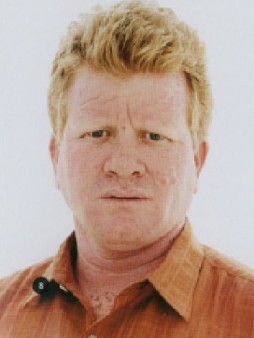
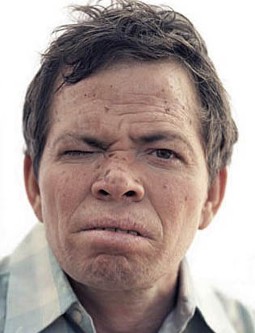
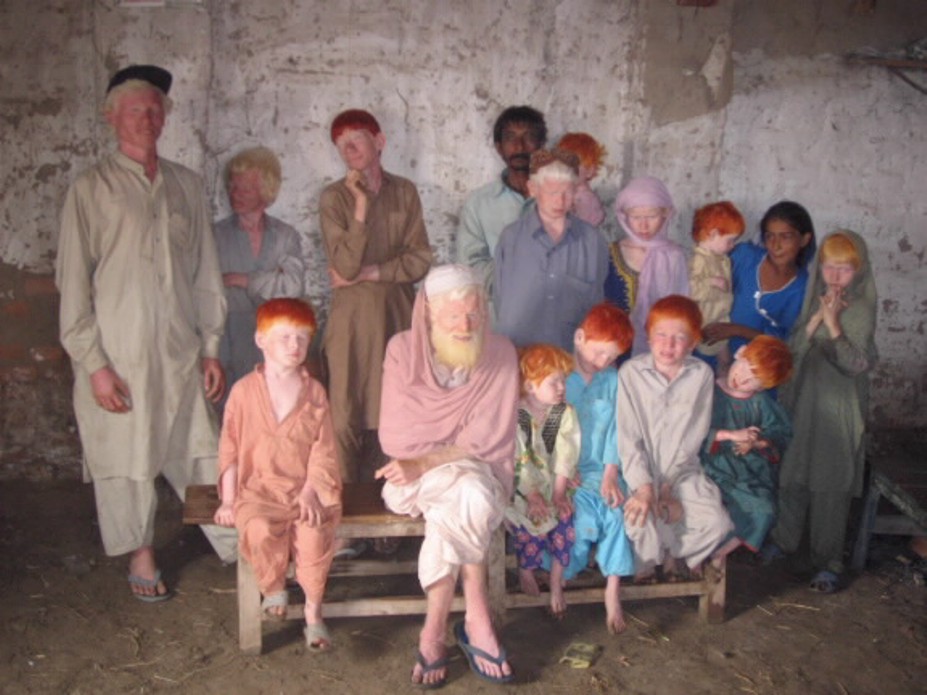
But here, the fact of the Aryan Invasion, whether it be migration or invasion, is of no consequence to us. Our interest is in establishing that Aryans and Dravidians, and by extension Europeans and Dravidians, are the same people genetically. This is possible because even thought their respective skin colors are very different; that difference is attributable to Albinism, a genetic defect with does not effect the general genetic make-up of those so afflicted. Thus the Albino child of a Black Dravidian father with Y-dna R1 will still, and also, have Y-dna R1 too. It's just that the child will also have a defective "P" gene, which robs the body of the ability to make sufficient melanin to protect itself from the Sun. As is the case with these Bhatti Albinos of Pakistan below, (note their pigmented family members in the back).
 |
 |
A Study: Human evolution: The southern route to Asia
By U.S. biological anthropologist Todd R. Disotell.
Quote: Migrations into India “did occur, but rarely from western Eurasian populations.” There are low frequencies of the western Eurasian mtDNA types in both southern and northern India. Thus, the ‘caucasoid’ features of south Asians may best be considered ‘pre-caucasoid’ — that is, part of a diverse north or north-east African gene pool that yielded separate origins for western Eurasian and southern Asian populations over 50,000 years ago.
In a study by Dr. Seema Nair, Aswathy Geetha and Chippy Jagannath of the Department of Biotechnology & Biochemical Engineering at the Sree Budha College of Engineering in Pattoor, Kerala. It was found that the Ezhavas, a Dravidian group, are described as closer to Jat Sikhs, Europeans and Central Asians. Quote: “Through Y STR we cannot determine whether Ezhavas originated from European populations or Europeans originated from Kerala/Indian populations.
 |
 |
 |
 |
 |
The Aryans
The scientific terms we use today were created by the Albinos, and they just love to confuse and bamboozle us with their usage. Here are some of their words dealing with their first homeland outside of Africa: India specifically. These are mostly Google definitions.DRAVIDIAN in British English HINDUISM was originally called Sanathana Dharma, which means righteousness forever. The Persians, who invaded India in the sixth century B.C, gave Hinduism its name from the root word Indus. A HINDU is a person who believes in the religion called Hinduism. Many Hindus live in India. Use the term Hindu to talk about someone who follows the teachings and practices of Hinduism, or who has a cultural connection to Hinduism. What does the prefix “INDO” mean? INDO-EUROPEANS are people genetically related to INDIANS. [Albino Europeans are Albino Indians who invaded Europe from Central Asia: (the place where they acquired the numbers to become a "Race" through the process of consanguineous living: "Severe Inbreeding") - Circa 1,200 B.C. - they reentered India in circa 1,500 B.C.]. SANSKRIT - an ancient language of India, in which the Hindu scriptures and classical Indian epic poems are written and from which many northern Indian (Indic) languages are derived. ARYAN - is a term which was originally used as a self-designation by Indo-Iranian peoples in ancient times. The idea of being an Aryan was religious, cultural and linguistic, not racial.
RIGVEDA - (Sanskrit: “The Knowledge of Verses”) also spelled gveda, the oldest of the sacred books of Hinduism, composed in an ancient form of Sanskrit about 1500 B.C., in what is now the Punjab region of India and Pakistan. It consists of a collection of 1,028 poems grouped into 10 “circles” (mandalas). It is generally agreed that the first and last books were created later than the middle books. The Rigveda was preserved orally before it was written down about 300 B.C. (See Veda). RIG – (Invented in 1776?), from Sanskrit rg- "praise, hymn, spoken stanza," literally "brightness" VEDA - the most ancient Hindu scriptures, written in early Sanskrit and containing hymns, philosophy, and guidance on ritual for the priests of Vedic religion. Believed to have been directly revealed to seers among the early Aryans in India, and preserved by oral tradition, the four chief collections are the Rig Veda, Sama Veda, Yajur Veda, and Atharva Veda. The Sanskrit word Arya is a surname and a masculine (आर्य ārya) and feminine (आर्या āryā) Hindu given name, signifying “honorable”. In Iran it is a popular masculine given name and a popular surname. In Indonesia, Arya is also commonly used as a masculine given name, usually in Java, Bali, and other places. General meaning: "Noble One's" ________________________________________________________________
Article from the on-line publication "Russia and India report" Europeans and Indians – divided or united by DNA?
|
 |
Among Britain’s colonial contributions in India, the Aryan Invasion Theory (AIT) ranks as the most enduring. While the idea has been discredited in serious academic circles, it continues to survive, like a persistent cold virus, in fringe academic circles. It also appeals – even if only as a Pavlovian reflex – to some Indians and Europeans for no fault of theirs other than decades of misinformed repetition.
AIT was created for one singular purpose – to facilitate the British conquest of India. If Indians were made to believe that they and the British belonged to the same ‘Aryan’ stock, then they would welcome the 'civilising' British instead of opposing them.
There was a secondary motive. When Britain’s contact with India grew, they were simply blown away by the country’s achievements in science, philosophy and spirituality among others. AIT enabled the colonisers to appropriate all this.
In the 1700s when the British drew up their imperial strategy they faced few major battles in India; most encounters were barely skirmishes. This was also the period when India was recovering from the deleterious effects of over 600 years of Muslim rule. By the middle of this century the Hindu kingdoms had re-conquered vast swathes of the country from Muslim rule. The Mughal emperor became a vassal of the resurgent Maratha rulers of western India who liberated Punjab after more than 800 years of Muslim rule. The conquest of Afghanistan was next on the agenda of the Maratha chiefs.
However, the British ran a coach and four through those plans. In places such as Bengal that had not been liberated by the Marathas, the British won easily. One reason was Bengal’s effete Muslim rulers – demoralised by their emperor becoming a protectee of the Hindus – had no will to fight. Without a battle, the British had India’s richest state.
The 1800s, however, were a different ball game. The Hindu kingdoms, especially the Marathas, launched a counter offensive against the British. When the British lost seemingly decisive battles, they sued for peace only to use the interregnum to divide the Hindus. This culminated in the First War of Independence in 1857, during which the British managed to hold on to their possessions in India only by their fingernails.
The colonialists realised there was no way they could conquer such a massive country of warlike people without conquering their minds. First, the British sent in shiploads of fundamentalist and racist missionaries, who had been arguing for decades to be allowed to “save the heathen Hindus”. However, they could not make any headway as Indians stubbornly refused to be “saved”.
That is when the British commissioned an ambitious – and unscrupulous – German scholar to come up with the most outrageous lies about Hindu religion. Max Muller in fact exceeded their expectations – he developed AIT.
Few realise how divisive and dangerous AIT is and how this idea played a catalytic role in the rise of racial exclusiveness among Europeans, especially the British and Germans. Until AIT arrived on the scene, nations did not look at themselves as belonging to one race or the other. Muller’s notion changed all that. Ultimately, Germany’s Adolf Hitler used it to advocate his concept of the supremacy of the ‘Aryan’ race and the inferiority of non-Aryans. Over 50 million people died in World War II and six million Jews were sent to the gas chambers – needless deaths that can be traced directly to Britain’s racial policies in India.
“We British European are Aryans, and far more pure and genuine Aryans than the Hindus, and no talk of the Hindus can alter our race, or make us any less or any different from what we are,” said A.C.L Carlleyle, a 19th century employee of the Archaeological Survey of India. “It is the Hindus who have altered and deteriorated, and not we. The Hindus have become the coffee dregs, while we have remained the cream of the Aryan race. The Hindus are like the monkey who pretend (sic) to treat some men with contempt because they had the bare white skins without any fur! The Hindus have become a sooty, dingy-coloured earthen pot, by rubbing against black aborigines rather too freely; and he consequently pretends to despise the white porcelain bowl.”
Clearly, the British were adamant about not moving the European homeland too far from their Biblical origins to India. “There were those among the British, in particular, whose colonial sensibilities made them reluctant to acknowledge any potential cultural indebtedness to the forefathers of the rickshaw pullers of Calcutta, and who preferred to hang on to the Biblical Adam far more than their European contemporaries,” says American Indologist, Edwin Bryant.
When Muller publicly announced that the British and the Indians came from the same stock and that the Scots were closer to Bengalis than they were to the Celts, it barely caused a ripple in Britain. By then the bitterness of the 1857 war had poisoned the minds of British scholars who could not even tolerate the newfound language relationship.
AIT has, of course, created a deep rift in Indian society – not only among scholars but also between people. When Indians kicked out the British in 1947, they unwisely retained the school curriculum of the colonialists.
Now the entire Aryan vs Dravidian idea revolves around skin colour. The people of northern India are light skinned and are in many instances white; they are supposedly the Aryans. On the other hand, the people of India below the Tropic of Cancer – or more specifically the south and east – have comparatively darker and sometimes black skin; they are presumably the Dravidians.
The problem, however, is that there are millions of dark people in the north and there are similar multitudes of light skinned or white skinned Indians in Dravidian areas. In fact, green and brown eyed people are not uncommon in southern India. Bear in mind that despite 190 years of British rule, the Europeans could not make a splash in India’s gene pool.
The basis of AIT has been tested by several genetic diversity studies. DNA samples taken from thousands of Indians have been compared with population groups from other parts of the world, particularly Europe and Central Asia.
The latest one is from Kerala, which is my home state on India’s south-western coast. According to the study, two entirely different castes – Ezhava, also known as Thiyya in northern Kerala, and Jat Sikh of Punjab – show remarkable genetic similarity.
In fact, Ezhavas showed more genotypic resemblance to the Jat Sikh population of Punjab, Turks and Germans than to East Asians, says the study by the Department of Biotechnology & Biochemical Engineering at the Sree Budha College of Engineering in Pattoor, Kerala. It was conducted by department head Dr Seema Nair, Aswathy Geetha and Chippy Jagannath under the aegis of Dr K. Sasikumar, the chairman of the institute. It has also been published in the Croatian Medical Journal.
Before we jump into the study, here’s a little note about genetics. For various reasons, DNA material undergoes slight alterations or mutations in the course of time. The mutations then become characteristic of the line of descendants. These mutations, or genetic markers, are organised into categories called haplotypes. Basically, your haplotype is your genetic fingerprint.
The Sree Budha study examined DNA from the Y chromosome, which is also known as the male chromosome because it is found only in males. More specifically, it examined Y Short Tandem Repeat (Y STR) DNA present in the Y chromosome. As these DNA sequences are passed from father to son, it is also useful in forensics and paternity testing.
The Ezhava population was compared with other Indian populations and with selected world populations in order to investigate the pattern of paternal contributions. Nair’s team examined 104 haplotypes among the Ezhavas. Ten were found identical to the Jat Sikhs, which is the highest number among Indian populations, and four to the Turkish population, which is the highest among European populations.
“The comparison suggests a genetic link between the populations,” says Nair. Ezhavas, she argues, are genetically more similar to Europeans (60 percent) than to East Asians (40 percent).
My interaction with Nair, who comes across as witty and erudite, was primarily fuelled by my search for my own roots. I belong to the same Ezhava community, which is at the centre of this research.
The Ezhavas have an intriguing history. The most persistent belief is that they are the original people of Kerala – the soldiers of the Villavar (archer) community which founded the Chera kingdom. It is a measure of their martial traditions that among the Ezhavas are the Chekavar – the only kamikaze group of fighters known in Indian history.
What is intriguing about the study is that the Ezhavas, a Dravidian group, are now being described as closer to Jat Sikhs, Europeans and Central Asians.
In terms of physical appearance, the Ezhavas are brown Caucasians. However, typical of many Indian communities, there are plenty of very dark and very fair people among them.
On the other hand, the Jat Sikhs who live 3000 km up north are a lot fairer. Plus, Jat Sikh surnames such Mann, Bader, Brar, Dhillon and Virk have an uncanny Germanic resonance.
Indeed, it is worth mentioning the during the early part of the 20th century Sikh immigrants to the US convinced the Immigration & Naturalization Service to grant them white status. Those days only white Europeans were allowed to enter the United States as immigrants. However, later the INS wised up to the fact that the Sikhs “weren’t that white” and again categorised them as Asian.
So there you have it. One group of Indians, the Ezhavas, and another group, the Jat Sikhs. The only thing they have in common is a martial tradition. And yet you have this study asserting that the two communities – that have never mixed and live thousands of miles away – are closer genetically than to communities that live close by.
So what was the reason for the study? “Though such studies have been conducted in many populations in India as well as abroad, the genetic profile of the Kerala population based on Y STR has not been documented so far,” says Nair. “Also the origin of Kerala's non-tribal population has been a matter of contention for centuries. While some claim that Negritos were the first inhabitants, some historians suggest a Dravidian origin for all people of Kerala. Others say the Dravidians originated from the Mediterranean and so on.”
When I argued that Indians overall are genetically similar, Nair was vehement they are not. “If you look at the historical or genotypic data, Indian communities are highly diverse and of varied origin,” she says.
So the conclusion is? “Ezhavas have European paternal lineage, which is not surprising considering that Aryanisation has led to genetic mixing between Aryans and Indian populations in the north as well as the south,” says Nair. “Through Y STR we cannot determine whether Ezhavas originated from European populations or Europeans originated from Kerala/Indian populations. Historical data suggest gene flow from Europe to India not vice versa.”
Aryanisation. Clearly, Nair and I are on opposite sides of this fault line.
So is there a way out of this bind, I asked the scientist. “Studying maternal mitochondrial DNA may give a clear picture as far as I understand,” she answered.
Mitochondrial DNA is like those cool ultraviolet torches they use in CSI Miami to see otherwise invisible evidence. If the mitochondrial DNA of two humans, however distant geographically, exhibit the same mutation, they necessarily share a common ancestor in the maternal line. More than any literary, linguistic or archaeological evidence, it is this clue – locked away in the recesses of our cells and obviously tamperproof – that has sent the AIT purveyors looking for alternative careers.
In an article in Archaeology Online titled Genetics and the Aryan Debate, author Michel Danino says as many nine such studies have been conducted on Indian populations.
The first such study dates back to 1999 and was conducted by the Estonian biologist Toomas Kivisild with 14 co-authors from various nationalities. It relied on 550 samples of mitochondrial DNA and revealed there was no recent population movement towards India; rather the subcontinent served as a pathway for eastward migration of modern humans from Africa, some 40,000 years ago.
Danino continues that a year later, 13 Indian scientists led by Susanta Roychoudhury studied 644 samples of mitochondrial DNA from some 10 Indian ethnic groups, especially from the east and south. They found a “fundamental genomic unity of ethnic India”.
Basically, Indians, whether white or black, have similar DNA.
If haplotypes are categories of genetic markers, then sequences of haplotypes are called haplogroups. Haplogroup M17 is regarded as the Aryan stamp on Indian populations. An extensive 2003 study conducted on 1000 Indians stressed that M17, which is found frequently in Central Asia, is present in two Indian aboriginal tribes.
The study also found that Bengalis (generally dark) and Gujaratis (mostly brown) are closer to Central Asians than Punjabis (fair to white). Also, the Lambadi tribe of Rajasthan is closest among Indians to Western Europeans while Konkani Brahmins and Punjabis are the furthest.
Another study in 2006 headed by Indian biologist Sanghamitra Sengupta concluded there is no evidence whatsoever to conclude that Central Asia is the donor rather than the receptor of M17.
First, separate groups of scientists demolished the racial basis of defining Indian DNA. Then Sengupta’s study said Caucasian DNA may have moved out of India or into India.
Finally, a study headed by biologist Sanghamitra Sahoo concludes: “The sharing of some Y-chromosomal haplogroups between Indian and Central Asian populations is most parsimoniously explained by a deep, common ancestry between the two regions, with diffusion of some Indian- specific lineages northward.”
Yes, Indian DNA is now moving north.
Oppenheimer goes “Out of India”
In his book The Real Eve, archaeologist Stephen Oppenheimer, says, “South Asia is logically the ultimate origin of M17 and his ancestors; and sure enough we find the highest rates and greatest diversity of the M17 line in Pakistan, India, and eastern Iran, and low rates in the Caucasus. M17 is not only more diverse in South Asia than in Central Asia, but diversity characterises its presence in isolated tribal groups in the south, thus undermining any theory of M17 as a marker of a ‘male Aryan invasion’ of India. One average estimate for the origin of this line in India is as much as 51,000 years. All this suggests M17 could have found his way initially from India or Pakistan, through Kashmir, then via Central Asia and Russia, before finally coming into Europe.”
Kivisild and his team agree with that argument in the American Journal of Human Genetics and the Aryan Debate. India acted “as an incubator of early genetic differentiation of modern humans moving out of Africa”, they conclude.
There is fundamental unity among humans. Africans, Indians and Europeans are the same people who developed different skin colours because of climate and environment. Indeed, blinded by the race wars, the pro-Aryans will not admit that warm blooded animals undergo de-pigmentation in the absence of light and warmth.
As American economist and anthropologist William Z. Ripley wrote in 1899 in the influential book Races of Europe, “There can be little doubt that the primitive type of European was brunette, probably with black eyes and hair and a swarthy skin. Teutonic blondness is certainly an acquired trait, not very recent, to be sure, judged by historic standards, but as certainly not old, measured by evolutionary time.”
And finally, let’s hear what Muller himself said as he neared death and sought redemption: “There is no Aryan race in blood. An ethnologist who speaks of Aryan race, Aryan blood, Aryan eyes and hair, is a great sinner. It is worse than a Babylonian confusion of tongues— it is downright theft.”
Like Muller, several pro-Aryan academics have jumped off the AIT bandwagon; but others hang on hoping for some miracle that will revive their fortunes. But genetics is ensuring their early retirement.
Danino says genetics is joining other disciplines in helping to clean the cobwebs of colonial historiography. “If some have a vested interest in patching together the said cobwebs so they may keep cluttering our history textbooks, they are only delaying the inevitable,” he says.
Meanwhile, down south Nair and Sasikumar say the first report on the Y-STR profile in Kerala population is just the beginning. Expect the unexpected.
 |
 |
 |
 |
 |
Excerpts from the Wiki: Rigveda is one of the oldest extant texts in any Indo-European language. Philological and linguistic evidence indicate that the Rigveda was composed in the north-western region of the Indian subcontinent, most likely between c. 1500 and 1200 BC, though a wider approximation of c. 1700–1100 B.C. has also been given.
The Padapatha and the Pratisakhya anchor the text's fidelity and meaning, and the fixed text was preserved with unparalleled fidelity for more than a millennium by oral tradition alone.
by which time the Brahmi script had become widespread (the oldest surviving manuscripts are from ~1040 AD, discovered in Nepal). The oral tradition still continued into recent times.
Comment: sometimes Albino history is so stupid that it is irksome! If any of you have ever tried to do your own family history, you know that even after only 50 years have passed, the recollections and stories of people change significantly from the original. Yet these idiots expect us to believe that descendants of the Albino invaders of India, kept histories accurately for perhaps 2,000 years. That is an insult to the intelligence of anyone told such idiocy.
Selected text from the Rig Veda.
Please note: as in the United States, Albinos always try to demonize peaceful Black people as they try to defend their lands against invading Albinos intent on murder and conquest. Yet today, even as the Albinos tally of Humans murdered increases, the Worlds population of European type Albinos decreases. Today they are less than 7% of the Human race. This has frightened Albinos in the United States so much, that they are willing to abandon all pretense of refined civilization, in order to hold onto their Bloody gains.The Albinos achieved world dominance by focusing on attaining the most modern and powerful killing weapons, and by having an insatiable Bloodlust, together with a total disregard for human life - even their own - as their two World Wars attest. In the United States, in state of Florida, they instituted laws making it easy to get weapons so as to intimidate the Black citizenry, who normally eschew guns. But not finding enough Blacks to kill, they turned their weapons on themselves. Today they murder each other with such abandon, and with such regularity, that it is hardly noticed anymore. And when the Albinos cannot find reason to kill others, they turn their weapons on themselves. While Suicide is very rare in "Pigmented" populations: in some U.S. States like Montana, suicide was the second-leading cause of death for young people aged 10 to 24; behind unintentional injuries such as auto accidents and drowning's. It is hoped that the Albinos will evolve into full humanity sometime soon, before they destroy the whole Human Race. As of this writing; in the U.S. city of St. Louis Missouri (a high suicide state), two Albino police officers (a male and a female) were playing Russian Roulette, the game ended when the female officer was shot in the chest and died. Her fellow officer was charged in her death. SEBRING, FLA. The man Florida authorities said opened fire at a SunTrust Bank in Sebring, Florida, on Wednesday 1/23/2019, killing at least five people, was arrested at the scene and taken into custody. Click here for the Newspaper story: >> ST. LOUIS MISSOURI - Russian Roulette! St Louis Cop Killed In Deadly Game By Follow Officer 1/25/2019. Click here for the Newspaper story: >> LOUISIANA 1/26/2019: 21-year-old wanted for slaying of parents and 3 others in Louisiana. Click here for the Newspaper story: >> Almost at least one mass killing or other senseless killing every day!
Below: note from usage that Aryans were NOT the invading Albinos, they were a Black tribe.
HYMN C. Indra.
HYMN XLI. Soma Pavamana. 1. ACTIVE and bright have they come forth, impetuous in speed like bulls, Driving the black skin far away.
HYMN DECADE IV Indra. HYMN CXLVIII. Indra. HYMN X.Yama Yami.
HYMN XXXVIII. Indra. HYMN LIV. Indra. HYMN LXIX. Agni. HYMN LXXXII. Manyu. HYMN CII. Indra. DECADE I Soma Pavamana HYMN C. Indra. HYMN CXXX. Indra. HYMN CI. Indra. HYMN IX. Agni. HYMN LXXIII. Soma Pavamana. |
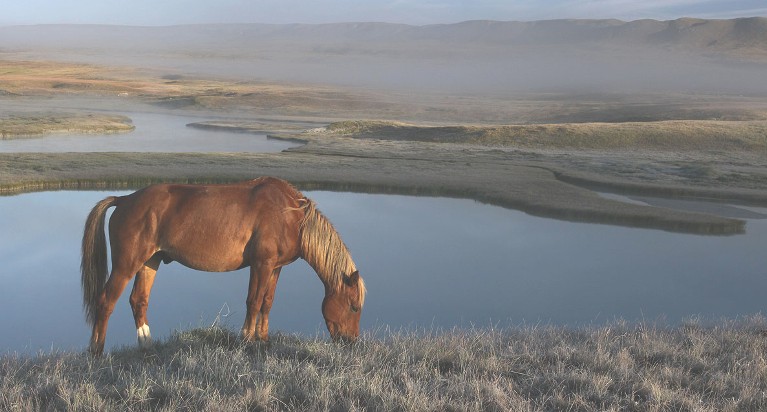
The Aryans/Arians came to the Indus Plain on horseback, in waves separated perhaps by decades or longer. Like other pastoral people, they were warriors, the Arian's were familiar with prowling and hunting and with bow and arrow. Each family was ruled by an authoritarian male, and each Arian tribe was ruled by a king called a raja, who was obliged to consult with tribal councils, on matters of major importance.
Like other pastoral people, the Arian invaders were storytellers. They brought with them their centuries old sacred hymns, myths and oral history - stories that expressed their desire to please their gods. They had a father god of the heaven, sky and atmosphere: called Dyaus Pitar (sky father). They had a male god of thunder and rain called Indra, who was also the god of war.
The Arians had a god of fire they called Agni. To the Arian's, Agni "was" fire, and they believed that Agni hungrily devoured the animals that they sacrificed in their rituals of burning. These sacrifices were performed by priests to obtain from their gods the gifts of children, success in war, wealth, health, longevity, food, drink or anything else that contributed to their happiness.
With the passing years, the waves of Arian tribes that had come to the Indus Plain, spread out across the region. They warred against the ancient original people, and they took and settled their land. This land then provided the Arians with pasture for their animals. The Arians grouped in villages and built homes of bamboo or light wood - homes without statues or art. They soon learned agriculture and began growing crops. The environment supplied them with all they needed. But perhaps responding to their old traditions and impulses, the Arian tribes began warring against each other - wars that might begin with the stealing of cattle.
Because of these wars, gradually Arian tribal kings began changing from elected leaders to autocratic rulers. Arian kings had begun associating their power with the powers of their gods, rather than the approval of their fellow tribesmen. They began allying themselves with priests. And as in the West, kings were acquiring divinity. By taxing their subjects, these kings could then create armies that were theirs, rather than an instrument of the tribe.
In the decades around 1,000 B.C, there was a shortage of rainfall in the Indus valley, and running from this drought, some Arian tribes trekked eastward along the foot of the Himalayan mountains. Here the jungles were less dense, and the rivers easier to cross, this path took them to the plains of the Ganges Valley. Meanwhile some Arian priests had wandered ahead of their tribes, in order to evangelize among the tribes that they may come upon. They found these societies to have a more egalitarian organization than they had, and so they despised them for not having kings as godly and autocratic as theirs.
By now, the Arian's had acquired iron tools and weapons, iron having spread eastward through Persia. And now with their superior weaponry, the Arian's fought those who resisted their advance. The Arian's believed that the gods were on their side, and that resistance from local peoples was inspired by demons. Gradually the Arian's spread out over much of the Ganges Valley.
Some Arian's also migrated south, along the western coast of the Indian subcontinent, and some Arian's went down the eastern coast, to an area called Kalinga. A few Arian's went as far south as the island that in Hindu literature, was called Lanka. And some Arian priests went as missionaries to southern India. Occasionally the Arian missionaries might feel threatened or mistreated, and they would then seek the aide of their king. This being a good pretext for incursions, their king's warriors would came south to their rescue. Incursions not withstanding, Southern India remained independent of Arian rule.
 |
 |
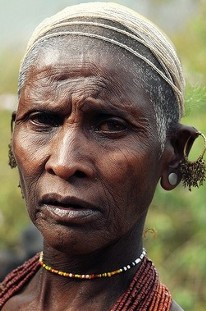 |
 |
 |
With the Arian's settling alongside local peoples, a complex hierarchy of classes developed that would be called caste. At the top of this class ranking was the priests and their entire families, the Brahmins. Also at the top were the warrior-aristocrats, the Kshatriyas, whose job it was to practice constantly for combat. Neither the Brahmins nor the Kshatriyas conceded superiority to the other, but they agreed that the other classes were lower than they. The first of these lower classes was the Vaishas and their families. This class were Arian's who tended cattle and served the Brahmins and Kshatriyas in others ways (the middle-class). The lowest class was the conquered Blacks, they were called the Shudras. The Arian's made these four classifications a part of their mythology. The four groups it was claimed, came from the body of the god Prajapati: the Brahmins from the god's mouth, the warriors from the god's arms, the tenders of cattle from his legs, and the Shudras from his feet.
 |
 |
 |
 |
 |
In the beginning this class system was less rigid than it would be centuries later. People from different classes could dine together. A man from a non-Brahmin family could still become a priest and therefore a Brahmin. And although marriage within one's own class was preferred, there was no absolute restriction against marrying people from a different class.
By around 700 or 600 B.C, the migrations of the Arian's had ended. With their new successes in agriculture, the Arian's increased in number and they began to create cities. Arian traders, merchants, and landlords appeared, as did money lending. Arian's began trading with Arabia and the great empire of the Assyrians. In the 600s B.C, India began trading with China, the Malay Peninsula and the islands of what is now, Indonesia and the Philippines. By 600 B.C, numerous cities had arisen in northern India - cities with fortifications, moats and ramparts in response to the dangers of war. In northern India, along the Ganges River, sixteen different kingdoms had emerged.
Over time, a mix developed between the nomadic religion of the Arian's, and the local religions of the conquered. This mix came with Arian males marrying non-Arian females, and it came with some among the conquered, accepting the religion of their conquerors - much as Amerindians in the Americas, accepted the religion of their Christian conquerors.
 |
 |
 |
 |
 |
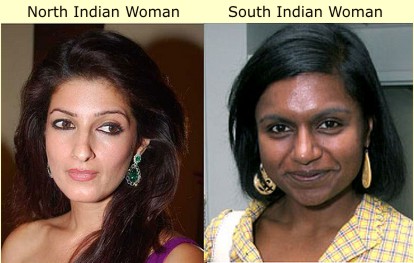 |
 |
 |
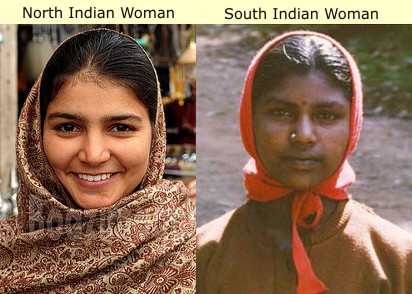 |
The above racial and genetic history of India is of course self evident with just the least bit of digging. But we are nonetheless very pleased to see our conclusions confirmed by a recent scientific study conducted by scientists from M.I.T. Harvard and other international institutions: and published in the (AJHG) American Journal of Human Genetics Aug. 8, 2013.
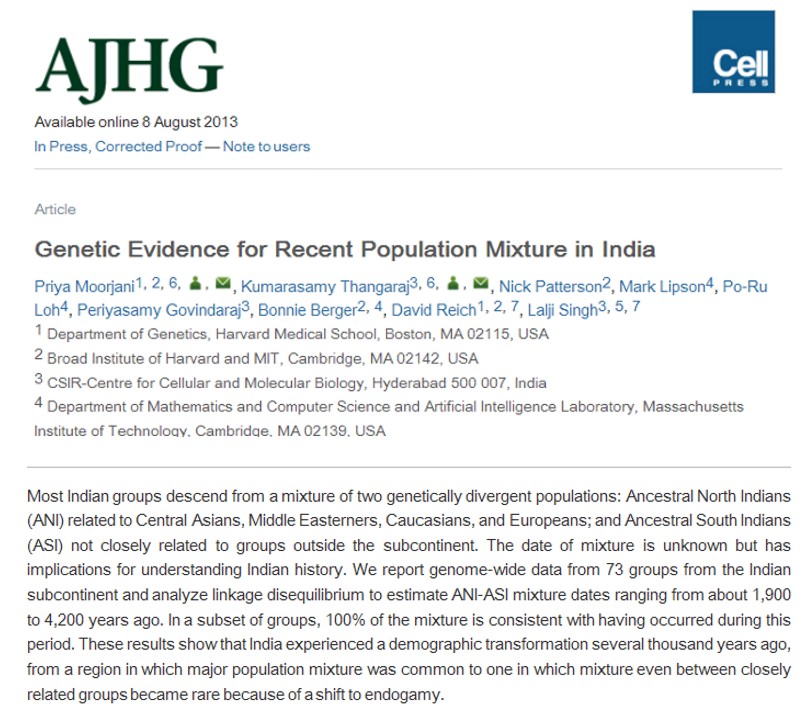 |
In India this blend of Arian and local religions became known as Hinduism, a word derived from the Arian word Sindu, the name the Arian's gave to the Indus River. The Hindu religion ranged from veneration of traditional Arian gods, by urban intellectuals, to the worship of a diversity of local, rural, and agricultural deities.
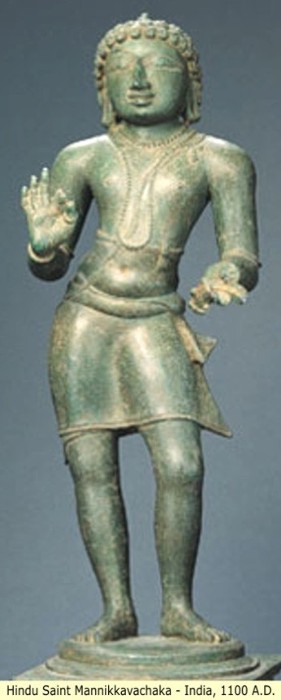
Generally; Hinduism is the conviction that the soul or self (atman) is subject to “samsara” the transmigration through many forms of incarnation. Held together with this belief is another, that of “karman” which says that the soul carries with it, the burden of its past actions; which conditions the forms of its future incarnations. As long as the soul mistakes this phenomenal world for reality and clings to existence in it, it is doomed to suffer endless births and deaths.
The various Indian cults and philosophical systems offer ways in which to attain moksa or mukti (release or liberation) from the misery of subjection to the inexorable processes of cosmic time. Basically, this liberation consists of the soul's effective comprehension of its essential unity with Brahman, the supreme “Atman” or essence of reality, and it’s merging with it. Most of the ways by which this goal may be attained require self-effort in mastering meditation techniques and living an ascetic life. But, in the devotional (bhakti) cults associated with Visnu (Vishnu) and Siva (Shiva), an intense personal devotion to the deity concerned is believed to earn divine aid to salvation. Also see Jainism – next Indus page.
 |
 |
 |
 |
 |
 |
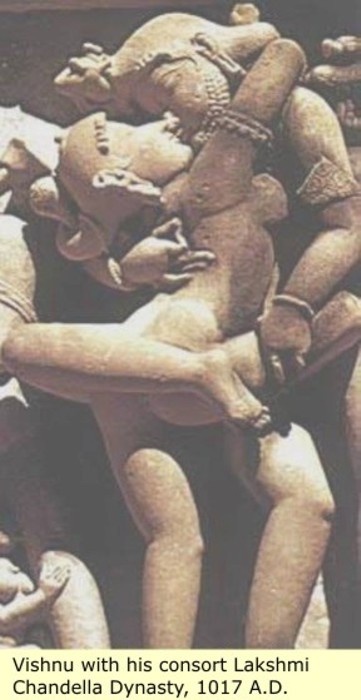
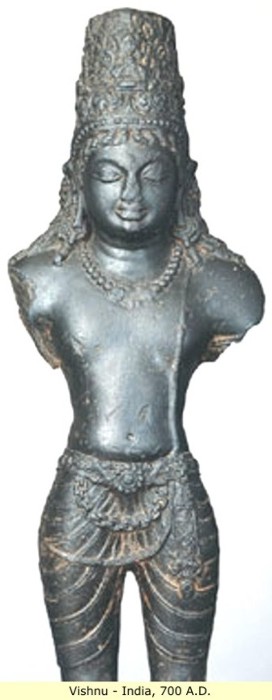
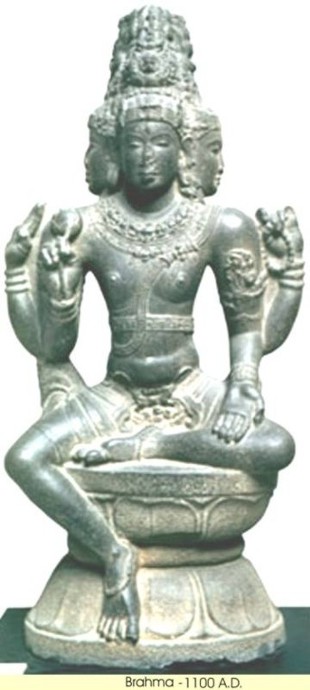
Vishnu is one of the principal Hindu deities, worshiped as the protector and preserver of the world and restorer of dharma (moral order). Vishnu, like Siva (the other major god of Hinduism), is a syncretic personality who combines many lesser cult figures and local heroes.
Temple images of Vishnu depict him either sitting, often in the company of his consorts Laksmi (also called Sri) and Bhumidevi (Earth); standing holding various weapons; or reclining on the coils of the serpent Sesa, asleep on the cosmic ocean during the period between the periodic annihilation and renewal of the world. The standing Vishnu is dressed in royal garments and holds in his four (sometimes two) hands the sankha (conch), cakra (discus), gada (club), or padma (lotus). On his chest is the curl of hair known as the srivatsa mark, a sign of his immortality, and around his neck he wears the auspicious jewel Kaustubha. In painting, Vishnu is usually shown as dark complexioned, which is also a distinguishing feature of his incarnations.
 |
 |
 |
|
 |
|
Also spelled Siwa, or Shiva, one of the main deities of Hinduism, worshiped as the paramount lord by the Saiva (Shaivite) sects of India. Siva (Sanskrit: “Auspicious One”) is one of the most complex gods of India, embodying seemingly contradictory qualities. He is both the destroyer and the restorer, the great ascetic and the symbol of sensuality, the benevolent herdsman of souls and the wrathful avenger. Though some of the combinations of roles may be explained by Siva's identification with earlier mythological figures, they also arise from a tendency in Hinduism to combine complementary qualities in a single ambiguous figure.
 |
 |
 |
Siva is usually depicted in painting and sculpture as white or ash-colored, with a blue neck (from holding in his throat the poison thrown up at the churning of the cosmic ocean, which threatened to destroy humankind), his hair arranged in a coil of matted locks (jatamakuta) and adorned with the crescent moon and the Ganges (according to legend he brought the Ganges River to earth by allowing her to trickle through his hair, thus breaking her fall). He has three eyes, the third eye bestowing inward vision but capable of burning destruction when focused outward. He wears a garland of skulls and a serpent around his neck and carries in his two (sometimes four) hands a deerskin, a trident, a small hand drum, or a club with a skull at the end.
 |
 |
| It can logically be deduced; that having two co-equal supreme gods “Vishnu and Siva” one Black, one White; was an attempt by the Arians to encourage acceptance of the new Hindu religion, by the ingenious people. |
Siva is represented in a variety of forms: in a pacific mood with his consort Parvati and son Skanda, as the cosmic dancer (Nataraja), as a naked ascetic, as a mendicant beggar, as a yogin, and as the androgynous union of Siva and his consort in one body, half-male and half-female (Ardhanarisvara). Among his common epithets are Sambhu (“Benignant”), Sankara (“Beneficent”), Pasupati (“Lord of Beasts“), Mahesa (“Great Lord”), and Mahadeva (“Great God”).
Siva's female consort is known under various manifestations as Uma, Sati, Parvati, Durga, and Kali (Siva is also sometimes paired with the supreme goddess, Sakti). The divine couple, together with their sons—the six-headed Skanda and the elephant-headed Ganesa—are said to dwell on Mount Kailasa in the Himalayas. Siva's mount and animal image is the bull Nandi; a sculpture of Nandi sits opposite the main sanctuary of every Siva temple. In temples and in private shrines Siva is worshiped in his fundamental form of the linga, or phallus.
 |
 |
 |
Please visit the "Additional Material Area" for many more photographs of each civilization, and related material <Click> |
Now lets go over to China, to see what the "Other" branch of the Eurasian Tree is up to.
| < Back | Home | Next > |


