
In 1931 Ernst Herzfeld, at that time Professor of Oriental Archaeology in Berlin, was commissioned by James H. Breasted, Director of the Oriental Institute of the University of Chicago, to undertake a thorough exploration, excavation and, if possible, restoration of the remains of Persepolis. Thus, Herzfeld, in 1931 became the first field director of the Oriental Institute’s Persepolis Expeditions. In 1931–34, assisted by his architect, Fritz Krefter, he uncovered on the Persepolis Terrace the beautiful Eastern Stairway of the Apadana and the small stairs of the Council Hall. He also excavated the Harem of Xerxes. When Herzfeld left in 1934, Erich F. Schmidt took charge. He continued the large-scale excavations of the Persepolis complex and its environs until the end of 1939, when the onset of the war in Europe put an end to his archaeological work in Iran. During the last years of excavating, the University Museum in Philadelphia and the Museum of Fine Arts in Boston had joined the Oriental Institute in order to cope with the tremendous work at hand. The digging crew, recruited from villagers, fluctuated from 200 to 500 men. Elaborating on this, Schmidt wrote that at the beginning of each season about 20 to 30 laborers arrived from Damghan.
As with many places and people, the ancient capital of the Achaemenian kings of Persia is known to us by it's Greek name "Persepolis" meaning Persian City. The Persians themselves called it "Parsa" meaning the city of Persians. The remains of Persepolis are located in the Fars region of what is now southwestern Iran.
Construction of the city was begun under Darius I (Darius the Great - reigned 522–486 B.C.). Persepolis was built in a remote and mountainous region which was quite inconvenient, making it's function as the royal residence and seat of power, somewhat strange. Administration of the Achaemenian Empire was likely still carried on from the traditional power centers of Susa, Babylon, and Ecbatana.
Upon the defeat of the Persian Empire by the Macedonian King Alexander the Great in 330 B.C. Persepolis was plundered, and the palace of the then Persian King Xerxes, was burned. According to one legend, it was Thais, a Athenian courtesan who traveled with the army of Alexander, that supposedly persuaded Alexander to set fire to the Achaemenian Palace. In another version, the fire was started when a drunken Thais led a revel that got out of hand. In any event, years later Persepolis was still the capital of Persia, but now as a province of the Macedonian empire. The city gradually declined, and then fell to ruin after the Seleucid period.
|
What's left of the palace is marked by a large terrace with its east side leaning on a hill called the Mount of Mercy. The other three sides of the terrace are formed by walls varying in height with the slope of the ground from 13 to 41 feet; on the west side of the terrace is the magnificent double stairs of Apadana. On the top of the terrace are the ruins of several colossal buildings, all constructed of an often polished, dark gray stone. These stones are of great size and were cut with such great precision that mortar was not needed, many of them are still in place today.
 |
The centerpiece of the terrace was Apadana (the meeting place), the Great audience hall of Darius. Several of the the huge columns that supported the audience hall are still standing. In 1933 two sets of gold and silver plates were found in the foundations of Apadana, they recorded in the cuneiform writing of old Persian, Elamite, and Babylonian, the boundaries of the Persian Empire.
 |
A number of inscriptions cut in stone, of the kings Darius I, Xerxes I, and Artaxerxes III, indicate which king built the various buildings. The oldest inscription on the south retaining wall gives us Darius' famous prayer for his people: “God protect this country from foe, famine and falsehood" - the Persians believed that the "Lie" was the greatest sin.
 |
 |
On the great stairways of Apadana, are relief's of Persian, Median, and Elamite officials. Additionally, there are twenty-three scenes, separated by cypress trees, depicting representatives from the twenty-three vassal kingdoms of the empire. They are being led by a Persian or Mede, as they come to made offerings to the king at the festival of the vernal equinox. The various delegates are shown in great detail, giving insight into the costume and equipment of the various peoples of the Persian Empire in the 5th century B.C. But, there is NO inscription to identify who these people are!
 |
In Antiquity, Bagastâna/Behistun, which means 'place where the gods dwell', was the name of a village and a remarkable, isolated rock outcrop along the road that connected the capitals of Babylonia and Media, and Ecbatana (modern Hamadan). Many travelers passed along this place, so it was the logical place for the Persian king Darius I (Darius the Great - 522-486) to proclaim his military victories.
The famous Behistun inscription was engraved on a cliff about 100 meters off the ground. Darius tells us how the supreme god Ahuramazda choose him to dethrone an usurper named Gaumâta, how he set out to quell several revolts, and how he defeated his foreign enemies.
The following translation of the Behistun Inscription was made by L.W. King and R.C. Thompson [1]
Where names are quoted in a Greekified or Biblical form, the Persian original sometimes follows in square brackets.
In original Persian words and names, "x"(like cyrilic X) means the "kh" sound as German "ch" in "ach".
King Darius says: These are the countries which are subject unto me, and by the grace of Ahuramazda I became king of them: Persia [Pârsa], Elam [Ûvja], Babylonia [Bâbiruš], Assyria [Athurâ], Arabia [Arabâya], Egypt [Mudrâya], the countries by the Sea, Lydia [Sparda], the Greeks [Yauna], Media [Mâda], Armenia [Armina], Cappadocia [Katpatuka], Parthia [Parthava], Drangiana [Zraka], Aria [Haraiva], Chorasmia [Uvârazmîy], Bactria [Bâxtriš], Sogdia [Suguda], Gandara [Gadâra], Scythia [Saka] (Ghi-mi-ri or Cimmeria in Babylonian version), Sattagydia [Thataguš], Arachosia [Harauvatiš] and Maka [Maka]; twenty-three lands in all.
 |
The order in which the subject countries are mentioned, is assumed to be indicative of their importance to Darius, but the position of Media (which should logically be second to the Persians), and Arabia at (5), which was of little importance, casts doubt on that logic. But certainly, who is first and last must mean something.
1)Persia, 2)Elam, 3)Babylonia, 4)Assyria, 5)Arabia, 6)Egypt - the countries by the Sea, 7)Lydia, 8)the Greeks, 9)Media, 10)Armenia, 11)Cappadocia, 12)Parthia, 13)Drangiana, 14)Aria, 15)Chorasmia, 16)Bactria, 17)Sogdia, 18)Gandara, 19)Scythia, 20)Ghi-mi-ri or Cimmeria in Babylonian version), 21)Sattagydia, 22)Arachosia, 23)and Maka; twenty-three lands in all.
Once again, in order to establish positioning, we assume that Persians would be depicted as the first to gain audience with Darius, and thus the first group at the top of the stairway - they are assigned the number one. Logically then, those at the very end, number 23, would be the least important. Once again that logic does not hold up when you note that in other sculptures, they included when others are excluded.
 |
The Albinos, specifically the Oriental Institute of the University of Chicago, tell us that these people were ETHIOPIANS/NUBIANS/KUSHITES. When Ethiopians/Nubians/Kushites are not even mentioned in the inscriptions. Actually they're probably the Maka's.
 |
The Albinos, specifically the Oriental Institute of the University of Chicago, tell us that these people were Libyans. When Libyans are not even mentioned in the inscriptions.
 |
 |
To be clear; it appears that the Oriental Institute of the University of Chicago, simply made it up: they did this to be in keeping with the Albino peoples policy of assigning all Blacks (whenever possible) to Africa. That is why all of the paintings of Black Knights in Europe are ALL called Saint Maurice. That is why EVERY European Black who ever had a painting made, is declared to be a servant, a former Slave, or kidnapped from Africa. In this way, they hope to protect their false history, counting themselves as native Europeans, and also to hide their atrocities when eradicating Europe's native Blacks from their homeland. What they did in Europe, is the same as what they did in the Americas. Destroying the native peoples historical documents and art, and replacing it with their own creations instead, is how they control the knowledge and thinking of conquered peoples.
There can be no doubt that the Albino people routinely translate ancient documents in ways designed to suit their racial agenda's, rather than in ways to advance truth and knowledge. Hence our use of their clinical and scientific name - Albino, rather than their preferred euphemism - White. That and other degenerate behaviors, do not merit accommodation.
The Greek Historian Herodotus is a major source of information about the first Persian Empire. But even in this trusted translation of Herodotus by George Rawlinson (1858–60), we find curious falsehoods and inconsistencies regarding Black people. We have no way of knowing if George Rawlinson is the source, or if it's modern handlers of the documents. Here, in some instances, we detail and answer the falsehoods below.
The first and most obvious, is that the voice of Herodotus is made to seem estranged from Blacks. The fact is that Herodotus was a Greek who was born in Halicarnassus, Caria, Anatolia: (modern day Bodrum, Turkey) and lived in the fifth century B.C. (c. 484–425 B.C.). As can easily be seen from these images of subject people of the Persian Empire, the great majority of the people in Anatolia were Blacks. Perpetrating falsehoods like this, is what we mean by degenerate behaviors, that do not merit accommodation.
Another instance is their insistence of including Ethiopia as a vassal state of the Persian Empire. When even here in Herodotus's accounts, the Persians fail at invading Ethiopia. Yet Albino translators steadfastly identify the sculpture with the short tightly curled hair as a Nubian/Kushite/Ethiopian, which is in keeping with the Albinos agenda of assigning all Blacks to Africa ONLY. But in fact, the paraphernalia of the scene (the Antelope and the Sword - NOT Elephant tusk) clearly identify the individual as an Asian. Also note Herodotus's description of how Ethiopians in the Persian army were dressed. Additionally, NO MAP OF THE PERSIAN EMPIRE INCLUDES ETHIOPIA!
Book 2 - EUTERPE
[2.22] The third explanation, which is very much more plausible than either of the others, is positively the furthest from the truth; for there is really nothing in what it says, any more than in the other theories. It is, that the inundation of the Nile is caused by the melting of snows. Now, as the Nile flows out of Libya, through Ethiopia, into Egypt, how is it possible that it can be formed of melted snow, running, as it does, from the hottest regions of the world into cooler countries?
{That is false - the temperature at the Equator is "constant" at about 81°F (27°C). Contrary to the perceptions of the Albino people: As can be seen by the table of maximum temperatures ever achieved on Earth, below: the Equator is very comfortable temperature wise, when compared to other areas}.
Africa 55 °C (131 °F) |
Asia 54 °C (129 °F) |
Europe 48.0 °C (118.4 °F) |
||
North America 56.7 °C (134.1 °F) |
Oceania 53 °C (127 °F)
|
South America 48.9 °C (120.0 °F) |
[2.104] There can be no doubt that the Colchians are an Egyptian race. Before I heard any mention of the fact from others, I had remarked it myself. After the thought had struck me, I made inquiries on the subject both in Colchis and in Egypt, and I found that the Colchians had a more distinct recollection of the Egyptians, than the Egyptians had of them. Still the Egyptians said that they believed the Colchians to be descended from the army of Sesostris. My own conjectures were founded, first, on the fact that they are black-skinned and have woolly hair, which certainly amounts to but little, since several other nations are so too; but further and more especially, on the circumstance that the Colchians, the Egyptians, and the Ethiopians, are the only nations who have practised circumcision from the earliest times.
Book 3 - THALIA
[3.25] When the spies had now seen everything, they returned back to Egypt, and made report to Cambyses, who was stirred to anger by their words. Forthwith he set out on his march against the Ethiopians without having made any provision for the sustenance of his army, or reflected that he was about to wage war in the uttermost parts of the earth. Like a senseless madman as he was, no sooner did he receive the report of the Icthyophagi than he began his march, bidding the Greeks who were with his army remain where they were, and taking only his land force with him. At Thebes, which he passed through on his way, he detached from his main body some fifty thousand men, and sent them against the Ammonians with orders to carry the people into captivity, and burn the oracle of Jupiter. Meanwhile he himself went on with the rest of his forces against the Ethiopians. Before, however, he had accomplished one-fifth part of the distance, all that the army had in the way of provisions failed; whereupon the men began to eat the sumpter beasts, which shortly failed also.
If then, at this time, Cambyses, seeing what was happening, had confessed himself in the wrong, and led his army back, he would have done the wisest thing that he could after the mistake made at the outset; but as it was, he took no manner of heed, but continued to march forwards. So long as the earth gave them anything, the soldiers sustained life by eating the grass and herbs; but when they came to the bare sand, a portion of them were guilty of a horrid deed: by tens they cast lots for a man, who was slain to be the food of the others. When Cambyses heard of these doings, alarmed at such cannibalism, he gave up his attack on Ethiopia, and retreating by the way he had come, reached Thebes, after he had lost vast numbers of his soldiers. From Thebes he marched down to Memphis, where he dismissed the Greeks, allowing them to sail home. And so ended the expedition against Ethiopia.
[3.94] The Paricanians and Ethiopians of Asia furnished a tribute of four hundred talents. This was the seventeenth satrapy.
[3.97] Such then were the governments, and such the amounts of tribute at which they were assessed respectively. Persia alone has not been reckoned among the tributaries - and for this reason, because the country of the Persians is altogether exempt from tax. The following peoples paid no settled tribute, but brought gifts to the king: first, the Ethiopians bordering upon Egypt, who were reduced by Cambyses when he made war on the long-lived Ethiopians, and who dwell about the sacred city of Nysa, and have festivals in honour of Bacchus. The grain on which they and their next neighbours feed is the same as that used by the Calantian Indians. Their dwelling-houses are under ground. Every third year these two nations brought - and they still bring to my day - two choenices of virgin gold, two hundred logs of ebony, five Ethiopian boys, and twenty elephant tusks. The Colchians, and the neighbouring tribes who dwell between them and the Caucasus - for so far the Persian rule reaches, while north of the Caucasus no one fears them any longer - undertook to furnish a gift, which in my day was still brought every fifth year, consisting of a hundred boys, and the same number of maidens. The Arabs brought every year a thousand talents of frankincense. Such were the gifts which the king received over and above the tribute-money.
{There is no known ancient city of Nysa on the African continent. Bacchus is the "Roman" name for the Greek god Dionysus}.
[3.98] The way in which the Indians get the plentiful supply of gold which enables them to furnish year by year so vast an amount of gold-dust to the kind is the following:- eastward of India lies a tract which is entirely sand. Indeed of all the inhabitants of Asia, concerning whom anything certain is known, the Indians dwell the nearest to the east, and the rising of the sun. Beyond them the whole country is desert on account of the sand. The tribes of Indians are numerous, and do not all speak the same language - some are wandering tribes, others not. They who dwell in the marshes along the river live on raw fish, which they take in boats made of reeds, each formed out of a single joint. These Indians wear a dress of sedge, which they cut in the river and bruise; afterwards they weave it into mats, and wear it as we wear a breast-plate.
[3.99] Eastward of these Indians are another tribe, called Padaeans, who are wanderers, and live on raw flesh. This tribe is said to have the following customs:- If one of their number be ill, man or woman, they take the sick person, and if he be a man, the men of his acquaintance proceed to put him to death, because, they say, his flesh would be spoilt for them if he pined and wasted away with sickness. The man protests he is not ill in the least; but his friends will not accept his denial - in spite of all he can say, they kill him, and feast themselves on his body. So also if a woman be sick, the women, who are her friends, take her and do with her exactly the same as the men. If one of them reaches to old age, about which there is seldom any question, as commonly before that time they have had some disease or other, and so have been put to death - but if a man, notwithstanding, comes to be old, then they offer him in sacrifice to their gods, and afterwards eat his flesh.
[3.100] There is another set of Indians whose customs are very different. They refuse to put any live animal to death, they sow no corn, and have no dwelling-houses. Vegetables are their only food. There is a plant which grows wild in their country, bearing seed, about the size of millet-seed, in a calyx: their wont is to gather this seed and having boiled it, calyx and all, to use it for food. If one of them is attacked with sickness, he goes forth into the wilderness, and lies down to die; no one has the least concern either for the sick or for the dead.
[3.101] All the tribes which I have mentioned live together like the brute beasts: they have also all the same tint of skin, which approaches that of the Ethiopians. Their country is a long way from Persia towards the south: nor had king Darius ever any authority over them.
[3.114] Where the south declines towards the setting sun lies the country called Ethiopia, the last inhabited land in that direction. There gold is obtained in great plenty, huge elephants abound, with wild trees of all sorts, and ebony; and the men are taller, handsomer, and longer lived than anywhere else.
[3.115] Now these are the farthest regions of the world in Asia and Libya. Of the extreme tracts of Europe towards the west I cannot speak with any certainty; for I do not allow that there is any river, to which the barbarians give the name of Eridanus, emptying itself into the northern sea, whence (as the tale goes) amber is procured; nor do I know of any islands called the Cassiterides (Tin Islands), whence the tin comes which we use. For in the first place the name Eridanus is manifestly not a barbarian word at all, but a Greek name, invented by some poet or other; and secondly, though I have taken vast pains, I have never been able to get an assurance from an eye-witness that there is any sea on the further side of Europe. Nevertheless, tin and amber do certainly come to us from the ends of the earth.
Book 7 - POLYMNIA
[7.9] Whereupon Mardonius took the word, and said: "Of a truth, my lord, thou dost surpass, not only all living Persians, but likewise those yet unborn. Most true and right is each word that thou hast now uttered; but best of all thy resolve not to let the Ionians who live in Europe - a worthless crew - mock us any more. It were indeed a monstrous thing if, after conquering and enslaving the Sacae, the Indians, the Ethiopians, the Assyrians, and many other mighty nations, not for any wrong that they had done us, but only to increase our empire, we should then allow the Greeks, who have done us such wanton injury, to escape our vengeance. What is it that we fear in them? - not surely their numbers? - not the greatness of their wealth? We know the manner of their battle - we know how weak their power is; already have we subdued their children who dwell in our country, the Ionians, Aeolians, and Dorians.
[7.69] The Arabians wore the zeira, or long cloak, fastened about them with a girdle; and carried at their right side long bows, which when unstrung bent backwards. The Ethiopians were clothed in the skins of leopards and lions, and had long bows made of the stem of the palm-leaf, not less than four cubits in length. On these they laid short arrows made of reed, and armed at the tip, not with iron, but with a piece of stone, sharpened to a point, of the kind used in engraving seals. They carried likewise spears, the head of which was the sharpened horn of an antelope; and in addition they had knotted clubs. When they went into battle they painted their bodies, half with chalk, and half with vermilion. The Arabians, and the Ethiopians who came from the region above Egypt, were commanded by Arsames, the son of Darius and of Artystone daughter of Cyrus. This Artystone was the best-beloved of all the wives of Darius; and it was she whose statue he caused to be made of gold wrought with the hammer. Her son Arsames commanded these two nations.
[7.70] The eastern Ethiopians - for two nations of this name served in the army - were marshalled with the Indians. They differed in nothing from the other Ethiopians, save in their language, and the character of their hair. For the eastern Ethiopians have straight hair, while they of Libya are more woolly-haired than any other people in the world. Their equipment was in most points like that of the Indians; but they wore upon their heads the scalps of horses, with the ears and mane attached; the ears were made to stand upright, and the mane served as a crest. For shields this people made use of the skins of cranes.
Book 9 - CALLIOPE
[9.32] I have named here the greatest of the nations which were marshalled by Mardonius on this occasion, to wit, all those of most renown and account. Mixed with these, however, were men of divers other peoples, as Phrygians, Thracians, Mysians, Paeonians, and the like; Ethiopians again, and Egyptians, both of the Hermotybian and Calascirian races, whose weapon is the sword, and who are the only fighting men in that country. These persons had formerly served on board the fleet of Xerxes, but Mardonius disembarked them before he left Phalerum; in the land force which Xerxes brought to Athens there were no Egyptians. The number of the barbarians, as I have already mentioned, was three hundred thousand; that of the Greeks who had made alliance with Mardonius is known to none, for they were never counted: I should guess that they mustered near fifty thousand strong. The troops thus marshalled were all foot soldiers. As for the horse, it was drawn up by itself.
As is always the case when Albinos tell Black history, all short haired Blacks are deemed Nubians, Ethiopians or some such nonsense, and facts can be changed to suit the need. Some have suggested that the figure was assumed to be a Kushite because of the animal, which was thought to be a Okapi. But it is not an Okapi, it is the Asian Nilgai. Therefore these men are obviously Asian.
 |
 |
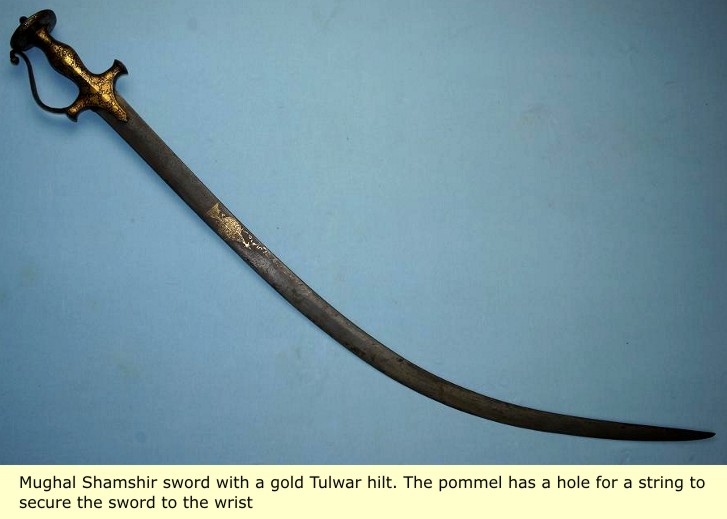
Note also that the last man is NOT carrying an Elephant tusk, it has a tassel loop at the end. Elephant tusks do not have tassel loops at the end, but Shamshir swords do: the hand goes through it, so that the sword does not slip out of the hand.
 |
 |
 |
 |
 |
 |
 |
 |
Clearly, it would be difficult for a person of reasonable intelligence, and honest intent, to confuse the Asian Nilgai and the Central African Okapi. Not only don't they really look alike, but their territories are so far apart, that the Asian would not see a Okapi, and a Central African would not see a Nilgai.
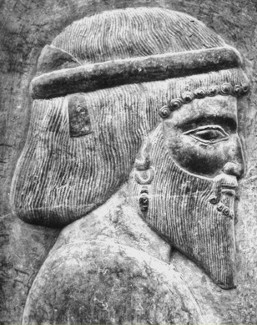
The Persians in their relief's made little effort to distinguish the various peoples of the empire by facial features, since they usually depicted in profile. Instead they differentiated the various peoples by their dress and the nature of their hair. Curly hair meant Blacks, Straight hair meant one of the Albino tribes, except for the Straight haired, Black skinned people - like Dravidians - whom Herodotus referred to as Eastern Ethiopians. A combination of Curly and Straight hair meant a Mulatto. Below: note how the Persians depicted themselves. The people of the Persian Empire are presented in the order they appear on the Eastern Stairway.
 |
1 |
2 |
3 |
||
 |
 |
 |
4 |
5 |
6 |
||
 |
EGYPTIAN SLOT??? |
 |
7 |
8 |
9 |
||
 |
 |
 |
10 |
11 |
12 |
||
 |
 |
 |
13 |
14 |
15 |
||
 |
 |
 |
16 |
17 |
18 |
||
 |
 |
 |
19 |
20 |
21 |
||
 |
 |
 |
22 |
23 |
|
 |
 |
About eight miles northeast of Persepolis, on the opposite side of the Pulvar River, rises a cliff-face in a place called Naqsh-e Rostam. Four tombs are carved out of the cliff-face, the first and oldest is the tomb of Darius I, which is identified by inscriptions. The other three tombs have no inscriptions to identify them, but are believed to be the tombs of Achaemenian kings Xerxes I, Artaxerxes I, and Darius II.
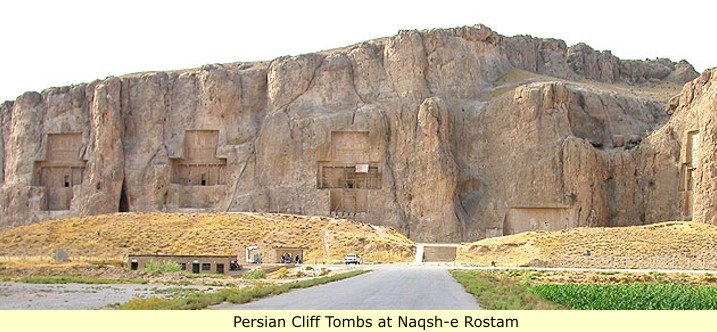 |
The facade of Darius' tomb is divided into three registers: the bottom register is blank, the middle is sculptured to imitate the front of a palace, and the top shows the monarch at worship on the top of a piece of furniture that is supported by representatives of the nations in his realm.
This top register is adorned with a framed relief panel showing a dais supported by thirty representatives of the nations of the empire. These representatives are identified by cuneiform captions. They are arranged in two tiers of fourteen people with raised arms between the legs, and two people on the outside supporting the feet of the dais.
 |
The engraved panel that forms the top arm of the cross shaped facade of the tomb of Darius I, the Great, contains an image of Darius standing in prayer before a fire altar. The platform on which he is standing is supported by twenty-eight men from the different the nations in Darius' Persian empire.
The panel also contains two sets of cuneiform inscriptions in Old Persian. The inscription in the top-left corner, is known as DNa. The central part of the cross contains another inscription known as DNb.
DNa
Great God Ahuramazda who created this earth , who created that sky who created mankind who created happiness for human-beings who granted Darius be king one king of many one lords of many. I am Darius Great King King of Kings King of countries diverse King of these lands great and distant, son of Hystaspes an Achaemenian, a Persian, son of a Persian, an Aryan, having Aryan lineage. Declared Darius King: By the grace of Ahuramazda these countries that I occupied outside of Persia; I ruled over them; they bore tribute to me. What was said to them by me, that they did; my law - that held them firm; Media, Elam, Parthia, Aria, Bactria, Sogdiana, Chorasmia, Drangiana, Arachosia, Sattagydia, Gandara, Sind, Amyrgian Scythians, Scythians with pointed caps, Babylonia, Assyria, Arabia, Egypt, Armenia, Cappadocia, Sardis (Lydian), Ionia, Scythians who are across the sea, Skudra, petasos-wearing Ionians (Macedonian?), Libyans, Ethiopians, people of Maka (Mykians/Makran?), Carians.
Declared Darius the King: When Ahuramazda beheld the earth in turmoil, thereupon upon me was bestowed my kingship; I became king. By the grace of Ahuramazda I restored the throne; what I decreed, that they obeyed, as my desire was. Now if you wonder this: How many are those countries which King Darius held, look at the sculptures (of those) who bear the throne, then you will know, Also, to you it will become known the spear of a Persian man has gone forth far; Further, to you it will become known a Persian man has very far from Persia has fought in war. Declared Darius King: This which has been done, all that by the will of Ahuramazda I did. Ahuramazda bore me aid, until I accomplished the work. May Ahuramazda protect me from harm, and my royal house, and this land and I pray of Ahuramazda, this may Ahuramazda give O man, that which Ahuramazda commands, let this not seem repugnant to you; do not leave the right path; do not rise in rebellion!
DNb
Great God Ahuramazda , who created this excellence which is seen, who created happiness for human beings, who wisdom and activity upon Darius (the) King bestowed . Declares Darius the King: By the grace of Ahuramazda, of such am I, that to right a friend I am, to wrong a friend I am not. Nor is it my desire that the weak be wronged by the powerful, nor is it my desire, that the powerful be wronged by the weak. What is right that is my desire. To men who follow the Lie, I am not a friend. I am not thoughtless. What things develop in my anger, I hold firm under control by my thinking power. I am firm control .
The man who cooperates, him according to his cooperative action, him thus do I reward. Who does harm, him according to the damage thus I punish. It is not my desire that a man should do harm; nor indeed is that my desire, if he should do harm, he should not be punished.
What a man says against a man, that does not convince me, until he satisfies the Ordinance of Good Regulations.
What a man does or performs (for me) according to his (natural) powers, (therewith) I am satisfied, and my pleasure is abundant, and I am well satisfied.
Of such a sort is my understanding and my command: when what has been done by me you shall see or hear of, both in the palace and in the war camp, this is my activity over and above my thinking power and my understanding.
This indeed is my activity: inasmuch as my body has the strength, as battle-fighter I am a good battle fighter. Once let there be seen with understanding in the place (of battle), what I see (to be) rebellious, what I see (to be) not (rebellious); both with understanding and with command then am I first to think with action, when I see a rebel as well as when I see a not-(rebel).
Trained am I both with hands and with feet. As a horseman I am a good horseman. As a bowman I am a good bowman both afoot and on horseback. As a spearman I am a good spear-man both afoot and on horseback.
And the (physical) skills which Ahuramazda has bestowed upon me and I have had the strength to use them -- by the grace of Ahuramazda what has been done by me, I have done with these skills which Ahuramazda has bestowed upon me.
menial, vigorously make you known of what sort I am, and of what sort my skills, and of what sort my superiority. Let not that seem false to you, which has been heard by thy ears. That do you hear, which is communicated to you.
O menial, let that not be made (to seem) false to you, which has been done by me. That do you behold, which [has been inscribed]. Let not the laws [be disobeyed] by you. Let not [anyone] be untrained [in obedience]. [O menial], let not the king (feel himself obliged to) inflict punishment (?) [for wrong-doing (?) on the dwellers (in the land) (?)].
Order of the countries of the Empire, as enumerated on Darius tomb. Note that there is no "Persia" on this list. |
Order of the countries of the Empire, as enumerated at Behistun. | |
1)Media, |
1)Persia, 2)Elam, 3)Babylonia, 4)Assyria, 5)Arabia, 6)Egypt - the countries by the Sea, 7)Lydia, 8)the Greeks, (Ionians) 9)Media, 10)Armenia, 11)Cappadocia, 12)Parthia, 13)Drangiana, 14)Aria, 15)Chorasmia, 16)Bactria, 17)Sogdia, 18)Gandara, 19)Scythia, 20)Ghi-mi-ri or Cimmeria in Babylonian version), 21)Sattagydia, 22)Arachosia, 23) Maka |
It is with the name list, and examination of the relief panel, that researchers must infer the identity of the people on Apadana's stairways: by comparing hats, clothing etc. Needless to say, the damage done to this cliff-face by two thousand years of weathering, makes inferred identification a very precarious proposition. Additionally, there are thirty peoples represented on the cliff-face, but only twenty-three on the stairway. There is no way to know that the correct twenty-three were extracted. Upon quick examination, it becomes apparent that Darius' list and the identifications provided by the Oriental Institute of the University of Chicago, (the sites original researchers), do not exactly dovetail.
 |
 |
 |
 |
 |
 |
 |
|
Whoever these people were, they were long with the Persians, and important to them. As they are always depicted as supporters of the Persian throne. |
 |
 |
 |
Left: 29. Right: 30. |
Click here for the reconstructed layout of the Apadana stairway using images like these; Click >>> |
| < Back | Home |
