Etruria |
Roman Empire |
Holy Roman Empire |
|
|
|
Ancient Man and His First Civilizations
Etruria-2
Modern Italy
The Eurasian Invasion - the Latin's
 When
last we left Etruria, we were mystified by the Etruscan's policy of not
helping each other when faced with a common threat. This incredible
policy would of course, have devastating effects. Moving ahead to
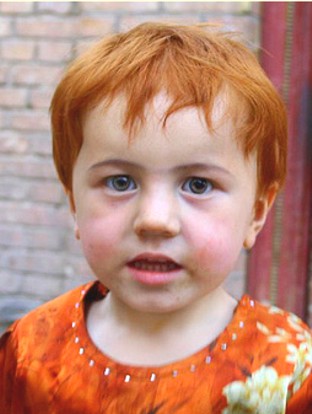
perhaps 1100 B.C. It is at about this time, that Albino people from the
Eurasian plains now called "the Latin's" later known as the Romans -
migrate in. These Latins may have accompanied the Hellenes into Greece,
and then continued on into Italy. The nature of the early contact
between the two peoples, is unknown. But, the later relationship is
well known to be one of violence. (Please remember that we are using
the terms Latin's and Hellenes in reference to Eurasian Albinos as a
convenience ONLY).
When
last we left Etruria, we were mystified by the Etruscan's policy of not
helping each other when faced with a common threat. This incredible
policy would of course, have devastating effects. Moving ahead to
perhaps 1100 B.C. It is at about this time, that Albino people from the
Eurasian plains now called "the Latin's" later known as the Romans -
migrate in. These Latins may have accompanied the Hellenes into Greece,
and then continued on into Italy. The nature of the early contact
between the two peoples, is unknown. But, the later relationship is
well known to be one of violence. (Please remember that we are using
the terms Latin's and Hellenes in reference to Eurasian Albinos as a
convenience ONLY).
Soon after the invasion of Whites from Eurasia began,
a coalition of the original Black inhabitants of Italy, Greece and the
Aegean area, formed a conglomeration called the "Sea People". They
boarded ships with all of their belongings and fled the area. But those
that stayed behind, still had to deal with the White newcomers.
Etruscan settlements were frequently built on a hill—the
steeper the better—and surrounded by thick walls. So according to Roman
mythology, Rome may have actually have been built by Etruscans, they
did so on the Palatine Hill according to the Etruscan model: that is,
they began with a pomoerium or sacred ditch. Then, they proceeded to
the walls.
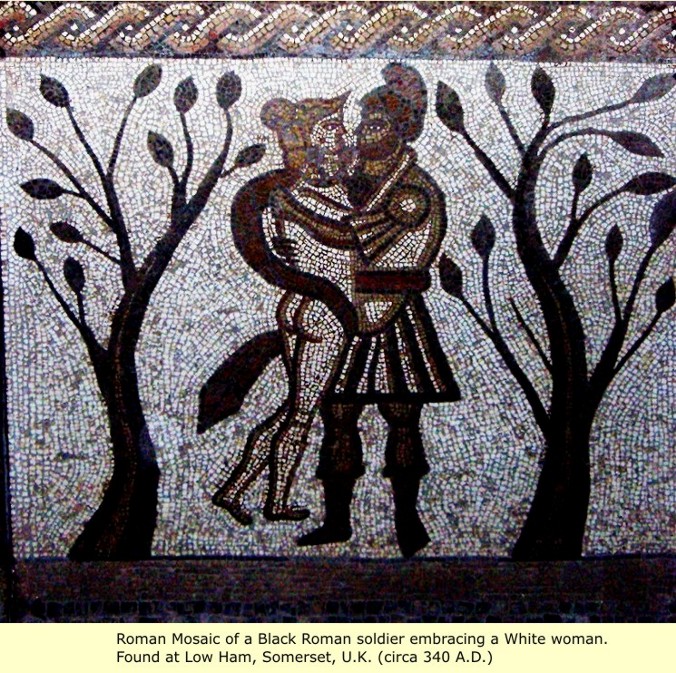
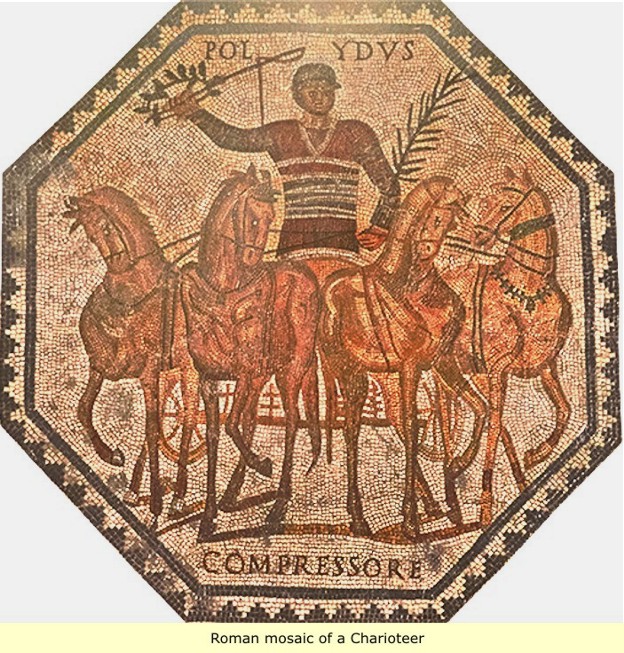
Were the original Romans Black People?
 |
 |
 |
 |
 |
 |
 |
 |
Were
the original Romans Black People? As we have shown on many pages, all
of those marble statues and busts of "Supposed" White Greeks and
Romans, that we find in museums today, are really 1600-1800s
fabrications. White history is so replete with lies and fake artifacts,
that it would be impossible for this, or any other "Truth Seeking"
publication, to investigate every possibility. So for convenience, we
will not delve into this founding of Rome, as documented in the Aeneid.
But rather, will work with the conventional story. |
The Aeneid
The Aeneid is a Latin epic poem written by Virgil in the late 1st century BC (70–19 B.C.) that tells the legendary story of Aeneas, a Trojan who traveled to Italy, where he became the ancestor of the Romans. It is composed of roughly 10,000 lines in dactylic hexameter.
The
first six of the poem's twelve books tell the story of Aeneas's
wanderings from Troy to Italy, and the poem's second half tells of the
Trojans' ultimately victorious war upon the Latins (Whites), under whose name Aeneas and his Trojan followers are destined to be subsumed.
The
hero Aeneas was already known to Greco-Roman legend and myth, having
been a character in the Iliad; Virgil took the disconnected tales of
Aeneas' wanderings, his vague association with the foundation of Rome
and a personage of no fixed characteristics other than a scrupulous
piety, and fashioned this into a compelling founding myth or
nationalist epic that at once tied Rome to the legends of Troy,
glorified traditional Roman virtues and legitimized the Julio-Claudian
dynasty as descendants of the founders, heroes and gods of Rome and Troy.
Entellus
was a Trojan hero from whom the town of Entella in Sicily was believed
to have received its name. He was a friend of the Trojan king Acestes.
A boxing match between Entellus and Dares is described in Virgil's
Aeneid. |
 |
The fight between Entellus and Dares, Roman mosaic, ca. 175 A.D. |
|
The
reason the poem is important, is because the Trojans were Phrygian's -
and this is what the Phrygian king Midas looked like.
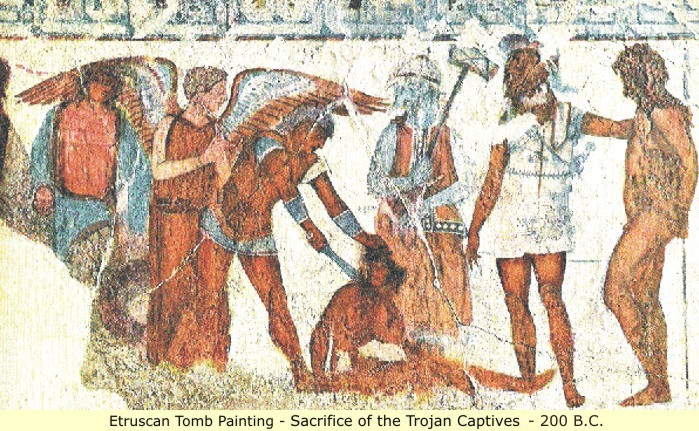
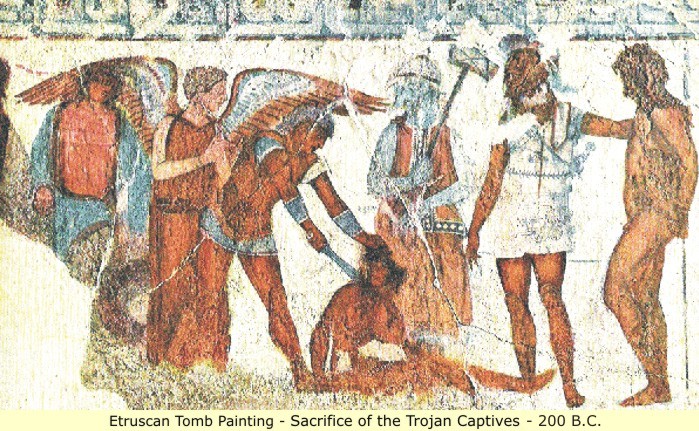
And this is how Etruscans depicted the Trojans (the guy on the ground).
|
Quote:
Although it was commissioned by the Emperor Augustus, the poem is more
than early imperial propaganda. It proclaims the divine mission of
Aeneas to found Rome and the divine injunction of the Romans to unite
the world under a noble Emperor such as Augustus.
As
a logical matter then, why would the Romans tolerate, much less
enthusiastically accept (the Aeneid was very popular), a founding story
that gives credit to Blacks for the nations creation, if they (the
elites), themselves were not Black?
The
other inescapable conclusion, is that the Emperor Augustus was himself
Black. In which case, we can chalk this statue up, to the same
people as "The Dying Gaul" statue. With it being nothing more than
"Pure White fantasy" probably done in the 1600-1700s.
Augustus of Prima Porta |
 |
From Wiki
Augustus
of Prima Porta (Italian: Augusto di Prima Porta) is a 2.04m high marble
statue of Augustus Caesar which was discovered on April 20, 1863, in
the Villa of Livia at Prima Porta, near Rome. Augustus Caesar's wife,
Livia Drusilla, retired to the villa after his death. The sculpture is
now displayed in the Braccio Nuovo of the Vatican Museums.
The
dating of the Primaporta piece is widely contested. It is thought to be
a marble copy of a possible bronze original. This original, along with
other high honors, was devoted to Augustus by the Senate in 20 B.C, and
set up in a public place. Up until this time Augustus had lived
modestly, but the fact that the statue was found in his widow's villa
shows that he was thoroughly pleased with it.
It
is also contested that this particular sculpture is a reworking in
marble of a bronze original, possibly a gift from Tiberius Caesar to
his mother Livia (since it was found in her villa Ad Gallinas Albas in
the vicinity of the ninth marker of the via Flaminia, and close to a
late Imperial gate called Prima Porta) after Augustus' death and in
honor of the woman who had campaigned so long for him to become the
next Caesar. This would explain the divine references to Augustus in
the piece, notably his being barefoot, the standard representation of
gods or heroes in classical iconography. Also, the reliefs in the
cuirass depict the retrieval of Crassus' standards captured by the
Parthians, an event in which the young Tiberius himself took a part,
serving as intermediary with the Parthian king, in the act that is
shown in the central scene of the armor, possibly his grandest service
to his adopted father Augustus. With the introduction of Tiberius as
the figure responsible for the retrieval of the standards, he
associates himself with Augustus, the emperor and the new god, as
Augustus himself had done previously with Julius Caesar. Under this
hypothesis, the dating of the statue can be placed during the first
years of Tiberius' reign as emperor (14 — 37 A.D.).
|
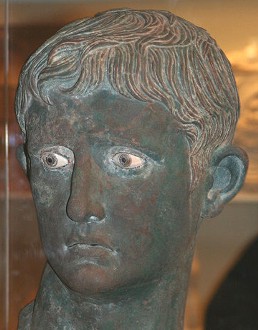
As
a further demonstration of the problems Whites have with the actual
race of Augustus: there is the matter of this statue head "Supposedly"
Discovered at Meroe in 1910 by J. Garstang. Based on accounts of the
Roman wars with Meroe in Strabo's Geography, circa 22 A.D. It was
decided that it was the head from one of the many giant statues of
Augustus, which were scattered all over Egypt. Aside from that
absurdity, of which there is no evidence, the statue head of course,
has no inscription.
Like
Herodotus, Strabo wrote entertainment in the guise of history. His
accounts of the wars is obviously fanciful, and to use that type of
material to make historical judgments, is a clear indication of the
fragility of White history.
| Click Here for some authentic and very reveling images of Roman Emperor Valerian: Click >>> |
|
In time, the Romans had learned how to built cities, now
there is great competition for power and territory. Wars rage, but the
Etruscan cities fight alone, and the Romans can simply attack and annex
each individual city; divide and conquer was the order of the day. This
disunity is further illustrated by the fact that the Romans concluded
treaties with individual Etruscan city/states, rather than the whole.
But the Etruscans reemerged as a local power during 800 -
700 B.C, spreading their trade to Corsica, Sardinia and Iberia and
creating a powerful navy to guard their interests. The Phoenicians and
Etruscans became trading partners and rivals, exchanging goods and
opportunistic raids with each other. However the situation changed
after the "Whites" of Greece, had consolidated power and began to
expand into the Western Mediterranean at about 750 B.C.}
In approximately 600 B.C, the Etruscans attacked and
occupied the area of Latium and settled themselves in the city of Rome,
from here the influence of Etruscan civilization and art made itself
felt in the entire Latin sphere.
But their expansion soon collided with that of the Greeks,
especially in the sixth century B.C, when Phoceans (Greeks in Italy)
founded colonies along the coast of France, Catalonia and Corsica. This
led the Etruscans to ally themselves with the Carthaginians
(Phoenicians), whose interests also collided with the Greeks.
{Note: The Phoenicians had planted trading posts in Africa,
Sicily, Sardinia and Iberia during 1100-900 B.C. while creating their
trading monopoly. They had a relatively free hand during that period as
other civilizations were suffering from a "Dark Age" during that period
because of the invasion of Whites from Eurasia.


In 540 B.C, at the Battle of Alalia; which took
place off the coast of Corsica, between Phocaeans and allied Etruscans
and Carthaginians. The Punic-Etruscan fleet of 120 ships defeated the
Greek force of sixty ships and the nearby colony of Alalia (now Aléria)
was taken over by the Etruscans. Corsica was shared by the
Carthaginians and Etruscans, and Carthage retained Sardinia.
This led to a new distribution of power in the western
Mediterranean Sea. Though the battle had no clear winner, Carthage
managed to expand its sphere of influence at the expense of both the
Etruscans and the Greeks, and Etruria saw itself relegated to the
northern Tyrrhenian Sea. From the first half of the fifth century, the
new international political situation meant the beginning of the
Etruscan decline after losing their southern provinces.
As Caucasians kept coming in, Rome soon became a large city,
similar to the powerful cities of southern Etruria, and it had also
become predominately Caucasian. Accordingly, it was a Caucasian
uprising that drove the Etruscans from Rome in 509 B.C.
In 480 B.C, Etruria's ally Carthage, was defeated by a
coalition of Magna Graecia (the Greek colonized zone encompassing
Sicily and Southern Italy) cities led by Syracuse. Later, it was a
coalition of Caucasians - Latin’s and the "new" Greeks, that led to the
Etruscans' withdrawal from the whole of Latium in 475 B.C.
A year later, in 474 B.C, Syracuse's tyrant Hiero, defeated
the Etruscans at the Battle of Cumae. Later, Etruria saw a Gallic
(Celtic - see next page for more on the Gauls/Celts) invasion end its
influence over the Po valley and the Adriatic coast. Meanwhile, Rome
had started annexing Etruscan cities. This first led to the loss of
their north provinces.
The Etruscans continued to decline, until finally Etruria
was incorporated into Rome. Over time the Etruscans ceased to exist as
a separate people, and they along with their culture and technology
were totally absorbed into Rome. However, it should be pointed out,
that if Etruscan Tomb Paintings are any indication, absorption by the
Latin's was not unduly traumatic.
Once
again, we must as the question: "Were the original Romans and Greeks
Black People?" Please consider: aside from the marble statues and busts
(which we know to be 1600-1800s creations), which depict them as
Whites. And the constant bombardment of White media; such as Books,
Movies, and Television, which serves to "Condition" us to the concept -
What evidence is there really that these people were White?
Certainly
there can be no argument that Whites eventually took over. The question
is "Which" Whites, and When? When we cast aside all of those fake
marble Statues and Busts, and rely on only the authentic artwork which
was done by the people themselves, in their own ancient times, we see a
very different story of ancient Greece and Rome.
Below
are pictures of authentic ancient artwork, and links to more: When we
look at them, something very revealing is instantly apparent: the main
subjects and owners of the tombs, were all Black people - as were the
"Gods". If all of the wealthy "Elites" and Gods, were Black people,
what does that tell us about the nature of these ancient societies? |
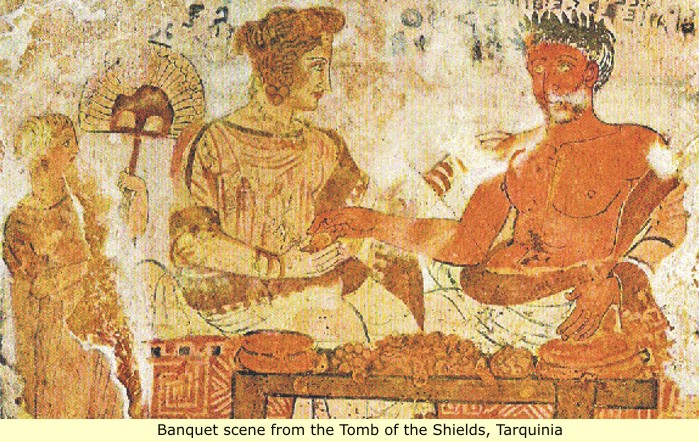
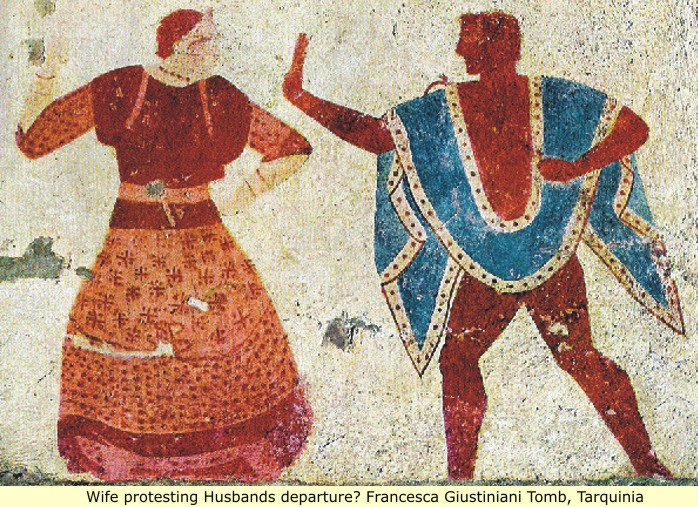
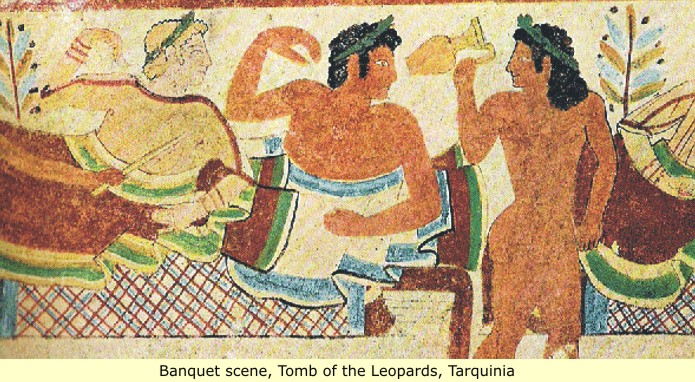
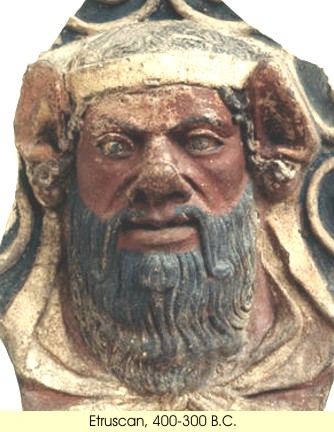
Etruscan Tomb Painting |
 |
later history relates that some Etruscans lived in
the Tuscus vicus, the “Etruscan quarter”, and that there was an
Etruscan line of kings (albeit ones descended from a Greek, Demaratus
the Corinthian) which succeeded kings of Latin and Sabine origin.

Pompeii
The city of Pompeii is a partially buried Roman
town-city near modern Naples in the Italian region of Campania, in the
territory of the comune of Pompei. The name “Pompeii” in Latin is a
second declension plural (Pompeii, -orum). According to Theodor Kraus,
“The root of the word Pompeii would appear to be the Oscan word for the
number five, pompe, which suggests that either the community consisted
of five hamlets or, perhaps, it was settled by a family group (gens
Pompeia).” Along with Herculaneum, its sister city, Pompeii was
destroyed and completely buried during a long catastrophic eruption of
the volcano Mount Vesuvius spanning two days in 79 AD.
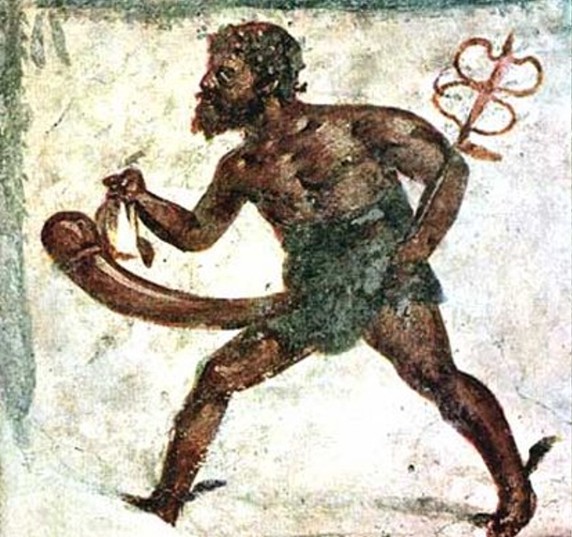
Erotic art in Pompeii and Herculaneum was discovered
in the ancient cities around the bay of Naples (particularly of Pompeii
and Herculaneum) after extensive excavations began in the 18th century.
The city was found to be full of erotic art and frescoes, symbols, and
inscriptions regarded by its excavators as pornographic.
| Click Here for more Pompeii frescoes (Caution: some are of a pornographic nature). Click Here >>> |
Pompeii Wall mural of Mercury/Priapus - between 89 B.C. and 79 A.D. |
 |
The Celts/Gaul's
By the end of the ancient era (B.C.), new invaders
had migrated into western Europe from the east; and pushed the
remaining indigenous peoples south. These new people were mainly Celts,
who had been pushed out of their central European lands by the invading
White Germanic tribes.
By now, the original people had accepted rule of the
conquering Romans, though the acceptance was uneasy. As would be
expected, there was almost constant warfare between these two peoples,
the western Celts known as Gaul's, and the eastern Celts. But their
hatred of each other was less than their hatred of Roman rule. There
were many rebellions against Rome by both groups. As we can see from
Julius Caesar's comments below; Gaul's and Celts were the same people.
As with all the ancient people of Europe, modern racists have sought to
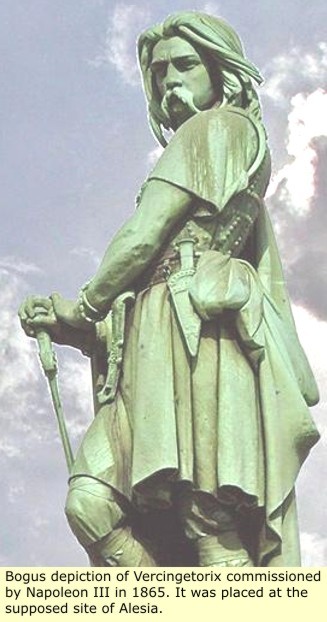
portray them as White people. The famous marble statue "The Dying Gaul"
is a fake, just as is the statue of Vercingetorix that was put up by
Napoleon III in 1865. See photo below.
As
we have said and demonstrated many times: modern Whites have
institutionalized the falsification of history. Even their translations
of ancient texts and historians, cannot be trusted. However, sometimes
a bit from one place, coupled with a bit from another place, yields the
truth.
In "THE HISTORY OF COUNT ZOSIMUS"
circa 500 A.D. Sextus Julius Saturninus (the governor of Syria) is
described as a Moor. In other texts, he is described as a Gaul. Such
interchangeability of description, would not be possible if Gaul's and
Moors were not the same thing: Black People! |
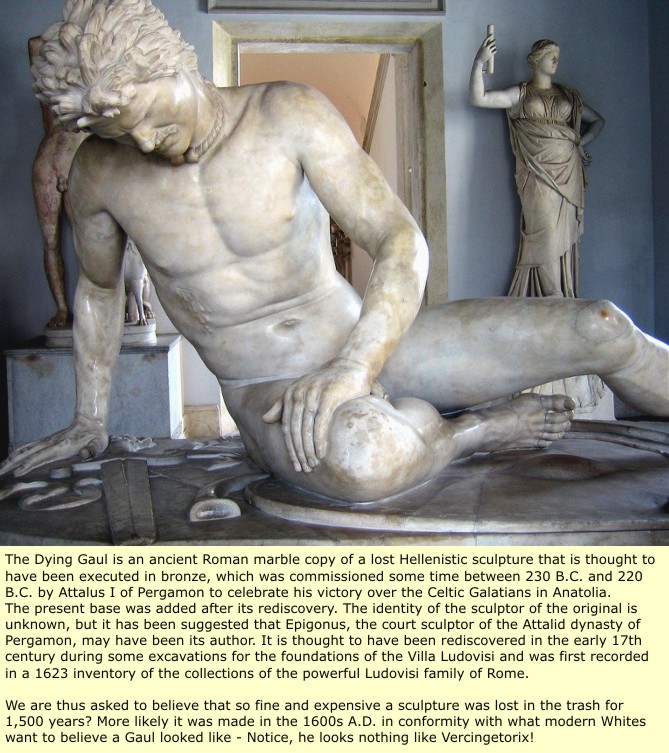 |
Strangely;
the statue "The Dying Gaul" does seem to be in exact conformity with
the "Supposed" description of "Diodorus Siculus" who is said to
describe them as such:
“The Gauls
are tall in body, with rippling muscles... They are always washing
their hair in limewater and pull it back from the forehead... , so that
that they look like Satyrs and Pans; the treatment of their hair makes
it so heavy and coarse that it looks like the mane of a horse... some
of them shave the beard, but others let it grow a little. The nobles
shave their cheeks but let the mustache grow until it covers the mouth".
Click here for more "Supposed" ancient comments and their true worth. |
Julius Caesar, in his book, Commentarii de Bello Gallico - ca. 50 B.C, comments:
All Gaul is divided into three parts, one of which the
Belgae inhabit, the Aquitani another, those who in their own language
are called Celts, in ours Gauls, the third. All these differ from each
other in language, customs and laws. The Garonne River (roughly divides
France and Spain) separates the Gauls from the Aquitani; the River
Marne (runs east and southeast from Paris) and the River Seine separate
them from the Belgae. Of all these, the Belgae are the bravest, because
they are furthest from the civilisation and refinement of (our)
Province, and merchants least frequently resort to them, and import
those things which tend to effeminate the mind; and they are the
nearest to the Germani, who dwell beyond the Rhine (runs north from
eastern Switzerland through Germany and the Netherlands to its
two-pronged outlet on the North Sea), with whom they are continually
waging war.
For which reason the Helvetii also surpass the rest of the
Gaul's in valour, as they contend with the Germani in almost daily
battles, when they either repel them from their own territories, or
themselves wage war on their frontiers. One part of these, which it has
been said that the Gauls occupy, takes its beginning at the River
Rhone; it is bounded by the Garonne River, the Atlantic Ocean, and the
territories of the Belgae; it borders, too, on the side of the Sequani
and the Helvetii, upon the River Rhine, and stretches toward the north.
The Belgae rises from the extreme frontier of Gaul, extend to the lower
part of the River Rhine; and look toward the north and the rising sun.
Aquitania extends from the Garonne to the Pyrenees and to that part of
the Atlantic (Bay of Biscay) which is near Spain: it looks between the
setting of the sun, and the north star.
Note: The Helvetii, refers to a conglomeration of Celtic
tribes formed by the Helvetian's of southern Germany and numbering in
excess of 300,000, who decided to flee the invading White Germanic
tribes.
Vercingetorix
 One
of the last, or perhaps the last, of the original Black civilizations
to be destroyed by the Whites, were the Arverni of southern France.
They were an advanced culture who lived in cities and were wealthy in
gold and silver, (as attested to by the huge booty taken from them by
the Romans).
One
of the last, or perhaps the last, of the original Black civilizations
to be destroyed by the Whites, were the Arverni of southern France.
They were an advanced culture who lived in cities and were wealthy in
gold and silver, (as attested to by the huge booty taken from them by
the Romans).
Their demise came about because of a revolt against Rome by another Black Gaul city called "Carnutes".
In early 52 B.C, Carnutes used the turmoil that accompanied the death
of Publius Clodius Pulcher; a Roman politician, as an opportunity to
rebell; they slaughtered all of the Romans in their territory.
Seeing this, "Vercingetorix" a young nobleman of the
Arvernian capital city of Gergovia, moved to join the rebellion. He was
however rebuffed by the nobles of Gergovia, forcing him to raise an
army in the countryside. He then returned to Gergovia and took the
city, whereupon he was declared king.
In most historical accounts, it is said that
Vercingetorix unified ALL of the Gaul's under his command. In his
campaign against Julius Caesar, Vercingetorix was at first successful,
but over time, the tide began to turn. The end came at the Battle of
Alesia, the capital city of another of the Black Gaul people, the Mandubii.
At Alesia, Vercingetorix made his last stand.
Caesar instead of making a direct assault, surrounded the city with
fortifications in order to starve them out. When Vercingetorix sent for
reinforcements, Caesar built another set of fortifications
to his rear, to hold back the reinforcements. When the reinforcements
arrived, they were of insufficient number to break through Caesars
line. After many loosing battles to break out, Vercingetorix was forced
to mount his horse, ride out and surrender to Caesar.
Vercingetorix was taken prisoner and imprisoned in
the Tullianum in Rome for five years, before being publicly displayed
in Caesar's triumph in 46 B.C, after which he was executed. Gergovia,
Alesia, and all the other Black Gaullic cities were destroyed. It is
estimated that one million persons died in the wars, and another
million were sold into slavery; at the end, Caesar had effected an
unprecedented genocide. The destruction was so complete, that at this
time, the only known evidence of their existence is Roman coins, (such
as the one above), and written Roman accounts.
Ancient references to the Celts/Gauls
The first literary reference to the Celtic people, as
(Κeltoi) is by the Greek historian Hecataeus of Miletus in 517 B.C; he
locates the ''Keltoi'' tribe in Rhenania (West/Southwest Germany). The
next Greek reference to the ''Keltoi'' is by Herodotus in the mid 5th
century B.C. He says that "the river Ister (Danube) begins from the
''Keltoi'' and the city of Pyrene and so runs that it divides Europe in
the midst (now the ''Keltoi'' are outside the Pillars of Heracles (Rock
of Gibraltar) and border upon the Kynesians, who dwell furthest towards
the sunset (West) of all those who have their dwelling in Europe)".
According to Greek mythology, (''Celtus'') was the son
of Heracles and (''Keltine''), the daughter of (''Bretannus''). Celtus
became the eponymous ancestor of Celts. In Latin ''Celta'' came in turn
from Herodotus' word for the Gauls, ''Keltoi''. The Romans used
''Celtae'' to refer to continental Gauls, but apparently not to Insular
Celts. The latter were long divided linguistically into Goidhels and
Brythons, although other research provides a more complex picture.
Another complication is that in the case of the Romans, Gaul (Latin
Gallia) is a historical name used in the context of the Roman Empire in
references to the region of Western Europe approximating present day
France and Belgium, but also sometimes including the Po Valley, western
Switzerland, and the parts of the Netherlands and Germany on the west
bank of the River Rhine.
In the third century B.C, Gauls immigrated from Thrace into
the highlands of central Anatolia (modern Turkey). These people, called
Galatians, later merged with the local population but retained many of
their own traditions. The Galatia became its ruling caste in the 3rd
century B.C. It has been called the "Gallia" of the East, Roman writers
calling its inhabitants Galli. St. Jerome states that as of the fourth
century A.D. their language was similar to that of the Treveri. This
language is in fact German. (The Romans called all people between the
Pyrenees and the Rhine Gauls. The word 'Gaul' didn't imply a specific
language).
The German Celts were great warriors, respected by Greeks
and Romans. They hired themselves out as mercenary soldiers, sometimes
fighting on both sides in the great battles of the times. For years the
chieftains and their war bands ravaged the western half of Asia Minor,
as allies of one or other of the warring princes, without any serious
check, until they sided with the renegade Seleucid prince Antiochus
Hierax, who reigned in Asia Minor. Hierax tried to defeat king Attalus
I of Pergamum (241–197 B.C.), but instead, the hellenised cities united
under his banner, and his armies inflicted several severe defeats upon
them, about 232 forcing them to settle permanently and to confine
themselves to the region to which they had already given their name.
The theme of the ''Dying Gaul'' (a famous statue displayed in Pergamon)
remained a favorite in Hellenistic art for a generation. Their right to
the district was formally recognized. The three Celtic tribes were
settled where they afterwards remained, the Tectosages round Ancyra,
the Tolistobogii round Pessinus, sacred to Cybele, and the Trocmi round
Tavium.
Diodorus Siculus and Strabo both suggest that the Celtic
heartland was in southern France. The former says that the Gauls were
to the north of the Celts but that the Romans referred to both as
Gauls. Before the discoveries at Hallstatt and La Tene, it was
generally considered that the Celtic heartland was southern France, see
Encyclopedia Britannica for 1813.
The Celts also expanded down the Danube river and its
tributaries. One of the most influential tribes, the Scordisci , had
established their capital at Singidunum in 3rd century BC, which is
present-day Belgrade , Serbia . The concentration of hill-forts and
cemeteries shows a density of population in the Tisza valley of
modern-day Vojvodina , Serbia , Hungary and into Ukraine . Expansion
into Romania was however blocked by the Dacians .
Further south, Celts settled in Thrace ( Bulgaria ), which
they ruled for over a century, and Anatolia , where they settled as the
Galatians (see also: Gallic Invasion of Greece ) . Despite their
geographical isolation from the rest of the Celtic world, the Galatians
maintained their Celtic language for at least seven hundred years. St
Jerome , who visited Ancyra (modern-day Ankara ) in 373 AD, likened
their language to that of the Treveri of northern Gaul.
The Boii tribe gave their name to Bohemia , Bologna and
possibly Bavaria , and Celtic artefacts and cemeteries have been
discovered further east in what is now Poland and Slovakia . A celtic
coin ( Biatec ) from Bratislava 's mint is displayed on today's Slovak
5 crown coin.
As there is no archaeological evidence for large scale
invasions in some of the other areas, one current school of thought
holds that Celtic language and culture spread to those areas by contact
rather than invasion. However, the Celtic invasions of Italy and the
expedition in Greece and western Anatolia , are well documented in
Greek and Latin history. There are records of Celtic
mercenaries in Egypt serving the Ptolemies. Thousands were employed in
283-246 B.C. and they were also in service around 186 BC. They
attempted to overthrow Ptolemy II. It had been known
for long time that there was an early Celtic (Lepontic, sometimes
called Cisalpine Celtic) presence in Northern Italy since inscriptions
dated to the sixth century B.C. have been found there.
 |
The site of Golasecca, where the Ticino exits from Lake
Maggiore, was particularly suitable for long-distance exchanges, in
which Golaseccans acted as intermediaries between Etruscans and the
Halstatt culture of Austria, supported on the all-important trade in
salt.
In 391 B.C. Celts "who had their homes beyond the Alps
streamed through the passes in great strength and seized the territory
that lay between the Appennine mountains and the Alps" according to
Diodorus Siculus. The Po Valley and the rest of northern Italy (known
to the Romans as Cisalpine Gaul) was inhabited by Celtic-speakers who
founded cities such as Milan. Later the Roman army was routed at the
battle of Allia and Rome was sacked in 390 B.C. by the Senones. At the battle of Telamon in 225 B.C. a large Celtic army was trapped between two Roman forces and crushed.
The defeat of the combined Samnite, Celtic and Etruscan
alliance by the Romans in the Third Samnite War sounded the beginning
of the end of the Celtic domination in mainland Europe, but it was not
until 192 B.C. that the Roman armies conquered the last remaining
independent Celtic kingdoms in Italy. The Celts
settled much further south of the Po River than many maps show.
Remnants in the town of Doccia, in the province of Emilia-Romagna,
showcase Celtic houses in very good condition dating from about the 4th
century B.C.
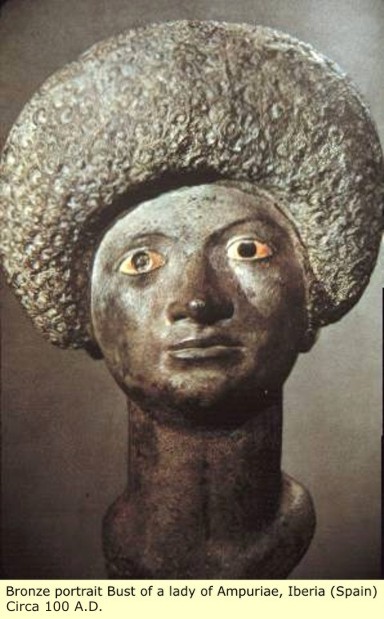 |
Rome would continue to grow, and in time it would come to absorb the classical Greek civilization as well.
As Rome extended its influence and presence throughout the
Mediterranean world, it encountered and absorbed deities and religious
practices of those it encountered. Attempts were made periodically to
suppress religions that seemed to threaten traditional morality and
unity; the Dionysian mysteries provoked unseemly exhibitions of
enthusiasm and wild behaviour, Christianity was superstition, or
atheism, or both; and druidism was thought to employ human sacrifice.
Judaism was merely tolerated.
By late antiquity, numerous foreign cults had gained vast popularity in
the farthest reaches of the Empire, including the mystery cult of the
syncretized Egyptian goddess Isis, and deities of solar monism such as
Mithras and Sol Invictus, found as far north as Roman Britain.
 |
Roman myth is complicated by the early influence of Greek
religion on the Italian peninsula during Rome's protohistory, and by
the later self-conscious imitation of Greek literary models by Roman
authors, who borrowed narratives of Greek deities reinterpreted as the
counterparts of Rome's own pantheon. Rome's early myths and legends
also have a dynamic relationship with Etruscan religion, less
documented than that of the Greeks.
Some examples of Egyptian-to-Greek-to-Roman Mythology
| Egyptian |
Greek |
Roman |
| Amun |
Zeus |
Jupiter ("Zeus pater") |
| Hathor |
Aphrodite |
Venus |
| Khonsu |
Heracles |
Hercules |
| Isis |
Demeter (Io) |
Ceres |
| Osiris |
Dionysus |
Bacchus |
| Horus |
Apollo |
Apollo |
According to Greek myth
Heracles was a divine hero, the son of Zeus and Alcmene, foster son of
Amphitryon and great-grandson (and half-brother) of Perseus. He was the
greatest of the Greek heroes, a paragon of masculinity, the ancestor of
royal clans who claimed to be Heracleidae and a champion of the
Olympian order against chthonic monsters. In Rome and the modern West,
he is known as Hercules, with whom the later Roman Emperors, in
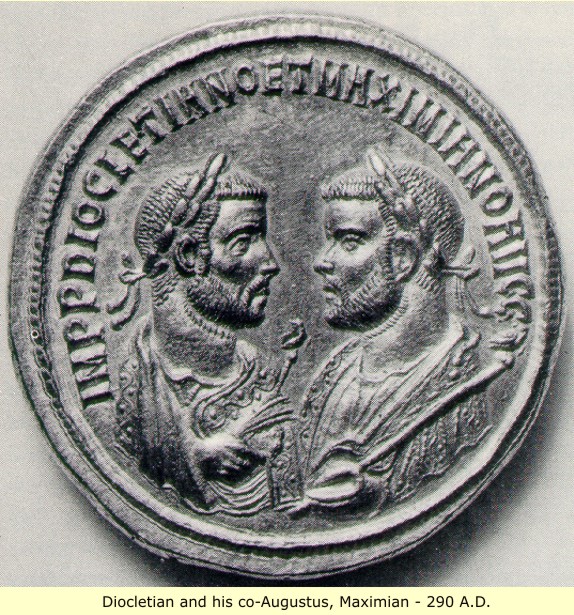
particular Commodus and Maximian, often identified themselves. The
Romans adopted the Greek version of his life and works essentially
unchanged.
Alcmene was born to Electryon, king of Mycenae and a son of
Perseus. Her mother was either Anaxo, daughter of Alcaeus and
Astydamia, or Lysidice, daughter of Pelops and Hippodameia. Hesiod
describes Alcmene as the tallest, most beautiful woman with wisdom
surpassed by no person born of mortal parents. It is said that her face
and dark eyes were as charming as Aphrodite's, and that she honoured
her husband like no woman before her. She was the great-granddaughter
of Zeus.
 |
According to Roman myth, Rome was
founded by Romulus and his twin brother Remus, descendants of Aeneas,
divinely fathered by Hercules on a virgin princess or priestess of
Vesta, who was exposed to die, but saved by a series of miraculous
interventions. They were eventually restored to their royal birthright
but decided to found a new city for themselves and their followers.
When they could not agree on its site, they used augury to seek the
opinion of the gods. Romulus was sent the most favourable signs, and
established a city on the Capitoline Hill, and created its sacred
boundary; Remus insulted the new city and was killed. Romulus named the
new city "Rome" after himself, appointed its first senate and organised
its armies. Faced with a shortage of marriageable young women, he
invented a religious festival, the Consualia, invited the neighbouring
Sabines then kidnapped their daughters.
Each of Rome's legendary or
semi-legendary kings was associated with one or more of the religious
institutions familiar to the later Republic. Tullus Hostilius and Ancus
Marcius devised the fetial priests and their rites. The first
"outsider" Etruscan king, Lucius Tarquinius Priscus founded a
Capitoline temple to Jupiter, Juno and Minerva which served as a later
model for the highest official cult throughout the Roman world. The
benevolent, divinely fathered Servius Tullius established the Latin
League and built its Aventine Temple to Diana, and instituted the
Compitalia to mark his social reforms. His arrogant successor (and
murderer) Tarquinius "the Proud" was expelled, and Rome became a
Republic, run by annually appointed consuls.
Correction to the lies of the White Mans History
Contrary to the racist revisionism of
modern Whites: Rome, like Greece, was a multi-ethnic, multi-racial
society. With many Black or mixed-race kings, Black Popes, Black
Commanders, soldiers, sailors, and of course citizens. (Being mindful
of the White mans propensity for manufacturing fake artifacts to show
Whites, there is no guarantee that the following Busts are accurate).
And of course, much of our current crop of Greek and Roman sculpture
are 18th - 19th century creations. We oftentimes compare Coins with
Busts to ascertain the truth. But unfortunately, Whites are also expert
at creating perfect fake coins, which look like ancient coins, so there
is no guarantee there either. The one saving grace, is that with Black
kings, the fabricators will sometimes leave a hint of Blackness in the
image, rather than making it appear pure White. Thus from that hint, we
can extrapolate.
Trajan
Emperor Trajan (53–117 AD) was Roman
Emperor from 98 A.D. until his death. Officially declared by the senate
as optimus princeps ("the best ruler"), Trajan is remembered as a
successful soldier-emperor who presided over the greatest military
expansion in Roman history, leading the empire to attain its maximum
territorial extent by the time of his death. He is also known for his
philanthropic rule, overseeing extensive public building programs and
implementing social welfare policies, which earned him his enduring
reputation as the second of the Five Good Emperors who presided over an
era of peace and prosperity in the Mediterranean world.
According to the Wiki article: "Plaster
casts of the relief were taken in the nineteenth and twentieth
centuries. After a century of acid pollution, they are now more legible
in some details than the original."
Implied in that statement, is that the
first 1,800 years exposed to the elements did little damage, it was the
last 100 years where the "Real" damage occurred. Therefore these
plaster casts showing the Romans as Albino people are accurate! Of
course those casts are typical Albino falsifications, the same as was
done to almost every piece of historical artifact that they got their
hands on. And as usual, they use a stupid lie, believable to only the
most motivated fools, to cover it up.
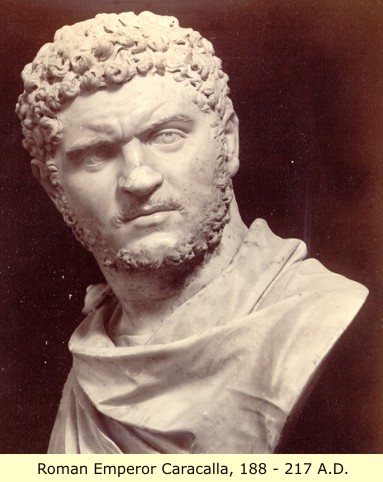
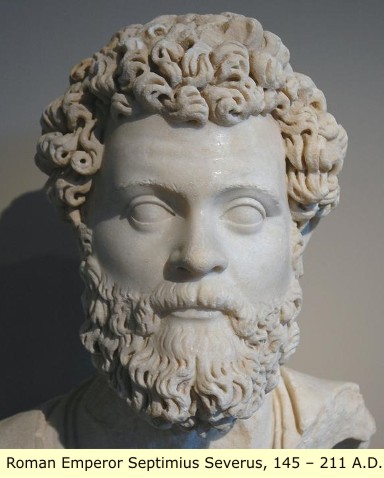
Which Caracalla is the Fake???
From the full text of "The Scriptores historiae augustae
(The Historia Augusta) with an English translation".
https://archive.org/stream/scriptoreshistor01camb/scriptoreshistor01camb_djvu.txt
VIII. Now when the confusion in the state was at
its height, inasmuch as it was made known that there
were three several emperors, Septimius Severus,
Pescennius Niger, and Clodius Albinus, the priest
of the Delphic Apollo was asked which of them as
emperor would prove of most profit to the state,
whereupon, it is said, he gave voice to a Greek verse
as follows :
"Best is the Dark One, the African good, but the
worst is the White One."
PESCENNIUS NIGER VIII. 2 IX.
And in this response it was clearly understood that
Niger was meant by the Dark One, Severus by the
African, and Albinus by the White One. Thereupon
the curiosity of the questioners was aroused, and they
asked who would really win the empire. To this
the priest replied with further verses somewhat as
follows :
"Both of the Black and the White shall the life-blood be shed all untimely;
Empire over the world shall be held by the native of Carthage."
And then when the priest was asked who should suc-
ceed this man, he gave answer, it is said, with another
Greek verse :
"He whom the dwellers above have called by the
surname of Pius."
But this was altogether unintelligible until Bassianus
took the name Antoninus, 1 which was Pius' true
surname. And when finally they asked how long he
should rule, the priest is said to have replied in
Greek as follows :
"Surely with twice ten ships he will cleave the Italian waters,
Only let one of his barques bound o'er the plain of
the sea."
From this they perceived that Severus would round
out twenty years.
417
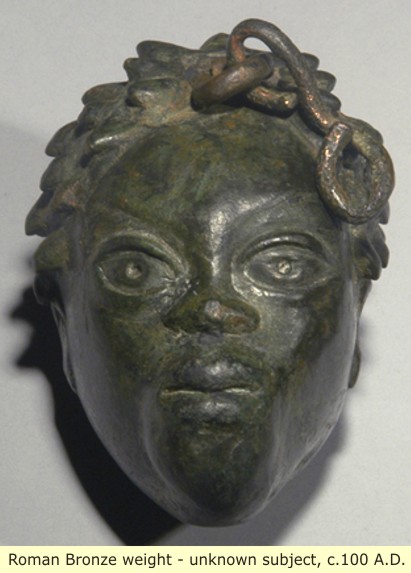
FAKE BRONZES
The Albino people of today, who are invaders from Central Asia in
the modern era: Germanics, Slavs, and Turks; are degenerate fakers of
history, so as to make it appear that they participated in the making
of Western History. To this end they not only lie and make up false
history, they also create fake artifacts of every kind. Here are some
things to look out for with the Bronzes.
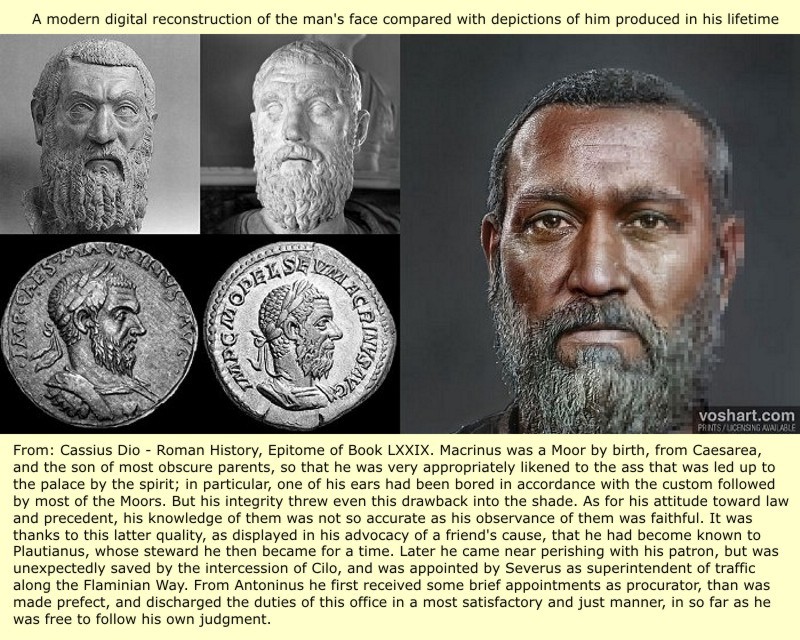
Roman Emperor Macrinus: Reign 217–218
A perfect example of the difference between the White Mans History: and "Real" factual History!
 |
 |
The legend of Saint Maurice and the Theban legion (circa 250 A.D.)
St.
Maurice was an Egyptian from Thebes in Upper Egypt, and General
(primicerius) of the Theban Legion. The Theban legend relates that the
legion, composed entirely of Christians, had been called from Thebes in
southern Egypt, to suppress a revolt of the Bagandae (also Christians)
in Gaul (now Saint-Maurice Switzerland). After victory, the soldiers
were ordered to sacrifice (Bagandae prisoners?) to the gods in
thanksgiving by Roman Emperor Maximian Herculius. But at Maurice’s
urging, they refused. Every tenth soldier was then killed (decimation).
Another order to sacrifice and another refusal caused a second
decimation, and then a general massacre of the Legion. (A Roman legion
was typically composed of perhaps 6,000 soldiers, divided into
"cohorts" and further divided into "centuries").
So
reads the earliest account of their martyrdom, contained in the public
letter of Eucherius, bishop of Lyon (434–450), addressed to his fellow
bishop Salvius. Alternate versions have the legion refusing Maximian's
orders only after discovering a town they had just destroyed had been
inhabited by innocent Christians. And some have Maurice as a captain of
the legion.
This legend and its
historical implications are a wonderful example of the pathetic racism
and outrageous stupidity; of the nonsense Whites try to pass of as
history. Lets deconstruct this nonsense for examination.
First, Maurice is not an Egyptian name.
Now lets look at the logistics of this: If Emperor Maximian was in Rome
at the time he sent for Maurice, it would have taken a minimum of 32
days for the message to reach Maurice. It would have taken Maurice
15-30 days to gather up his 6,000 men and supplies for the journey. On
his 80 day (armies travel slow) 2,000 mile journey to Switzerland he
would have PASSED Rome. All told, 4-5 months have passed: the Bagandae
couldn’t have been much of a threat, and Emperor Maximian must have
been very weak militarily. So then, exactly who were the Roman troops
with the strength to impose a decimation, and then a massacre, on
Maurice’s 6,000 strong Army? Pure nonsense!
Maurice
is said to have the title of "Primicerius". But in the military, the
use of the term was restricted to units associated with the imperial
court, chiefly imperial guards. WHAT WOULD THE IMPERIAL GUARD BE DOING
IN EGYPT? Worst yet logically - PERMANENTLY STATIONED THERE? Pure
nonsense!
Maurice died 287 A.D.
Eucherius, Bishop of Lyon, discovered his story, and wrote about him in
about 450 A.D. THEN about ONE THOUSAND years LATER: Whites SUDDENLY
started making Statues and Paintings of Maurice in MEDIEVAL UNIFORM,
not ROMAN UNIFORM! Pure nonsense!
Why would Whites need to come up with such a ridicules story?
Simple: they needed an explanation for the presence of a prominent
Black man in Europe. There are just too many statues and paintings of
him to hide or destroy, and replace with White depictions of him – as
they usually do. So that ridiculous story was the only way to explain
his presence in Europe. Take note that they were careful to place his
origin in Africa. Because as we all know, that is the only place Blacks
were found in those days – according to the nonsense of Whites.
So
who was Maurice? Owing to the fact that he became the Patron saint of
the Germany based, Holy Roman Empire: He was probably a Celt from what
is now Germany.
But to be clear - the
images of Black knights commonly called Saint Maurice by Albino
historians WERE REAL BLACK KNIGHTS of the medieval period! Research has
revealed that the one above was Ulrich von Hutten (1488 – 1523) who was
a German scholar, poet and reformer. He was an outspoken critic of the
Roman Catholic Church and a bridge between the humanists and the
Lutheran Reformation. He was a leader of the Imperial Knights of the
Holy Roman Empire.
Btw - It appears that in the medieval, ALL knights were Black, as there are few authentic images of Albino knights. |
Roman Citizens
See the Stanford University Study below:
Our timelines and analysis from 2004 have been proven right in 2019.
Bravo to us at Realhistoryww!
 |
Science. 2019 Nov 8.
Ancient Rome:
A genetic crossroads of Europe and the Mediterranean. This is the list of the institutions who took part in the Study.
Program in Biomedical Informatics, Stanford University, Stanford, CA, USA.
Howard Hughes Medical Institute, Stanford University, Stanford, CA, USA.
Department of Genetics, Stanford University, Stanford, CA, USA.
Stanford University, Department of Anthropology, Stanford, CA, USA.
DANTE Laboratory for the study of Diet and Ancient Technology, Sapienza Università di Roma, Rome, Italy.
School of Archaeology, University College Dublin, Dublin, Ireland.
Dipartimento di Biologia Ambientale, Sapienza Università di Roma, Rome, Italy.
Department of Evolutionary Anthropology, University of Vienna, Vienna, Austria.
Dipartimento di Scienze Mediche, Università di Torino, Torino, Italy.
Dipartimento di Biologia, Università di Pisa, Pisa, Italy.
Ministero dei Beni e delle Attività Culturali (retired), Rome, Italy.
CIAS, Department of Life Sciences, University of Coimbra, Coimbra, Portugal.
Soprintendenza Archeologia, belle arti e paesaggio per le province di Sassari e Nuoro, Sassari, Italy.
Dipartimento di Civiltà e Forme del Sapere, Università di Pisa, Pisa, Italy.
Dipartimento di Studi Umanistici, Università degli Studi di Roma Tre, Rome, Italy.
Curatore beni culturali presso la Sovrintendenza Capitolina, Rome, Italy.
Dipartimento di Studi Umanistici Università degli Studi di Roma Tre, Rome, Italy.
Soprintendenza Speciale Archeologia Belle Arti e Paesaggio di Roma, Rome, Italy.
Servizio di Bioarcheologia, Museo delle Civiltà, Rome, Italy.
Christian and Medieval Archaeology, University of Rome Tor Vergata, Rome, Italy.
Università della Tuscia, DISUCOM Dipartimento di Scienze Umanistiche, della Comunicazione e del Turismo, Viterbo, Italy.
Aix-Marseille University, Marseille, France.
Soprintendenza speciale Archeologia Belle arti e paesaggio di Roma, Rome, Italy.
University College Dublin, Dublin, Ireland.
Musei Vaticani, Reparto Antichità Greche e Romane, Vatican City.
Dipartimento di Archeologia, Università di Foggia, Foggia, Italy.
SABAP-LAZ Ministero dei Beni e delle Attività Culturali, Rome, Italy.
Department of Biology, Stanford University, Stanford, CA, USA.
Dipartimento di Biologia Ambientale, Sapienza Università di Roma, Rome,
Italy. pritch@stanford.edu ron.pinhasi@univie.ac.at
alfredo.coppa@uniroma1.it.
Department of Evolutionary Anthropology, University of Vienna, Vienna,
Austria. pritch@stanford.edu ron.pinhasi@univie.ac.at
alfredo.coppa@uniroma1.it.
Howard Hughes Medical Institute, Stanford University, Stanford, CA,
USA. pritch@stanford.edu ron.pinhasi@univie.ac.at
alfredo.coppa@uniroma1.it.
|
The next wave of Whites/Albinos from Central Asia
At the turn of the "modern Era" (year "0" A.D.) The Mongol Huns chased the Dravidian Albino Germanic's and Slav's out of Asia.
We have no good single source to explain the expulsion of the Albino Germanic's and Slav's from Central Asia.
Consequently several sources must be referenced:
See: The Roman historian Jordanes, his book on the history of the Goths, called "Getica" (circa 551 A.D.)
See: The Byzantine historian Zosimus (491-518), his book "Historia Nova"
See: The historian Priscus (circa 450 A.D.)
See: Ammianus Marcellinus (325–391) a fourth-century Roman historian.
Note: excerpts from those sources are in the "Eastern Europe" page (Main menu).
Six hundred years later, another group of Mongols chased the last of the Dravidian Albinos out of Asia - The Turks.
We do not have a good single source
for the expulsion of the Germanic's and Slav's, but the following is a
good, not overly complicated, source for the Turks.
The Turks
Click here to visit this page at Calgary University
Note;
the University of Calgary (Canada), has disabled all links from
Realhistoryww. Clearly they don’t like how we use their information.
Which is good, because it destroys the myth of nonracist Canadians. All
Albinos (Everywhere) of any wealth and/or Power, or aspires to any
wealth and power, have a vested interest in maintaining the fantasy
history of Albinos (which says they were everyone, everywhere –
Egyptians, Hebrews, Persians, etc.). And the social structure that says
Albinos are supposed to be on top. All this because Albinos ganged
together, gathered up all the best weapons in the world, and proceeded
to topple Black Empires just 400 years ago. (The Thirty Years War on
the Continent, and the British Civil Wars). And now when we point out
that Hebrews couldn’t be White, they say Jesus couldn’t be Black – he
was “Mediterranean”. You know they always want to talk about the
“Olive” complexioned “Mediterranean’s”. Note this exchange:
| Rarely
do we have an opportunity to praise young Black men, but this one does
not seem to have had his mind turned into mush by rap culture, ala
Kanye, Nick, and millions more. It seems that he sincerely wants to
know and understand more. |
Back
to point: No surprise, when you knock down one Albino lie, they raise
another. Actually those “Olive” complexioned people they speak of, are
the Mulattoes of Albinos of the Vandal and Alan subtribes of the
Visigoths (western Goths) of the Germanic super tribe of Central Asian
Albinos who invaded North Africa in 429 A.D. The other Mulattos are
those of Turks who the Black Arabs foolishly used as Slave Soldiers,
and who overthrew them, and took over their religion in 1055 A.D. The
others are Mulattoes from the French invasion and colonization in 1830,
and the Italian invasion and colonization of 1911. Take away those
Albinos and their Mulattoes and it’s all Black, we call them as a group
- Berbers.
To get to the Calgary University information:
Google “The End of Europe's Middle Ages, Calgary”
Click the following Search Results
www.faculty.umb.edu › Courses › Philosophers › End
End of Europe's Middle Ages - Home Page
Click “Begin the Tutorial”
Click “Ottoman Turks” then Click “Origins of the Ottoman Empire”.
|
The Germanic's and Slav's
The point has been made in these pages, many times,
that modern Whites are derived from Central Asian Albinos, who invaded
Europe in the early modern era. And that modern Whites have little
relationship to Ancient Europeans, Greeks or Romans. To make this
point, we quote "Cornelius Tacitus" (who was likely a Celt, 56 -
117 A.D.) He was a senator, and a historian of the Roman Empire: We
quote from his book, The Germania (Latin: De Origine et situ
Germanorum, literally Concerning the Origin and Situation of the
Germanics).
|
Cornelius Tacitus, Germany and its Tribes
The
Germans themselves I should regard as aboriginal, and not mixed at all
with other races through immigration or intercourse. For, in former
times, it was not by land but on shipboard that those who sought to
emigrate would arrive; and the boundless and, so to speak, hostile
ocean beyond us (the north Sea), is seldom entered by a sail from our
world. And, beside the perils of rough and unknown seas, who would
leave Asia, or Africa, or Italy for Germany, with its wild country, its
inclement skies, its sullen manners and aspect, unless indeed it were
his home? In their ancient songs, their only way of remembering or
recording the past, they celebrate an earth-born god, Tuisco, and his
son Mannus, as the origin of their race, as their founders.
The
name Germany, on the other hand, they say, is modern and newly
introduced, from the fact that the tribes which first crossed the Rhine
and drove out the Gauls, and are now called Tungrians, were then called
Germans. Thus what was the name of a tribe, and not of a race,
gradually prevailed, till all called themselves by this self-invented
name of Germans, which the conquerors had first employed to inspire
terror.
For my own part, I agree with those
who think that the tribes of Germany are free from all taint of
inter-marriages with foreign nations, and that they appear as a
distinct, unmixed race, like none but themselves. Hence, too, the same
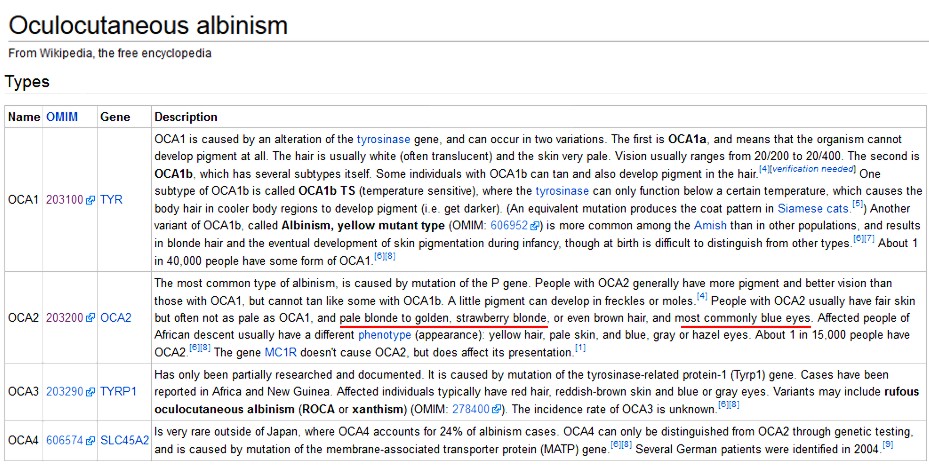
physical peculiarities throughout so vast a population. All have fierce
blue eyes, red hair, (classic Albinism), huge frames, fit only for a
sudden exertion. They are less able to bear laborious work. Heat and
thirst they cannot in the least endure; to cold and hunger their
climate and their soil inure them.
|
Decline of the Roman Empire
When Constantine became the sole Roman Emperor in
324, Christianity became the leading religion of the empire. After the
death of Constantine in 337, two of his sons, Constantius II and
Constans took over the leadership of the empire. Constans, ruler of the
western provinces, was like his father, a Christian. In 341, he decreed
that all pre-Christian Graeco Roman worship and sacrifice should cease;
warning those who still persisted in practising ancient Graeco-Roman
polytheism with the threat of the death penalty.
Lay Christians took advantage of new anti-Graeco-Roman
polytheism laws by destroying and plundering the temples. Temples that
survived were converted into Christian churches: the Pantheon is the
most notable example, having once been a temple to all the gods and
later, removing the statues of the so-called 'pagan' gods and replacing
them with Christian saints, becoming a church in honor of their own one
god. Many of the buildings in the Roman Forum were similarly converted,
preserving the structures if not their original intent.
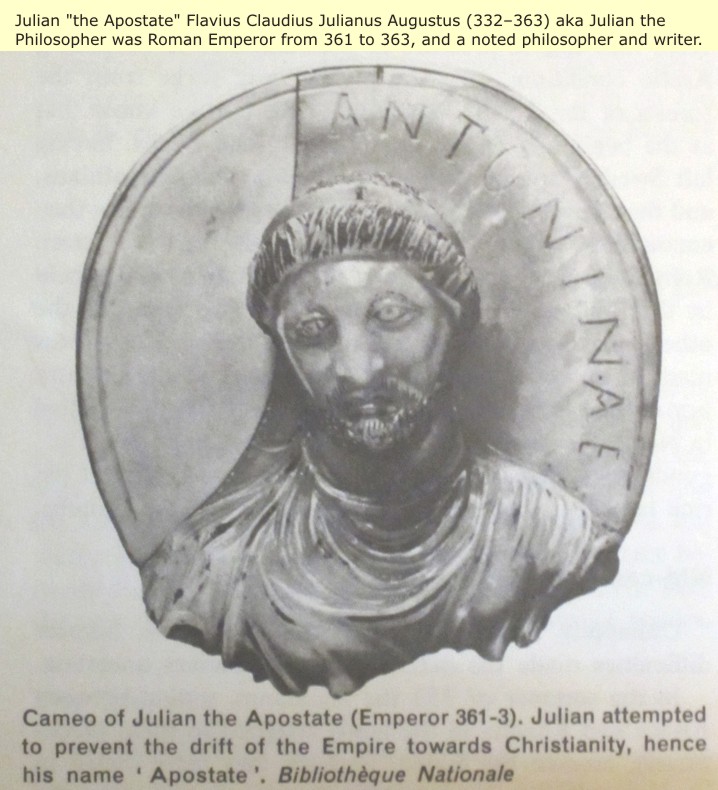
Later on, the emperor Julian the Apostate attempted to
reverse the process of Christianization and bring back the native forms
of polytheism, but his death in Persia caused the empire to once again
fall under the power of Christian control, this time permanently.
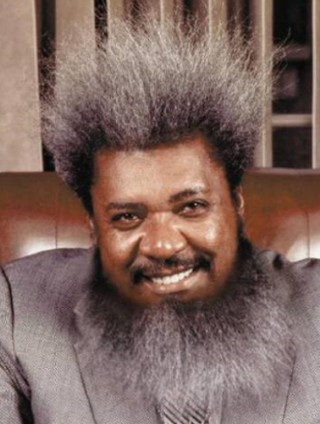
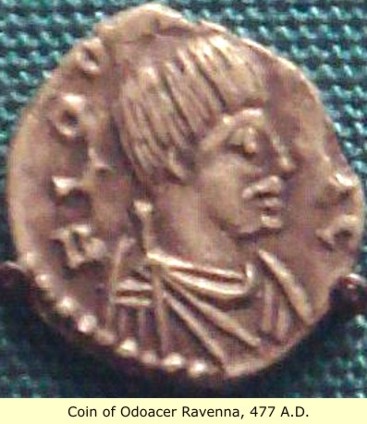
The decline of the Roman Empire was a slow process,
which occurred over a period of over 350 years. Beginning at about 100
A.D. and culminating on September 4, 476, when Romulus Augustus, the
last Emperor of the Western Roman Empire, was deposed by Odoacer, a
Germanic chieftain.
Though by appearance, Odoacer was probably a
Celt/Gaul: they being the original people of Germany. With the actual
true (White) Germaic's following. Note that Odoacers hair stands
straight up, White peoples hair cannot do that naturally. (Laugh at the
example if you will, but the point still holds true, also note
Vercingetorix's hair).
Today's descendants of the Germanic, Slav, and Turk
Albinos from Central Asia, have so confused and obfuscated history with
their false accounts and fake artifacts, that it is impossible at this
time, to say definitively what the hierarchy of ancient western Rome
was like, (from artifacts, we know that the Eastern Empire was ruled by
Blacks). What little that we do have of artifactual evidence, suggests
that like the Eastern Empire, the Western Empire was also ruled by
Blacks. This painting of unknown provenance and period, may well be
fanciful, but we feel that it accurately depicts the hierarchy of the
Western Roman Empire.
Charlemagne
Rome's replacement "The Holy Roman Empire" was a
realm that existed for about a millennium in West and Central Europe:
ruled by a Holy Roman Emperor. Charlemagne (meaning Charles the Great;
possibly 742 – 28 January 814 - King of the Franks). He expanded the
Frankish kingdom (France) into an empire that incorporated much of
Western and Central Europe. During his reign, he conquered Italy and
was crowned Imperator Augustus by Pope Leo III on 25 December 800 A.D.
This temporarily made him a rival of the Byzantine Emperor in
Constantinople. His rule is also associated with the Carolingian
Renaissance, a revival of art, religion, and culture through the medium
of the Catholic Church. Through his foreign conquests and internal
reforms, Charlemagne helped define both Western Europe and the Middle
Ages.
He is numbered as Charles I in the regnal lists of
Germany (where he is known as Karl der Große), the Holy Roman Empire,
and France. He was crowned Emperor of the Romans in 800 A.D. and was
then the forerunner of the Holy Roman Emperors, largely because he had
inaugurated the tradition of imperial coronation by the Pope of the
Catholic Church. This continued as a significant institution in the
Holy Roman Empire until the 16th century. In a decree following the
1512 Diet of Cologne, the name was officially changed to Holy Roman
Empire of the German Nation. Charlemagne's policy of "renovatio
Romanorum imperii" (reviving the Roman Empire) remained at least in
theory, as the official position of the Empire until its end in 1806.
Was Charlemagne a Black man? At this point there is
no way to know - and that information is not likely to be forthcoming.
But it appears that contrary to what Whites say, the Franks were
probably a "Native" NOT Germanic people. As such, Charlemagne would
have indeed, probably been a Black man. But because Whites have so
interwoven European history with lies, there are really no safe
assumptions, and no safe place to start.
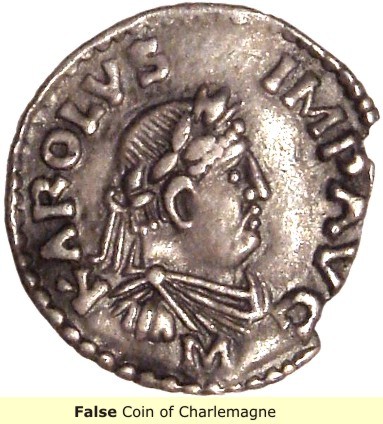
As to the false Coin: In 1861, Charlemagne's tomb was
opened by scientists who reconstructed his skeleton and estimated it to
be measured 74.9 inches (190 centimeters). A modern study based on the
dimensions of his tibia estimate his height as 1.84 m. This puts him in
the 99th percentile of tall people of his period given that average
male height of his time was 1.69 m. The width of the bone suggest he
was gracile not robust in body build. So at least one thing we know for
sure: that COIN image is NOT of Charlemagne. But what's new, Whites
routinely use fake artifacts to bolster their lies. Charlemagne was
actively and personally involved in wars into distant lands throughout
his 46 year reign - Fat guys don't get around like that! So whoever
decided to falsely use that coin, didn't even know the history of the
man.
But there is no ambiguity about Charlemagne's successor as Holy Roman Emperor: Otto I, he was most certainly a Black man!
Holy Roman Emperor: Otto I
Note: Otto I is the Black Freising King on the
"Coat of Arms" of the current Pope: Pope Benedict XVI, who is of German
extraction.
 Otto
I, the Great (23 November 912 in Wallhausen – 7 May 973 in Memleben),
son of Henry I the Fowler and Matilda of Ringelheim, was Duke of
Saxony, King of Germany, King of Italy, and "the first of the Germans
to be called the emperor of Italy" according to Arnulf of Milan. While
Charlemagne had been crowned emperor in 800, his empire had been
divided amongst his grandsons, and following the assassination of
Berengar of Friuli in 924, the imperial title had lain vacant for
nearly forty years. Otto succeeded his father as king of the Saxons in
936, on February 2, 962, Otto was crowned Emperor of what would later
become the Holy Roman Empire.
Otto
I, the Great (23 November 912 in Wallhausen – 7 May 973 in Memleben),
son of Henry I the Fowler and Matilda of Ringelheim, was Duke of
Saxony, King of Germany, King of Italy, and "the first of the Germans
to be called the emperor of Italy" according to Arnulf of Milan. While
Charlemagne had been crowned emperor in 800, his empire had been
divided amongst his grandsons, and following the assassination of
Berengar of Friuli in 924, the imperial title had lain vacant for
nearly forty years. Otto succeeded his father as king of the Saxons in
936, on February 2, 962, Otto was crowned Emperor of what would later
become the Holy Roman Empire.
Edith of England (910 – 26 January 946), also spelt Eadgyth
or Ædgyth, was the daughter of Edward the Elder, King of England and
Ælfflæd. Her paternal grandparents were Alfred the Great, King of
Wessex, and his wife Ealhswith. (The obvious corollary is that Edith
came from a long line of Black British royalty).
| Click Here for more on Black British Royalty: Click >>> |
In order to seal an alliance between two Saxon kingdoms, her
half-brother, King Athelstan of England, sent two of his sisters to
Germany, instructing the Duke of Saxony (later Otto I, Holy Roman
Emperor) to choose whichever one pleased him best. Otto chose Edith and
married her in 929. The remaining sister Algiva or Adiva was married to
a "king near the Jupiter mountains" (the Alps). The precise identity of
this sister is debated. She may have been Eadgifu of England, who
married King Charles III of France, or another sister otherwise unknown
to history.
As queen, Eadgyth undertook the usual state duties of a
Queen: when she turns up in the records it is generally in connection
with gifts to the state's favoured monasteries or memorials to female
holy women and saints. In this respect she seems to have been more
diligent than her now widowed and subsequently sainted mother-in-law
Queen Matilda whose own charitable activities only achieve a single
recorded mention from the period of Eadgyth's time as queen. There was
probably rivalry between the Benedictine Monastery of St Maurice
founded at Magdeburg by Otto and Eadgyth in 937, a year after coming to
the throne and Matilda's foundation at Quedlinburg Abbey, intended by
her as a memorial to her husband, the late King Henry I. Like her
brother, Athelstan, Edith was devoted to the cult of Saint Oswald and
was instrumental in introducing this cult into Germany after her
marriage to the emperor. Her lasting influence may have caused certain
monasteries and churches in Saxony to be dedicated to this saint.
Eadgyth died at a relatively young age. Her
tomb is located in the Cathedral of Magdeburg, Germany. A lead coffin
inside a stone sarcophagus with her name on it was found and opened in
2008 by archaeologists during work on the building. An inscription
recorded that it was the body of Eadgyth, reburied in 1510. It was
examined in 2009, then brought to Bristol, England, for tests in 2010.
Professor Mark Horton of Bristol University said that "this may prove
to be the oldest complete remains of an English royal."
Edith and Otto's children were: 1. Liutgarde, married Conrad the Red,
2. Liudolf, Duke of Swabia (930-September 6 957)
Click Here for medieval Christian frescos from northern Greece: Click >>> |
Click Here for histories and images of some of the first Christians: Click >>> |
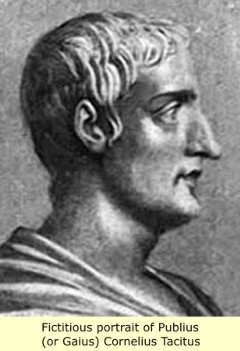 From
the words of Cornelius Tacitus, and others: Herodotus, Xenophanes, it
is clear that the ancient Romans and Greeks did NOT look like the
White, Blue-eyed, Red haired Germaic's. And of course from modern
studies, we know that aside from being Germaic, the modern populations
also have significant Turk admixture. But just WHO were these White
Germanic invaders? From
the words of Cornelius Tacitus, and others: Herodotus, Xenophanes, it
is clear that the ancient Romans and Greeks did NOT look like the
White, Blue-eyed, Red haired Germaic's. And of course from modern
studies, we know that aside from being Germaic, the modern populations
also have significant Turk admixture. But just WHO were these White
Germanic invaders?
Major
Germanic Peoples: English, Norwegians, Danes/Denmark, Franks/France,
Goths/Spain, Saxons, Finni, Flemish, Icelanders, Frisians, Gall,
Batavians, Calucones, Dutch, Helisii, Ingvaeones (North Sea Germans),
Irminones (Elbe Germans), Istvaeones (Rhine-Weser Germans), Jutes,
Juthungi, Lombards or Langobardes, Ostrogoths, Teutons, Vagoth,
Vandals, Vangiones, Vargiones, Varini, Varisci, Vinoviloth, Viruni,
Visburgi, Visigoths, Vispi.
(Pretty much all of Modern Europe, isn't it).
|
The European Dark Ages
The "Dark Ages" is a term referring to the perceived period
of both cultural and economic deterioration as well as disruption that
took place in Western Europe following the decline of the Roman Empire:
the phrase was first recorded in 1602. Originally, the term
characterized the bulk of the Middle Ages as a period of intellectual
darkness between the extinguishing of the light of Rome, and the
Renaissance or rebirth from the 14th century onwards.
The concept of a Dark Age originated with the Italian
scholar Petrarch (Francesco Petrarca) in the 1330s, and was originally
intended as a sweeping criticism of the character of Late Latin
literature. Petrarch regarded the post-Roman centuries as "dark"
compared to the light of classical antiquity. Later historians expanded
the term to refer to the transitional period between Roman times and
the High Middle Ages, including not only the lack of Latin literature,
but also a lack of contemporary written history, general demographic
decline, limited building activity and material cultural achievements
in general. Popular culture has further expanded on the term as a
vehicle to depict the Middle Ages as a time of backwardness, extending
its pejorative use and expanding its scope.
The Problem!
Just as the Hellenes and Romans were an illiterate nomadic
people, when they first entered Black Europe over a thousand years
earlier. And just as they struggled to learn the ways and technologies
of civilization, so it was also for the Germanic's. And just as before,
there was a "Dark Ages" of regression, while they learned the ways of
civilization.
But unlike the Hellenes, the Germanic's did NOT attribute
their inheritance of civilization to the rightful benefactor (albeit an
unwilling benefactor), the Black ancients. They perhaps ignorantly,
perhaps racistly, attributed it to the Classical Greeks. Though
somewhat eclipsed by technology today, the sense of a legacy was
strongly felt by post-Renaissance European elite, who saw themselves as
the spiritual heirs of Greece. As late as 1939 Will Durant could write
"excepting machinery, there is hardly anything secular in our culture
that does not come from Greece," and conversely "there is nothing in
Greek civilization that doesn't illuminate our own".
Had it remained just a sense of debt to the ancient Greeks,
the world would have been a much better place today. But it did not,
the Germanic's not having any history of their own, decided to make one
up, with the Hellenes and Romans as the base. They decided that they
were the descendants of the Hellenes and Romans, but since they were
White skinned, Blue-eyed, Blond haired, and the Hellenes and Romans
were not. They decided to create statues and other artifacts depicting
Hellenes and Romans as such.
Then, perhaps as a "Snowballing" effect, they decided that
ALL ancient civilizations must be White like them also: soon White
Egyptian artifacts began to appear (exclusive of the legitimate Greek
and Roman period type). Then ancient Europeans, Mesopotamian's,
Hebrews, and Persians became White. Then with their success in wars of
expansion and colonization, they decided that because they were so
great, then everyone previous of any consequence must also have been
White - and the requisite artifacts thus appeared. (All this from a
people who just a few hundred years earlier, couldn't figure out why it
was a bad idea to shit in the same places that you took your drinking
water from).
Under the heading "Better late than Never"
mainstream White media, in the form of "The Guardian" known until 1959
as The Manchester Guardian (founded 1821), a British national daily
newspaper: for reasons unknown, has decided to acknowledge the obvious:
Greece and Rome were NOT Albino societies or cultures, and decided to
do a newsstory on it, Thursday 11 July 2013.
The headline: Ancient Greece, the Middle East and an ancient cultural internet
The ancient Greek world is being recast from an isolated entity to one of many hybrid cultures in Africa and in the East
Click here for link to the original newsstory
(Note: The pictures associated with the newsstory are often incorrect).
The Turks
The next, and final wave of White Asians, the Turks,
continued their migrations into Europe, North Africa, and Western Asia,
well into the modern era. And just like the previous Whites, they were
bent on conquest. And just like the Germanic's, having no history, they
decided to create a place in history for themselves. Thus they became
the descendants of the Berbers, Egyptians, Mesopotamian's, Persians,
Phoenicians, and Arabs - and oh yes, the Hebrews, vis-à-vis the Khazar
Turks.
Interestingly though, Turks in Turkey proper, are taught
something quite different. In the Turkish Nations creation myth (a
modern country with a creation myth?). From tomes: a large or scholarly
book, produced by the Ministry of Education in 1932; Turks are taught
that at the dawn of history, their ancestors, led by a mythical gray
she-wolf, started migrating outwards from the heart of Central Asia. As
the numbers of their people swelled and droughts dried the traditional
grazing lands on the steppe, some of them, they are told, even crossed
the Bering Strait into the Americas. Presumably becoming the American
Indians. In his later years, Mustafa Kemal Ataturk (the founder of the
modern Turkey nation), himself adopted a creed known as the "Sun
Theory", which depicts the Turks as the mother race of all mankind, and
proposed that all human languages are descendants of one proto-Turkic
primal language. (Note: though the theory may sound outlandish, there
is justification, and anecdotal evidence, for believing that at least
the "North American Indian" was a Turk mulatto).
Mustafa Kemal Ataturk, taught that the Turks discovered the
America's fifty years before Christopher Columbus. The proof of this
assertion, he told journalist, was that the Turks and Caicos Islands in
the Caribbean, had obviously been named by Turks, especially since
their capital was called Grand Turk. (The islands are in fact named
after a fez-shaped cactus).
Under the heading "This is Backwards": Just
as Albino media seems reconciled to the fact that the truth of Greece
and Rome will get out. They seem determined to continue to pass-off the
Turks and Turk mulattoes, of North Africa, Arabia, Middle-East, and
West Asia, as original people: rather than the recent invaders that
they are. Obviously this serves to continue the myth that the original
people of those areas were other than Black Africans. But unfortunately
for those purveyors of falsehood, many 19th century writers had already
acknowledged, and wrote about the Turk conquest and rule over parts of
Europe, Arabia, the Middle East, North Africa, etc. Needless to say,
the primary subject matter of these books is of no interest to us, and
may in fact be contrary to our position.
Prince Michael's Kingdom: A Review of the Epochs of Creation, and of the Bible History by Charles R. Harvey (1880) Link to book
The Christian Observer [Afterw.] the Christian Observer and Advocate by Anonymous Author (1867) Link to Book
A chronological, geographical and historical view of the ancient and modern world, from the earliest period to 1850 (1851) Link to Book
The Christian guardian - and Church of England magazine (1833) Link to Book
The Worlds Greatest Painter:
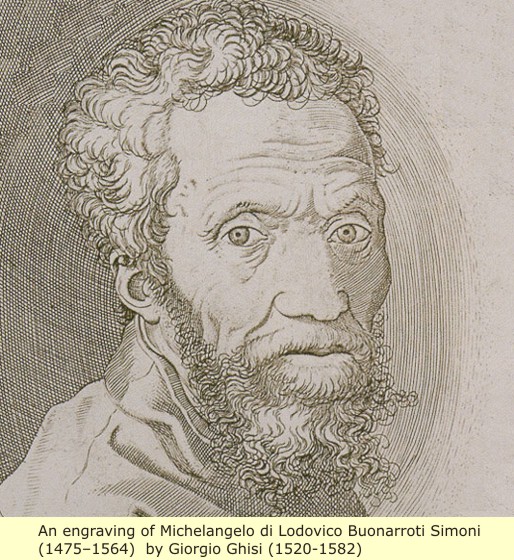
Michelangelo di Lodovico Buonarroti Simoni - 6 March 1475 – 18 February 1564.
Michelangelo left no documented self-portrait. The often
fanciful portraits, said to have been done by his contemporary artists,
are of course not accurate, or done by his contemporaries, except the
Ghisi engraving. His contemporaries would have known exactly what he
looked like, and there would not have been such variation in his
appearance as depicted in the various portraits that now exist ( Whites
do lie about these things). The description by the 16th century painter
and art historian Giorgio Vasari is all there is. It seems that in
reality, Michelangelo wasn't exactly a refined man, according to
Vasari, "he wore stockings of dogskin constantly for months together,
so that when he took them off the skin of the leg often came away with
them."
The only known self-portrait of the artist, is scratched
into the margin of one of Michelangelo's poems. It is said that the
image is a sort of caricature of the artist, done during the years he
was painting the frescoes of the Sistine Chapel in Rome. The drawing is
described as showing him with cartoon-like features including huge eyes
and hair standing straight up on ends." Interestingly, no photograph of
the drawing seems to exist.
Regardless, the anecdotal information like
Ghisi's engraving, clearly indicates that Michelangelo was a Black man.
And it is the Black man Michelangelo who shows us what a "Slave" really
looked like in past times. Not surprisingly, it is completely opposite
to what the Albino people say.
Wiki:
The Dying Slave is a sculpture by the Italian Renaissance artist
Michelangelo. Created between 1513 and 1515, it was to serve with
another figure, the Rebellious Slave, at the tomb of Pope Julius II. It
is a marble figure 2.15 metres (7' 4") in height, and is held at the
Louvre, Paris. |
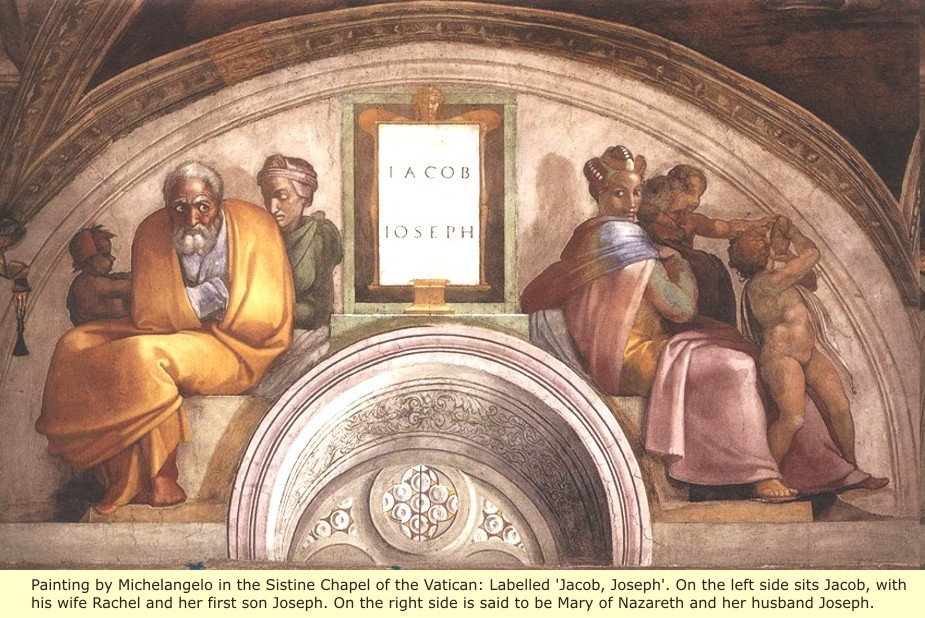
A painter must paint that which the customer demands.
But the problem of reconciling the incongruities of the scene above -
Black Parents, White Children - seems to be reflected in the faces of
Jacob and Michelangelo.
Who are these modern White (Albino) Europeans?
Through means and methods that we can still only guess at, these least
of all humans, both numerically and otherwise, had managed to gain
control over much of the world. Though that control is now waning,
many, especially the uneducated, are still dependent on them to tell us
exactly who they are. But even this simple task is complicated by the
fact that these people once claimed to be native to Europe, and today,
the uneducated still do. Therefore their researchers and educators tend
to lie and double-talk as relates to the origins of the European
Albinos.
The Germanics:
This is particularly true of the Germanics: The basic ethnic stock in
the composition of the modern peoples of Sweden, Norway, Denmark,
Iceland, Germany, Austria, Switzerland, Northern Italy, the
Netherlands, Belgium, Luxembourg, North and central France, Lowland
Scotland, and England. When we go to the Encyclopedia to look-up
Germanics, we are greeted with pure nonsense as to their origins. But
when we use a lateral approach, such as looking up their former
tormentors, the Huns, then we see more truthful entries.
Encyclopedia:
The Huns
The Huns occupied North China from the 3rd century until 581. Having swept across Asia, they
invaded the lower Volga valley (Russia - see map) c.372 and advanced
westward, pushing the Germanic Ostrogoths and Visigoths before them
and thus precipitating the great waves of migrations (into Europe) that
destroyed the Roman Empire and changed the face of Europe.
Bibliography
See T. Hodgkin, Italy and Her Invaders, Vol. I (rev. ed. 1892, repr.
1967); W. M. McGovern, Early Empires of Central Asia (1939); E. A.
Thompson, A History of Attila and the Huns (1948); F. Teggart, China
and Rome (1969, repr. 1983); J. D. Maenchen-Helfen, The World of the
Huns (1973).
The Slavs
The Slavs are the largest ethnic and linguistic group of peoples in
Europe belonging to the Indo-European linguistic family. It is
estimated that the Slavs number over 300 million in the world. They are
usually classified in three main divisions. The West Slavs include the
Poles, the Czechs, the Slovaks, and the Wends (also known as Lusatians)
and other small groups in East Germany. The South Slavs include the
Serbs, the Croats, the Slovenes, the Macedonians, the Montenegrins, the
Bosniaks, and the Bulgars. The East Slavs, the largest group, include
the Great Russians, Ukrainians, and Belorussians (or White Russians).
Origins
Ethnically the Slavs possess little unity, for they have mixed for
centuries with other peoples, including Turko-Tatars, Finnic peoples,
Germans, Mongols, Greeks, and Illyrian tribes. The Bulgarians are not
of Slavic origin. The obscure beginnings of the Slavs have given rise
to several theories, all of which include as a possible place of origin the area of the Polesie marshes in Galicia (region spanning southeastern Poland and western Ukraine ).
The ancestors of the Slavs were Neolithic tribes who occupied this
territory a few centuries before the Christian era. (The Albinos will
not venture into their origins before this time, as that would surely
lead to Central Asia and Albinohood).
Bibliography
See K. Jazdzewski, Atlas to the Prehistory of the Slavs (tr., 2 vol.,
1948—49); J. S. Roucek, ed., Slavonic Encyclopaedia (4 vol., 1949,
repr. 1969); F. Dvornik, The Slavs (1956) and The Slavs in European
History and Civilization (1962, repr. 1986); S. H. Cross, Slavic
Civilization through the Ages (1963); A. P. Vlasto, The Entry of the
Slav
s into Christendom (1970); M. A. Gimbutas, The Slavs (1971).
Turks
Because the Turks are now a predominately Mulatto people, no efforts
are made to hide their origins. Therefore all Albino sources will
freely admit that Turks were an Asian People.
Greeks and Romans
Greeks and Romans were a Black and Mulatto people comprised of the
Original Black Europeans and the first Central Asian Albinos to reach
Europe, circa 1200 B.C. Modern Albinos have nothing to do with these
people, as they were the victims of the marauding Albinos from Central
Asia. But modern Albinos do falsely claim that the Hellenes of Greece
were Albinos. The Greek historian Herodotus clearly explains the
Hellenes were only "partly Albino" thusly:.
Herodotus (circa 440 B.C.)
Book 1 – CLIO
[1.58]
The Hellenic race has never, since its first origin, changed its
speech. This at least seems evident to me. It was a branch of the
Pelasgic, which separated from the main body, and at first was scanty
in numbers and of little power; but it gradually spread and increased
to a multitude of nations, chiefly by the voluntary entrance into its ranks of numerous tribes of barbarians. |
Writing Blacks out-of-History
One of the great successes's of the Albino people,
has been their success in writing Blacks out-of-History. As can clearly
be seen from the preceding artifacts, not only are Blacks the original
settlers of Europe, but all throughout history, at every step, they
have been the preeminent people. Example: Greeks in the person of
Alexander, took Egypt from the Persians who had conquered it, and ruled
Egypt from 332 to 30 B.C. The Romans took it from them, and ruled from
30 B.C. to 640 A.D. at which point the Arabs took it from them. In
Egypt, the Europeans buried their dead in Egyptian style, but in
cemeteries exclusively for them. Typical of these European cemeteries
are those at the Fayum/Faiyum Oasis, 62 miles southwest of Cairo. The
Mummy Portraits at Fayum demonstrate that Greeks and Romans were Blacks
and Whites, but in the main "Mulattoes".
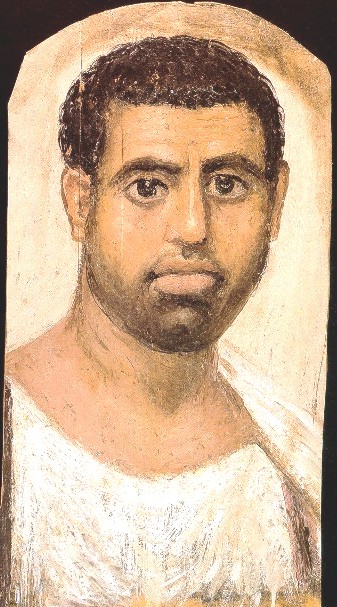 |
|
 |
 |
|
 |
 |
|
 |

As
we can see from this portrait, almost a century after Benjamin
Franklin's 1751 essay titled "America as a Land of Opportunity" (where
he declared that all of Europe's people were of a "swarthy complexion")
except the English and the Saxons: Europe was still full of "swarthy Complexion people" (Mulattoes).
But
the constant killings and expulsions of European Blacks as a result of
the English Civil War (1642), and the Thirty years Wars (1618–1648) in
continental Europe: (which were really "Race" wars), left few Blacks in
Europe for this type of person to mate with. The result has been an
inexorable Whiting of Europe's population through inbreeding: and the
associated shrinking of the European gene pool. Today, Europeans have
the smallest genetic diversity of all, and the greatest risk of
inherited disease. |
Closing thoughts:
Let us end with a rather sad observation: As we have seen, the
Albino peoples history is a totally made-up contrivance, devoid of much
truth at all. Likewise is their definition of themselves: they
steadfastly refuse to believe/acknowledge that they are Albinos, yet
every honest study that they have ever done for themselves, clearly
shows that they are indeed either Albinos, or the much more numerous
and darker ones, those who are "derived" from Albinos, (through
admixture with Black Europeans).
By way of example, let us look at a 1997 study done by Luigi Luca
Cavalli-Sforza, who is an Italian population geneticist born in Genoa,
who has been a professor at Stanford University since 1970 (now
emeritus).
Clearly the data told Luigi Luca Cavalli-Sforza that White
Europeans like himself were hybrids, but he steadfastly refused to
acknowledge what that meant. Instead he tried to obfuscate by saying
that modern Europeans were two-thirds Asian and one-third African. But
what does that mean????
Lets do a test:
All of these people are Asians, the first three are Chinese, the last is a Dravidian Indian.
Do you think that Luigi Luca Cavalli-Sforza meant "These" people when he said that modern Europeans were two-thirds Asian???
Or, do you think that he meant "These" Central Asian Albinos?
Or these: Uyghur People, currently of Xinjiang China: which is in extreme western China/Central Asia.
Click here for link to the full Study
Please visit the "Additional Material Area" for many more photographs of each civilization, and related material <Click> |