
| Back | Home |
Etruscans, like Egyptians, painted their burial chambers with scenes reminiscent of fond activities during life, and scenes hopeful of a pleasant afterlife. The Tomb paintings also suggest; that sometime after Latin conquest of the Etruscans, relations between the two peoples became normalized. This is indicated by the prevalence of later bi-racial tomb scenes, as well as the changing appearance of the Etruscans themselves. As evidenced by tomb paintings and sarcophagus' bi-racial marriages were common.
UNESCO description: These two large Etruscan cemeteries reflect different types of burial practices from the 9th to the 1st century BC, and bear witness to the achievements of Etruscan culture. Wich over nine centuries developed the earliest urban civilization in the nothern Mediterranean. Some of the tombs are monumental, cut in rock and topped by impressive tumuli (burial mounds). Many feature carvings on their walls, others have wall paintings of outstanding quality. The necropolis near Cerveteri, known as Banditaccia, contains thousands of tombs organized in a city-like plan, with streets, small squares and neighbourhoods. The site contains very different types of tombs: trenches cut in rock; tumuli; and some, also carved in rock, in the shape of huts or houses with a wealth of structural details. These provide the only surviving evidence of Etruscan residential architecture. The necropolis of Tarquinia, also known as Monterozzi, contains 6,000 graves cut in the rock. It is famous for its 200 painted tombs, the earliest of which date from the 7th century BC.
The necropolises of Tarquinia and Cerveteri constitute a unique and exceptional testimony to the ancient Etruscan civilization, the only urban civilization in pre-Roman Italy. Moreover, the depiction of daily life in the frescoed tombs, many of which are replicas of Etruscan houses, is a unique testimony to this vanished culture. Many of the tombs represent types of buildings that no longer exist in any other form. The cemeteries, replicas of Etruscan town planning schemes, are some of the earliest existing in the region. The necropolis of Cerveteri (Banditaccia) developed from the 9th century BC. It expanded from the 7th century onwards, following a precise plan. The ancient history and development of the Tarquinia (Monterozzi) necropolis is similar.Each of these cemeteries is different in the characteristics of the tombs and therefore covers together the Etruscan burial culture.
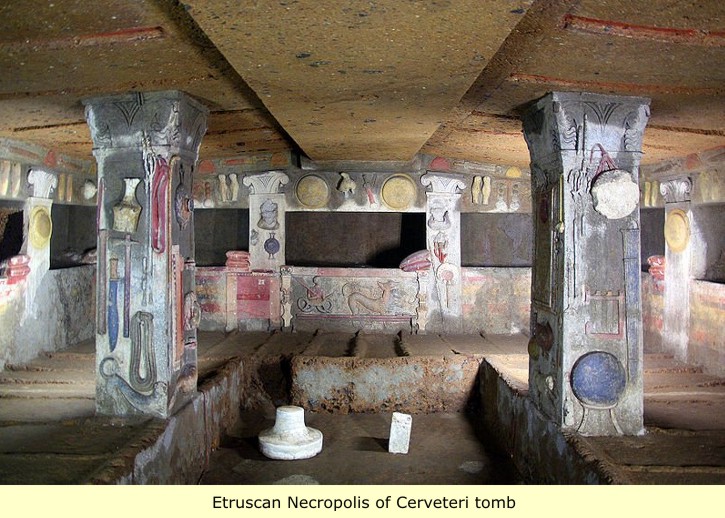
Thousands of tombs exist in the vast cemetery of Cerveteri: they are organized in a city-like plan, with 'streets', small squares and 'neighbourhoods'. The tombs are of different types depending on period, family status and other criteria. The earliest known are series of rock-cut trenches holding pottery ossuaries containing the ashes of the deceased. Most famous are the tumuli - tombs often containing more than one tomb under an imposing mound. A famous example is known as the 'Hut Shaped Tomb', from the 4th century. It presents an excellent rock-cut hut with all structural and building elements, such as gabled roof, main crossbeam, wood and straw roofing materials as well as stone couches next to the walls. This tomb and others, imitating houses, are the best and only evidence of the residential architecture of the Etruscans. The 6th-century Tomb of the Greek Vases is accessible through a rock-cut dromos (corridor) that imitates an Etruscan temple. The Tomb of the Moulding (cornice) has two thrones with footstools, cut in the rock, at the sides of its door. It also imitates a contemporary domestic interior. The Tomb of the Capitals has an imitation wooden floor on its ceiling. The most famous among the thousands of the Banditaccia tombs is the 'Tomb of Reliefs'. This 4th-century tomb is accessible via a long rock-cut stairway leading to a large hall with a ceiling supported by two columns with Aeolic capitals. It includes 13 double funerary niches and additional place for 34 bodies on a specially carved ledge. The 13 niches have double cushions with red painted stucco. Many objects are depicted on the stuccoed walls, including weapons and domestic and religious ones.
The other cemetery, known as Monterozzi or the necropolis of Tarquinia, is famous for its painted tombs. The tombs are all cut in the rock and accessible via sloping or stepped corridors. Most of them were made for a single couple and constitute one burial chamber. The earliest painted tombs are from the 7th century but only in the 6th century were they fully developed and completely covered with painting. The 4th-century Tomb of the Lionesses consists of a small chamber with gabled roof. The painting depicts flying birds and dolphins and scenes from the life of the Etruscan aristocracy. The 6th-century Tomb of the Hunting Pavilion shows the view seen through the transparent fabric of the pavilion. The Hunting and Fishing Tomb is composed of two chambers. In the first, there is a depiction of Dionysian dancing in a sacred wood, and in the second, a hunting and fishing scene and portraits of the tomb owners. The painted tombs of the aristocracy, as well as more simple ones, are extraordinary evidence of what objects cannot show: daily life, ceremonies and mythology as well as artistic abilities. The necropolis of Cerveteri (Banditaccia) developed from the 9th century BCE. It expanded from the 7th century on, following a precise plan. The ancient history and development of the Tarquinia (Monterozzi) necropolis is similar.
Earliest evidence of ‘modern' interest in the tombs comes from the Renaissance. It grew in the 17th and 18th centuries, when scholars and artists started to describe and paint the tombs. In the first half of the 19th century the Tarquinia cemetery was studied by scholars and this is when most of the tombs known today were discovered. The site was visited in 1834 by Ludwig I from Bavaria, who ordered the reproduction of the paintings, to decorate the new Alte Pinakothek in Munich.
Since the 1950s research has been carried out using geophysical, non intrusive methods.
|
The Tomb of the Bulls is an Etruscan tomb in the Necropolis of Monterozzi near Tarquinia, Italy. It is dated to 540–520 BC or 530–520 B.C. and was apparently commissioned by Arath Spuriana according to an inscription. The tomb is named after the two bulls which appear on one of its frescoes. It is the earliest example of a tomb with complex frescoes in the necropolis.
 |
 |
 |
 |
 |
 |
 |
 |
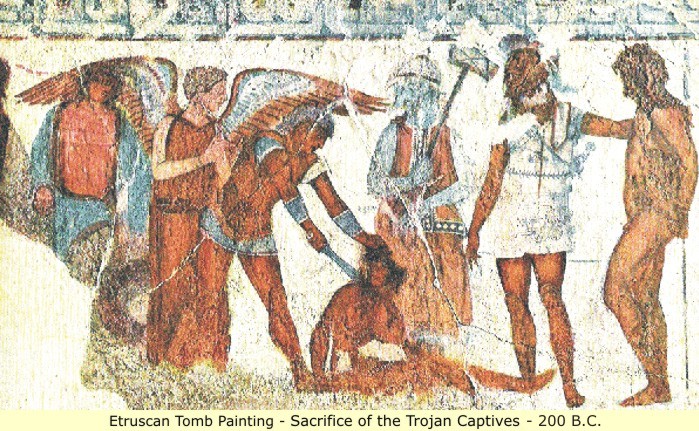
| Sacrifice of the Trojan Captives, François Tomb, Vulci, circa 2nd century B.C. The scene depicts the burial ceremony for the Greek hero Patroclos. After burning his body on a bier, a tumulus was raised and games celebrated. Horses and captives were sacrificed and placed in the tumulus. Charon, the grim ferryman, stands ready with a hammer to hit the victim over the head before admitting him into the underworld, Hades. |
 |
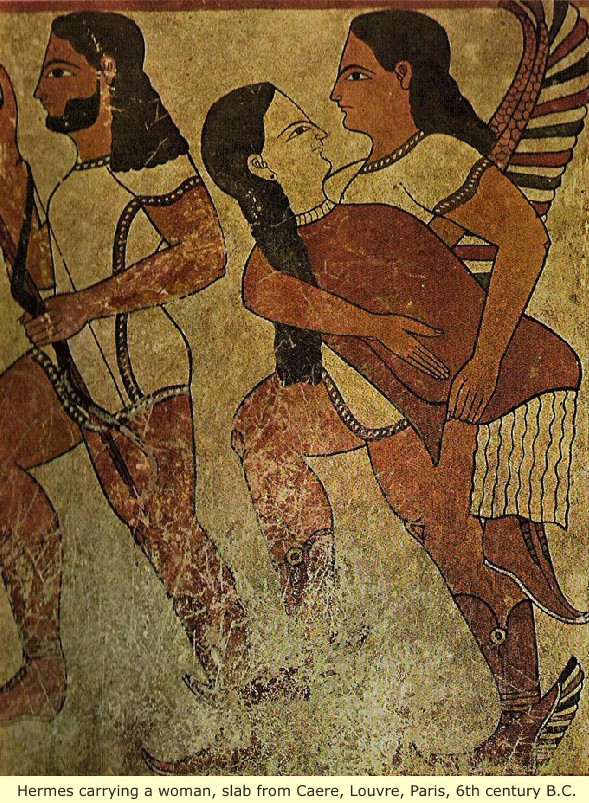
| Hermes carrying a woman, slab from Caere, Louvre, Paris, 6th century B.C. Hermes (Latin, Mercury) is the messenger of the gods. According to Julius Caesar and other sources, the main god of the Celts was Hermes. Agni, the god of fire of the Rig Veda of India, has an important role as the messenger of the gods. Offerings to the fire are carried by Agni up to the abode of the gods. The Etruscan messenger may be like Agni, carrying the cremated soul to heaven. |
 |
 |
 |
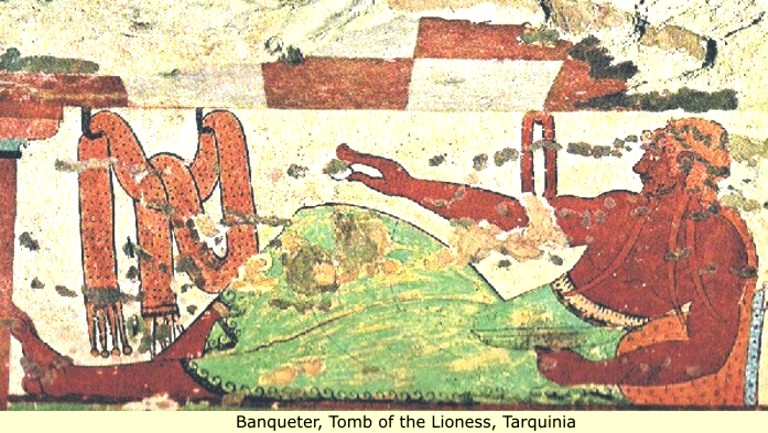
| Banqueter, Tomb of the Lioness, Tarquinia, circa 520 B.C. Of interest in this image is the fact that he holds an egg, a symbol of rebirth, in his right hand, and he seems to be focused on the sash hanging in front of him. Pysanka, a Ukranian tradition of decorating Easter Eggs, gives us some background into the meanings of the eggs and their designs. The egg is a common symbol of the Etruscan "afterlife." |
 |
| "Battle of the Amazons," Sarcophagus from Tarquina, Archeological Museum, Florence. Photo from Skira, Inc., Etruscan Painting, 1952. This painting obviously involves a woman and warriors, and the text should explain who is involved and what is happening in the scene. The woman does not appear to be wearing armor, and the semi-naked warrior in blue also has no armor, has a Phrigian helmet, and brandishes a sword towards the woman. On the other side of the woman is an armored soldier pointing a spear at the woman. The armed man, carring a bow, on the far right is actually leading the group away. The scene suggests the capture of the woman, not necessarily a battle. It may depict an abduction. |
 |
 |
 |
 |
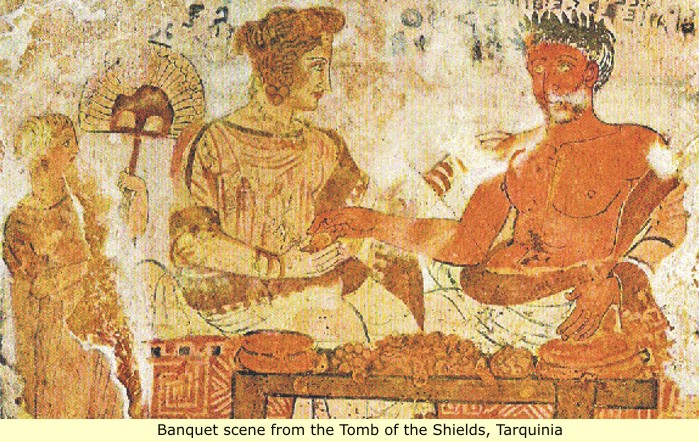
| The Tomb of the Shields, ( dated 340 B.C. and discovered in 1870), is a large and complex hypogeum with four doorways, one in the central position and linked to a room at the back, with two others on the sides, linked through doors and windows, all decorated with painted frames. Its name derived by the fact that walls of the room at the rear of the tomb are decorated with numerous golden shields.
A number of scenes are painted on the entrance wall, showing members of the Velcha family, the tomb occupants. On right of the wall in front of you , there is a banquet, with Larth Velcha reclining on his bed with his wife Velia Seitithi, who is passing him an egg, symbol of rebirth, often reproduced in Etruscan tomb paintings. She is well dressed, and is seated next to her husband's feet, as was the custom. Not far from them, on the right wall, two other members of the family, Velthur and Arnth, the grandparents of Larth, are standing, dressed in large cloaks. They are accompanied by two young musicians. On the left wall Velthur and Ravnthiu appear again, but this time, they sit on folded stools. Velthur is holding a sceptre, symbol of his power. Over the windows, winged Spirits appear. |
 |
 |
 |
 |
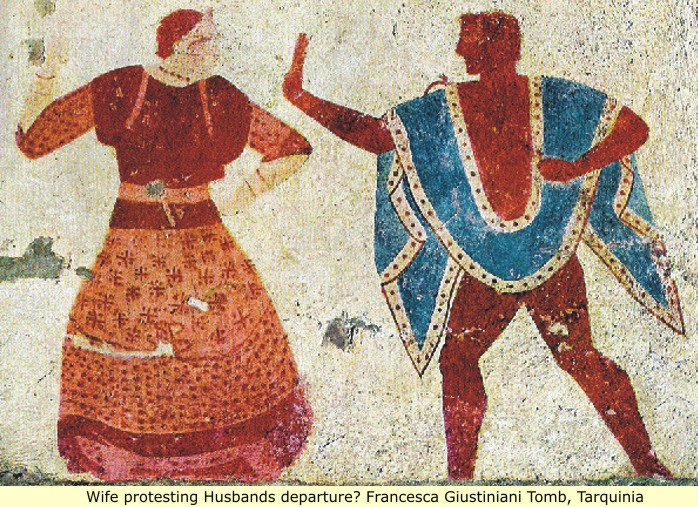
Francesca Giustiniani Tomb, Tarquinia, circa 5th century B.C. The man holds a crook in his left hand. Not seen in this image, to the left of the woman, is a chariot, and the woman may be protesting his departure in the chariot. |
 |
| Dancers, Tomb of the Lionesses, Tarquinia, 520 B.C. The young man carries a metal olpe, or jug, and in the young lady's right hand are castanets. |
 |
| Tomb of the Baron, Tarquinia, circa 510 B.C. The deceased may be the woman to whom the drink is being offered. Note the wreaths or ring, a common device, and the Hippocampus and dolphins. |
 |
 |
| The Tomb of the Bulls and its Religious Symbols: This Tomb, dated 2nd half of the 6th century B.C. and discovered in 1892, is one of the most well known monuments of the whole Etruria. Close-up of the central mural in the Tomb of the Bulls, Tarquinia, "Achilles in Ambush." Mid 6th century B.C. A scene from the Illiad. The Trojan prince, Troilus, upon a stallion is ambushed at the well outside the walls of Troy by Achilles. Below, are trees representing winter, summer and fall, and between the trees is a girdle worn around the waist of Etruscan men, frequently appearing in Etruscan scenes. A wreath or garland hangs on the branch of the tree in winter, which may indicate the time of the hero's death. The girdle may be from the Cestus Girdle of Aphrodite, here carried by Hemeros. |
 |
 |
 |
 |
 |
 |
 |
 |
 |