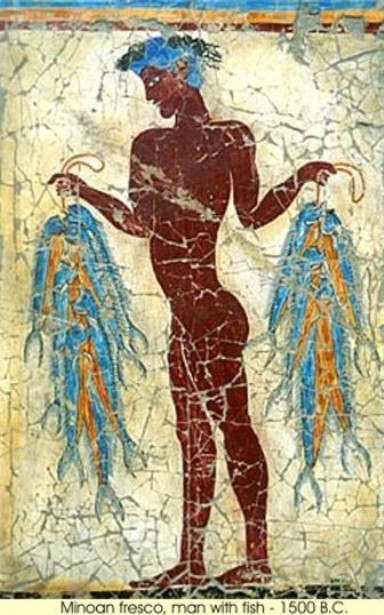
Minoan culture reached its peak at about 1,600 B.C, and was noted for its cities and palaces, extended trade contacts, and use of writing (see Linear A and Linear B). Its art included elaborate seals, pottery, and notably, the vibrant frescoes decorating palace walls, which depicted both religious and secular scenes, including goddesses reflective of a matriarchal religion. Palace ruins show evidence of paved streets and piped water. Familiar Minoan art motifs are the snake (symbol of the goddess) and the bull and leaping dancer, also of mystical significance.
Prosperity and artistic achievement remained at a high level in the Aegean area until about 1,450 B.C, when all the great centers of Cretan culture were destroyed by earthquakes (probably connected with a cataclysmic eruption of the volcanic island of Thera). After these disasters, only the palace at Knossos was restored. At about 1,375 B.C, the palace at Knossos was destroyed by fire, Thereafter Crete was a second-class power and became somewhat of a cultural backwater.
 Cyprus reached its highest degree of prosperity in the Late Cypriot period, due to increased exploitation of its copper mines. There were close commercial relations not only with the Levant coast, as before, but also with Egypt, Crete, and Mycenaean Greece (the latter being close from about 1,400 B.C.).
Sometime around 1,200 B.C, the White invaders from Central Asia, who had three hundred years earlier, conquered the Black civilizations in Eastern Europe, invaded the Aegean area. The cause of this massive migration south and west is completely unknown.
These people of the Eurasian plains were originally nomadic hunter-gathers. The horse had been domesticated by them, and was their main mode of transportation. They did not yet know writing, so we do not know what their previous history was. In the Indus Valley they will be known as the Arians, in Elam they will be known as the Parni, the Parthians, the Scythians and also the Arians. In China they will be known as the Zhou. In Anatolia they will be known as the Dorian’s, Ionians and the Turks. And in mainland Europe, they will be known as the Hellenes, Dorian’s, Ionians, Latin’s, Slavs, Germans, as well as many other sub-groups with other names.
As mentioned above, the earliest White Invaders had spent about three hundred years in Eastern Europe, mixing with the indigenous Blacks there. So there is a possibility that these people were already a “mixed-race” people when they arrived in the Aegean area. Relief’s from the Persian capital of Persepolis show them to be curly haired people, suggesting that they were mixed-race, but that may have happened in Europe during the intervening four hundred years, (the Persians depicted White people with completely straight hair).
But the Persian reliefs do bring into question the thousands upon thousands of Greek busts from the Classical period - all of the most perfect looking, pure White people. But these busts, though being of the same person and at the same age, look nothing alike - busts of Alexander and Cleopatra come immediately to mind. It seems as though the later artists were more interested in portraying the pure White nature of the ancient Hellenes - and welcome to it; rather than the true appearance of the subject person. One can only wonder what happened to these perfect creatures, as they only exist today - with great assistance, on Television and in the movies.


Of course the reality is that all of the Mediterranean countries, both North and South, in post White invasion times, developed populations that were to some extent "mixed-race". But the millions upon millions of additional Whites, (Slavs, Germans, Turks, etc.) who poured into Europe in the current era (circa 200 A.D. onward), proved too much for the indigenous Blacks of Europe to maintain any racial identity.
 |
 |
 |
 |
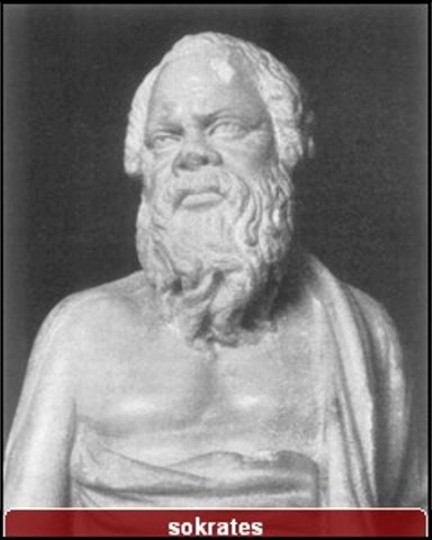 |
Conon (444–394 B.C.) was an Athenian general at the end of the Peloponnesian War, who presided over the crucial Athenian naval defeat at the Battle of Aegospotami. Later he contributed significantly to the restoration of the political and military power of Athens.
 |
 |
As a consequence, the modern nation that we call Greece, is such a conglomeration of different ethnicity, that it would be impossible to identify any one group as being uniquely Hellene. Thus the government refuses to census by ethnicity, thus grouping the all into one. But accommodation was afforded to the ancient "first White inhabitants" when in 1829, Greece gained its independence from the Ottoman Empire, and took the name "The Hellenic Republic". The origin of the name "Greece" is unknown, it may have been taken from the original inhabitants of the country, the Pelasgians.
A supposed prehistoric Illyrian invasion of the Balkans, which involves a great movement of Illyrian tribes from the lowlands of central Europe (now modern Hungary), towards southeastern Europe and the Balkan Peninsula, is estimated to have occurred around 1,300 B.C. The numerous Thracian names in Illyria have led many scholars to believe that the region was originally inhabited by Thracians, who were either displaced or submitted to the Illyrian invaders. The Illyrians were most likely in turn, pushed eastwards by Celtic tribes from Germany in the northwest. According to this theory, the Illyrian invasion most likely caused the Thracian expansion to the east and the Phrygian migration from Thrace into central Asia Minor (Anatolia/Turkey), and the movement of the invading Whites (Hellenes) into Greece in the south. The Hellenes invasion of the Peloponnese (the large peninsula in southern Greece) may have forced the Black Mycenaean Greeks, who lived there, to flee south, and colonize Cyprus and the coast of Asia Minor (Turkey). |
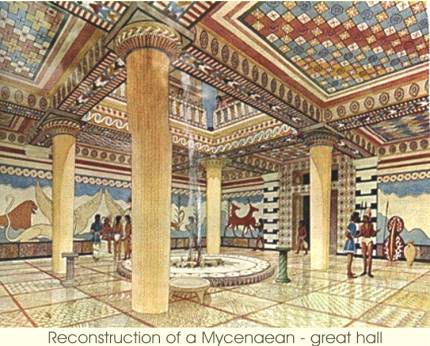
By 1200 B.C, the invaders had destroyed many of the Mycenaean strongholds. And the end of Mycenaean civilization came at about 1100 B.C. Soon the presence of these newcomers had caused enough upheaval in the Mediterranean Islands and Southern Europe, so as to cause the original African inhabitants to band together and leave. Though the precise circumstances are unknown, it can be surmised that as more and more of these newcomers moved into the area, their need for more land and resources grew. The natural result of this competition for land and resources would be conflicts and wars.
As a consequence of these wars, there was a general collapse of the indigenous economies, and their trade. This general collapse prompted some members, of seemingly all of the countries, to band together and head East and South, perhaps to re-populate their former homelands. This confederation of the people of the Mediterranean countries became known as "The Sea People". Among this group called "The Sea People" were the following.
 |
The Peleset and Tjeker (Minoans) of Crete, they would later be known as the “Philistines” after they had settled in Southern Canaan. Over time, this area became known by a form of their name “Palestine”. The Lukka who may have come from the Lycian region of Anatolia, The Ekwesh and Denen seem to be identified with the original (Black) Greeks, The Shardana (Sherden) who may be associated with Sardinia, The Teresh (Tursha or Tyrshenoi), the Tyrrhenians - the Greek name for the Etruscans, and The Shekelesh (Sicilians?). The fate of those that stayed behind, would of course be absorption. Unfortunately for the Sea People, their first choice for a new homeland was Egypt. Pharaoh Rameses III easily defeated them, but allowed the Cretans to settle in Canaan. Click Here for an account of the Sea People in Egypt: And Pictures of the Sea People. <<CLICK>>
About 1100 B.C, the Mycenaean Greeks, refugees from their homeland, settled in Cyprus. They introduced their skills and produced many luxury articles in a mixed Mycenaean-Cypriot style. Cyprus initially escaped the invasions that finally destroyed Mycenaean and Minoan culture, but its own culture did not last much longer. By about 1050 B.C, the White invaders reached Cyprus too, and it’s culture ceased to exist.
On Melos island, the most southwesterly of the major islands of the Cyclades Islands. The great city of Phylakopi was destroyed in about 1100 B.C, by Dorian invaders.
Santorini, also known as Thera (or Thira) is a volcanic island located in the southern Aegean Sea, about 200 km (120 mi) southeast from Greece's mainland. It is the largest island of a small, circular archipelago which bears the same name. It forms the southernmost member of the Cyclades group of islands.
The island is the site of one of the largest volcanic eruptions in recorded history: the Minoan eruption (sometimes called the Thera eruption), which occurred some 3,600 years ago at the height of the Minoan civilization. The eruption left a large caldera surrounded by volcanic ash deposits hundreds of feet deep and may have led indirectly to the collapse of the Minoan civilization on the island of Crete, 110 km (68 mi) to the south, through the creation of a gigantic tsunami. This theory is not, however, supported by chronology, in that the collapse of the Minoan civilization did not occur concurrently with the date of the Tsunami.
Akrotiri is the name of an excavation site on Thera. It was buried by the widespread Theran eruption in the middle of the second millennium B.C. (during the Late Minoan IA period); as a result, like the Roman ruins of Pompeii after it, it is remarkably well-preserved. Frescoes, pottery, furniture, advanced drainage systems and three-story buildings have been discovered at the site, whose excavation was started in 1967 by Spyridon Marinatos.
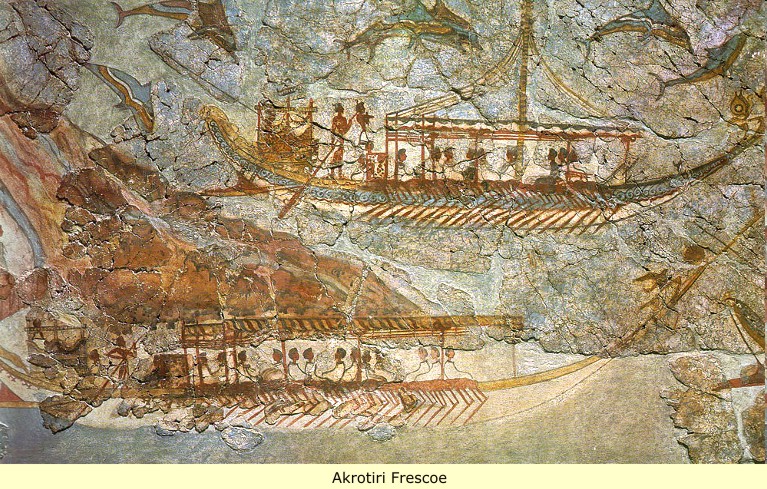 |
 |
 |
 |
 |
 |
Hagia Triada is in south central Crete, situated at the western end of the Mesara Plain. The site was not one of the "palaces" of Minoan Crete, but an upscale town, and possibly a royal villa. After the catastrophe of 1450 B.C, the town was rebuilt and remained inhabited until the 2nd century B.C. Later, a Roman period villa was built at the site.
Hagia Triada and nearby Phaistos, were excavated from 1900 to 1908 by a group from Italian Scuola Archeologica Italiana di Atene. They unearthed a sarcophagus (the Ayia Triada Sarcophagus)painted with illuminating scenes from Cretan life (now at the Archaeological Museum in Iraklion). The sarcophagus was used for the burial of a prince during the period of the Mycenaean occupation (1400 B.C).The main scene is a bull sacrifice and shows all the stages of the sacred ceremony. On it appear a large number of religious symbols, a male figure playing a flute and a man playing a seven-string lyre. This is the oldest picture of the lyre known in classical Greece.
The site includes a town and a miniature "palace", an ancient drainage system servicing both, and Early Minoan tholos tombs. The settlement was in use, in various forms, from Early Minoan I until the fires of Late Minoan IB. Hagia Triada has yielded more Linear A tablets than any other Minoan archaeological site. Other famous finds include the Chieftain's Cup, the Boxer Vase, and the Harvest Vase.
 |
 |
 |
 |
Knossos: Fakes, Facts, and Mystery
Mary Beard
August 13, 2009 Issue
Knossos and the Prophets of Modernism
by Cathy Gere
University of Chicago Press, 277 pp., $27.50
The masterpieces of Minoan art are not what they seem. The vivid frescoes that once decorated the walls of the prehistoric palace at Knossos in Crete are now the main attraction of the Archaeological Museum in the modern city of Heraklion, a few miles from the site of Knossos. Dating from the early or mid-second millennium BC, they are some of the most famous icons of ancient European culture, reproduced on countless postcards and posters, T-shirts and refrigerator magnets: the magnificent young “prince” with his floral crown, walking through a field of lilies; the five blue dolphins patrolling their underwater world between minnows and sea urchins; the three “ladies in blue” (a favorite Minoan color) with their curling black hair, low-cut dresses, and gesticulating hands, as if they have been caught in mid-conversation. The prehistoric world they evoke seems in some ways distant and strange—yet, at the same time, reassuringly recognizable and almost modern.
The truth is that these famous icons are largely modern. As any sharp-eyed visitor to the Heraklion museum can spot, what survives of the original paintings amounts in most cases to no more than a few square inches. The rest is more or less imaginative reconstruction, commissioned in the first half of the twentieth century by Sir Arthur Evans, the British excavator of the palace of Knossos (and the man who coined the term “Minoan” for this prehistoric Cretan civilization, after the mythical King Minos who is said to have held the throne there). As a general rule of thumb, the more famous the image now is, the less of it is actually ancient.
 |
Most of the dolphin fresco was painted by the Dutch artist, architect, and restorer Piet de Jong, who was employed by Evans in the 1920s (and whose watercolors and drawings of archaeological finds in Athens, Knossos, and elsewhere were featured in a 2006 exhibition at the Benaki Museum in Athens, curated by John Papadopoulos). The “Prince of the Lilies” is an earlier restoration, from 1905, by the Swiss artist Émile Gilliéron (see illustration on page 60). In this case it is far from certain that the original fragments—a small piece of the head and crown (but not the face), part of the torso, and a piece of thigh—ever belonged to the same painting.
The records of the original excavation suggest that they were found in the same general area of the ancient palace, but not particularly close together. And despite Gilliéron’s best efforts, the resulting “prince” (there is, of course, no evidence beyond the so-called “crown” for his royal status) is anatomically very awkward; his torso and head apparently face in different directions. The history of the “ladies in blue” is even more complicated. This painting was first recreated by Gilliéron after the discovery of a few fragments in the early years of the twentieth century, but that restoration was itself badly damaged in an earthquake in 1926 and re-restored by Gilliéron’s son (also Émile).
From the Metropolitan Museum of Art New York
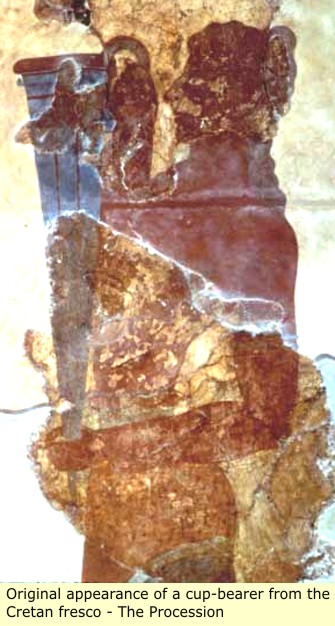
Quote: This group of three women was originally restored by E. Gillieron, pere on the basis of other fragments of frescos from Knossos, mostly of a much smaller scale. It has been shown that details of the facial outline of the "Cup-bearer" fresco, a reproduction of which is displayed in the exhibition, supplied the model for the faces of the "Ladies in Blue", which are not preserved at all.
This copy reproduces the few fragments of burnt and abraded original fresco, represented as slightly offset from the restoration, and shows the extent to which the Gillierons recreated the scene. Extensive restorations like this one led the writer Evelyn Waugh after a visit to the Archaeological Museum in Herakleion in 1929 to state it is not easy to judge the merits of Minoan painting "since only a few square inches of the vast area exposed to our consideration are earlier than the last twenty years, and it is impossible to disregard the suspicion that their painters have tempered their zeal for accurate reconstruction with a somewhat inappropriate predilection for the covers of Vogue." The original is in the Archaeological Museum of Herakleion, Crete.
 |
 |
 |
 |
 |
Please visit the "Additional Material Area" for many more photographs of each civilization, and related material <Click> |
| < Back | Home | Next > |