
How did the Hebrews turn White? Of course they didn't really; except in the imaginations, and then the lying histories of Albino people. Who for probably practical reasons, decided that Hebrews, and the Blacks who originally lived in and ruled over, the Country’s they took over as a result of the “Thirty Years War” on the continent and the British “Civil Wars” of the 1600s. These were of course actually “Race Wars” with religion as the focal point. These wars pitted Europe’s ancient Black and Catholic Rulers against the rebellious Albinos who had “In-mass” been chased out of their Homelands in Asia by the Mongols and into the Black lands of Europe. Black Europe was never “Densely Populated”, so this massive influx of millions upon millions of Asian Albinos was sure to cause a “Seed Change” in Europe: and of course it did, it just took over two thousand years for it to happen.
|
The intricacies of what actually happened in Europe is still well hidden by the Albinos, but we do know that the expulsion of the last Albino tribe from Asia, the “Turks”: was the last nail in the coffin for Black Europe. Fortunately for us, the Turks being chased out of Asia, and their subsequent machinations in the West, is well covered by the University of Calgary in their on-line course titled "The End of Europe's Middle Ages" which is designed to assist students engaged in Renaissance, Reformation and Early Modern studies who lack a background in medieval European history. Intended to provide a brief overview of the conditions at the end of Europe's Middle Ages, the tutorial is presented in a series of chapters that summarize the economic, political, religious and intellectual environment of the fourteenth and fifteenth centuries. In the main, the tutorial is rudimentary, but the part on the Turks is quite good, that is why it is listed here. The tutorial seems to be in partnership with Encyclopaedia Britannica, which has a link and search panel on the pages. Note: some browsers have problems with the pages.
Note; the University of Calgary (Canada), has disabled all links from Realhistoryww. Clearly they don’t like how we use their information. Which is good, because it destroys the myth of nonracist Canadians. All Albinos (Everywhere) of any wealth and/or Power, or aspires to any wealth and power, have a vested interest in maintaining the fantasy history of Albinos (which says they were everyone, everywhere – Egyptians, Hebrews, Persians, etc.). And the social structure that says Albinos are supposed to be on top. All this because Albinos ganged together, gathered up all the best weapons in the world, and proceeded to topple Black Empires just 400 years ago. (The Thirty Years War on the Continent, and the British Civil Wars). And now when we point out that Hebrews couldn’t be White, they say Jesus couldn’t be Black – he was “Mediterranean”. You know they always want to talk about the “Olive” complexioned “Mediterranean’s”. Note this exchange:
Back to point: No surprise, when you knock down one Albino lie, they raise another. Actually those “Olive” complexioned people they speak of, are the Mulattoes of Albinos of the Vandal and Alan subtribes of the Visigoths (western Goths) of the Germanic super tribe of Central Asian Albinos who invaded North Africa in 429 A.D. The other Mulattos are those of Turks who the Black Arabs foolishly used as Slave Soldiers, and who overthrew them, and took over their religion in 1055 A.D. The others are Mulattoes from the French invasion and colonization in 1830, and the Italian invasion and colonization of 1911. Take away those Albinos and their Mulattoes and it’s all Black, we call them as a group - Berbers. To get to the Calgary University information:Google “The End of Europe's Middle Ages, Calgary” |
We do not know what the Albinos religious concepts were when they were in Asia, but their hatred for their creators – Blacks; is well documented In surviving passages of the “Rig-Veda” The Hindu Bible of sorts: which is a hybrid of Albino (Aryan) invader and Native Black Dravidian history in hymns. Example:
HYMN C. Indra.
18. He, much invoked, hath slain Dasyus and Simyus, after his wont, and laid them low with arrows.
The mighty Thunderer with his fair−complexioned friends won the land, the sunlight, and the waters.
HYMN XLI. Soma Pavamana.
1. ACTIVE and bright have they come forth, impetuous in speed like bulls, Driving the black skin far away.
 |
As the Asian Albinos crossed into Eastern Europe, the Black Romans forced them to convert to Christianity (Catholicism); later one of the Turkic tribes, the Khazars, converted to Judaism. Christianity seemed to serve them well until they had gathered enough manpower to take over, then it became clear that like every Black civilization that came before, they needed their own religion for Albinos to rally-round. Thus the creation of Protestantism, a new religion for Albinos. Today, the only Protestant European countries or areas with significant Protestant populations are Germany (home of the Black Holy Roman Empire) and Britain (home of the deposed Black House of Stuart). Both Albino Germany and Albino Britain, were the major players in the 1600s "Race Wars". The Racist United States Albino population is mainly made up of Albino Germans and Albino British people. Denmark, Finland, Iceland, Norway, Sweden, and the eastern, northern and western parts of Switzerland also have Protestant populations. The rest of Albino Europe went back to Catholicism once Albinos had taken control of the Catholic Church. As a point of interest: Roughly 48.9% of Americans are Protestants, 23.0% are Catholics.
Clearly, as has been shown by Americas Albinos during the Trump years; their loud claims of “Love of Country” “Love of Freedom” “Love of Democracy” were just empty words to make themselves seem “Moral and Advanced”. The fact is they are still just Albinos frightened of pigmented people. And as has become clear, they wouldn’t mind too much if the Russians took over, because at least they are Albinos too.
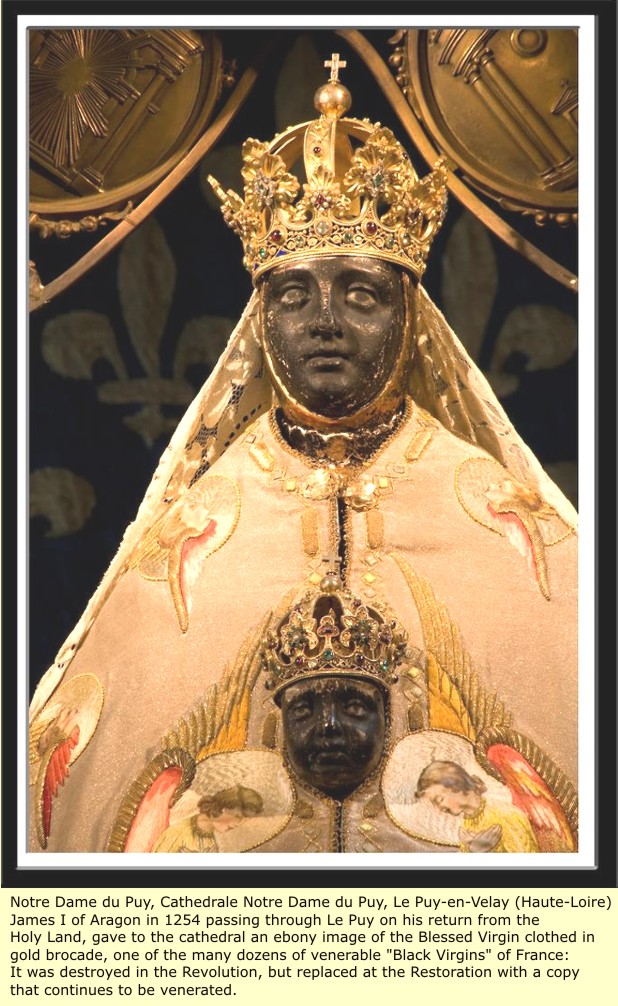
Which brings up a very strange predilection among Russians, and Slavs in general; unlike all other Albinos, they have steadfastly refused to destroy “all” of the paintings of their past Black Kings, and refused to create fake White images of religious icons. Almost all of their Black Saints and other religious figures are still depicted as Black (though with Caucasian features). But the most amazing thing is that the Russians still display portraits of Black “Peter the Great” and his son on the Hermitage Museum Site. We have no idea why they do that – conscience?
 |
 |
Here is the link to the actual portrait of the “Real” (BLACK) Peter the Great, Czar of Russia and his son Tsarevich Alexei Petrovich at the State Hermitage Museum in Russia.Peter the Great (Search page 28)Tsarevich Alexei Petrovich (Search page 29)No telling when the Russians will stop showing respect for their former Black rulers, and take on the lying fake history of all other Albinos. So visit the links and save your own copies of these portraits. |
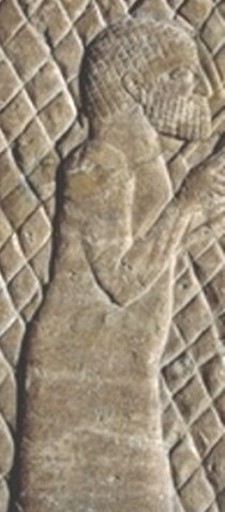
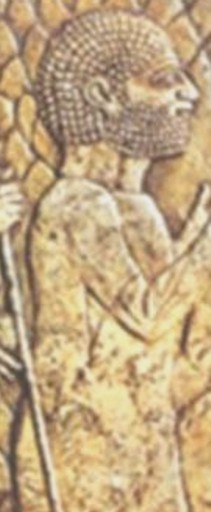
With that out of the way, let us now go back to see what Hebrews REALLY looked like. The earliest authentic pictures of real Hebrews that we have, date back to before Christ. They are Assyrian relief's showing Hebrews, and others that they conquered, in pictorial scenes detailing the battles fought, with associated text. These relief's decorated Assyrian palaces, and were no doubt used to gloat over their conquest of the Hebrews and others. Here we are using pictures of: Assyrian King Shalmaneser IIIs "Black Obelisk" (858 B.C.). Assyrian king Tiglath-pilesar III’s relief's of his conquest of a city near the Sea of Galilee (730 B.C.). Assyrian King Sennacherib’s relief's of the conquest of the Judean City of Lachish (701 B.C.). The four pictures below, are from those Assyrian relief's. (These relief's are stored in the British Museum, London England).
 |
 |
 |
 |
 |
 |
 |
It is worth mentioning, that the Hebrews were just as literate, and just as artistic as the other Black civilizations around them. The reason that we have to depend on outside sources for pictures of them, is because Whites destroyed all that the Hebrews ever created. Even down to the very religious writings that they claim to worship by. That fact is that ALL Hebrew writings, even the SEPTUAGINT {the original Bible}, which was only roughly Hebrew (it was made for the Greek King of Egypt, Ptolemy II (Philadelphus) in 282-246 B.C.), has been destroyed. Everything except for the "Dead Sea Scrolls" which were found in 1947, in Qumran, a village situated about twenty miles east of Jerusalem. The Scrolls are under the joint custody of the Catholic Church and the Israelis. The translated contents of those Scrolls has never been made public, and probably never will be - no doubt the differences in teachings and facts would be irreconcilable. (A few inconsequential snippets have been made public - the entire Scrolls is a huge work, which contains the entire old Testament plus many other works).
Why wasn't the material in these pages destroyed? Because after it's fall, Assyria came under the control of the Persian Empire, which was itself a Black Empire. It then came under the control of Greeks, who were at that time, seeking to merge with the Black Persians, not in denying that they were Black people. Then Assyria again came under Persian control, and then finally under the control of the original Black Arabs. So at the time when Whites were destroying vestiges of Black history, they had no access to the Assyrian artifacts.
But at those times when Whites did have control of an area, they seem to have been very through in destroying all vestiges of the former Black inhabitants; there is nothing left to suggest that Carthage was a Black city, Mesopotamia and the Indus Valley civilizations are some of the oldest known, yet very little is left - next to nothing in the Indus valley. Ancient Anatolia (Turkey), was home to many great and famous civilizations, but very little has been found there. The Egyptian artifacts, of which there are many, were mostly recovered in modern times, when Whites rather than simply destroy, instead modify artifacts; sometimes just by breaking the noses off, in order to make them look like White people, and then proudly display them as proof of the White mans greatness.
The Khazars, a Turkish tribe who had established a Kingdom in the Caucasus region, and converted to Judaism in the 8th century A.D. Must have seen the doings of the Romans and Greeks, and seen it as an opportunity for them to take over the Hebrew identity, and thus control of the orthodox branch of the Hebrew religion - which indeed they did. They logically thinking that if Jesus can be White, why not then, the entire Hebrew nation - which was by then a diaspora anyway. The Islamist side-stepped the entire issue by forbidding imagery of any kind.
Color struck: America's White Jesus is a global export and false product
|
Let us proceed then, with our pictorial essay of how Jesus, and thus, the Hebrews TURNED WHITE!
Thanks to Religion Facts.com (Link)
 |
The Alexamanos Graffito, dating from c.200 AD or earlier, is an interesting early parody of Christianity. This early graffito (wall-scratching; singular of graffiti) was discovered in 1857 in a guardroom on Palatine Hill near the Circus Maximus in Rome, and is now in the Palatine Antiquarian Museum. The drawing shows a man with an ass's head being crucified, to which a youth is raising his hand as if in prayer. The text in Greek reads: ALE, XAMENOS, SEBETE, THEON. which means, "Alexamenos worships his god." Before Christianity, the Hebrews had already been charged with worshipping an ass; this was probably the basis of this accusation being directed at Christianity. |
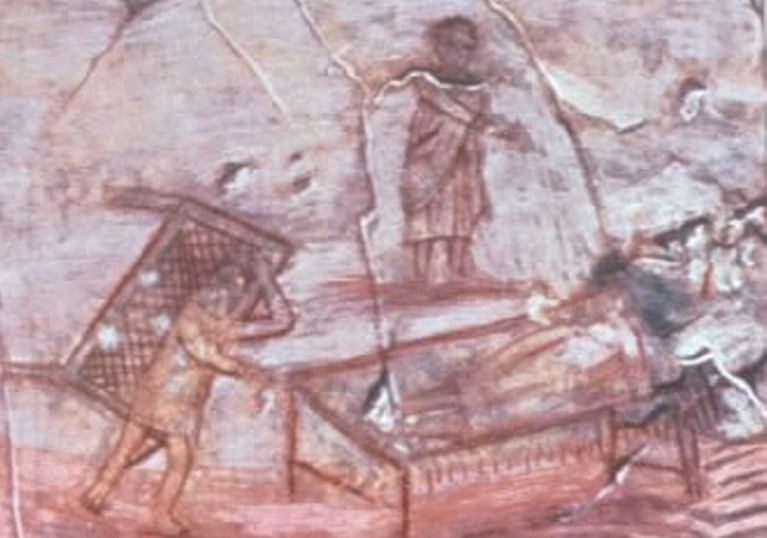 |
| This wall painting, depicting the Healing of the Paralytic, is the earliest known representation of Jesus, dating from about 235 AD. The painting was found in 1921 on the left-hand wall of the baptismal chamber of the house-church at Dura-Europos on the Euphrates River in modern Syria. It is now part of the Dura Europos collection at the Yale University Gallery of Fine Arts. |
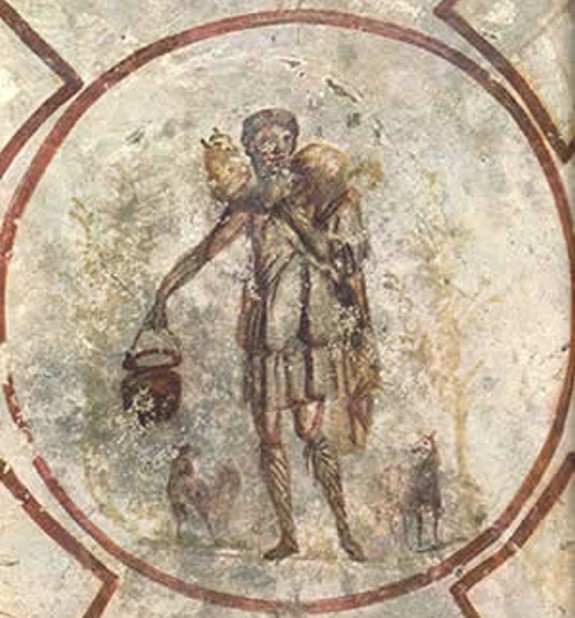 |
This fresco of the Good Shepherd was found on the ceiling of the Vault of Lucina in the Catacomb of Callixtus in Rome. The construction of the vault itself has been dated to the second half of the 2nd century, but the use of the red and green lines to divide the space (similar to the chambers under San Sebastiano) has suggested the first half or middle of the 3rd century for this fresco. The image of Jesus as the Good Shepherd was an especially popular motif in the early Christian centuries. It was based on several biblical passages, including the 23rd Psalm and sayings of Jesus, and is also an adaptation of a popular pagan image. |
 |
This fresco of the Good Shepherd was found on the ceiling of the Vault of Lucina in the Catacomb of Callixtus in Rome. The construction of the vault itself has been dated to the second half of the 2nd century, but the use of the red and green lines to divide the space (similar to the chambers under San Sebastiano) has suggested the first half or middle of the 3rd century for this fresco. The image of Jesus as the Good Shepherd was an especially popular motif in the early Christian centuries. It was based in several biblical passages, including the 23rd Psalm and sayings of Jesus, and is also an adaptation of a popular pagan image. |
 |
 |
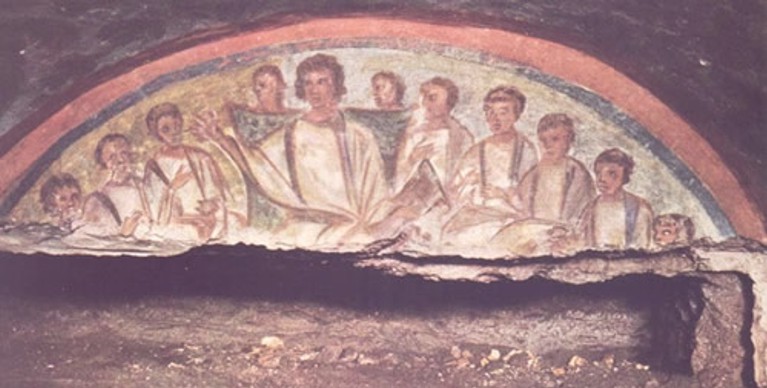
| This fresco of Christ Among the Apostles is in an arcosolium of the Crypt of Ampliatus in the Catacombs of St. Domitilla in Rome. The Catacombs of Domitilla date from the 2nd through 4th centuries. According to W.F. Volbach, "The extent to which the type of the apostolic group as been developed suggests a 4th-century origin" for this particular fresco. |
 |
 |
 |
 |
The city of Dura-Europos was founded in 303 B.C. by the Seleucids on the intersection of an east-west trade route and the trade route along the Euphrates. The new city controlled the river crossing on the route between his newly founded cities of Antioch and Seleucia on the Tigris. It is located near the village of Salhiyé, in today's Syria. The city is extremely important for archaeological reasons, as it was abandoned after its conquest in 257, and nothing was built over it and no later building programs obscured the architectonic features of the ancient city. Its location on the edge of contending empires made for a co-mingling of cultural traditions, much of which was preserved under the city's ruins. Some remarkable finds have been brought to light, including numerous temples, wall decorations, inscriptions, military equipment, tombs, and even dramatic evidence of the Sassanian siege during the Imperial Roman period which led to the site's abandonment.
The Jewish synagogue, located by the western wall between towers 18 and 19, the last phase of which was dated by an Aramaic inscription to 244. It is the best preserved of the many ancient synagogues of that era that have been uncovered by archaeologists. It was preserved, ironically, when it had to be infilled with earth to strengthen the city's fortifications against a Sassanian assault in 256. It was uncovered in 1932 by Clark Hopkins, who found that it contains a forecourt and house of assembly with frescoed walls depicting people and animals, and a Torah shrine in the western wall facing Jerusalem. At first, it was mistaken for a Greek temple. The synagogue paintings, the earliest continuous surviving biblical narrative cycle, are conserved at Damascus Syria.
 |
 |
 |
 |
 |
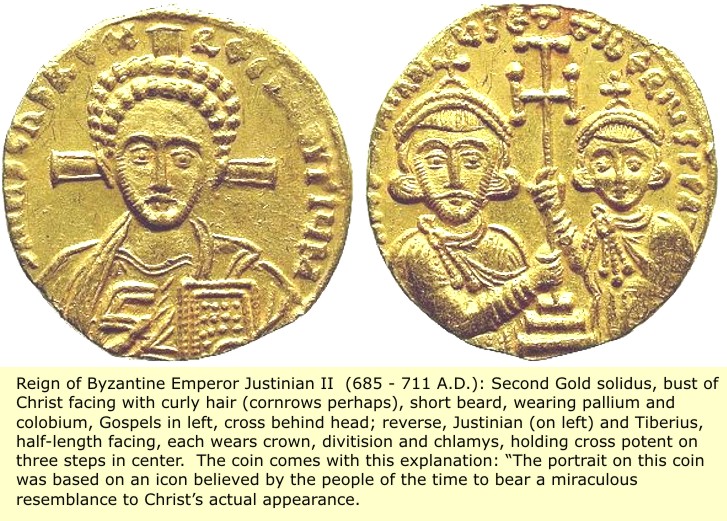
Justinian II (669 – 711) was the last Byzantine Emperor of the Heraclian Dynasty, reigning from 685 to 695 and again from 705 to 711. Justinian II generated enormous opposition to his reign, and it resulted in his deposition in 695 in a popular uprising, and he only returned to the throne in 705 with the help of a Bulgar and Slav army. His second reign was even more despotic than the first, and it too saw his eventual overthrow in 711, abandoned by his army who turned on him before killing him.
 |
 |
 |
 |
 |
The modern country of Georgia in the Caucasus region of the former Soviet Union (The place where European Albinos tell themselves and the world that they are from - they call themselves Caucasians): is the location of one of the oldest Black kingdoms in Europe - Colchis.
According to Greek mythology, Colchis was a fabulously wealthy land situated on the mysterious periphery of the heroic world. Here in the sacred grove of the war god Ares, King Aeëtes hung the Golden Fleece until it was seized by Jason and the Argonauts. Colchis was also the land where the mythological Prometheus was punished by being chained to a mountain while an eagle ate at his liver, for revealing to humanity the secret of fire. The Amazons also were said to be from Colchis. The main mythical characters from Colchis are Aeëtes, Medea, Absyrtus, Chalciope, Circe, Eidyia, Pasiphaë.
In about 730 B.C, Colchis was overrun by the White Kurgan tribes called Cimmerians and Scythians. But they appear to have done little permanent damage. In about 600 B.C, the advanced economy of Colchis soon attracted the attention of the Milesian (White) Greeks in Anatolia (Turkey), who colonized the Colchian coast and established trading posts at Phasis, Gyenos, and Sukhumi. In about 580 B.C, the kingdom came under the control of (probably by the dating); King Astyages of the Median Empire. Which would soon become part of the first Persian Empire under Cyrus II, the Great. (The Sassanian was the second Persian Empire).
[2.104] There can be no doubt that the Colchians are an Egyptian race. Before I heard any mention of the fact from others, I had remarked it myself. After the thought had struck me, I made inquiries on the subject both in Colchis and in Egypt, and I found that the Colchians had a more distinct recollection of the Egyptians, than the Egyptians had of them. Still the Egyptians said that they believed the Colchians to be descended from the army of Sesostris. My own conjectures were founded, first, on the fact that they are black-skinned and have woolly hair, which certainly amounts to but little, since several other nations are so too; but further and more especially, on the circumstance that the Colchians, the Egyptians, and the Ethiopians (Nubians), are the only nations who have practised circumcision from the earliest times.
Sometime around the year 2 B.C. both Pontus and Colchis were incorporated into the Roman province of Galatia. Soon the lowlands and coastal area of Colchis, began to suffer raids by White tribes from the surrounding mountains; the Soanes and Heniochi being the most powerful of them. After swearing allegence to Rome, the White tribes were allowed to create their own kingdoms in Colchis; which enjoyed significant independence from Rome. Christianity began to spread in the early 1st century A.D. Traditional accounts relate the event with Saint Andrew, Saint Simon the Zealot, and Saint Matata. However the previous religious beliefs, like the Hellenistic, the local pagan and the Mithraic beliefs, would still be widespread until the 4th century A.D. By about the 130s A.D. the new kingdoms of Machelons, Heniochi, Egrisi, Apsilia, Abasgia, and Sanigia, had sprung up from south to north. The Goths, dwelling in the Crimea and looking for new homes, raided Colchis in 253 A.D, but they were repulsed with the help of the Roman garrison of Pitsunda. By the 3rd-4th centuries A.D, most of the local kingdoms and principalities had been subjugated by the (Turkic) Lazic kings, and thereafter the country was generally referred to as Lazica. In the late 8th century A.D, Colchis was attached to Abasgia, which in turn was incorporated into Russian Georgia. Blacks however, are said to have survived in the area until the early 20th century.
The David Gareja monastery is a rock-hewn Georgian Orthodox monastery complex located in the Kakheti region of Eastern Georgia, on the half-desert slopes of Mount Gareja, some 60–70 km southeast of Georgia's capital Tbilisi. The complex includes hundreds of cells, churches, chapels, refectories and living quarters hollowed out of the rock face. Part of the complex is located in the Agstafa rayon of Azerbaijan and has become subject to a border dispute between Georgia and Azerbaijan. The area is home to evidence of some of the oldest human habitations in the region.
 |
The monastery complex was founded in the 6th century by David (St. David Garejeli), one of the thirteen Assyrian monks who arrived in the country at the same time. His disciples Dodo and Luciane expanded the original lavra and founded two other monasteries known as Dodo's Rka (literally, "the horn of Dodo") and Natlismtsemeli ("the Baptist"). The monastery saw further development under the guidance of the 9th-century Georgian saint Ilarion. The convent was particularly patronized by the Georgian royal and noble families. The 12th-century Georgian king Demetre I, the author of the famous Georgian hymn Thou Art a Vineyard, even chose David Gareja as a place of his confinement after he abdicated the throne.
With the downfall of the Georgian monarchy, the monastery suffered a lengthy period of decline and devastation by the Mongol army (1265), but was later restored by the Georgian kings. It survived the Safavid attack of 1615, when the monks were massacred and the monastery's unique manuscripts and important works of Georgian art destroyed, to be resurrected under Onopre Machutadze, who was appointed Father Superior of David Gareja in 1690.
After the violent Bolshevik takeover of Georgia in 1921, the monastery was closed down and remained uninhabited. In the years of the Soviet War in Afghanistan, the monastery's territory was used as a training ground for the Soviet military that inflicted damage to the unique cycle of murals in the monastery.
 |
 |
 |
 |
 |
 |
 |
 |
Christ at the Second Coming, In the center of the apse mosaic is Christ standing on red clouds (representing the dawn), dressed in golden robes labeled with the monogram I. He holds the scroll of the Law in his left hand. The basilica of Santi Cosma e Damiano is one of the ancient churches of Rome called tituli, of which cardinals are patrons as deacons: the Cardinal Deacon of the Titulus Ss. Cosmae et Damiani is Giovanni Cheli. The basilica, devoted to the two Greek brothers, doctors, martyrs and saints Cosmas and Damian, is located in the Forum of Vespasian, also known as the Forum of Peace. The Temple of Romulus was dedicated by Emperor Maxentius to his son Valerius Romulus, who died in 309 and was rendered divine honours. It is possible that the temple was in origin the temple of "Iovis Stator" or the one dedicated to Penates, and that Maxentius restored it before the re-dedication. The ancient Roman fabric was Christianized and dedicated to Sancti Cosma et Damiano in 527, when Theodoric the Great, king of the Ostrogoths, and his daughter Amalasuntha donated the library of the Forum of Peace (Bibliotheca Pacis) and a portion of the Temple of Romulus to Pope Felix IV. The pope united the two buildings to create a basilica devoted to two Greek brothers and saints, Cosmas and Damian, in contrast with the ancient pagan cult of the two brothers Castor and Pollux, who had been worshipped in the nearby Temple of Castor and Pollux. The apse was decorated with a Roman-Byzantine mosaic, representing a parousia, the Second Coming of Christ at the end of time. The bodies of Saints Mark and Marcellian were translated, perhaps in the ninth century, to this church, where they were rediscovered in 1583 during the reign of Pope Gregory XIII. In 1632, Pope Urban VIII ordered the restoration of the basilica. The works, projected by Orazio Torriani and directed by Luigi Arrigucci, raised the floor level seven metres, bringing it equal with the Campo Vaccino, thus avoiding the infiltration of water. Also, a cloister was added. The old floor of the basilica is still visible in the lower church, which is actually the lower part of the first church. In 1947, the restorations of the Imperial Forums gave a new structure to the church. The old entrance, through the Temple of Romulus, was closed, and the temple restored to its original forms; with the Pantheon, the Temple of Romulus is the best preserved pagan temple in Rome. A new entrance was opened on the opposite side (on via dei Fori Imperiali), whose arch gives access to the cloister, and through this to the side of the basilica. |
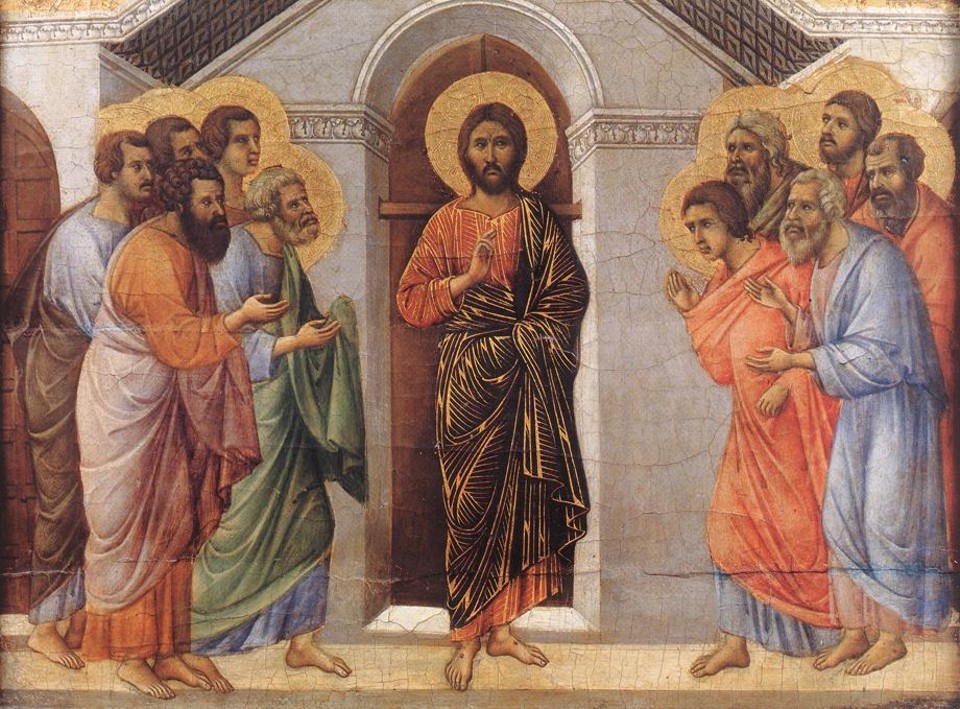 |
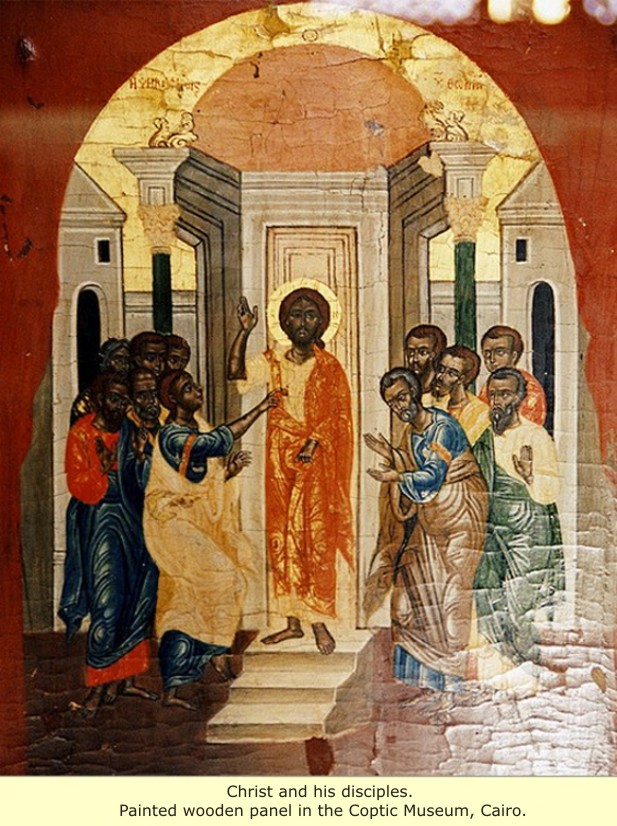
Jesus' appearance from behind locked doors, by Duccio-di-Buoninsegna - 1308 A.D. |
| The Duccio-di-Buoninsegna above, which still has a "somewhat" Black looking Jesus, and some likewise "Black looking" Apostles, seems to mark the end of Black Jesus, and the beginnings of the total lie. No non-White depiction of Jesus is known to have been made after this time - by White people. |
 |
The last judgment by Pietro Cavallini - 1293 A.D. St Cecilia Trastevere, Rome. |
 |
|
Another fresco of Christ Among the Apostles is in an arcosolium of the Crypt of Ampliatus in the Catacombs of St. Domitilla in Rome. Probably from a later time than the first fresco. Is this the beginning of the Whitinization of Black People? It may be that later artists felt that since this fresco didn't cause the artist to immediately burn in Hell, it might be okay to paint Jesus as White. |
 |
Santa Costanza mosiac - Santa Costanza is a church in Rome, built under Emperor Constantine I and place of burial (mausoleum) of his daughters Constantina and Helena. Later, Constantina was venerated as saint, with the Italian name of Costanza, and the church was dedicated to her. The church was built under Constantine, probably by Constantinia, next to the cemetery of Sant'Agnese fuori le mura, where Saint Agnes, who allegedly had healed Constantina, was buried. After their deaths, Constantine's daughters Constantina and Helena were buried here. Since Consantina was venerated as saint, the mausoleum was consecrated as a church in 1254 by Pope Alexander IV. After the church was restored in 1620 by Cardinal Fabrizio Veralli, Constantina's magnificent porphyry sarcophagus was moved to the Vatican Museums. The Church was originally a mausoleum. |
 |
Dead Christ - Giovanni Bellini, 1460 A.D. Museum Poldi Pezzoli, Milan |
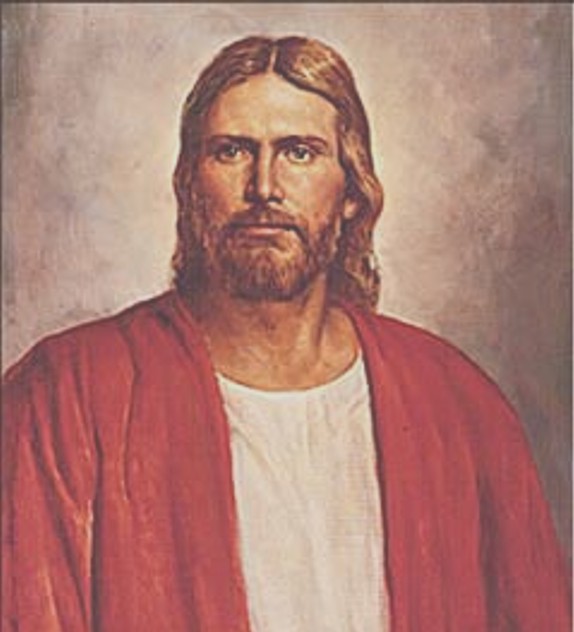 |
The Modern Jesus |
The Roman historian Cornelius Tacitus (56-118 A.D.) had these thoughts on the origins and customs of the Hebrews, as the Romans prepared to destroy Jerusalem. |
|
This is in the context of Titus Caesar, who had been selected by his father to complete the subjugation of Judaea.Tacitus: History Book 51. EARLY in this year Titus Caesar, who had been selected by his father to complete the subjugation of Judaea, and who had gained distinction as a soldier while both were still subjects, began to rise in power and reputation, as armies and provinces emulated each other in their attachment to him. The young man himself, anxious to be thought superior to his station, was ever displaying his gracefulness and his energy in war. By his courtesy and affability he called forth a willing obedience, and he often mixed with the common soldiers, while working or marching, without impairing his dignity as general. He found in Judaea three legions, the 5th, the 10th, and the 15th, all old troops of Vespasian's. To these he added the 12th from Syria, and some men belonging to the 18th and 3rd, whom he had withdrawn from Alexandria. This force was accompanied by twenty cohorts of allied troops and eight squadrons of cavalry, by the two kings Agrippa and Sohemus, by the auxiliary forces of king Antiochus, by a strong contingent of Arabs, who hated the Jews with the usual hatred of neighbours, and, lastly, by many persons brought from the capital and from Italy by private hopes of securing the yet unengaged affections of the Prince. With this force Titus entered the enemy's territory, preserving strict order on his march, reconnoitring every spot, and always ready to give battle. At last he encamped near Jerusalem. 2. As I am about to relate the last days of a famous city, it seems appropriate to throw some light on its origin. Some say that the Jews were fugitives from the island of Crete, who settled on the nearest coast of Africa about the time when Saturn was driven from his throne by the power of Jupiter. Evidence of this is sought in the name. There is a famous mountain in Crete called Ida; the neighbouring tribe, the Idaei, came to be called Judaei by a barbarous lengthening of the national name. Others assert that in the reign of Isis the overflowing population of Egypt, led by Hierosolymus and Judas, discharged itself into the neighbouring countries. Many, again, say that they were a race of Ethiopian origin, who in the time of king Cepheus were driven by fear and hatred of their neighbours to seek a new dwelling-place. Others describe them as an Assyrian horde who, not having sufficient territory, took possession of part of Egypt, and founded cities of their own in what is called the Hebrew country, lying on the borders of Syria. Others, again, assign a very distinguished origin to the Jews, alleging that they were the Solymi, a nation celebrated in the poems of Homer, who called the city which they founded Hierosolyma after their own name. (The Solymi were supposedly a tribe from Pisidia, a region of ancient Anatolia/Asia Minor/Byzantium/Eastern Roman Empire/Turkey).
3. Most writers, however, agree in stating that once a disease, which horribly disfigured the body, broke out over Egypt; that king Bocchoris, seeking a remedy, consulted the oracle of Hammon, and was bidden to cleanse his realm, and to convey into some foreign land this race detested by the gods. The people, who had been collected after diligent search, finding themselves left in a desert, sat for the most part in a stupor of grief, till one of the exiles, Moyses by name, warned them not to look for any relief from God or man, forsaken as they were of both, but to trust to themselves, taking for their heaven-sent leader that man who should first help them to be quit of their present misery. They agreed, and in utter ignorance began to advance at random. Nothing, however, distressed them so much as the scarcity of water, and they had sunk ready to perish in all directions over the plain, when a herd of wild asses was seen to retire from their pasture to a rock shaded by trees. Moyses followed them, and, guided by the appearance of a grassy spot, discovered an abundant spring of water. This furnished relief. After a continuous journey for six days, on the seventh they possessed themselves of a country, from which they expelled the inhabitants, and in which they founded a city and a temple. 4. Moyses, wishing to secure for the future his authority over the nation, gave them a novel form of worship, opposed to all that is practised by other men. Things sacred with us, with them have no sanctity, while they allow what with us is forbidden. In their holy place they have consecrated an image of the animal by whose guidance they found deliverance from their long and thirsty wanderings. They slay the ram, seemingly in derision of Hammon, and they sacrifice the ox, because the Egyptians worship it as Apis. They abstain from swine's flesh, in consideration of what they suffered when they were infected by the leprosy to which this animal is liable. By their frequent fasts they still bear witness to the long hunger of former days, and the Jewish bread, made without leaven, is retained as a memorial of their hurried seizure of corn. We are told that the rest of the seventh day was adopted, because this day brought with it a termination of their toils; after a while the charm of indolence beguilded them into giving up the seventh year also to inaction. But others say that it is an observance in honour of Saturn, either from the primitive elements of their faith having been transmitted from the Idaei, who are said to have shared the flight of that God, and to have founded the race, or from the circumstance that of the seven stars which rule the destinies of men Saturn moves in the highest orbit and with the mightiest power, and that many of the heavenly bodies complete their revolutions and courses in multiples of seven. 5. This worship, however introduced, is upheld by its antiquity; all their other customs, which are at once perverse and disgusting, owe their strength to their very badness. The most degraded out of other races, scorning their national beliefs, brought to them their contributions and presents. This augmented the wealth of the Jews, as also did the fact, that among themselves they are inflexibly honest and ever ready to shew compassion, though they regard the rest of mankind with all the hatred of enemies. They sit apart at meals, they sleep apart, and though, as a nation, they are singularly prone to lust, they abstain from intercourse with foreign women; among themselves nothing is unlawful. Circumcision was adopted by them as a mark of difference from other men. Those who come over to their religion adopt the practice, and have this lesson first instilled into them, to despise all gods, to disown their country, and set at nought parents, children, and brethren. Still they provide for the increase of their numbers. It is a crime among them to kill any newly-born infant. They hold that the souls of all who perish in battle or by the hands of the executioner are immortal. Hence a passion for propagating their race and a contempt for death. They are wont to bury rather than to burn their dead, following in this the Egyptian custom; they bestow the same care on the dead, and they hold the same belief about the lower world. Quite different is their faith about things divine. The Egyptians worship many animals and images of monstrous form; the Jews have purely mental conceptions of Deity, as one in essence. They call those profane who make representations of God in human shape out of perishable materials. They believe that Being to be supreme and eternal, neither capable of representation, nor of decay. They therefore do not allow any images to stand in their cities, much less in their temples. This flattery is not paid to their kings, nor this honour to our Emperors. From the fact, however, that their priests used to chant to the music of flutes and cymbals, and to wear garlands of ivy, and that a golden vine was found in the temple, some have thought that they worshipped father Liber, the conqueror of the East, though their institutions do not by any means harmonize with the theory; for Liber established a festive and cheerful worship, while the Jewish religion is tasteless and mean. |
 |
But before the modern era of pathetic White racism, with it's White fright of all things Black, and Black identity theft. Where Khazar Turks are the new Hebrews, and Osman Turks are the new Berbers, Egyptians, Arabs, and Middle-Easterners. Before every ancient Black figure encountered in a museum or book was explained away as a Nubian-Ethiopian, a Slave, or a servant: All people knew Hebrews to be Black people, and depicted them as Black people. |
 |
 |
 |
 |
 |
 |
 |
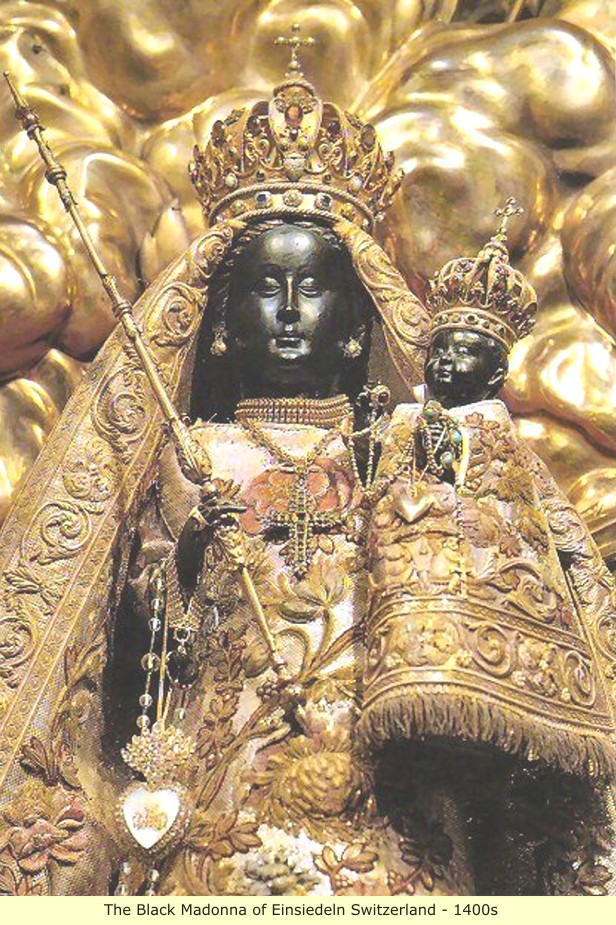 |
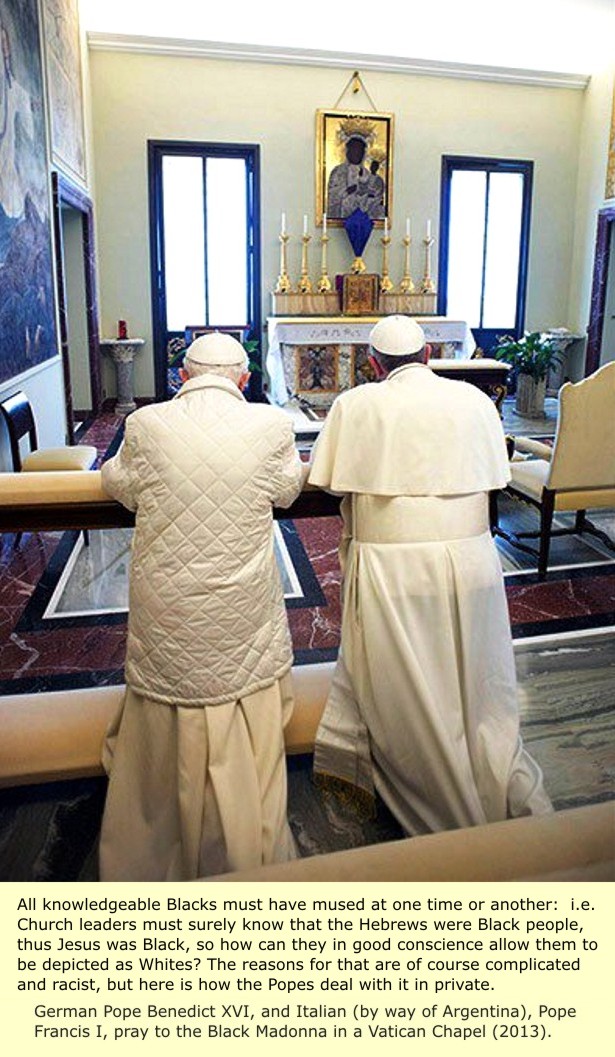 |
 |
 |
 |
According to the Albinos and their pronouncements from the Liber Pontificalis, three popes-Pope St Victor I (c. 186-198), Pope St Miltiades (311-14), and Pope St Gelasius (492-496)-were Africans. The Liber Pontificalis is composed of a series of biographical entries, which record the dates and important facts for each pope. It is the oldest and most detailed chronicle dating from the Early Church. The Liber Pontificalis is dated from the sixth century. The record of names begins with St Peter. As the work progressed the entries became longer and more detailed. The Liber Pontificalis continued to be written until 1431. So then, is the Liber Pontificalis deception by word play, differentiating between African and Black? Which is actually okay, if people know what you are doing. But somehow I doubt the criminals in the Vatican would let on to that.
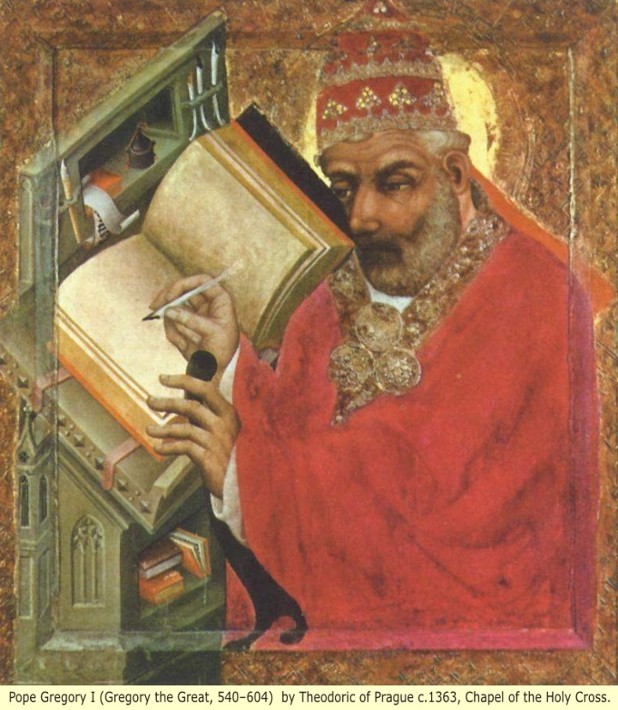 |
 |
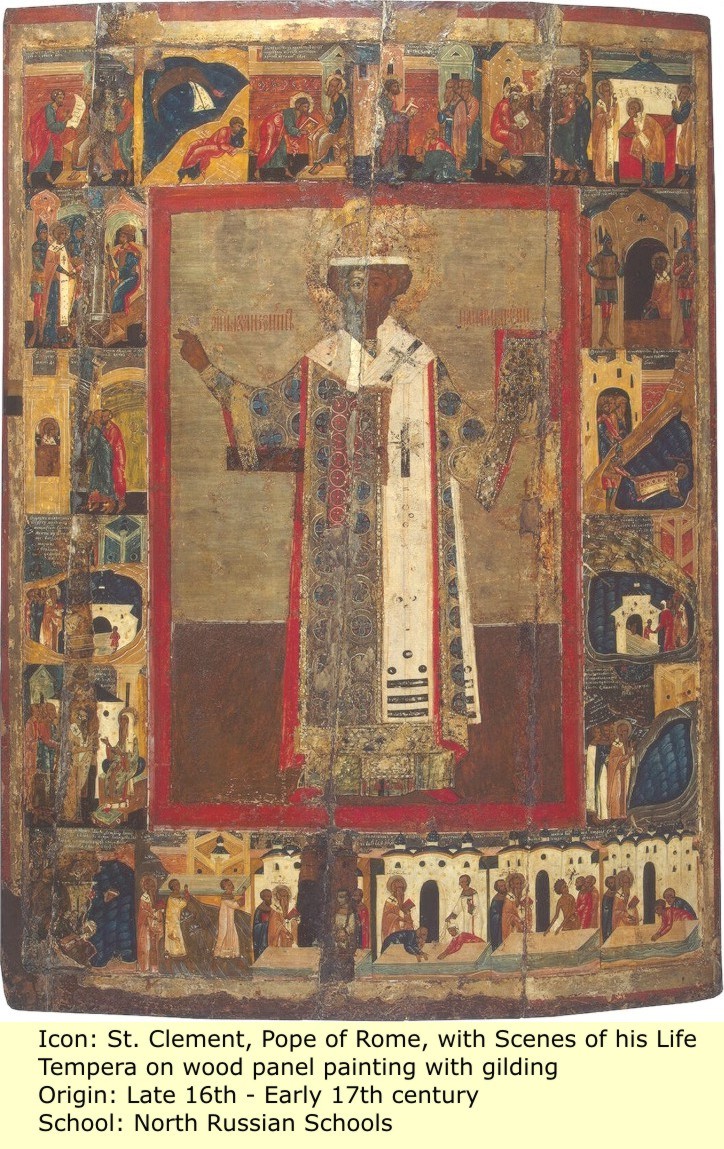 |
 |
 |
 |
 |
 |
 |
 |
 |
 |
 |
 |
 |
 |
For histories and images of some of the first Christians: Click Here >>> |
Lucius Cassius Dio Cocceianus (155 A.D. to circa after 229), was a Roman consul and a noted historian writing in Greek.
Cassius Dio
Roman History
Book XXXVII
14 - 3: After the death of Mithridates all portions of his dominion except a few were subjugated. A few garrisons which at that time were still holding forts outside of Bosporus, did not immediately come to terms, not so much because they were minded to resist Pompey as because they were afraid that others might seize the money which they were guarding and lay the blame upon them; hence they waited, wishing to show everything to Pompey himself. When, then, the regions in that quarter had been subdued, and Phraates remained quiet, while Syria and Phoenicia had become tranquil, Pompey turned against Aretas. The latter was king of the Arabians, now subjects of the Romans, as far as the Red Sea. Previously he had done the greatest injury to Syria and had on this account become involved in a battle with the Romans who were defending it; he was defeated by them, but nevertheless continued the war at that time. Pompey accordingly marched against him and his neighbours, and, overcoming them without effort, left them in charge of a garrison.
Thence he proceeded against Syria Palaestina, because its inhabitants had ravaged Phoenicia. Their rulers were two brothers, Hyrcanus and Aristobulus, who were quarrelling themselves, as it chanced, and were creating factions in the cities on account of the priesthood (for so they called their kingdom) of their god, whoever he is. Pompey immediately won over Hyrcanus without a battle, since the latter had no force worthy of note; and by shutting up Aristobulus in a certain place he compelled him to come to terms, and when he would surrender neither the money nor the garrison, he threw him into chains. After this he more easily overcame the rest, but had trouble in besieging Jerusalem. 16 Most of the city, to be sure, he took without any trouble, as he was received by the party of Hyrcanus; but the temple itself, which the other party had occupied, he captured only with difficulty. For it was on high ground and was fortified by a wall of its own, and if they had continued defending it on all days alike, he could not have got possession of it. As it was, they made an excavation of what are called the days of Saturn, and by doing no work at all on those days afforded the Romans an opportunity in this interval to batter down the wall. The latter, on learning of this superstitious awe of theirs, made no serious attempts the rest of the time, but on those days, when they came round in succession, assaulted most vigorously. Thus the defenders were captured on the day of Saturn, without making any defence, and all the wealth was plundered. The kingdom was given to Hyrcanus, and Aristobulus was carried away.
This was the course of events at that time in Palestine; for this is the name that has been given from of old to the whole country extending from Phoenicia to Egypt along the inner sea. They have also another name that they have acquired: the country has been named Judaea, and the people themselves Jews. I do not know how this title came to be given to them, but it applies also to all the rest of mankind, although of alien race, who affect their customs. This class exists even among the Romans, and though often repressed has increased to a very great extent and has won its way to the right of freedom in its observances. They are distinguished from the rest of mankind in practically every detail of life, and especially by the fact that they do not honour any of the usual gods, but show extreme reverence for one particular divinity. They never had any statue of him even in Jerusalem itself, but believing him to be unnamable and invisible, they worship him in the most extravagant fashion on earth. They built to him a temple that was extremely large and beautiful, except in so far as it was open and roofless, and likewise dedicated to him the day called the day of Saturn, on which, among many other most peculiar observances, they undertake no serious occupation.
Now as for him, who he is and why he has been so honoured, and how they got their superstitious awe of him, accounts have been given by many, and moreover these matters have naught to do with this history. The custom, however, of referring the days to the seven stars called planets was instituted by the Egyptians, but is now found among all mankind, though its adoption has been comparatively recent; at any rate the ancient Greeks never understood it, so far as I am aware. But since it is now quite the fashion with mankind generally and even with the Romans themselves, I wish to write briefly of it, telling how and in what way it has been so arranged. I have heard two explanations, which are not difficult of comprehension, it is true, though they involve certain theories. For if you apply the so-called "principle of the tetrachord" (which is believed to constitute the basis of music) to these stars, by which the whole universe of heaven is divided into regular intervals, in the order in which each of them revolves, and beginning at the outer orbit assigned to Saturn, then omitting the next two name the lord of the fourth, and after this passing over two others reach the seventh, and you then go back and repeat the process with the orbits and their presiding divinities in this same manner, assigning them to the several days, you will find all the days to be in a kind of musical connection with the arrangement of the heavens. This is one of the explanations given; the other is as follows. If you begin at the first hour to count the hours of the day and of the night, assigning the first to Saturn, the next to Jupiter, the third to Mars, the fourth to the Sun, the fifth to Venus, the sixth to Mercury, and the seventh to the Moon, according to the order of the cycles which the Egyptians observe, and if you repeat the process, you will find that the first hour of the following day comes to the Sun. And if you carry on the operation throughout the next twenty-four hours in the same manner as with the others, you will dedicate the first hour of the third day to the Moon, and if you proceed similarly through the rest, each day will receive its appropriate god. This, then, is the tradition.
The Roman historian Cornelius Tacitus (56-118 A.D.) had these thoughts on the origins and customs of the Hebrews, as the Romans prepared to destroy Jerusalem.
This is in the context of Titus Caesar, who had been selected by his father to complete the subjugation of Judaea.
Tacitus: History Book 5 [1]
1. EARLY in this year Titus Caesar, who had been selected by his father to complete the subjugation of Judaea, and who had gained distinction as a soldier while both were still subjects, began to rise in power and reputation, as armies and provinces emulated each other in their attachment to him. The young man himself, anxious to be thought superior to his station, was ever displaying his gracefulness and his energy in war. By his courtesy and affability he called forth a willing obedience, and he often mixed with the common soldiers, while working or marching, without impairing his dignity as general. He found in Judaea three legions, the 5th, the 10th, and the 15th, all old troops of Vespasian's. To these he added the 12th from Syria, and some men belonging to the 18th and 3rd, whom he had withdrawn from Alexandria. This force was accompanied by twenty cohorts of allied troops and eight squadrons of cavalry, by the two kings Agrippa and Sohemus, by the auxiliary forces of king Antiochus, by a strong contingent of Arabs, who hated the Jews with the usual hatred of neighbours, and, lastly, by many persons brought from the capital and from Italy by private hopes of securing the yet unengaged affections of the Prince. With this force Titus entered the enemy's territory, preserving strict order on his march, reconnoitring every spot, and always ready to give battle. At last he encamped near Jerusalem.
2. As I am about to relate the last days of a famous city, it seems appropriate to throw some light on its origin. Some say that the Jews were fugitives from the island of Crete, who settled on the nearest coast of Africa about the time when Saturn was driven from his throne by the power of Jupiter. Evidence of this is sought in the name. There is a famous mountain in Crete called Ida; the neighbouring tribe, the Idaei, came to be called Judaei by a barbarous lengthening of the national name. Others assert that in the reign of Isis the overflowing population of Egypt, led by Hierosolymus and Judas, discharged itself into the neighbouring countries. Many, again, say that they were a race of Ethiopian origin, who in the time of king Cepheus were driven by fear and hatred of their neighbours to seek a new dwelling-place. Others describe them as an Assyrian horde who, not having sufficient territory, took possession of part of Egypt, and founded cities of their own in what is called the Hebrew country, lying on the borders of Syria. Others, again, assign a very distinguished origin to the Jews, alleging that they were the Solymi, a nation celebrated in the poems of Homer, who called the city which they founded Hierosolyma after their own name.
3. Most writers, however, agree in stating that once a disease, which horribly disfigured the body, broke out over Egypt; that king Bocchoris, seeking a remedy, consulted the oracle of Hammon, and was bidden to cleanse his realm, and to convey into some foreign land this race detested by the gods. The people, who had been collected after diligent search, finding themselves left in a desert, sat for the most part in a stupor of grief, till one of the exiles, Moyses by name, warned them not to look for any relief from God or man, forsaken as they were of both, but to trust to themselves, taking for their heaven-sent leader that man who should first help them to be quit of their present misery. They agreed, and in utter ignorance began to advance at random. Nothing, however, distressed them so much as the scarcity of water, and they had sunk ready to perish in all directions over the plain, when a herd of wild asses was seen to retire from their pasture to a rock shaded by trees. Moyses followed them, and, guided by the appearance of a grassy spot, discovered an abundant spring of water. This furnished relief. After a continuous journey for six days, on the seventh they possessed themselves of a country, from which they expelled the inhabitants, and in which they founded a city and a temple.
4. Moyses, wishing to secure for the future his authority over the nation, gave them a novel form of worship, opposed to all that is practised by other men. Things sacred with us, with them have no sanctity, while they allow what with us is forbidden. In their holy place they have consecrated an image of the animal by whose guidance they found deliverance from their long and thirsty wanderings. They slay the ram, seemingly in derision of Hammon, and they sacrifice the ox, because the Egyptians worship it as Apis. They abstain from swine's flesh, in consideration of what they suffered when they were infected by the leprosy to which this animal is liable. By their frequent fasts they still bear witness to the long hunger of former days, and the Jewish bread, made without leaven, is retained as a memorial of their hurried seizure of corn. We are told that the rest of the seventh day was adopted, because this day brought with it a termination of their toils; after a while the charm of indolence beguilded them into giving up the seventh year also to inaction. But others say that it is an observance in honour of Saturn, either from the primitive elements of their faith having been transmitted from the Idaei, who are said to have shared the flight of that God, and to have founded the race, or from the circumstance that of the seven stars which rule the destinies of men Saturn moves in the highest orbit and with the mightiest power, and that many of the heavenly bodies complete their revolutions and courses in multiples of seven.
5. This worship, however introduced, is upheld by its antiquity; all their other customs, which are at once perverse and disgusting, owe their strength to their very badness. The most degraded out of other races, scorning their national beliefs, brought to them their contributions and presents. This augmented the wealth of the Jews, as also did the fact, that among themselves they are inflexibly honest and ever ready to shew compassion, though they regard the rest of mankind with all the hatred of enemies. They sit apart at meals, they sleep apart, and though, as a nation, they are singularly prone to lust, they abstain from intercourse with foreign women; among themselves nothing is unlawful. Circumcision was adopted by them as a mark of difference from other men. Those who come over to their religion adopt the practice, and have this lesson first instilled into them, to despise all gods, to disown their country, and set at nought parents, children, and brethren. Still they provide for the increase of their numbers. It is a crime among them to kill any newly-born infant. They hold that the souls of all who perish in battle or by the hands of the executioner are immortal. Hence a passion for propagating their race and a contempt for death. They are wont to bury rather than to burn their dead, following in this the Egyptian custom; they bestow the same care on the dead, and they hold the same belief about the lower world. Quite different is their faith about things divine. The Egyptians worship many animals and images of monstrous form; the Jews have purely mental conceptions of Deity, as one in essence. They call those profane who make representations of God in human shape out of perishable materials. They believe that Being to be supreme and eternal, neither capable of representation, nor of decay. They therefore do not allow any images to stand in their cities, much less in their temples. This flattery is not paid to their kings, nor this honour to our Emperors. From the fact, however, that their priests used to chant to the music of flutes and cymbals, and to wear garlands of ivy, and that a golden vine was found in the temple, some have thought that they worshipped father Liber, the conqueror of the East, though their institutions do not by any means harmonize with the theory; for Liber established a festive and cheerful worship, while the Jewish religion is tasteless and mean.
Pirke De-Rabbi Eliezer
Pirke De-Rabbi Eliezer is an aggadic-midrashic work on Genesis, part of Exodus, and a few sentences of Numbers, ascribed to R. Eliezer ben Hyrcanus (80-118 C.E.), a disciple of Rabbi Yochanan ben Zakai and teacher of Rabbi Akiva. It comprises fifty four chapters. Some parts appear to be written as late as the 8th century CE, although there are older elements. Pirke De-Rabbi Eliezer comprises ethical guidelines, legends and folklore, as well as astronomical discussions related to the story of the Creation. Many ancient customs that are not found in other sources are described in this work.
The Pirke appears, according to Zunz, to be incomplete, and to be merely a fragment of a larger work. S. Sachs, on the other hand, thinks that it was compiled from two previous works by the same author, the relation of the two productions to each other being that of text and commentary, the text giving merely the story of the Bible, which was interrupted by the commentary in the form of the Aggadah, and the commentary being intended for reading during the ten days of penitence. Meir ha-Levi Horwitz thinks that the author developed those Bible stories which bore relation to the entire nation, dealing lightly with those that concerned only individuals.
Jost was the first to point out that in the 30th chapter, in which at the end the author distinctly alludes to the three stages of the Muslim conquest, that of Arabia, of Spain, and of Rome (830 C.E.), the names of Fatima and Ayesha occur beside that of Ishmael, leading to the conclusion that the book originated in a time when Islam was predominant in Asia Minor. As in ch. xxxvi. two brothers reigning simultaneously are mentioned, after whose reign the Messiah shall come, the work might be ascribed to the beginning of the 9th century, for about that time the two sons of Harun al-Rashid, El-Amin and El-Mamun, were ruling over the Islamic realm. If a statement in ch. xxviii. did not point to an even earlier date, approximately the same date might be inferred from the enumeration of the four powerful kingdoms and the substitution of Ishmael for one of the four which are enumerated in the Talmud and the Mekilta.
The author seems to have been a rabbi of the Land of Israel; this appears not only from the fact that some of the customs to which he refers (in ch. xiii. and xx.) are known only as customs of the Land of Israel, but also from the fact that nearly all the authorities he quotes are from the Land of Israel, the exceptions being Rav Mesharshia and Rav Shemaiah, who are from Babylonia. The work is ascribed to R. Eliezer (80-118 C.E.), although he was a tanna, while the book itself the Pirḳe Abot is quoted. Late Talmudic authorities belonging to the 3rd century C.E., like Shemaiah (ch. xxiii.), Ze'era (ch. xxi., xxix.), and Shila (ch. xlii., xliv.), are also quoted, indicating that the work was edited or additions were made to it after the time of R. Eliezar.
The work is divided into 54 chapters, which may be divided into seven groups.
Supposedly a 10th century Palestinian Jewish author gives
the word of Roman era Ribbi Eli`ezer Hyrkanus that
"[God] blessed Shem and his sons, black and beautiful,
giving them the habitable earth.", his Pirqe, daf 28a.
This blackness was not as dark as Ham's raven similied
black skin.
Amos 9: (King James Version)
7: Are ye not as children of the Ethiopians unto me, O children of Israel? saith the LORD. Have not I brought up Israel out of the land of Egypt? and the Philistines from Caphtor, and the Syrians from Kir?
Isaiah 43: (King James Version)
3: For I am the LORD thy God, the Holy One of Israel, thy Saviour: I gave Egypt for thy ransom, Ethiopia and Seba for thee.
2 Kings 5 (King James Version)
1Now Naaman, captain of the host of the king of Syria, was a great man with his master, and honourable, because by him the LORD had given deliverance unto Syria: he was also a mighty man in valour, but he was a leper.
2And the Syrians had gone out by companies, and had brought away captive out of the land of Israel a little maid; and she waited on Naaman's wife.
3And she said unto her mistress, Would God my lord were with the prophet that is in Samaria! for he would recover him of his leprosy.
4And one went in, and told his lord, saying, Thus and thus said the maid that is of the land of Israel.
5And the king of Syria said, Go to, go, and I will send a letter unto the king of Israel. And he departed, and took with him ten talents of silver, and six thousand pieces of gold, and ten changes of raiment.
6And he brought the letter to the king of Israel, saying, Now when this letter is come unto thee, behold, I have therewith sent Naaman my servant to thee, that thou mayest recover him of his leprosy.
7And it came to pass, when the king of Israel had read the letter, that he rent his clothes, and said, Am I God, to kill and to make alive, that this man doth send unto me to recover a man of his leprosy? wherefore consider, I pray you, and see how he seeketh a quarrel against me.
8And it was so, when Elisha the man of God had heard that the king of Israel had rent his clothes, that he sent to the king, saying, Wherefore hast thou rent thy clothes? let him come now to me, and he shall know that there is a prophet in Israel.
9So Naaman came with his horses and with his chariot, and stood at the door of the house of Elisha.
10And Elisha sent a messenger unto him, saying, Go and wash in Jordan seven times, and thy flesh shall come again to thee, and thou shalt be clean.
11But Naaman was wroth, and went away, and said, Behold, I thought, He will surely come out to me, and stand, and call on the name of the LORD his God, and strike his hand over the place, and recover the leper.
12Are not Abana and Pharpar, rivers of Damascus, better than all the waters of Israel? may I not wash in them, and be clean? So he turned and went away in a rage.
13And his servants came near, and spake unto him, and said, My father, if the prophet had bid thee do some great thing, wouldest thou not have done it? how much rather then, when he saith to thee, Wash, and be clean?
14Then went he down, and dipped himself seven times in Jordan, according to the saying of the man of God: and his flesh came again like unto the flesh of a little child, and he was clean.
15And he returned to the man of God, he and all his company, and came, and stood before him: and he said, Behold, now I know that there is no God in all the earth, but in Israel: now therefore, I pray thee, take a blessing of thy servant.
16But he said, As the LORD liveth, before whom I stand, I will receive none. And he urged him to take it; but he refused.
17And Naaman said, Shall there not then, I pray thee, be given to thy servant two mules' burden of earth? for thy servant will henceforth offer neither burnt offering nor sacrifice unto other gods, but unto the LORD.
18In this thing the LORD pardon thy servant, that when my master goeth into the house of Rimmon to worship there, and he leaneth on my hand, and I bow myself in the house of Rimmon: when I bow down myself in the house of Rimmon, the LORD pardon thy servant in this thing.
19And he said unto him, Go in peace. So he departed from him a little way.
20But Gehazi, the servant of Elisha the man of God, said, Behold, my master hath spared Naaman this Syrian, in not receiving at his hands that which he brought: but, as the LORD liveth, I will run after him, and take somewhat of him.
21So Gehazi followed after Naaman. And when Naaman saw him running after him, he lighted down from the chariot to meet him, and said, Is all well?
22And he said, All is well. My master hath sent me, saying, Behold, even now there be come to me from mount Ephraim two young men of the sons of the prophets: give them, I pray thee, a talent of silver, and two changes of garments.
23And Naaman said, Be content, take two talents. And he urged him, and bound two talents of silver in two bags, with two changes of garments, and laid them upon two of his servants; and they bare them before him.
24And when he came to the tower, he took them from their hand, and bestowed them in the house: and he let the men go, and they departed.
25But he went in, and stood before his master. And Elisha said unto him, Whence comest thou, Gehazi? And he said, Thy servant went no whither.
26And he said unto him, Went not mine heart with thee, when the man turned again from his chariot to meet thee? Is it a time to receive money, and to receive garments, and oliveyards, and vineyards, and sheep, and oxen, and menservants, and maidservants?
27The leprosy therefore of Naaman shall cleave unto thee, and unto thy seed for ever. And he went out from his presence a leper as white as snow.
Leviticus 13 (King James Version)
1And the LORD spake unto Moses and Aaron, saying,
2When a man shall have in the skin of his flesh a rising, a scab, or bright spot, and it be in the skin of his flesh like the plague of leprosy; then he shall be brought unto Aaron the priest, or unto one of his sons the priests:
3And the priest shall look on the plague in the skin of the flesh: and when the hair in the plague is turned white, and the plague in sight be deeper than the skin of his flesh, it is a plague of leprosy: and the priest shall look on him, and pronounce him unclean.
4If the bright spot be white in the skin of his flesh, and in sight be not deeper than the skin, and the hair thereof be not turned white; then the priest shall shut up him that hath the plague seven days:
5And the priest shall look on him the seventh day: and, behold, if the plague in his sight be at a stay, and the plague spread not in the skin; then the priest shall shut him up seven days more:
6And the priest shall look on him again the seventh day: and, behold, if the plague be somewhat dark, and the plague spread not in the skin, the priest shall pronounce him clean: it is but a scab: and he shall wash his clothes, and be clean.
7But if the scab spread much abroad in the skin, after that he hath been seen of the priest for his cleansing, he shall be seen of the priest again.
8And if the priest see that, behold, the scab spreadeth in the skin, then the priest shall pronounce him unclean: it is a leprosy.
9When the plague of leprosy is in a man, then he shall be brought unto the priest;
10And the priest shall see him: and, behold, if the rising be white in the skin, and it have turned the hair white, and there be quick raw flesh in the rising;
11It is an old leprosy in the skin of his flesh, and the priest shall pronounce him unclean, and shall not shut him up: for he is unclean.
12And if a leprosy break out abroad in the skin, and the leprosy cover all the skin of him that hath the plague from his head even to his foot, wheresoever the priest looketh;
13Then the priest shall consider: and, behold, if the leprosy have covered all his flesh, he shall pronounce him clean that hath the plague: it is all turned white: he is clean.
14But when raw flesh appeareth in him, he shall be unclean.
15And the priest shall see the raw flesh, and pronounce him to be unclean: for the raw flesh is unclean: it is a leprosy.
16Or if the raw flesh turn again, and be changed unto white, he shall come unto the priest;
17And the priest shall see him: and, behold, if the plague be turned into white; then the priest shall pronounce him clean that hath the plague: he is clean.
18The flesh also, in which, even in the skin thereof, was a boil, and is healed,
19And in the place of the boil there be a white rising, or a bright spot, white, and somewhat reddish, and it be shewed to the priest;
20And if, when the priest seeth it, behold, it be in sight lower than the skin, and the hair thereof be turned white; the priest shall pronounce him unclean: it is a plague of leprosy broken out of the boil.
21But if the priest look on it, and, behold, there be no white hairs therein, and if it be not lower than the skin, but be somewhat dark; then the priest shall shut him up seven days:
22And if it spread much abroad in the skin, then the priest shall pronounce him unclean: it is a plague.
23But if the bright spot stay in his place, and spread not, it is a burning boil; and the priest shall pronounce him clean.
24Or if there be any flesh, in the skin whereof there is a hot burning, and the quick flesh that burneth have a white bright spot, somewhat reddish, or white;
25Then the priest shall look upon it: and, behold, if the hair in the bright spot be turned white, and it be in sight deeper than the skin; it is a leprosy broken out of the burning: wherefore the priest shall pronounce him unclean: it is the plague of leprosy.
26But if the priest look on it, and, behold, there be no white hair in the bright spot, and it be no lower than the other skin, but be somewhat dark; then the priest shall shut him up seven days:
27And the priest shall look upon him the seventh day: and if it be spread much abroad in the skin, then the priest shall pronounce him unclean: it is the plague of leprosy.
28And if the bright spot stay in his place, and spread not in the skin, but it be somewhat dark; it is a rising of the burning, and the priest shall pronounce him clean: for it is an inflammation of the burning.
29If a man or woman have a plague upon the head or the beard;
30Then the priest shall see the plague: and, behold, if it be in sight deeper than the skin; and there be in it a yellow thin hair; then the priest shall pronounce him unclean: it is a dry scall, even a leprosy upon the head or beard.
31And if the priest look on the plague of the scall, and, behold, it be not in sight deeper than the skin, and that there is no black hair in it; then the priest shall shut up him that hath the plague of the scall seven days:
32And in the seventh day the priest shall look on the plague: and, behold, if the scall spread not, and there be in it no yellow hair, and the scall be not in sight deeper than the skin;
33He shall be shaven, but the scall shall he not shave; and the priest shall shut up him that hath the scall seven days more:
34And in the seventh day the priest shall look on the scall: and, behold, if the scall be not spread in the skin, nor be in sight deeper than the skin; then the priest shall pronounce him clean: and he shall wash his clothes, and be clean.
35But if the scall spread much in the skin after his cleansing;
36Then the priest shall look on him: and, behold, if the scall be spread in the skin, the priest shall not seek for yellow hair; he is unclean.
37But if the scall be in his sight at a stay, and that there is black hair grown up therein; the scall is healed, he is clean: and the priest shall pronounce him clean.
38If a man also or a woman have in the skin of their flesh bright spots, even white bright spots;
39Then the priest shall look: and, behold, if the bright spots in the skin of their flesh be darkish white; it is a freckled spot that groweth in the skin; he is clean.
40And the man whose hair is fallen off his head, he is bald; yet is he clean.
41And he that hath his hair fallen off from the part of his head toward his face, he is forehead bald: yet is he clean.
42And if there be in the bald head, or bald forehead, a white reddish sore; it is a leprosy sprung up in his bald head, or his bald forehead.
43Then the priest shall look upon it: and, behold, if the rising of the sore be white reddish in his bald head, or in his bald forehead, as the leprosy appeareth in the skin of the flesh;
44He is a leprous man, he is unclean: the priest shall pronounce him utterly unclean; his plague is in his head.
45And the leper in whom the plague is, his clothes shall be rent, and his head bare, and he shall put a covering upon his upper lip, and shall cry, Unclean, unclean.
46All the days wherein the plague shall be in him he shall be defiled; he is unclean: he shall dwell alone; without the camp shall his habitation be.
47The garment also that the plague of leprosy is in, whether it be a woollen garment, or a linen garment;
48Whether it be in the warp, or woof; of linen, or of woollen; whether in a skin, or in any thing made of skin;
49And if the plague be greenish or reddish in the garment, or in the skin, either in the warp, or in the woof, or in any thing of skin; it is a plague of leprosy, and shall be shewed unto the priest:
50And the priest shall look upon the plague, and shut up it that hath the plague seven days:
51And he shall look on the plague on the seventh day: if the plague be spread in the garment, either in the warp, or in the woof, or in a skin, or in any work that is made of skin; the plague is a fretting leprosy; it is unclean.
52He shall therefore burn that garment, whether warp or woof, in woollen or in linen, or any thing of skin, wherein the plague is: for it is a fretting leprosy; it shall be burnt in the fire.
53And if the priest shall look, and, behold, the plague be not spread in the garment, either in the warp, or in the woof, or in any thing of skin;
54Then the priest shall command that they wash the thing wherein the plague is, and he shall shut it up seven days more:
55And the priest shall look on the plague, after that it is washed: and, behold, if the plague have not changed his colour, and the plague be not spread; it is unclean; thou shalt burn it in the fire; it is fret inward, whether it be bare within or without.
56And if the priest look, and, behold, the plague be somewhat dark after the washing of it; then he shall rend it out of the garment, or out of the skin, or out of the warp, or out of the woof:
57And if it appear still in the garment, either in the warp, or in the woof, or in any thing of skin; it is a spreading plague: thou shalt burn that wherein the plague is with fire.
58And the garment, either warp, or woof, or whatsoever thing of skin it be, which thou shalt wash, if the plague be departed from them, then it shall be washed the second time, and shall be clean.
59This is the law of the plague of leprosy in a garment of woollen or linen, either in the warp, or woof, or any thing of skins, to pronounce it clean, or to pronounce it unclean.
| < Back | Home | < Back |
