Often times; it seems to us here at Realhistoryww that the ignorant Negro is a bigger problem than the Albinos. Even worst, it seems that they are too often educated in their ignorance by Negro institutions.
 |
Ancient Egypt |
Nubia |
Assyrian Empire |
Persian Empire |
Middle East |
Alexanders Empire |
Ottoman Empire |
Before beginning our history of Egypt, let us first dispel some popular White Lies and subterfuge.
Egyptians, Sumerians, Mohenjo-daroans, Harappans, and Cretans, Elamites, and Nubians, were literate 3,000 years, 4,000 years, who knows how many thousands of years, before the world ever heard of Greeks or Romans. And there is ample evidence of their literacy.Yet there is not one single entry: describing any of the people of their times, whether it be friends, foes, or invaders: or even more incredulously, there is not one single entry describing invading Whites in any of their literature.Contrast that with Greek and Roman writings, in which these NEWLY literate people, describe EVERYTHING and EVERYONE!The discrepancy is of course, not accidental, nor for lack of material.Hopefully, the White man has simply withheld this material, and not destroyed it. |
Often times; it seems to us here at Realhistoryww that the ignorant Negro is a bigger problem than the Albinos. Even worst, it seems that they are too often educated in their ignorance by Negro institutions.
<< Click here for the Negro answers to this question >> |
Throughout the pages of Realhistoryww we rail against the lies of Albinos as relates to history and Race. We offer proof of our claims and hope to shame Albinos into better behavior. But alas, it has all been for naught, Albinos haven’t gotten better, they have gotten even worst! Note these latest examples.
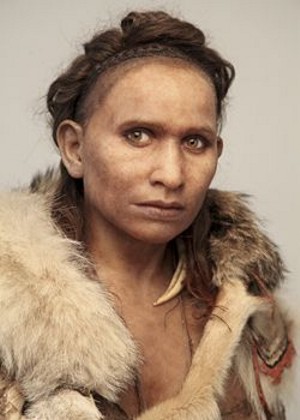
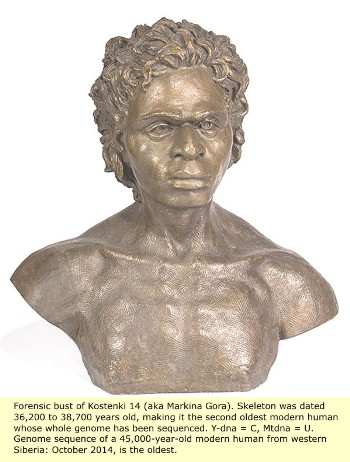
Just look at that, the Albinos are so desperate to get their lies out, with at least some support, that they are now taking UNEDUCATED hacks and commissioning them to make forensic mockups of ancient Blacks.And then Albinos had the nerve to give them prizes, as if they had done something worthwhile: when in fact all they had done was to do great injury to truth, and hopes for Brotherhood and understanding.
Here is what it takes to actually do "REAL" forensic mockups
Here is more of Élisabeth Daynès lying handiwork.
These "REAL" people, not the silly Albino mockups of Albino imagination above: were of course Africans settling Europe at the end of the last "Ice Age". In all pages in Realhistoryww relating to Europe, you will find the scientific proof of that. We are particularly fond of the scientific Study "Cranial Discrete Traits in a Byzantine Population and Eastern Mediterranean Population Movements": but for those wanting more, there are many other scientific studies cited and displayed on our pages. |
So why are we making so much fuss about a simple Albino lie, one of so many? Because it feeds into the overall Albino lie methodology used to keep Blacks ignorant and powerless. We have said that Albino media, Academia, and Institutions, are all a part of the Albino lie infrastructure. Here is a nice example of Albino Newspapers promoting the lies.
SEE NOW HOW THE PHONY PICTURES OF ALBINO EUROPEANS ABOVE, COME INTO PLAY?
Now here is the "REAL" story
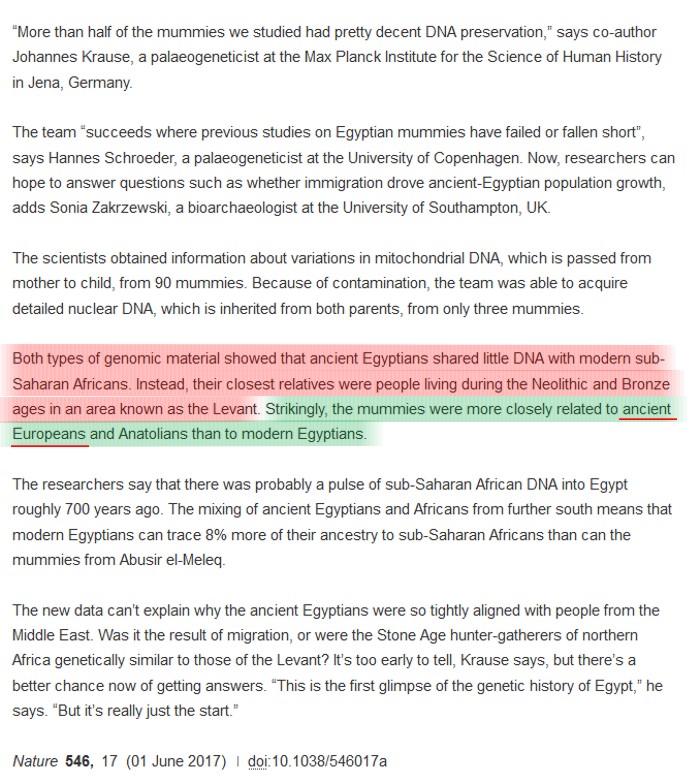
Quote above: Strikingly, the mummies were more closely related toancient Europeans and Anatolians than to modern Egyptians.
Well here are the ancient Europeans!
And here are the ancient Egyptians!
There are TWO kinds of MODERN Egyptians,Anatolians (Turkey), Arabians, and Middle Easterners generally:The White and Mulatto ones are Turks!
The others are the Black onesthat Albino media never show you!
Modern Egyptians
Modern Persians aka Iranians
Modern Arabs
Now do you see how the Albino Lie Machine Works? |
The Nonsense that White People are Cold Adapted HumansOne of the Albinos most outrageous lies is that they are “WHITE SKINNED” because they are a “COLD ADAPTED” People who EVOLVED light Skin to better absorb Sunlight for vitamin “D” synthesis. That is a ridiculous lie, and it is thoroughly and scientifically debunked Here: << Click here >> |
THE VANISHING EVIDENCE OF CLASSICAL AFRICAN CIVILIZATIONS
by Prof. Manu Ampim
The widespread damage to the temple images has allowed Egyptologists to argue from such sources as the temple evidence that ancient Egypt was a multi-racial society and therefore belongs to the world’s heritage and not necessarily to African history. There are probably about a million tourists each year who visit Egypt and Nubia, and they get a totally false view of the identity of the builders of these great civilizations, largely because the evidence of the builders’ Black origin is disappearing. This vanishing evidence has enabled dishonest Egyptologists and tour guides to misrepresent the identity of the founders and builders of ancient Egypt by selectively pointing out the “non-African” images on the walls. Actually, the images which appear to look “non-African” have undergone a racial make-over and look nothing like they did originally. These images have been crudely recarved by European and Arab conspirators who work hard to eliminate all traces of African facial features. Only through exhaustive first-hand research can one demonstrate from the surviving on-site temple evidence that ancient Egypt was a Black civilization.
The altering of Black (African) facial features and the lightening of the skin colors of painted reliefs inside the tombs are central aspects of the conspiracy to destroy the memory of classical African civilizations. The two main conspirator groups carrying out these acts are European and American research teams, and local government workers. Throughout Egypt and Nubia, the tomb images have suffered different levels of decay and destruction. In places such as Giza the tombs are closed as there is little left to see; in Tell Amarna the tomb carvings are in an advanced state of decay; in El Kab and Aswan many of the images have been systematically defaced; and in Beni Hassan only 4 of the 39 tombs are open because the rest are badly damaged. The only major location which has escaped serious tomb damage is Sakkara, but this may not remain true in the future because the conspirators’ work is not complete, until they have destroyed or defaced all the evidence of classical African civilizations.
The problem of deterioration of the Kings Valley (KV) tombs has led to a growing international movement to build replica tombs and close the original structures. The tomb replication project will likely be implemented in the future. Under this plan, the popular tombs which have suffered irreparable damage, such as the tomb of Tutankhamen, will be permanently closed to the public. Once they are closed, the only persons who will have access to the original KV tombs will be Egyptian government officials and workers, and “qualified” researchers. The completion of this tomb replication project will be a major step in further erasing the memory of a Black Egypt. These replica tombs, with the lightened colors and remade facial features, will graphically demonstrate that the evidence of classical African civilizations is vanishing. This of course, holds true for the Minoan and all other Black civilizations.
 |
 |
 |
 |
Three Female Musicians from the Tomb of Nakht - XVIII Dynasty 1450 B.C. How much longer will they remain Black? |
 |
(Note the Libyan and Asiatic are depicted as White)
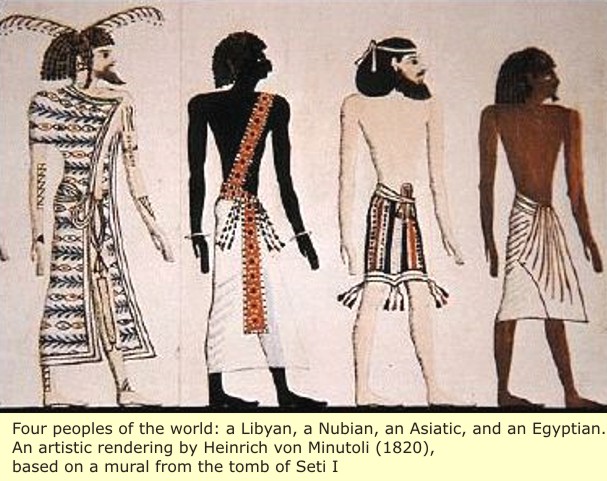 |
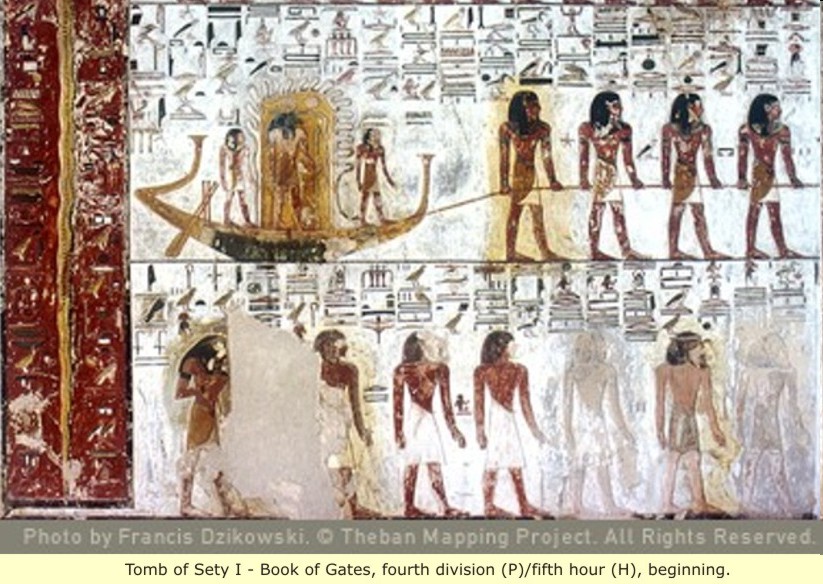 |
 |
1) Rameses II was a Caucasian with Red Hair:
This is one of the sillier lies: At the time of his death, Rameses II was approximately 95 years old. The only hair color people 95 years old have is WHITE!! As documented at the time of his "Supposed" Mummies unwrapping, and by subsequent studies - his hair was white and colored with Henna.
2) Many Egyptian Pharaohs were Caucasian: as proof of that, pictures of Mummies like the one below (left) are bandied about.
Alexander entered Egypt in late October 332 B.C. And from then until 640 A.D, when the Islamist took over, Egypt had been ruled by White Greeks and Romans, who assumed all the paraphernalia and customs of an Egyptian Pharaoh - including Statues and Mummification - for 972 years. That makes for 972 years of White statues and Mummies - which is ample supply for the Turks of Egypt, and the Europeans, to swap and mix and misidentify, to their hearts content. Considering the track record of the Turks of Egypt, and the Europeans who control Egyptian artifacts - the surprise is that they allow ANY real artifacts of Black Egyptians to see the light of day.
 |
 |
 |
And who hasn't seen this Greek Pharaoh or this Greek Priest: passed-off as Egyptians? |
 |
 |
As a helpful hint for those looking for ways to ascertain the truthfulness of Mummy claims; it should be remembered that the ancient Egyptians - Men and Women - shaved their heads and wore wigs, for comfort and cleanliness in the hot climate. The only exception was Royal Princes, who were allowed to have a "side lock" of hair. The wigs that they wore could be made from any number of materials, including human hair.
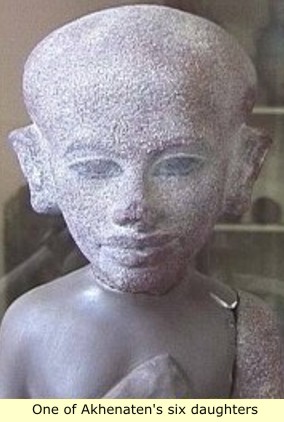 |
 |
 |
 |
Regarding the reference to Rameses II above: The words "at the time of his "Supposed" Mummies unwrapping" were purposefully used. Because as stated above, it was the custom of ALL Egyptians to shave their heads - yet his "Supposed" Mummy has hair. And though there is no evidence that it is really his mummy, and as we know, the people involved are known to lie about such things. The benefit of the doubt is here given, because at the time of his death, Rameses II was a very old man; arthritic and in very poor condition. Therefore it is possible that he would have been unable to suffer having his head shaved, and opted for hair coloring instead - if it's his Mummy.
It is also surprising that ALL White scientists don't seem to know of the Shenanigans of the curators of Egypt's artifacts. Note Gaston Maspero's reported surprise at the REAL appearance of Thutmose III, at the time of his Mummies unwrapping: Thutmose III's mummy was discovered in the Deir el-Bahri above the Mortuary Temple of Hatshepsut in 1881. He was interred along with those of other eighteenth and nineteenth dynasty leaders Ahmose I, Amenhotep I, Thutmose I, Thutmose II, Ramesses I, Seti I, Ramesses II, and Ramesses IX, as well as the twenty-first dynasty pharaohs Pinedjem I, Pinedjem II, and Siamun. While it is popularly thought that his mummy originally was unwrapped by Gaston Maspero in 1886, it was in fact first unwrapped by Émile Brugsch who "evacuated" the mummies from the Deir el-Bahri Cache five years earlier in 1881. Soon after its arrival in the Boulak Museum (The Museum of Egyptian Antiquities), and while Maspero was away in France, the Director General of the Egyptian Antiquities Service ordered the mummy unwrapped and then re-wrapped. So when it was "officially" unwrapped by Maspero in 1886, he almost certainly knew it was in relatively poor condition. The mummy had been damaged extensively in antiquity by tomb robbers, and its wrappings subsequently cut into and torn by the Rassul family who had rediscovered the tomb and its contents only a few years before. Maspero's description of the body provides an idea as to the magnitude of the damage done to the body: His mummy was not securely hidden away, for towards the close of the 20th dynasty it was torn out of the coffin by robbers, who stripped it and rifled it of the jewels with which it was covered, injuring it in their haste to carry away the spoil. It was subsequently re-interred, and has remained undisturbed until the present day; but before re-burial some renovation of the wrappings was necessary, and as portions of the body had become loose, the restorers, in order to give the mummy the necessary firmness, compressed it between four oar-shaped slips of wood, painted white, and placed, three inside the wrappings and one outside, under the bands which confined the winding-sheet. Of the face, which was undamaged, Maspero's says the following:
Question - are we to believe that an experienced Egyptologist like Maspero, actually BELIEVED that ancient Egyptians really looked like the doctored Statues and paintings provided by the Turks of Egypt and Europeans? Note: the nose on many Mummies, like Ramses II's "Supposed Mummy", appear prominent because they had been filled with seeds and animal bone to keep them erect.
Additionally: The reason the world is so fascinated by the genetics of King Tut, and he ALONE, even though he was historically of no importance - is because King Tut is the ONLY verifiably REAL Egyptian Pharaoh - He was found IN HIS OWN TOMB, and it was opened with World Media there to document the occasion - thereby affording little opportunity for the liars to later swap it with a fake Greek or Roman Mummy.
The Mummy face, now put on display, is a lot less idealised than the lustrous and splendid golden mask. It is shrivelled and leather-like from the embalming process. However, it is a lot more human and exhibits one very human characteristic in particular. The mummified face reveals that the young king had buck teeth and the 'overbite' which was characteristic of the Thurmosid royal line to which Tutankhamun belonged. The DNA study findings A DNA study released in February 2010 claimed that Tutankhamun was weakened by congenital illnesses and died of complications from the broken leg aggravated by severe brain malaria. Genetic tests have provided evidence that Tutankhamun and at least four other mummies from his family were infected with Plasmodium falciparum, a parasite that causes an often deadly form of malaria. The team, led by Zahi Hawass, of the Supreme Council of Antiquities in Cairo, concluded that the king’s many disorders probably weakened his immune system, so that he could have died after suffering a “sudden leg fracture, possibly introduced by a fall,” which became life-threatening when he got malaria. The study also revealed that Tutankhamun suffered from a cleft palate, Köhler's disease and club foot. Dr. Zahi Hawass and his team have now examined the remains of Tutankhamun and 10 other royal mummies from his family — two of which they have now confirmed using genetic fingerprinting to be the young king's grandmother and most probably his father. They say there is no compelling evidence to suggest King Tutankhamon or indeed any of his royal ancestors had Marfan's Syndrome. But what's missing above? His actual DNA Haplogroup, Clade and Allele Numbers - that's What! And like the full contents of the "Dead Sea Scrolls" that information will likely NEVER be published - Whites have invested far too much in their False, Made-up History, to EVER let that information be known. |
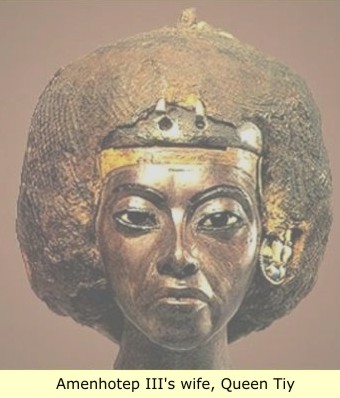
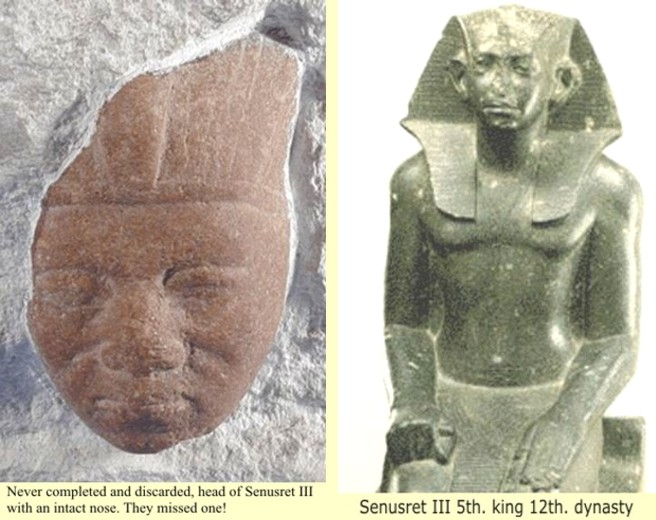
In presenting our history of the worlds first civilizations, we rely heavily on pictures of the statues and relief's that the ancients made in their own image to tell their stories. In viewing these images, it immediately becomes evident that the noses don't look like Black peoples noses. That is because the White people responsible for restoring these artifacts to good condition for display, routinely modify them to make them appear to be White people. In many cases, they don't even bother to change the noses, they simply just break them off.
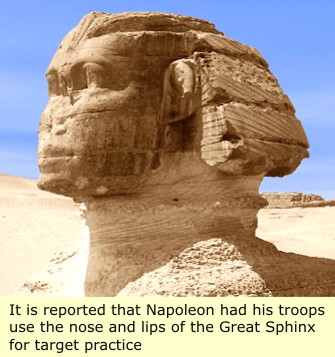 The
British Museum - one of the main depositories of ancient artifacts: has
come up with a truly novel explanation for the defacing of Black
artifacts.
The
British Museum - one of the main depositories of ancient artifacts: has
come up with a truly novel explanation for the defacing of Black
artifacts.
From the British Museum - Quote: Royal statues in Egypt were sometimes usurped (taken over) by later rulers. The normal procedure was simply to re-carve their name over the old one, but in some cases the physical features were also altered. Ramesses II (1279-1213 BC) seems to have altered a number of statues of Amenhotep III in this way, presumably because he wished to represent his ideal image in a certain form. Ramesses seems to have concentrated on changing the characteristic thick lips of the older statuary to thinner ones. In other cases he took to reducing the plump stomach areas of Amenhotep's statues to make them closer to his ideal of the physical shape of the king. End Quote.
So now we are to believe that it was not White people, (modern Europeans and Turks) they who have held Egypt's treasures for over 2,500 years; who are responsible for defacing Black artifacts, but rather, it was done by another Black man, Rameses II. Great, but we are left to wonder how Rameses II managed to get his hands on all of those statues, even those made after he was dead; and what about Sumerian statues? Seeing as how the same thing was done to them too, truly amazing.
Putting aside that nonsense from the British Museum, let us look at some examples of defacement of Black artifacts by White people. One of the best examples is of the wife of the aforementioned Pharaoh Amenhotep III, Queen Tiy. The Egyptians often used "faience" a finely glazed ceramic material, to make small statues and jewelry. Being a brittle material, faience would break if it was filed down, and it would be impossible to patch it to make it look natural after modification. Thus Queen Tiy's small faience statue below has her natural nose - compare that to her bust.
 |
 |
 |
 |
 |
 |
Perhaps the most blatant!
|
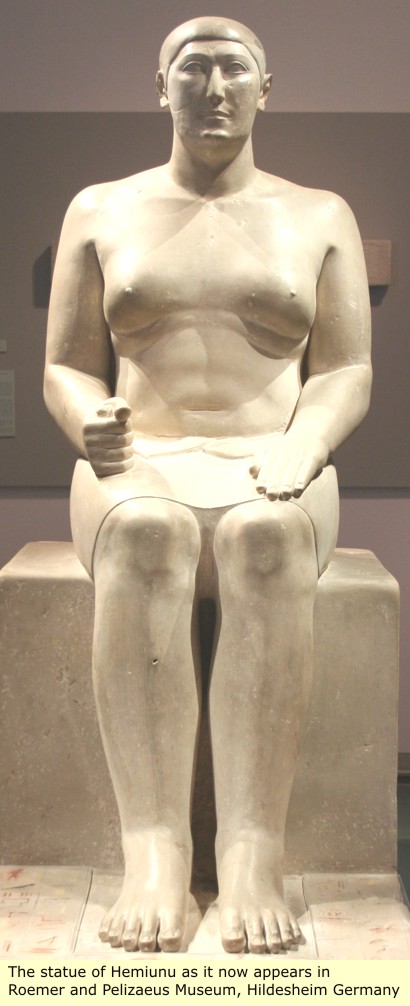
Hemiunu was a son of prince Nefermaat, son of King Snofru. He is believed to be the architect of the Great Pyramid of Giza, Egypt. Below is his uncle, King Khufu.
|
This is Hemiunu's Grandfather, King Snofru or Sneferu , 1st king of the 4th dynasty. |
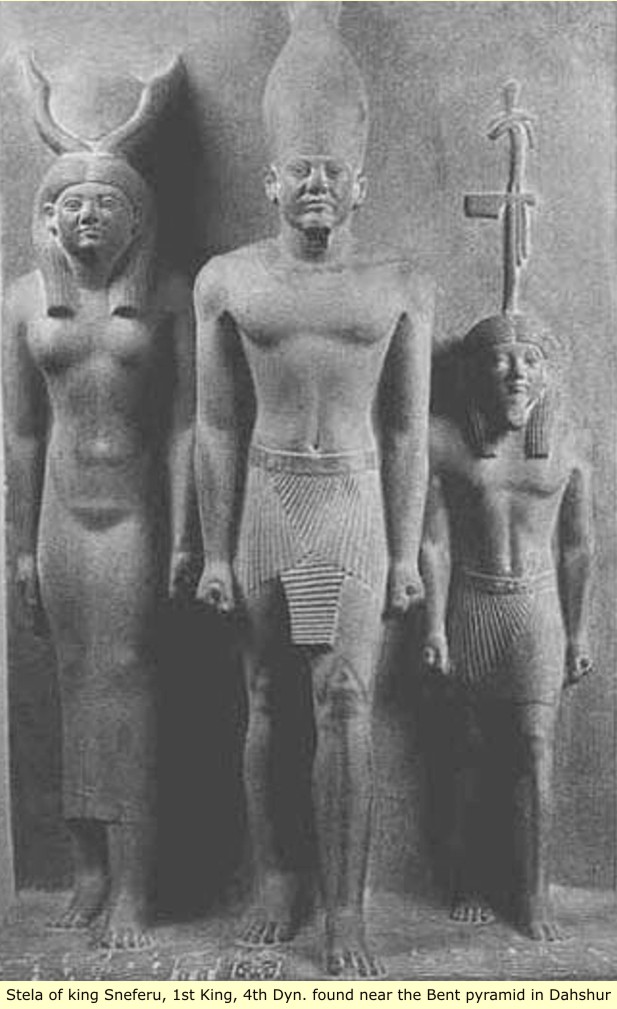 |
In one of the most blatant examples of racist White hubris:White people had the unmitigated gall to put the face of a White man, on a Black mans body!Surely when pressed on this matter, whites will say; well it was accidental. But they had access to these very same statues, and many more. There were ample examples of Hemiunu's family's appearance and features. This is just another episode, in the White mans ongoing program to write Blacks out-of-history, and replace them with Whites. This because while Blacks were MAKING history, the Albino Whites were still illiterate Nomads in the Central Asian plains. When they arrived in Europe, (circa 1,200 B.C.) they simply appropriated all that the Black man had built and accomplished. But being the degenerates that they are, they couldn't content themselves with simply having it, they felt compelled to claim creation of it. And to that end, there is a huge White industry of fake artifacts, not only of Egyptians, but of ALL the original first civilizations created by Black people.
|
 |
 |
| In the case of the two statues above: the stupidity of the forgers is sublime. A complete list of the errors would take the whole page, but here are just a few. The Egyptians were fastidious about removing facial and head hair - that's why they wore wigs. A Royal Prince with a full head of hair and a mustache would have been unthinkable. Plus, Caucasians did not reach the middle east until well after 1,200 B.C. - Ra-Hotep is completely out of the question. Queen Tetisheri - it is hard to tell with the nose, but the style and look is all wrong for an Egyptian statue. |
 |
The Turks of North Africa and the Middle East: together with Europeans, both in Europe, and around the World; have done horrible, destructive, disrespectful things to Mankind's precious inheritance - the Artifacts of the Ancient Blacks. They played no meaningful part in Mankind's formative years, and those involved know it. But resentful pique, together with false pride, compels them to try and force a false place for themselves in Mankind's history, when there really is none. And sadly, it seems lost on them, that all they have really accomplished, is to guarantee that those that proceed them, will do the same to them.
The next few pages, though speaking specifically of Egypt, are typical of ancient man. All dates presented in pre-historic and early historic times of Egypt and the other civilizations, are largely guesses. The methods most often used to date artifacts and remains, namely carbon-14 and potassium-argon decay, are not very useful in calculating dates in the Lower and early Middle Paleolithic eras (stone ages), and other methods for later times, are no better. As an example: many date the Sphinx of Egypt to be more than 12,000 years old, but it is conventionally dated at 4,500 years old, quite a difference. So please take the dates given as a guesstimate - a convenient point of reference, nothing more.
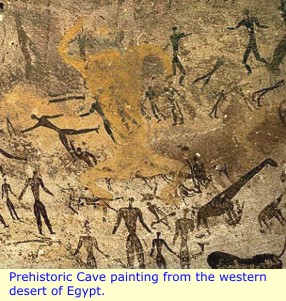 In
Egypt, sometime around 40,000 to 15,000 years ago, the rains started to
diminish, and the Sahara, which had been a fertile land, started to dry
up, and was becoming a desert. Fleeing the advancing desert, many of
the people that were living in the area started to migrated closer to
the only dependable source of fresh water - the Nile River. Over the
following thousands of years, the Sahara became a total desert,
completely incapable of supporting human life except for the Oasis'. By
then, the people of the area had already moved to the Nile River
Valley. And it is here in the Nile Valley, where as these early human
groups are forced to live closer and ever closer to each other, they
start to cooperate with each other, and to learn from each other.
In
Egypt, sometime around 40,000 to 15,000 years ago, the rains started to
diminish, and the Sahara, which had been a fertile land, started to dry
up, and was becoming a desert. Fleeing the advancing desert, many of
the people that were living in the area started to migrated closer to
the only dependable source of fresh water - the Nile River. Over the
following thousands of years, the Sahara became a total desert,
completely incapable of supporting human life except for the Oasis'. By
then, the people of the area had already moved to the Nile River
Valley. And it is here in the Nile Valley, where as these early human
groups are forced to live closer and ever closer to each other, they
start to cooperate with each other, and to learn from each other.
Over time, they begin to form the first pools of collective knowledge, (as an example of collective knowledge: no one person knows how to build a car by himself - it takes thousands of people, each pooling their individual knowledge and skills to build a car). With this collective knowledge, early man first learns how to make better tools for fishing, hunting and butchering his kill, (in time, this knowledge would grow to the point where they can build the Pyramids). Then the early forms of farming begin to appear. At a few sites, there is evidence that fishing was abandoned by some people, possibly because farmed grains (barley, most likely), together with the large herd animals that they still hunted, created a diet that was more than adequate for their needs.
| There can be no question as to the truthfulness of the saying "Necessity is the Mother of Invention." This very same scenario of early man being forced to live together in River Valleys, because of harsh conditions in the surrounding areas, is played out again and again, for each of the other founding civilizations. The Tigress and Euphrates River Valleys in Sumer. The Indus River Valley in India. The Yellow River Valley in China. |
Soon we begin to see the first signs of "true" culture emerging, such as the Qadan culture (13,000 - 9,000 B.C.). These Qadan sites, which stretch from the Second Cataract of the Nile to Tushka (just above Aswan), actually have cemeteries and evidence of ritual burial. It is also during this time, that true agriculture begins, grinding stones and reaping blades have been found in great numbers there. It is also about this time that they learn to domesticate animals. But as is always the case with man, there is always conflict and war. A statistical analysis of the main cemetery at Jebel Sahaba, gives a figure of 40 percent of the people buried there, died from wounds due to thrown projectiles; spears, darts, and arrows.
 Now
lets look at these ancient people in terms of their cultural phases:
that is to say, how man was thinking, living and working at a given
time in a given place. (as always, these cultural phase names are taken
from the place where the evidence and artifacts were found, we never
know what they called these places or themselves).
Now
lets look at these ancient people in terms of their cultural phases:
that is to say, how man was thinking, living and working at a given
time in a given place. (as always, these cultural phase names are taken
from the place where the evidence and artifacts were found, we never
know what they called these places or themselves).
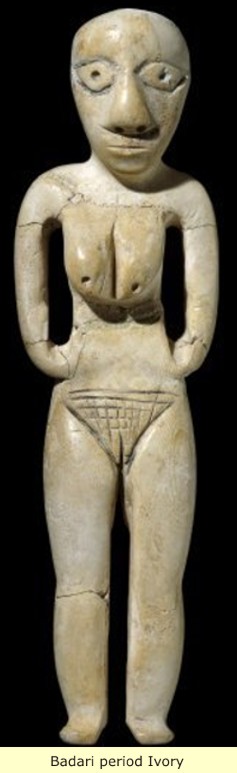
The Badari are believed to be the ancestors of the pre-dynastic Egyptians. They lived in Upper Egypt, on the eastern bank of the Nile near the village of Badari, which is south of Asiut. Here archaeologists have found both, a series of settlement sites, as well as various cemeteries. These people lived before 4400 B.C, though they were a semi-nomadic people, they started to cultivate grain and domesticate animals. They had a series of small villages in the flat desert which borders the flood plain created by the Nile. Their burial grounds were found on the outskirts of their villages. They performed ritual sacrifice of cattle and sheep, and then gave these animals ceremonial burial.
The graves of these people were simple - the dead were laid to rest on their left side facing the west in a fetal position and wrapped in matting. They were buried with fine grave goods - such as beautiful ceramics, decorated plates, bowls and dishes. Also cosmetic utensils, which included makeup palettes, ointment spoons, decorative combs and bracelets, necklaces, copper beads and pins. They also usually had an ivory or clay female figure, (which may have been a fertility doll or idol), placed in the grave with the deceased. This all indicates a highly evolved funerary system, the dead were buried with their finest possessions for use in the next world. Unfortunately, many of these graves were robbed.
Succeeding the Badari, the Amratian/Naqada people took over. They were one of the most important prehistoric cultures in Upper Egypt, and their development can be traced to the founding of the Egyptian state. The Amratian (Naqada I), started as a parallel culture to the Badari, but eventually replaced it. These then were the people commonly thought of, as the first "true" Egyptians, about 4500-3100 B.C.
Like the Badari, they lived in villages, and cultivated the fertile Nile valley. Each village had it's own animal deity, which was identified on the clan ensign. From this came the different Egyptian Nome's (districts), with their own local totems, later these totems would become the gods of the dynastic pantheon.
As the artistic abilities of the people grew, they started making pottery decorated with animals and humans engaged in hunting or worshiping. Female idol figures continue to appear - but now in greater numbers and in a wider variety. And now bearded male figures, also started to appear on pendants and ivory sticks, these seem to have a magical or spiritual purpose.
In the Amratian graves, the deceased were buried with statuettes to keep them company in the afterlife. These were the forerunners of ushabti figures, which are found in later Egyptian tombs. Along with these figures, the dead person was buried with food, weapons, amulets, ornaments, and decorated vases and palettes.
 |
 |
 |
In the middle of the fourth millennium B.C, the Gerzean/Naqada II culture superceded the Naqada I. They had by now, mastered the art of agriculture and the use of artificial irrigation (canals and dykes). With this and their domesticated animals, they no longer needed to hunt for their food. The people started to live in towns, not just villages. The Gerzean people continued to grow in the artistic area also, creating new styles of pottery and more elegant artwork. Metalworking increased - the Gerzean people made great use of copper knives. They also created their own cast-metal implements and weapons.
They also traded with far distant peoples and places, such as Mesopotamia and Asia, for copper, silver, lapis lazuli, lead, and cylinder seals. Soon foreign influences brought in through their trading activities, began to show in their style of dress, ornaments and various implements. Radical changes in the design of knives, daggers and pottery were made by the Gerzeans because of these influences, which were of course two-way.
 It
was also at this time, that they introduced the Sun God "Ra" (later
Horus). Whose symbol was the falcon, and the love goddess Hathor, whose
symbol was the cow. There were also significant changes in their type
of burial. Whereas before, the corpse was generally wrapped in some
sort of covering, and buried in a contracted position facing the west.
Now those in Gerzean graves, showed no particular orientation at all,
but the graves were now much more elaborate. Here also is evidence of
an elite social class, from the grave goods found. These more elaborate
funerals have larger rectangular graves, with walls lined with either
masonry or wood.
It
was also at this time, that they introduced the Sun God "Ra" (later
Horus). Whose symbol was the falcon, and the love goddess Hathor, whose
symbol was the cow. There were also significant changes in their type
of burial. Whereas before, the corpse was generally wrapped in some
sort of covering, and buried in a contracted position facing the west.
Now those in Gerzean graves, showed no particular orientation at all,
but the graves were now much more elaborate. Here also is evidence of
an elite social class, from the grave goods found. These more elaborate
funerals have larger rectangular graves, with walls lined with either
masonry or wood.
In Nekhem (Hierakonpolis), we see the beginnings of this class distinction, here we find large dynastic type buildings, with new rituals and social structure. In the cult center of Horus, there is a palace and ritual precinct, which was made of timber and matting, but can only be theoretically reconstructed from the positions of the postholes - some of which were big enough for entire tree trunks! The features of this complex can be compared with the buildings of Pharaoh Djoser's pyramid complex, because it also has a large oval courtyard, surrounded by various buildings. This is clearly the forerunner to the royal ritual precincts of the early Dynastic Period.
Upper Egypt - referrers to southern Egypt, Lower Egypt referrers to northern Egypt. The reason for this apparent switch, is that their reference was the Nile river, which runs South to North.
The word Pharaoh means "Great House" a reference to the kings residence.
The actual name of the country that we call Egypt is "Kemet" which in the Kemetian language means the "Black land", no doubt referring to the dark soil of the Nile river valley. The word "Egypt" is the Greek name for the country and is a reference to a mythical Greek hero "Aegyptus". The Kemetians called themselves simply, "the people".
This brings up some rather annoying problems. The fact is that much of the ancient history available to us, was written by Europeans. Consequently they converted person and place names to words in their languages. Unfortunately at this point, it would only cause more confusion, not to continue using the European words.
However, there is one thing that is particularly nonsensical: English is called "English" because England is the originating country, French is called "French" because France is the originating country, etc. etc. So why is it that Egyptian is called "Semitic" a word coined by a German professor of languages, A.L. von Schlozer, he first coined the word "semitic" in 1780 to describe Middle Eastern languages.
There can be no doubt that Egypt is the major, of the originating civilizations for all of man's subsequent civilizations. Yet Egypt's language is referred to by some trumped-up name. Anyway, there is no such thing as a "Semitic" language, there is no such thing as a "Semitic" people, there is no such thing as a "Semitic" anything, it's not a real word! What they really mean is Kemetian. But, we're forced to use semitic here anyway, for convenience.
Also Note, Countries with the names: Libya, Syria and Ethiopia, are creations of our time! The place names "Libya", Syria, Ethiopia and others, as used in these texts, are for convenience. They didn't exist at that time. Ethiopia: in ancient times was called "Punt", Syria was called "Arum/Aram" of the famous Aramaeans. The original name for Libya is "Lebu" which is the Egyptian term for the Berbers, who are the original inhabitants of that area. After the Arab invasion, these Berbers joined forces with the Arabs and went on to invade Spain. There they were known as Moors. {Care should be taken, to understand that we are NOT talking about the current Turkish/mixed-race people who call themselves Berbers, like the current people who call themselves Arab, these are the result of subsequent cross-breeding}. The term "Libya" is Greek, and was used to denote all of Africa except Egypt. Lastly, Cush/Kush is Nubia, (modern Sudan).
Also note: quotes will sometimes be taken from the following..
Manetho
An Egyptian priest who wrote a history of Egypt, in Greek, probably for Ptolemy I (305-282 B.C.)
Herodotus (480 B.C.)
Greek author of the great narrative history, the History of the Greco-Persian Wars. However, one would be better off thinking of Herodotus as a storyteller rather than as a historian, his accounts are often fanciful.
Please visit the "Additional Material Area" for many more photographs of each civilization, and related material <Click> |
|
NOT OUT OF AFRICA
Professor Mary Lefkowitz, Professor in the Humanities at Wellesley College Massachusetts is a Jewish woman from New York. It's been 28 years (1996) since her "Not Out of Africa" book was published, and we are amazed at the number of Black people who still don't know that it is PURE NONSENSE with her accusing Blacks of doing exactly what Albinos routinely do concerning history. AND WE DON'T LEGISLATE AGAINST TEACHING ALBINO CHILDREN ABOUT ALBINO ANCIENT HISTORY - THERE IS NONE! But Hey Gov. Ron DeSantis - sooner or later your Albino Children will learn the truth, what will you do then? In "Not Out of Africa" the Professor said that she "comprehensively" exposes how Afrocentrism became an excuse to teach myth as history."
As you can see she/they (Albinos) placed a picture of what they supposed was a WHITE GREEK man on the cover to show us what the REAL creators of Civilization looked like in "THEIR FANTASY'S" (we hope you can detect that it is a PLASTIC bust). Of course most Greeks were Black as were most people in ancient Europe, even after the Sea Peoples exodus. (We assume that you know that Africans started settling Europe after the "Last Ice Age" from about c.45,000 B.C.). If not, we cover it here in many different pages. Amazon review capsule: Not Out of Africa has sparked widespread debate over the teaching of revisionist history in schools and colleges. Was Socrates black? Did Aristotle steal his ideas from the library in Alexandria? Do we owe the underlying tenets of our democratic civilization to the Africans? Mary Lefkowitz explains why politically motivated histories of the ancient world are being written and shows how Afrocentrist claims blatantly contradict the historical evidence. Not Out of Africa is an important book that protects and argues for the necessity of historical truths and standards in cultural education. In other words, Mary is asking: “Who are you going to believe, me or your own lying eyes?” By Chico Marx - Jewish actor. From the Robert T. Carroll (a PhD) Book review quote: What is offensive about Afrocentrism is not that its advocates assert such things as that Socrates and Cleopatra were black Africans or that Aristotle stole his ideas from the library at Alexandria when he visited Egypt. What is offensive is not that they claim that the ancient Greeks took everything they are known for from the Egyptians, and that those Egyptians were black Africans. What is offensive is that these claims are put forth as articles of faith. Any challenge to them is seen as racist. CAN YOU BELIEVE THAT AT THIS "LATE" DATE, ALBINOS STILL BELIEVE THAT EGYPTIANS WERE WHITE?? Continue: What is offensive is that these claims are not based on scholarly research, evidence and argument from evidence. Nor are they based on a sincere desire to discover historical truth. They are based on unsubstantiated opinions of mythmakers and fiction writers. They are based on the possibility they are true. They are based on a desire for them to be true. They are based on a preconceived notion that white scholars have conspired from time immemorial to repress the truth that everything good about Western civilization came out of Black Africa. They are based on the desire to give African-American children self-esteem and pride. By Robert T. Carroll, November 27, 1996 OUR ANSWER IS QUITE SIMPLE: "A picture is worth a thousand words." That adage is believed to stem from an article by Fred R. Barnard in an advertising trade journal of 1921 promoting the use of images in advertisements". THAT IS WHY Realhistoryww has thousands of photos of Real ancient People and Real ancient Artifacts with written documents to back them up. Unlike Albino bullshit which they assume you will believe, just because they are ALL-KNOWING Albinos, or at least that is what you have been trained to believe. Quote: They are based on a preconceived notion that white scholars have conspired from time immemorial to repress the truth that everything good about Western civilization came out of Black Africa. Answer: YOU are Albinos, that is a disease; you are NOT normal nor natural, and you have NOT existed from time immemorial, your OWN scientists have set your time of existence at 6,000 - 12,000 years. Speaking to Blacks: Mary Lefkowitz is a Professor, Robert T. Carroll is a PhD, yet both of these "Ignoramuses" falsely believe that Albinos are native to Europe and that the Greeks, Romans, etc. were Albinos just like THEM - which of course is part of their nonsense history.
Was the above quote designed to give BLACKS: a desire to give African-American children self-esteem and pride - By Robert T. Carroll OR Albino children self-esteem and pride? The Smithsonian Institution is the world’s largest museum, education, and research complex, with 21 museums and the National Zoo—shaping the future by preserving heritage, discovering new knowledge, and sharing our resources with the world. The Institution was founded in 1846 with funds from the Englishman James Smithson (1765–1829) according to his wishes “under the name of the Smithsonian Institution, an establishment for the increase and diffusion of knowledge.” We continue to honor this mission and invite you to join us in our quest. People! The worlds greatest "EDUCATIONAL INSTITUTION" (he,he) wrote that nonsense below the little Albino girl putting on her Sun Block above, yet you still believe them?? In case you didn't know; CENTRAL ASIAN ALBINOS: Germanic's, Slavs, Turks, (who modern Albino liars call Greeks and Romans) entered Europe as ILLITERATE NOMADS; some as Slave Soldiers of Black Arabs called MAMLUKS! << See Wiki - The Migration Period >> |
| < Back | Home | Next > |










 Happily
the face, which had been plastered over with pitch at the time of
embalming, did not suffer at all from this rough treatment, and
appeared intact when the protecting mask was removed. Its appearance
does not answer to our ideal of the conqueror. His statues, though not
representing him as a type of manly beauty, yet give him refined,
intelligent features, but a comparison with the mummy shows that the
artists have idealized their model. The forehead is abnormally low, the
eyes deeply sunk, the jaw heavy, the lips thick, and the cheek-bones
extremely prominent; the whole recalling the physiognomy of Thûtmosis
II, though with a greater show of energy.
Happily
the face, which had been plastered over with pitch at the time of
embalming, did not suffer at all from this rough treatment, and
appeared intact when the protecting mask was removed. Its appearance
does not answer to our ideal of the conqueror. His statues, though not
representing him as a type of manly beauty, yet give him refined,
intelligent features, but a comparison with the mummy shows that the
artists have idealized their model. The forehead is abnormally low, the
eyes deeply sunk, the jaw heavy, the lips thick, and the cheek-bones
extremely prominent; the whole recalling the physiognomy of Thûtmosis
II, though with a greater show of energy.


