Modern Palestine-Israel-Lebanon
As sometimes happens, in order to maintain a logical flow in another section, we may have to move far ahead in time. Having done just that, let's now move back in time.
When last we left Canaan, Josiah was king and he had successfully re-taken territory from the Assyrians, who were rapidly declining in power, and then their hated capital "Nineveh", was destroyed by the Medes.
But Josiah's successful rebellion ended, when he fell in battle against pharaoh Necho (Nekau II - 26 dyn.), of Egypt. Who was intent on re-establishing Egyptian dominance in Canaan after Assyria's decline. At the same time, the Chaldean kings of Babylonia were rapidly gaining strength. King Nabopolassar of Babylon and King Cyaxares of Media divided the old Assyrian empire between themselves. After Nabopolassar's death, his son Nebuchadrezzar II, later gained control of Syria and Canaan in swift campaigns.
The Story of Daniel
Daniel - meaning in Hebrew "God is my Judge") is the protagonist in the Book of Daniel of the Hebrew Bible. In the narrative, when Daniel was a young man, he was taken into Babylonian captivity where he was educated in Chaldean thought. However, he never converted to Neo-Babylonian ways. By Divine Wisdom from his God, Yahweh, he interpreted dreams and visions of kings, thus becoming a prominent figure in the court of Babylon. Eventually, he had apocalyptic visions of his own that have been interpreted as the Four monarchies. Some of the most famous accounts of Daniel are: Shadrach, Meshach, and Abednego, The writing on the wall and Daniel in the lions' den. In the third year of the reign of Jehoiakim (606 B.C.), Daniel and his friends Hananiah, Mishael, and Azariah were among the young Hebrew nobility carried off to Babylon. The four were chosen for their intellect and beauty to be trained as advisors to the Babylonian court, Daniel was given the name Belteshazzar, i.e., prince of Bel, or Bel protect the king! (not to be confused with the neo-Babylonian king, Belshazzar). Hananiah, Mishael, and Azariah were given the Babylonian names, Shadrach, Meshach, and Abednego, respectively. Nebuchadnezzar's madnessIn the narrative of Daniel chapter 2, it is the second year of the reign of Nebuchadnezzar and the king is distressed by his dreams. Nebuchadnezzar recounts a dream of a huge tree which is suddenly cut down at the command of a heavenly messenger. Daniel is summoned and interprets the dream. The tree is Nebuchadnezzar himself, who for seven years will lose his mind and become like a wild beast. All of this comes to pass until, at the end of the specified time, Nebuchadnezzar acknowledges that "heaven rules" and his kingdom and sanity are restored and his kingdom is restored to him. Daniel in the lions' denThe
story of Daniel in the lions' den is found in the sixth chapter of the
Book of Daniel in the Hebrew Bible, and in the lesser known story of
Bel and the Dragon in the Greek versions. Daniel is an official in the
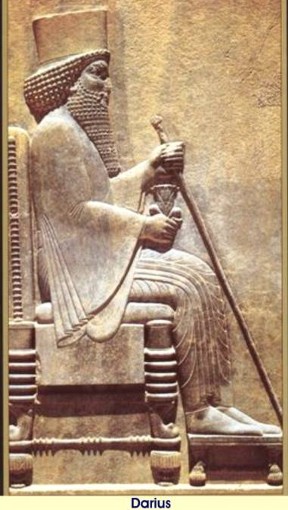
Persian empire under King Darius.
Darius (at the instigation of his other officials) had made a decree that no-one was to offer prayer to any god or man except him for a period of thirty days. Daniel continued to pray as was his habit, and for this he was arrested and thrown into a lions' den. However, he was unharmed, and after he was released the following morning, the people who had cajoled the king into making the decree (which was for the sole purpose of getting at Daniel) were thrown into the lions' den themselves.
As we know, ancient Canaan contained many people: The original people who moved into the north and became known as Phoenicians.
New people like the Philistines who lived in the south.
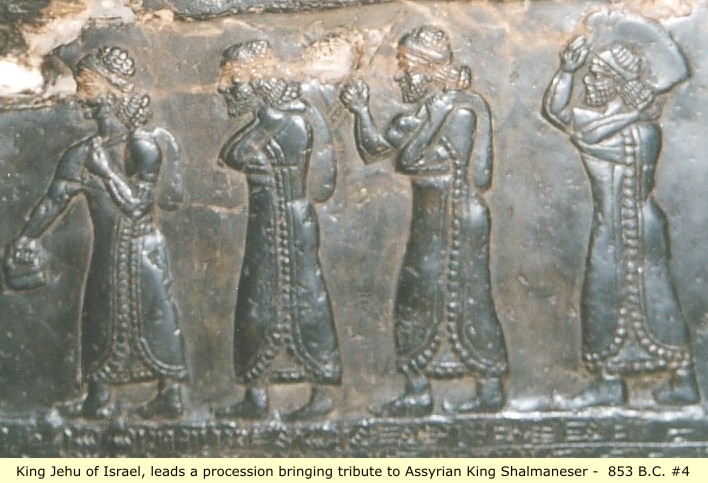
Then there were the Canaanites and Hebrews who lived in the middle. But we could never differentiate between the two:
(The Roman mosaic of Daniel seems to suggest that the Hebrews were the SHORT haired people). |
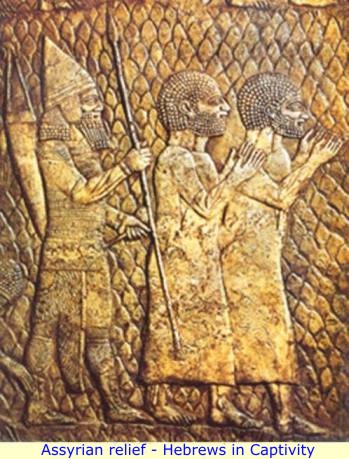
The Egyptians however, continued to intrigue in Canaan, whose native states were repeatedly induced to join anti-Babylonian coalitions. All of which collapsed of themselves, or were crushed by the Chaldean armies. Jerusalem was twice besieged in 597 and again in 589 B.C. Finally in about 587/586 B.C, it was stormed and destroyed. The prophet Jeremiah, who had foreseen this tragic end, and who had repeatedly warned his people against their suicidal policy, died in Egypt. Judah was devastated and almost depopulated, with most of it's people sent off to Mesopotamia.
Psalm 137
King James Version (KJV)
1) By the rivers of Babylon, there we sat down, yea, we wept, when we remembered Zion.
2) We hanged our harps upon the willows in the midst thereof.
3) For there they that carried us away captive required of us a song;
and they that wasted us required of us mirth, saying, Sing us one of
the songs of Zion.
4) How shall we sing the Lord's song in a strange land?
5) If I forget thee, O Jerusalem, let my right hand forget her cunning.
6) If I do not remember thee, let my tongue cleave to the roof of my mouth; if I prefer not Jerusalem above my chief joy.
7) Remember, O Lord, the children of Edom in the day of Jerusalem; who said, Rase it, rase it, even to the foundation thereof.
8) O daughter of Babylon, who art to be destroyed; happy shall he be, that rewardeth thee as thou hast served us.
9) Happy shall he be, that taketh and dasheth thy little ones against the stones.
 |
 |
 |
 |

This all changed with the victory and ascension of the Persian King Cyrus II (Cyrus the Great). After Cyrus had taken Babylon, he ordered that all the captives there be freed, and returned to their homelands, this was to be financed by Cyrus! He ordered the Hebrews restored to Jerusalem, and bade them to rebuild their temple. This period of peace lasted for almost three hundred years, but then the Persian Empire was destroyed by the armies of Alexander of Macedon.
After Alexander the Great's conquest of Persia, Judah first came under the rule of the Ptolemy's (Greek kings of Egypt), and later under that of the Seleucids, (Greek kings of Mesopotamia). Opposition to the Seleucid attempts to suppress the Hebrew ancestral faith, led to the rise of a family of Hebrew leaders known as the Maccabees. They gradually drove the Seleucids from the country, and set up a revived kingdom of Judaea. Family disputes however, led to Roman intervention in 63 B.C.
Now under Roman control, Herod the Great was made king of Judaea in 37 B.C, and later of all Canaan (20-4 B.C.). After Herod's death, the country was ruled alternately by Herod's direct descendants and by Roman procurators. As the result of a Hebrew revolt that broke out in 66 A.D, the city of Jerusalem was destroyed by Romans in 70 A.D. The city was destroyed by Titus Flavius Vespasianus ( 39 – 81 A.D.), commonly known as Titus, he was Roman Emperor from 79 to 81. A member of the Flavian dynasty, Titus succeeded his father Vespasian upon his death.
Prior to becoming emperor, Titus gained renown as a military commander, serving under his father in Judaea during the First Jewish-Roman War. The campaign came to a brief halt with the death of emperor Nero in 68, launching Vespasian's bid for the imperial power during the Year of the Four Emperors. When Vespasian was declared emperor on 1 July 69, Titus was left in charge of ending the Jewish rebellion. In 70, he successfully laid siege to and destroyed the city and Temple of Jerusalem. For this achievement Titus was awarded a triumph; the Arch of Titus commemorates his victory to this day.
The Zealots - who were a Hebrew sect which opposed the pagan rule of Rome, and the polytheism that it professed, were an aggressive political party. Their concern for the national and religious life of the Hebrew people, led them to despise even Hebrews, who sought peace and conciliation with the Roman authorities. Some extremists among the Zealots, turned to terrorism and assassination, they became known as Sicarii (“dagger men”). They frequented public places with hidden daggers, ready to strike down persons friendly to Rome. In the first revolt against Rome (66–70 A.D.) the Zealots played a leading role, and at the mountaintop fortress of Masada, they committed suicide, rather than surrender the fortress (73 A.D.).
The Roman historian Cornelius Tacitus (56-118 A.D.) had these thoughts on the origins and customs of the Hebrews, as the Romans prepared to destroy Jerusalem. |
|
This is in the context of Titus Caesar, who had been selected by his father to complete the subjugation of Judaea.Tacitus: History Book 51. EARLY in this year Titus Caesar, who had been selected by his father to complete the subjugation of Judaea, and who had gained distinction as a soldier while both were still subjects, began to rise in power and reputation, as armies and provinces emulated each other in their attachment to him. The young man himself, anxious to be thought superior to his station, was ever displaying his gracefulness and his energy in war. By his courtesy and affability he called forth a willing obedience, and he often mixed with the common soldiers, while working or marching, without impairing his dignity as general. He found in Judaea three legions, the 5th, the 10th, and the 15th, all old troops of Vespasian's. To these he added the 12th from Syria, and some men belonging to the 18th and 3rd, whom he had withdrawn from Alexandria. This force was accompanied by twenty cohorts of allied troops and eight squadrons of cavalry, by the two kings Agrippa and Sohemus, by the auxiliary forces of king Antiochus, by a strong contingent of Arabs, who hated the Jews with the usual hatred of neighbours, and, lastly, by many persons brought from the capital and from Italy by private hopes of securing the yet unengaged affections of the Prince. With this force Titus entered the enemy's territory, preserving strict order on his march, reconnoitring every spot, and always ready to give battle. At last he encamped near Jerusalem. 2. As I am about to relate the last days of a famous city, it seems appropriate to throw some light on its origin. Some say that the Jews were fugitives from the island of Crete, who settled on the nearest coast of Africa about the time when Saturn was driven from his throne by the power of Jupiter. Evidence of this is sought in the name. There is a famous mountain in Crete called Ida; the neighbouring tribe, the Idaei, came to be called Judaei by a barbarous lengthening of the national name. Others assert that in the reign of Isis the overflowing population of Egypt, led by Hierosolymus and Judas, discharged itself into the neighbouring countries. Many, again, say that they were a race of Ethiopian origin, who in the time of king Cepheus were driven by fear and hatred of their neighbours to seek a new dwelling-place. Others describe them as an Assyrian horde who, not having sufficient territory, took possession of part of Egypt, and founded cities of their own in what is called the Hebrew country, lying on the borders of Syria. Others, again, assign a very distinguished origin to the Jews, alleging that they were the Solymi, a nation celebrated in the poems of Homer, who called the city which they founded Hierosolyma after their own name. (The Solymi were supposedly a tribe from Pisidia, a region of ancient Anatolia/Asia Minor/Byzantium/Eastern Roman Empire/Turkey).
3. Most writers, however, agree in stating that once a disease, which horribly disfigured the body, broke out over Egypt; that king Bocchoris, seeking a remedy, consulted the oracle of Hammon, and was bidden to cleanse his realm, and to convey into some foreign land this race detested by the gods. The people, who had been collected after diligent search, finding themselves left in a desert, sat for the most part in a stupor of grief, till one of the exiles, Moyses by name, warned them not to look for any relief from God or man, forsaken as they were of both, but to trust to themselves, taking for their heaven-sent leader that man who should first help them to be quit of their present misery. They agreed, and in utter ignorance began to advance at random. Nothing, however, distressed them so much as the scarcity of water, and they had sunk ready to perish in all directions over the plain, when a herd of wild asses was seen to retire from their pasture to a rock shaded by trees. Moyses followed them, and, guided by the appearance of a grassy spot, discovered an abundant spring of water. This furnished relief. After a continuous journey for six days, on the seventh they possessed themselves of a country, from which they expelled the inhabitants, and in which they founded a city and a temple. 4. Moyses, wishing to secure for the future his authority over the nation, gave them a novel form of worship, opposed to all that is practised by other men. Things sacred with us, with them have no sanctity, while they allow what with us is forbidden. In their holy place they have consecrated an image of the animal by whose guidance they found deliverance from their long and thirsty wanderings. They slay the ram, seemingly in derision of Hammon, and they sacrifice the ox, because the Egyptians worship it as Apis. They abstain from swine's flesh, in consideration of what they suffered when they were infected by the leprosy to which this animal is liable. By their frequent fasts they still bear witness to the long hunger of former days, and the Jewish bread, made without leaven, is retained as a memorial of their hurried seizure of corn. We are told that the rest of the seventh day was adopted, because this day brought with it a termination of their toils; after a while the charm of indolence beguilded them into giving up the seventh year also to inaction. But others say that it is an observance in honour of Saturn, either from the primitive elements of their faith having been transmitted from the Idaei, who are said to have shared the flight of that God, and to have founded the race, or from the circumstance that of the seven stars which rule the destinies of men Saturn moves in the highest orbit and with the mightiest power, and that many of the heavenly bodies complete their revolutions and courses in multiples of seven. 5. This worship, however introduced, is upheld by its antiquity; all their other customs, which are at once perverse and disgusting, owe their strength to their very badness. The most degraded out of other races, scorning their national beliefs, brought to them their contributions and presents. This augmented the wealth of the Jews, as also did the fact, that among themselves they are inflexibly honest and ever ready to shew compassion, though they regard the rest of mankind with all the hatred of enemies. They sit apart at meals, they sleep apart, and though, as a nation, they are singularly prone to lust, they abstain from intercourse with foreign women; among themselves nothing is unlawful. Circumcision was adopted by them as a mark of difference from other men. Those who come over to their religion adopt the practice, and have this lesson first instilled into them, to despise all gods, to disown their country, and set at nought parents, children, and brethren. Still they provide for the increase of their numbers. It is a crime among them to kill any newly-born infant. They hold that the souls of all who perish in battle or by the hands of the executioner are immortal. Hence a passion for propagating their race and a contempt for death. They are wont to bury rather than to burn their dead, following in this the Egyptian custom; they bestow the same care on the dead, and they hold the same belief about the lower world. Quite different is their faith about things divine. The Egyptians worship many animals and images of monstrous form; the Jews have purely mental conceptions of Deity, as one in essence. They call those profane who make representations of God in human shape out of perishable materials. They believe that Being to be supreme and eternal, neither capable of representation, nor of decay. They therefore do not allow any images to stand in their cities, much less in their temples. This flattery is not paid to their kings, nor this honour to our Emperors. From the fact, however, that their priests used to chant to the music of flutes and cymbals, and to wear garlands of ivy, and that a golden vine was found in the temple, some have thought that they worshipped father Liber, the conqueror of the East, though their institutions do not by any means harmonize with the theory; for Liber established a festive and cheerful worship, while the Jewish religion is tasteless and mean. |
 |
Dura-Europos was founded in 303 B.C. by the Seleucids on the intersection of an east-west trade route and the trade route along the Euphrates. The new city controlled the river crossing on the route between his newly founded cities of Antioch and Seleucia on the Tigris. The traditional view of Dura-Europos as a great caravan city is becoming nuanced by the discoveries of locally made manufactures and traces of close ties with Palmyra.
During the later 2nd century B.C. it came under Parthian control and it served as a frontier fortress of the Arsacid Parthian Empire. It had a multicultural population, as inscriptions in Greek, Latin, Aramaic, Hebrew, Syriac, Hatrian, Palmyrenean, Middle Persian and Safaitic Pahlavi testify. It was captured by the Romans in 165 and abandoned after a Sassanian siege in 256-257. After it was abandoned, it was covered by sand and mud and disappeared from sight.
Dura-Europos was a cosmopolitan society, controlled by a tolerant Macedonian aristocracy descended from the original settlers. In the course of its excavation, over a hundred parchment and papyrus fragments and many inscriptions have revealed texts in Greek and Latin (the latter including a sator square), Palmyrenean, Hebrew, Hatrian, Safaitic, and Pahlavi. The excavations revealed temples to Greek, Roman and Palmyrene gods. There was a Mithraeum, as one would expect in a Roman military city.
The Jewish synagogue, located by the western wall between towers 18 and 19, the last phase of which was dated by an Aramaic inscription to 244. It is the best preserved of the many ancient synagogues of that era that have been uncovered by archaeologists. It was preserved, ironically, when it had to be infilled with earth to strengthen the city's fortifications against a Sassanian assault in 256. It was uncovered in 1932 by Clark Hopkins, who found that it contains a forecourt and house of assembly with frescoed walls depicting people and animals, and a Torah shrine in the western wall facing Jerusalem. At first, it was mistaken for a Greek temple. The synagogue paintings, the earliest continuous surviving biblical narrative cycle, are conserved at Damascus.
 |
 |
 |
 |
 |
 |
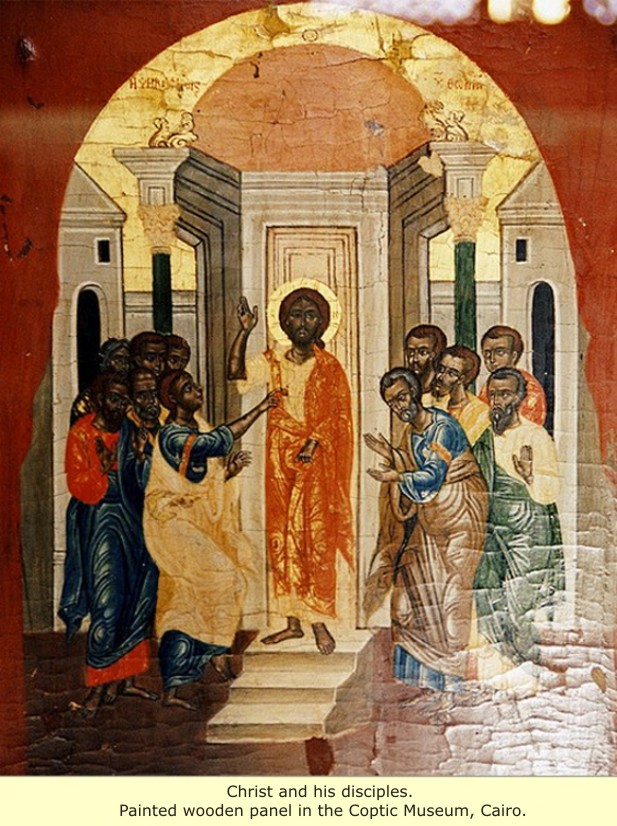
The Byzantine Empire was the predominantly Greek-speaking continuation of the Roman Empire during Late Antiquity and the Middle Ages. Its capital city was Constantinople (modern-day Istanbul), originally known as Byzantium. Initially the eastern half of the Roman Empire (often called the Eastern Roman Empire in this context), it survived the 5th century fall of the Western Roman Empire and continued to exist for an additional thousand years until it fell to the Ottoman Turks in 1453. During most of its existence, the empire was the most powerful economic, cultural, and military force in Europe. Both "Byzantine Empire" and "Eastern Roman Empire" are historiographical terms applied in later centuries; its citizens continued to refer to their empire as the Roman Empire.
 |
All of the Albino people migrating westward from Central Asia passed through Byzantine territory, and caused wars and conflicts. Over time, the only way that the Black Greeks of the Byzantine Empire could gain a semblance of peace, was to marry Albino princesses, thus creating a nobility that had many Mulattoes. Their art often reflected this admixture.
 |
 |
One of the enduring mysteries of ancient Canaan is; what happened to the ancient writings of the Hebrews. The Hebrew’s were a very literate people, who wrote on many subjects. Yet today all that exists is the works of Josephus Flavius: who was a Hebrew traitor named Joseph, who upon going over to the Romans, was made a General and given the title Josephus Flavius. He subsequently commanded Roman troops in putting down the Hebrew rebellion.
Josephus, in his delusion, attempted to establish the greatness and antiquity of his people in his written works, even after he had aided in their destruction. His, and the works of a few other authors, written around the time of the fall of Jerusalem in 70 A.D. is all that survives today.
Certainly history is replete with instances of Khazar/Jewish texts, some claimed to be ancient? Being burned in Europe, But what about the genuine ancient texts of the Hebrews? How could it be, that the self-written history of an entire nation, with thousands of years of ups and downs: and a people with arguably the most convoluted and eventful path to nationhood, be lost to all mankind?
Stranger still; is the absence of the original Septuagint.
This is a work that was commissioned by the second Greek king of Egypt
Ptolemy II, in 323 B.C. Ptolemy arranged for six translators from each
of the twelve tribes of Israel to come to Egypt and translate the
Hebrew Scriptures into a volume for his library in Alexandria.
This book is known as the “Septuagint” derived from the
Latin word for "seventy". It is the first Bible, and the prototype for
all other Bibles including the Masoretic text, which was begun around
600 A.D. and completed in 1000 A.D. (the Bible of the Khazars or Jews).
All that remains of the Septuagint today is copies of copies, which
have been reinterpreted and reworked so often, that its relationship to
the original cannot be judged.
Roman desire to destroy anything and everything that might
offer the Hebrew’s moral support is well known. Their destruction of
Hebrew buildings and institutions is well documented. However, there is
universal silence as to who destroyed all the Hebrew writings.
Roman culpability for at least some of it, was established with the
discovery of the Dead Sea Scrolls, which the Hebrew’s successfully hid
for 2000 years, in order to prevent them from being destroyed by the
Romans, (the Romans also burned the writings of the Etruscans in Italy).
The first of the Dead Sea Scroll discoveries
occurred in 1947 in Qumran, a village situated about twenty miles east
of Jerusalem on the northwest shore of the Dead Sea. A young Bedouin
shepherd, following a goat that had gone astray, tossed a rock into one
of the caves along the sea cliffs and heard a cracking sound: the rock
had hit a ceramic pot containing leather and papyrus scrolls that were
later determined to be nearly twenty centuries old. Ten years and many
searches later, eleven caves around the Dead Sea were found to contain
tens of thousands of scroll fragments dating from app. 300 B.C. to 68
A.D. and representing an estimated eight hundred separate works.
 |
The Dead Sea Scrolls comprise a vast collection of
Hebrew documents written in Hebrew, Aramaic, and Greek, and
encompassing many subjects and literary styles. They include
manuscripts or fragments of every book in the Hebrew Bible except the
Book of Esther, all of them created nearly one thousand years earlier
than any previously known biblical manuscripts. The scrolls also
contain the earliest existing biblical commentary on the Book of
Habakkuk, and many other writings, among them religious works
pertaining to Hebrew sects of the time.
But were the Romans the only ones? It seems strange that the
writings of the people whose religious beliefs are at the core of the
great religions of Christianity, Judaism, and Islam, could be made
non-existent, without a clue as to how it happened, when it happened,
or who did it. That the Romans would then turn around, and build their
great religion of Catholicism upon the religious beliefs of the
Hebrews, a people that they utterly destroyed, is truly bizarre.
Then there is the curiosity as to why the Vatican and the leadership in Israel will not allow the World to see the Dead Sea Scrolls, except for a few minor and unimportant pieces which have been loaned out. As the only surviving authentic Hebrew writings, they are invaluable for learning the true nature and beliefs of the ancient Hebrews, as well as ascertaining the fidelity of modern religious teachings.
 |
Amazon.com The
Dead Sea Scrolls Bible: The Oldest Known Bible Translated for the First
Time into English Paperback – October 22, 2002 by Martin G., Jr. Abegg
(Author), Peter Flint (Author) Top Customer Reviews Book is False Advertisement
|
 |
Amazon.com The Complete Dead Sea Scrolls in English: Seventh Edition (Penguin Classics) 7th Edition by Geza Vermes (Author) Suffers heavy abridgement! DECEIPTIVE TITLE!
|
Click Here for the History of the Bible <<Click>>
Please visit the "Additional Material Area" for many more photographs of each civilization, and related material <Click> |
| < Back | Home | Next > |