Ancient Egypt under Greek and Roman Rule
From: New York University - unofficial on-line content
The Importance of Periods of Foreign Domination to the Study of Egypt Overall
If one wishes to understand how the Egyptians conceived of themselves
(or, as many would put it, how the Egyptians constructed their
identity), one of the most productive ways of doing so would be to
examine the interactions between Egyptians and foreigners - the
Egyptians’ view of things when their land was under foreign control.
For one thing, there are several examples of foreign rulers attempting
to present themselves as part of the ancient pharaonic tradition.
During times of foreign rule the Egyptians frequently adopted certain
means to maintain and emphasize the distinctness of their cultural
heritage. Both attempts, those of foreigners to acquire an Egyptian
identity as well as those of the Egyptians to maintain it, offer some
telling insights into what being Egyptian was. Although we cannot be
certain, it is likely that in these efforts of both parties, we are
shown behavior which probably closely paralleled events in other, less
documented eras of Egyptian history, such as the Hyksos Period.
Some General Characteristics of Greek Rule in Egypt
The Ptolemies were quite unlike other foreigners who had ruled Egypt in
several respects. Most importantly, they ruled within Egypt. One of the
best phrases for understanding the nature of their government’s
relationship with the country on which they imposed their rule is that
“the Ptolemies used Egypt.” (By contrast, it is fair to say that “the
Romans abused Egypt.”) The Greeks could use Egypt because they came
upon a well developed country in respect to its economic, intellectual,
and political life. These factors were in force to an extent which was
unparalleled anywhere else within the Hellenistic world where the
Greeks had placed themselves to rule over indigenous populations. In
the case of Egypt, the Ptolemies found themselves in control of a
highly sophisticated ancient civilization and administration, not a
group of cloddish barbarians. The Egyptians had as high a level of
culture as the Greeks, but it was quite different from theirs. The fact
that the Egyptians stuck to their ways annoyed and puzzled the Greeks
and gave the Egyptians the reputation as being stubborn, ornery, and,
for lack of a better word, reversed.
On
the latter point, we should listen to Herodotos describing his
impression of Egypt as he visited it (Book 2, 35): “Just as the climate
that the Egyptians have is entirely their own and different from anyone
else’s, and their river has a nature quite different from other rivers,
so, in fact, the most of what they have made their habits and their
customs are the exact opposite of other folks’. Among them the women
run the market and shops, while the men, indoors, weave; and, in this
weaving, while other people push the woof upwards, the Egyptians push
it down. The men carry burdens on their heads, the women carry theirs
on their shoulders. The women urinate standing upright, while the men
do it squatting. The people ease nature’s needs in the houses but eat
outdoors in the streets; their explanation of this is that what is
shameful but necessary should be done in secret, but what is not
shameful should be done openly. No woman is dedicated to any god, male
or female, but men to all gods and goddesses. There is no obligation on
sons to maintain their parents if they are unwilling, but an absolute
necessity lies on the daughters to do so, whether they will or not.”
This is typical of Herodotos in that it is a mixture of fact and
fiction, all of which was heavily colored by his desire always to tell
a good story. To this observation we should also add the remarks of
Alan Lloyd, an Egyptologist who has done what still remains as the best
study of Herodotos’ description of Egypt from an Egyptological point of
view. Lloyd, not incidentally, is the author of the relevant chapter in
our textbook. Lloyd’s ultimate conclusion is that Herodotos, “presents
a view of Egypt’s past which shows no genuine understanding of Egyptian
history. Everything has been uncompromisingly customized for Greek
consumption and cast unequivocally into a Greek mold.” The last
statement here also summarizes much of the Greek point of view when
dealing with Egypt administratively . . . at least, that is what they
tried at first.
The Ptolemaic regime may
have modernized several aspects of the Egyptian economy, particularly
with the introduction of coinage that made transactions much more
efficient, yet we should also bear in mind that Egypt already had had a
successful agricultural system in place for several millennia when the
Greeks appeared. The history of Ptolemaic Egypt is not a unity; it
changed with the course of time, particularly in the Ptolemies’
governance of their Egyptian subjects. In the end run it was not
possible to exclude the indigenous population and at the same time to
compete successfully against the other nations of the Mediterranean. It
is also important to remember that the Greeks were never evenly
distributed throughout Egypt, especially at the beginning of Ptolemaic
rule.
The two cultures existed
side-by-side, but they seldom truly mixed in any meaningful fashion. It
was possible for an Egyptian to Hellenize, but the process was rather
formidable, since it essentially required abandoning the native culture
almost totally. To a great extent in the past this had been true of
foreigners entering Egypt who had wished to adopt the Egyptian way of
life.
Language and dress,
rather than any notions of race or ethnicity, were the means by which
one became Egyptian (or Greek). In general, one does not really see
anything quite like what we would consider as racism until perhaps
Roman times. If nothing else, the willingness of Greek men to marry
Egyptian women – not merely to have them as concubines – speaks loudly
to that point. As Ritner puts it, (“Cross-cultural Interaction,” p.
289), “Clear evidence of any sort of racial or cultural chauvinism is
exceedingly rare for the Ptolemaic period.” Attitudes of cultural
superiority, of course, were another matter, but this feeling of
superiority was by no means necessarily racist in its nature. In both
societies there was a great degree of snobbishness towards outsiders.
The very word “barbarian” was derived from a Greek word that originally
meant “a non-Greek speaker.” The Ionian Greeks, for example, were well
aware that their Persian overlords whom they describe as “barbarians”
possessed a very high level of cuture. Clannishness of both Greeks and
Egyptians certainly existed, but this is to be expected given the
cultural and language differences in the towns where they lived
side-by-side. Certainly one of the most
telling indicators in this matter was the prevalence of intermarriage.
Intermarriage was even more common out in the countryside and among the
military where there was not as much of a wealth and status difference
between the Egyptians and Greeks. In all fairness, it should be pointed
out that in almost every case the documentation shows a Greek or
Macedonian man marrying an Egyptian woman and seldom an Egyptian man
marrying a Greek woman. The law seems to have been that the children
inherited their ethnic identification through the father. A Greek woman
marrying an Egyptian man would probably be losing her status (“marrying
down”). However, in the end run, Egyptian culture was always more
tolerant in its outlook than the Greek.
For another critical aspect of making a cross-cultural transformation
in Ptolemaic society, we should consider a word borrowed from
contemporary Greek society, i.e. “barbarian.” As pointed out above,
although today the word means a brutish, uncultured, and unlettered
foreigner, in Ptolemaic times the term primarily meant “one who did not
speak the Greek language.” It is important also to remember the
significance of the term for this period – the Hellenistic Period, lit.
the Greek-speaking Period. Here again, both the Greek and Egyptian
cultures were in agreement that in order for one to enter their
respective societies, one had to speak their language.
“Church” and “State” in Ptolemaic Egypt
These entities two were never separate in pharaonic Ancient Egypt, so
we shouldn’t expect too much difference in this respect during the
Ptolemaic period. Nevertheless, the Greeks tended to keep church and
state more separate, except, strikingly enough, in Ptolemaic Egypt.
These rulers strongly promoted a cult of the divine king, even while
the monarch was still alive. This cult, furthermore, was aimed
primarily at the Greek part of the population. By Alexander’s time
there were three politically relevant groups in Egypt: the military,
the bureaucracy and the clergy. Of these, the “church,” i.e. the temple
system and the associated priesthoods, was the trickiest aspect of the
culture to deal with. The Egyptian temples were the main repositories
of the native cultured and the primary site of native elite
intellectual life. The Greek administration recognized this from the
beginning and acted accordingly. The idea would be to co-opt this power
to the benefit of the Ptolemaic kings. Above all, this aid to the
“church” took the form of fiscal relief and exemptions from various
regulations, and most important of all temple building along the
requisite financial support.
It
should be borne in mind that for a great deal of the Ptolemaic regime,
the only means for advancement for many native Egyptians were through
the temple and priestly administrations. The phyle system of rotating
priestly activity, which had the practical result of the priests
spending most of their time in cultivating their lands for their own
support, was a major factor in the economy. This meant that the priests
were by no means separate from the daily concerns of their fellow
Egyptians. Instead men who were nominally priests moved among the rest
of the population as regular citizens, especially in the economic
sense. In addition, this mean that for the practical matters of most of
their daily life, Egyptian priests were literally neighbors to the
Greeks living on the military cleruchies (land allotments), who were
military men by their formal occupation, but farmers for most practical
concerns. These two important groups knew each other well. The
combination of their priestly and agricultural duties meant that the
Egyptian priests’ role as the guardians of the traditional culture was
quite fitting.
The priesthood may have
been something of a hereditary occupation at this time. Egyptian
culture required that there should be textual support for the
legitimacy of the Ptolemaic kings in the temples. At the same time,
these temples were the chief locations for the support of the native
Egyptian culture. The Greek rulers needed the Egyptians to put the
correct formulations on their legitimacy.
Some Egyptian cults had quite a bit of success among the Greeks,
especially that of Osiris and Isis. The cult of Serapis represents an
interesting attempt on the part of the Greek ruling house to integrate
into the Egyptian belief system, but it remained a primarily
Greek-oriented cult. The Serapis cult was not, however, an attempt to
integrate the two religious spheres as is sometimes stated. Serapis was
not worshipped under that name among the Egyptians. Also striking was
the deification of the Ptolemy kings and queens even while they were
alive, something relatively uncommon among the Egyptians. Ptolemy I
by-name “Sotor (the Savior),” eventually took on a religious
designation as well. The royal cult was a most important aspect of
Ptolemaic kingship. It is hard, however, to judge how this transferred
into genuine religious feeling among the Greeks, let alone the
Egyptians.
The use of the Egyptian gods
for oracles was still quite common among the native populace, another
factor in maintaining the influence of the old religion. In this, one
can say that their gods were still very much involved in the daily life
of the native population.
From the
native point of view, legitimacy also had to be transferred into the
practical political sphere. The Egyptians had to identify with the
aspirations, domestic and foreign, of the Ptolemies. The temples were a
particularly good medium for the spreading of royalist propaganda, as
had been the case in pharaonic times.
Counter-Greek propaganda existed in literary forms that was produced
and broadcast primarily through the temples. The “Demotic Chronicle”
and the “Potters Prophecy” reveal that there were opposing opinions
among the Egyptian intellectuals to the ruling power. Of course, with
these oracles’ predictions of eventual disaster to befall the foreign
interlopers, such documents expressed a type of wishful thinking
prevalent among the native population that had to be placated. At the
same time, the Nectanebos Legend, stating that Alexander was an
offshoot of the last legitimate native king is significant, perhaps
expressing a desire among the native population to see in the new
rulers a tie with the last of the independent Egyptian monarchs.
Other Aspects of Greek-Egyptian Relationships
The appearance of the Greeks in Egypt was in effect a social revolution
in a different form. Egypt was now dominated by a new elite. Before the
arrival of the Greeks, furthermore, status in society was determined
largely by one’s function, i.e. occupational caste. The country was not
merely divided now between rich and poor, for members of either group
could become wealthy or poor. Originally, the Greeks came as
mercenaries who were settled as colonists, the so-called cleruchies
(kleruchoi, from the term kleroi “allotments”). Generally speaking,
this land grant system was not normally the practice with mercenaries
elsewhere in the ancient world who often went home after their
enlistments were over, so the kleruchoi were something of a Ptolemaic
innovation. As time went on, other Greeks entered Egypt in considerable
numbers through immigration, but never amounting to a substantial
proportion of the overall population. Nevertheless, these Greeks now
became the dominant voice in the historical record. After all, the
literacy rate in their own language was higher among the Greeks than it
was among the Egyptians. Outside of Alexandria and its immediate
vicinity, the major Greek settlements were at Naukratis, Philadelphia
(in the Fayyum), and Ptolemais (near Dendera in Upper Egypt). These
settlements were unlike the Greeks’ former pattern of colonization
through independent cities, since these places had none of the same
degree of self-government found in the colonies outside of Egypt. The
local governments, the politeumata, in many ways were formed largely as
a means of preserving (Greek) national identity more than anything
else. The alphabetized Greek language, considerably easier to learn for
the purposes of reading and writing, was to have a profound influence
on the profile of literacy in the country. To enter the bureaucracy one
had to Hellenize, i.e. adopt the Greek language. There are cases in
which the officials would label someone who could read Egyptian (but
not Greek) as being illiterate -- a rather telling attitude!
Obviously,
under circumstances such as these, an ambitious young Egyptian would
have to learn Greek if he wished to be successful in this society and
its administration. Significantly, despite the Greek attitude towards
the Egyptian language, it was possible to deposit documents in Demotic
for legal purposes during the Ptolemaic period, provided the matter
concerned Egyptian parties alone; an abstract of the document in Greek
was frequently appended. The Romans discontinued this practice of
limited acceptance of the Demotic dialect—a major blow to the survival
of the ancient language. In addition, there seem to have been a great
number of bilingual people in the land, but these men and women for the
most part were in the middle and upper strata of society. In respect to
written language, however, it was the flow towards Greek that
overwhelmingly predominated. Greeks were not apt to learn how to read
and write Egyptian. Increasingly the native language was supported only
by the priestly class. Consequently, one never sees Greeks playing a
role in Egyptian cult, which was ultimately quite language oriented,
especially because it was the main repository of Egyptian culture. At
the same time, however, certain Egyptian deities enjoyed considerable
popularity among the Greeks, whereas Greek religion never found much
support among the Egyptians. This does not mean that the native
religion did not receive subsidies from the royal house—quite to the
contrary, as remarked previously. The Jews were another prominent group
of foreigners in the land, located mostly in Alexandria, but could be
found on the local level as well. On the whole, the Ptolemies seem to
have had a “philo-Semitic” policy. The Jews did not mix as well with
the Egyptians, however.
The Greeks
intermarried extensively with the Egyptians. Discrimination was seldom
on any basis which one might call racial by today’s standards. At least
among the Egyptians, marriage was considered to be a strictly civil
matter, much like other civil contracts and removed from any
interference from civil and religious authorities. Language and customs
determined who one was in the eyes of society. Obviously, clothing also
played an important role here. The native legal system was allowed to
exist, but only where it did not conflict with the dominant Greek
interests. Mixed courts even existed to a limited extent. Again, this
was a practice which the Romans were to end.
As mentioned above, citizenship from the Greek point of view was hard
to come by and strictly controlled. People were associated with
‘tribes’ and other local units (demes) that had Greek names. On the
local level Greek males belonged to assemblies, gymnasia, acted as
magistrates and members of local councils, but the overall practice was
not really democratic in the sense of the older Greek tradition. Often
one had to show Greek ancestry to enter into this combination of
educational and fraternal system. Wealth and privilege were tied to
governmental obligations as well. This distinctive set-up was allowed
to persist into the Roman era.
Native Revolts and Resistance
There
were several of native uprisings of varying severity during the
Ptolemaic regime. These colored heavily the Greeks’ relations with
their Egyptian subjects, forcing them towards increasing accommodation
if they wished to survive the pressures from the outside. During the
Third Syrian war (246-241) in Euergetes’ reign (Ptolemy III Euergetes
“Benefactor” I 246-222), there were disturbances caused by the economic
hardships arising from the need to support a long war. The resulting
unrest was severe enough to force the king’s return to Egypt. Thebes
was the focal point of one serious revolt in 207/6, and seemed to have
housed two native “pharaohs” for a while, perhaps with Nubian backing.
Dissatisfaction was rife well up into the 190s in this region of Egypt.
As I may have pointed out before, this uprising may have all been a
result of the prominent role of the Egyptian troops at the battle of
Raphia in 217 BC and the failure for the Ptolemies to throw enough sops
in the direction of the Egyptians afterwards. This intermittent series
of uprisings were perhaps the most worrisome of all and Ptolemy V’s
Rosetta (or: Memphis) Decree was probably a direct result. Ptolemy V
(Ptolemy V Epiphanes “God-manifest” 204-180) was crowned at Memphis
according to the ancient Egyptian custom as well, even though he
continued to rule from Alexandria. Other revolts broke out in the 160s
then again 130s as well. Later on we have literary evidence of
resistance to Egyptian rule, such as the so-called Oracle of the
Potter, a Demotic text predicting the end of the reign of Alexandria
and the return to Memphis of the (Egyptian) ruling house, i.e. the
restoration of native rule. Thus, both pressure within and pressure
without forced the Ptolemies to bring Egyptians more fully into both
the military and the governing apparatus.
The focal point for most of the Egyptian resistance to Greek rule was
centered on the temples, which were the focal points of Egyptian
cultural activity.
Cultural Disasters under Ptolemy VIII and later
For all its great reputation as the intellectual capital of the
Hellenistic world, Alexandria did not maintain that position for ever.
An enormous blow to its reputation came in 145 BCE when Ptolemy VIII
(Ptolemy VIII Euergetes II Physcon 145-116) expelled nearly all the
leading intellectual lights of his capital city in a fit of unexplained
pique. He removed Aristarchos of Samothrace, a man of world-wide
scholarly reputation, as the head of the famous Library, replacing him
with a low-level military officer, so as to deepen the insult. The
Museum and its scholars suffered similarly. As a consequence, even when
the city was to regain some of its intellectual prestige in later
years, it never quite recovered from this needless blow. During the
Mitradaic war, many writers, artists, and thinkers from all over the
region fled to Alexandria to avoid this clash between Rome and the
Pontic kingdom. Rome, now an intellectual center in its own right, also
benefited from this flight.
Nearly a
hundred years after this great banishment, Julius Caesar appeared in
Alexandria in the summer of 48 BCE. Among other things, he attempted to
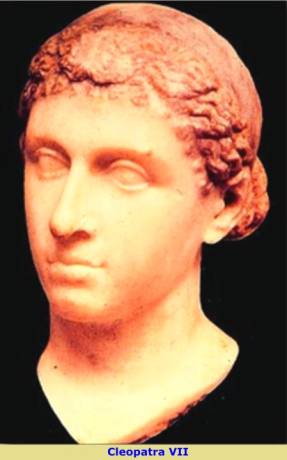
settle the dispute between Cleopatra (VII) and her brother Ptolemy XII,
by establishing a joint rule between them. He had a love affair with
Cleopatra from which sprang their child, Casareon (Ptolemy XIV).
Unfortunately, the struggle between the various parties did not end,
and in 47 BCE the Alexandrians rose up against Caesar, who at one point
barely escaped with his life. During this revolt (or riot) the great
Library supposedly caught fire and burnt to the ground. Other versions
of the events, however, say that it was only a warehouse in which
copies of works for export were stored that was destroyed and the
Library survived only to be destroyed later. Caesar later defeated the
Egyptians, killing Ptolemy XIII in the process. He handed over the
reigns of the country to Cleopatra and Ptolemy XIV to rule jointly and,
returning home, left three legions in Egypt to maintain Roman control.
The country became a Roman province between 47-44. Caesar left before
his son was born
The Economy
This was by far the most successful aspect of the Ptolemaic regime. It
was still primarily agriculturally based, although in Alexandria
foreign trade and finance were to play a considerable role in the life
of that city. Trade guilds, something which we know of in small numbers
in pharaonic times, became more important at this time. Royal patronage
was important in this respect. It is important to bear in mind that
even as the Ptolemies were declining as a military and political power
(and as Rome’s influence was growing), Egypt’s position as a major
economic power remained virtually unchanged.
Most
labor was paid for in kind rather than coinage. Outside of Alexandria
probably only around one-fifth to one-sixth of the population lived in
what might be considered an urban environment, but still, this was a
much higher percentage than had been the case during pharaonic times.
Alexandria, always a special case, grew to an immense size—it has been
estimated that in the early days of Roman control Alexandria may have
had over a million inhabitants. Villages were quite common, but could
never grow much in size due to the constraints of the environment.
Plagues could wipe out a large segment of any town. Out in the
countryside the peasantry lived by subsistence farming, but real,
abject poverty was rare. Consequently, Egypt may have enjoyed something
of a population boom during the Ptolemaic Period. On occasion when the
burdens of taxation, etc. became too great, large segments of the
farming population would abandon their plots and flee into the nearby
desert – anachoreisis, as the phenomenon was called. This phenomenon
increased under the Romans.
The main
impact of the Greeks was the successful implementation of coinage, and
therefore, money. This did not however end the barter or exchange
aspect of the economy, but it did greatly increase the role of markets
in the system. Taxes, certainly, continued to be paid in kind, since
the peasantry by-and-large participated only marginally in the
monetized segment of the economy. These people, furthermore, no longer
needed to be located near the river to participate in the economy.
Fairly soon on, the coinage became “closed,” i.e. foreign currency was
not allowed and had to be exchanged for the Ptolemaic coinage. People
were aware of any fooling around with the currency, so debasement or
the like could not be done by the ruling house with impunity. The
government may have taken about 30% of the gross national product of
the country in taxes. Additional governmental influence on the economy
came in the form of regulations. We have no idea of how the rate of
taxation compared with the practices of the ancient pharaonic regime.
|


 There were many Greek kings, notable among them were..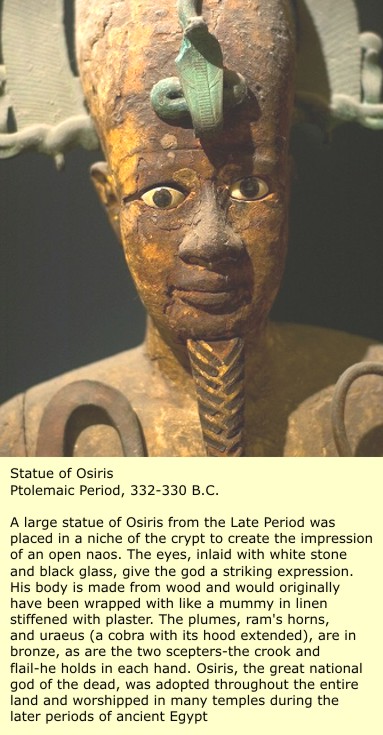


 Ptolemy II (Philadelphus)