Modern Palestine-Israel-Lebanon
In Canaan, like elsewhere in the region, the people went on to develop an advanced civilization. They lived in large cities with magnificent palaces and temples. They had writing, mathematics and a calendar, they also became great artisans, creating beautiful works of art. The main cities of Canaan were Jericho, Ugarit, Tyre, Sidon, Ebla, Biblos, Lachish, Hazor, Megiddo, Jerusalem and later, the North-African Phoenician settlement of Carthage.
Like all the other ancient societies, the Canaanite's had many gods, but their main gods were "EL" and his son "Baal" with EL being the supreme god.
Here are some modern names of ancient origin, which evoke the name of El: Michael - he who is like God, Daniel - God is my judge, Gabriel - strong man of God, Gamaliel - benefit of God, Hazael - one that sees God, Emmanuel - God is with us, Ishmael - God will hear, Israel - God contented.
 |
 |
The main Canaanite Goddess was Athirat (Asherah, Ashtartian) 'the Lady of the Sea' or Elat 'the goddess'. She was El's loving consort and is protective mother of her seventy children, who may also be known as the gracious gods, to whom she is both mother and nursemaid. Initially Astarte is one of her children, but over time the two became merged in some cultures. Canaanite Goddesses were worshipped in many lands under different names.
The Lady of Galera - probably the Goddess Athirat - 600 B.C.The figurine was found in a tomb in Galera Spain, probably of Phoenician manufacture (Phoenicians established colonies in Iberia during 1100-900 B.C.) She sits between two sphinxes and holds a bowl for liquid that poured from two holes in her breasts. The figure shows Egyptian and Mesopotamian influences. |
 |
 |
Throughout its existence, Canaan's history was one of Egyptian domination. Sometimes this took the form of loose oversight, and sometimes it took the form of direct over-lordship with garrisoned troops. The reason for this close involvement was that Canaan provided a buffer zone for Egypt's security, and was the route out; going north and east, for Egyptian trade and military excursions. Not to mention the famous Canaanite Cedar trees that Egypt was dependent upon for its building projects. (later called the "Cedars of Lebanon").
The introduction of "bronze" in the Early Bronze Age (3000–2000 B.C.) brought about a cultural revolution marked by the development of metallurgy, and a decline in pottery. By the Middle Bronze Age (2000–1550 B.C.), Amorites who were originally nomads from the desert regions to the east, and southern Anatolia (modern Turkey), had penetrated Canaan and were inhabiting the hilly areas around the cities. From these hills, they launched raids and harassment attacks against the cities.
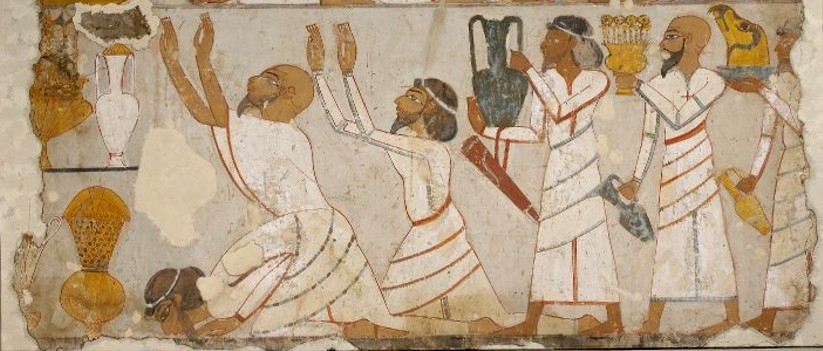
The tomb of SebekhotepSebekhotep was an important treasury official in the reign of Thutmose IV (c. 1400-1390 BC), bearing the title 'overseer of the seal', in effect the minister of finance. He was the son of Min, who had held the same title in Thutmose III's reign. It is likely that Sebekhotep was mayor of the Faiyum region before attaining his highest title in Thebes; as his father came from the Delta, it is possible that, like many other Theban officials, he came south at the king's request. The wall from which this fragment came almost
certainly showed Sebekhotep receiving the produce of the Levant and
Africa, which he then presented to the king. A scene like this would
have been placed in his tomb to illustrate his importance as an
official and to represent his relationship with the king, so that it
would be reflected in his life after death. |
 |
 |
 |
 |
In addition to the Amorites, other invaders included the the Hurrians (the Horites of the Old Testament), also came to Canaan from the north. The Late Bronze Age (1550–1200 B.C.) was marked by incursions of new Amorite marauders, these were Amorites displaced by the fall of the Hammurabian dynasty in Babylon. As it were, over time, the nomadic Amorites were joined by Amorites who had previously been in Mesopotamia. So that by now, the total of these Amorites had became the dominant element of the population in canaan.
Many of these Amorites, such as the Biblical Abraham, continued on to Egypt.
Genesis 11:27-32
Now these are the generations of Terah: Terah begat Abram, Nahor, and Haran; and Haran begat Lot. And Haran died before his father Terah in the land of his nativity, in Ur of the Chaldees (Sumer). And Abram and Nahor took them wives: the name of Abram's wife was Sarai; and the name of Nahor's wife, Milcah, the daughter of Haran, the father of Milcah, and the father of Iscah. But Sarai was barren; she had no child. And Terah took Abram his son, and Lot the son of Haran his son's son, and Sarai his daughter in law, his son Abram's wife; and they went forth with them from Ur of the Chaldees, to go into the land of Canaan; and they came unto Haran (Anatolian city), and dwelt there. And the days of Terah were two hundred and five years: and Terah died in Haran. Genesis 12:9-10 And Abram journeyed, going on still toward the south. And there was a famine in the land: and Abram went down into Egypt to sojourn there; for the famine was grievous in the land.


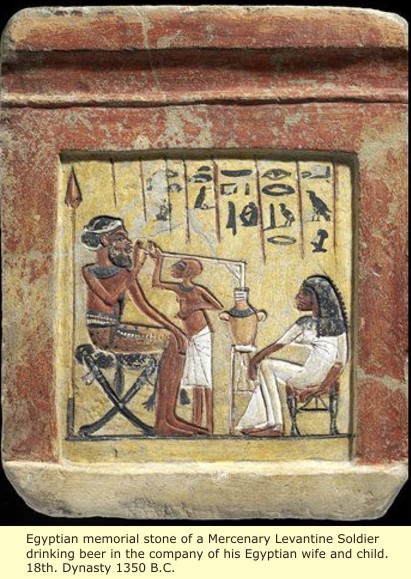
In Egypt these Amorites become known as Habiru or Hapiru (one who sells his services), whether these "services" were as Mercenaries or tradesman is unknown. In time, the number of Amorites in northern Egypt was sufficient to overthrow Egyptian rule, and establish an independent region of Egypt ruled by Amorites, since known as the Hyksos (foreign kings or Shepherd Kings). The Egyptian historian Manetho, and the traitor Hebrew, Josephus Flavius, both wrote of the Amorite coup as an invasion, but there is no evidence of an invasion, apparently it was a gradual takeover. In Egyptian history, the Hyksos comprise the 15th. Dynasty.
Manetho on the Hyksos
Manetho, Aegyptiaca, frag. 42, 1.75-79.2
Tutimaeus (historically unknown Pharaoh), In his reign, for what cause I know not, a blast of God smote us; and unexpectedly, from the regions of the East, invaders of obscure race marched in confidence of victory against our land. By main force they easily overpowered the rulers of the land, they then burned our cities ruthlessly, razed to the ground the temples of the gods, and treated all the natives with a cruel hostility, massacring some and leading into slavery the wives and children of others. Finally, they appointed as king one of their number whose name was Salitis. He had his seat at Memphis, levying tribute from Upper and Lower Egypt, and leaving garrisons behind in the most advantageous positions. Above all, he fortified the district to the east, foreseeing that the Assyrians, as they grew stronger, would one day covet and attack his kingdom.
In the Saite [Sethroite] nome he found a city very favorably situated on the east of the Bubastite branch of the Nile, and called Auaris (Avaris) after an ancient religious tradition. This place he rebuilt and fortified with massive walls, planting there a garrison of as many as 240,000 heavy-armed men to guard his frontier. Here he would come in summertime, partly to serve out rations and pay his troops, partly to train them carefully in maneuvers and so strike terror into foreign tribes.
 |
Josephus Flavius quoting passages concerning the Hyksos from Manetho's Aegyptiaca
Flavius Josephus: Against Apion
(Slightly different, longer version)
Book 1, section 73
Under a king of ours named Timaus
(Tutimaeus) God became angry with us, I know not how, and there came,
after a surprising manner, men of obscure birth from the east, and had
the temerity to invade our country, and easily conquered it by force,
as we did not do battle against them. After they had subdued our
rulers, they burnt down our cities, and destroyed the temples of the
gods, and treated the inhabitants most cruelly; killing some and
enslaving their wives and their children.
Then they made one of their own king. His name was Salatis; he lived at Memphis, and both the upper and lower regions had to pay tribute to him. He installed garrisons in places that were the most suited for them. His main aim was to make the eastern parts safe, expecting the Assyrians, at the height of their power, to covet his kingdom, and invade it. In the Saite Nome there was a city very proper for this purpose, by the Bubastic arm of the Nile. With regard to a certain theological notion it was called Avaris. He rebuilt and strengthened this city by surrounding it with walls. and by stationing a large garrison of two hundred and forty thousand armed men there. Salitis came there in the summer, to gather corn in order to pay his soldiers, and to exercise his men, and thus to terrify foreigners.
After a reign of thirteen years, he was followed by one whose name was Beon, who ruled for for forty-four years. After him reigned Apachnas for thirty-six years and seven months. After him Apophis was king for sixty-one years, followed by Janins for fifty years and one month. After all these Assis reigned during forty-nine years and two months. These six were their first kings. They all along waged war against the Egyptians, and wanted to destroy them to the very roots.
"These people, whom we have called kings before, and shepherds too, and their descendants," as he says, "held Egypt for five hundred and eleven years. Then," he says, "the kings of Thebes and the other parts of Egypt rose against the shepherds, and a long and terrible war was fought between them." He says further, "By a king, named Alisphragmuthosis, the shepherds were subdued, and were driven out of the most parts of Egypt and shut up in a place named Avaris, measuring ten thousand acres." Manetho says, "The shepherds had built a wall surrounding this city, which was large and strong, in order to keep all their possessions and plunder in a place of strength.
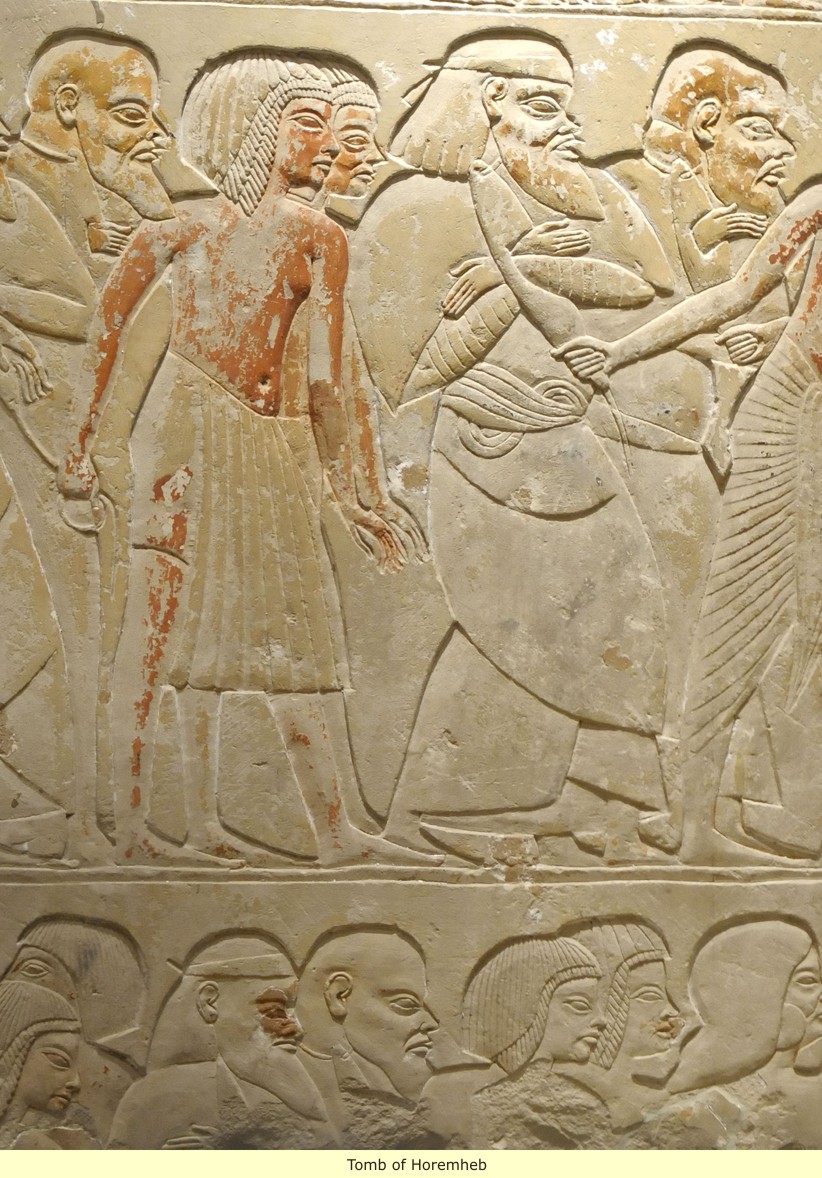
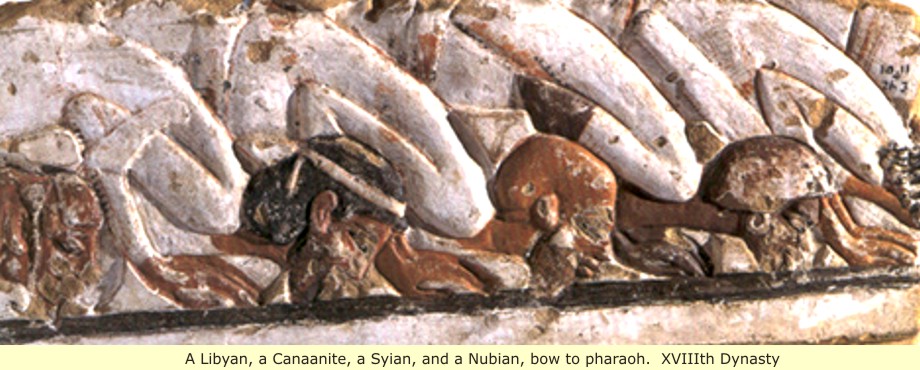
The bowing bald-headed Syrian, pictured above: is only infrequently shown in ancient art. They are sometimes shown with hair, but always as big-headed, large people: Might they be the Biblical giants, said to live north of Israel?
|
Relief of Levantine Prisoners
|
Joshua 15:8 And the border went up by the valley of the son of Hinnom unto the south side of the Jebusite; the same is Jerusalem: and the border went up to the top of the mountain that lieth before the valley of Hinnom westward, which is at the end of the valley of the giants northward: |
 |
Numbers 13: 25-And they returned from searching of the land after forty days. |
The Hyksos were indeed driven out of Egypt by Egyptian king Ahmose I, and were allowed to settle in Canaan. This is the only known event in Egyptian history similar to the Biblical Exodus. His reign is usually dated to about 1550–1525 B.C. See Egyptian history for more.
The Hyksos presence in Canaan only added to the calamity there. Two hundred years later, by the time of pharaoh Akhenaten (1350– 1330 B.C.), there was still disorder. The upheaval in Canaan eventually drew the attention of the Egyptian king, and Egyptian troops were dispatched to Canaan in an attempt to eradicate the Habiru threat.
This letter to the Egyptian pharaoh Akhenaten, in reference to the Habiru/Amorites, sums-up the situation well.
A Letter from Abdu-Heba of Jerusalem
To the king, my Lord, thus speaks Abdu-Heba, your servant. At the feet
of the king, my Lord, seven times and seven times I prostrate myself.
What have I done to the king, my Lord? They blame me before the king,
my Lord, saying: Abdu-Heba has rebelled against the king, my Lord. I am
here, as far as I am concerned, it was not my father, nor my mother,
who put to me in this position; the arm of the powerful king lead me to
the house of my father! Why would I commit a transgression against the
king, my Lord.
While the king, my Lord lives, I will say to the commissioner of the king, my Lord: Why do you favor the Hapiru and are opposed to the rulers? And thus I am accused before the king, my Lord. Because it is said: Lost are the territories of the king, my Lord. Thus am I calumniated before the king, my Lord! But may the king, my Lord know that, when the king sent a garrison, Yanhamu [The Egyptian commissioner in Canaan] seized everything, and... the land of Egypt... Oh king, my Lord, there are no garrison troops here! (Therefore), the king takes care of his land! May the king take care of his land! All the territories of the king have rebelled; Ilimilku caused the loss of all the territories of the king. May the king take care of his land!


I repeat: Allow me to enter the presence of the king, my Lord, and let me look into both eyes of the king, my Lord. But the hostility against me is strong, and I cannot enter the presence of the king, my Lord. May the king send garrison troops, in order that I may enter and look into the eyes of the king, my Lord. So certain as the king, my Lord lives, when the commissioners come, I will say: Lost are the territories of the king. Do you not hear to me? All the rulers are lost; the king, my Lord, does not have a single ruler left. May the king direct his attention to the archers, and may the king, my Lord,send troops of archers, the king has no more lands. The Hapiru sack the territories of the king. If there are archers (here) this year, all the territories of the king will remain (intact); but if there are no archers, the territories of the king, my Lord, will be lost! To the king, my Lord thus writes Abdu-Heba, your servant. He conveys eloquent words to the king, my Lord. All the territories of the king, my Lord, are lost.
By about 1200 B.C, all of the invasions and wars had started to squeeze the Canaanites. Some of them moved north along the Mediterranean coast, to what is today modern Lebanon. This became known as the "Phoenician culture", a Greek term for those Canaanites who moved north, and developed a new civilization on the coast of what is now modern Lebanon.
 |
 |
 |
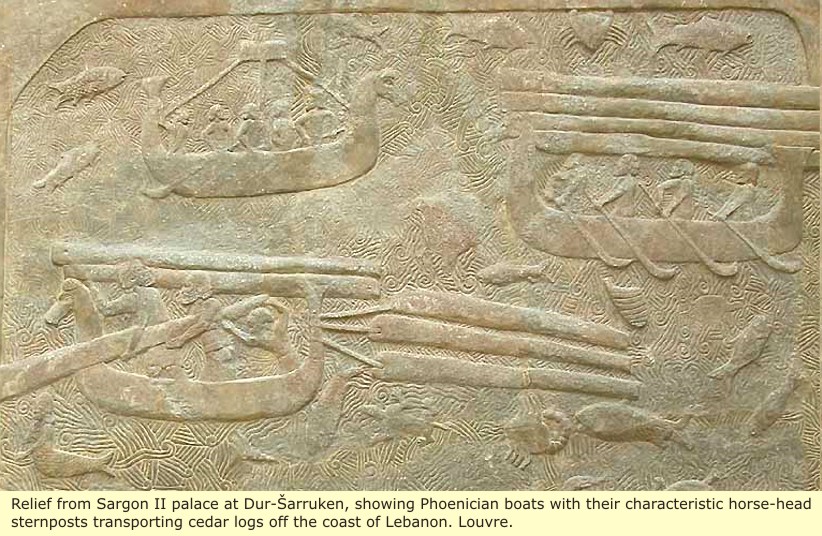
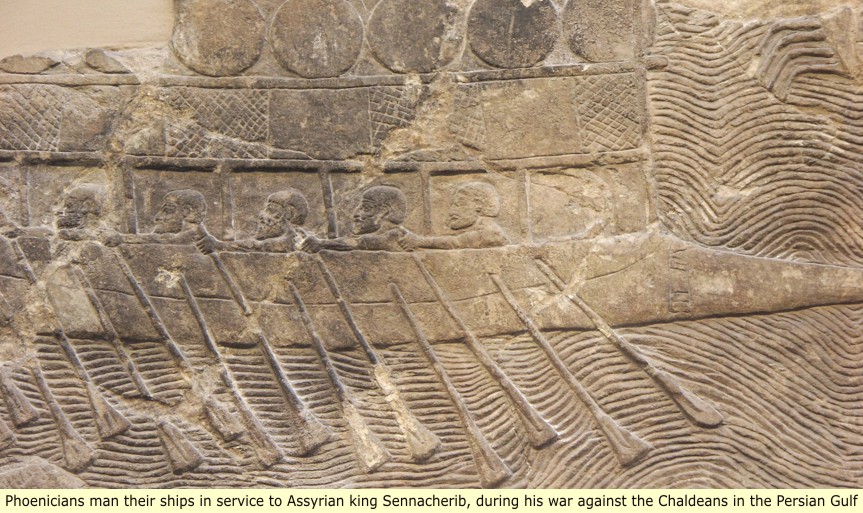
The Phoenicians were active merchants who traded throughout the Mediterranean and established colonies as far away as Spain. The best known of these Phoenician colonies was Carthage, one of the most famous cities of antiquity. It was founded on the north coast of Africa by the Phoenicians of Tyre, in 814 B.C. It is from here, that the great Phoenician general "Hannibal" (his name means - Joy of Baal), will launch his historic wars against Rome. Phoenicians are best known, for spreading a system of writing known as the “alphabet” to western civilizations. The Phoenicians were also renowned for their skill in carving ivory.
| Click here for the Story of Hannibal >>> |


 |
 |
 |
 |
 |
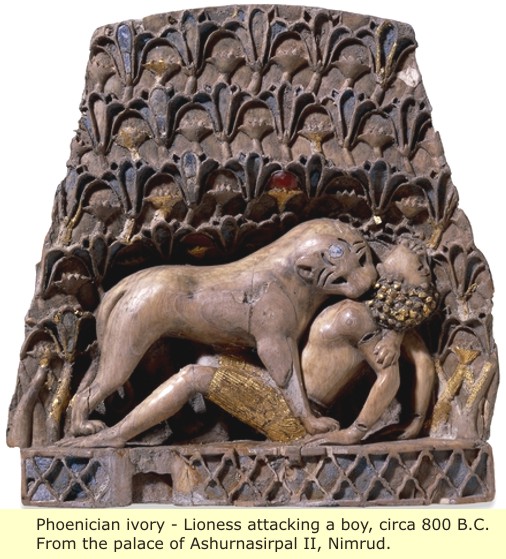
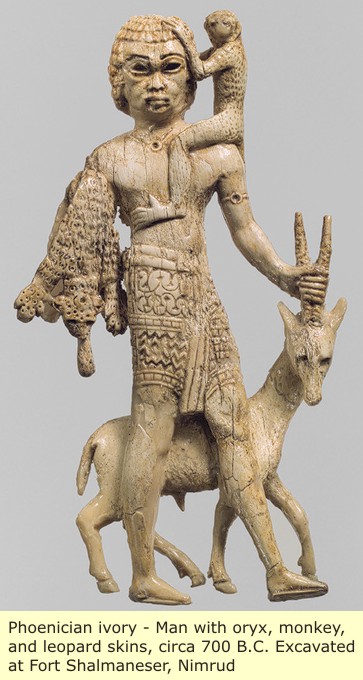
White institutions, such as Museums, are part and parcel of the White mans efforts to falsify history. They are after all, where the bogus and purposefully misidentified artifacts are stored and displayed. A very good example of purposeful misidentification, is with the Phoenician Ivory's below. Above each, is the text that accompanies them at the respective White institution. And as is standard procedure at White institutions, whenever there is a Black artifact from a civilization that Whites want to claim as White, they call it a Nubian, Ethiopian, or African. The fact is, there is absolutely no reason to believe those ivories are of anyone other than Phoenicians.
Why do Whites do these things? Because without their made-up history - at the expense of Black history - they really wouldn't have much history at all. The Greek and Roman civilizations were merely Black civilizations carried forward by the mulattoes of the indigenous Blacks and the Hellenes and Latin's - long since destroyed by the invading Germanics and Slavs. Artifacts tell us that the Trojans were Black people. Herodotus in Book 4 - MELPOMENE [4.145 - 149] tells us that the Spartans were a combination of Phoenicians and Minyae {The Minyans and the Pelasgians were the original Black inhabitants of Greece}. So what's left for Whites to claim credit for? Not much, so they lie and make it up.
As to the Phoenician ivories, sometimes their lies are just plain stupid! The ivory with the description "A Nubian with oryx, monkey, and leopard skins" makes no sense at all. The Assyrians hated the Nubians - they were contending powers. The Assyrian king Esarhaddon, after subjugating Canaan, drove Nubian king "Taharka" reeling back to the south. Here is a shortened excerpt from the best preserved of his inscriptions:
From the town of Ishhupri as far as Memphis, a distance of fifteen days, I fought daily, very bloody battles against Tarky, king of Egypt and Nubia, the one accursed by all the great gods. Five times I hit him with the point of my arrows, inflicting wounds, and then I laid siege to Memphis, his royal residence. I destroyed it, tore down its walls, and burnt it down. (After mentioning the booty which he carried off to Assyria he continues): All Nubians I deported from Egypt, leaving not even one to do homage to me. Everywhere in Egypt I appointed new kings, governors, officers, harbor overseers, officials, and administrative personnel.
So then, we are to believe that the Phoenicians made Ivory carvings of Nubians, whom the Assyrians hated, rather than of themselves or the Assyrians - and then sold them to the Assyrians? Not likely!
The British Museum says this about the Ivory carving below: The carving shows an African boy with jeweled armlets and bracelets being attacked by a lioness. |
The Metropolitan Museum of Art, New York City: says this about the Ivory carving below: A Nubian with oryx, monkey, and leopard skins. |
|
 |
 |
The silver coins of the family of Hannibal
The city of Carthage was founded by Phoenician settlers and grew to be the main power - commercial and military - in much of North Africa, Sicily and Spain. Its coinage began in the late fifth century B.C. in silver, with gold, electrum and bronze following later. The designs employed for the coinage drew for the most part on a small stock of images - a goddess, a horse, a palm tree - to display civic, ethnic and religious identity.
An exception to this was the series of coins issued by the great Barcid family in Spain during the latter part of the third century B.C. During this period Carthage was twice at war with the growing Italian power of Rome, most famously under the great Barcid general Hannibal. This silver coin was probably produced in about 230 B.C. The Punic (Carthaginian) god Melqart is shown on the obverse (front) of the coin. He is depicted resembling the Greek hero Herakles with a club over his shoulder. On the reverse is a war elephant, as used by Hannibal in his great campaign against Rome.
 |
 |
 |
 |
 |
A point of information: Silver tarnishes very quickly. "Authentic" coins are NEVER shined-up: to do so would not only remove some of the material, but the patina too, which is necessary for authentication. Removal of the patina greatly diminishes the value of a coin, because as we see, it is very easy to make a fake coin. A patina which has taken thousands of years to develop, is not so easily faked.
Please visit the "Additional Material Area" for many more photographs of each civilization, and related material <Click> |
| < Back | Home | Next > |