
The name Pelasgians, was used by ancient Greek writers to refer to populations that preceded the White Hellenes in Greece. During the classical period, enclaves under that name survived in several locations of mainland Greece, Crete and other regions of the Aegean. Populations identified as "Pelasgian" spoke a language that at the time, Greeks identified as not Greek. A tradition also survived that large parts of Greece had once been Pelasgian before being Hellenized. Archaeological excavations during the 20th century have unearthed artifacts in areas traditionally inhabited by the Pelasgians, like Thessaly and Attica and Lemnos. Archaeologists excavating at Sesklo and Dimini have described Pelasgian material culture as Neolithic.
Since next to nothing is known about the Pelasgians, The question of who built Mycenae (The first great city on mainland Greece), looms large. According the myth of Danaus, the building of Mycenae was a collaborative effort between Crete and Egypt. But since Mycenae was build at about 2,000 B.C, almost one thousand years before the Hellenes arrived in Greece, there can be no confidence that the hellenic myth has any factual basis.
We know from Herodotus that the Hellenes were original Greeks, NOT Whites, they just accepted the White invaders into their midst for unknown reasons. Herodotus refers to the Whites as Barbarians, but if we used that term, it would be confusing to those who know the Hellenes as Whites. Since the Hellenes and others, came to be at least part White through admixture, we will continue to use Hellene to designate White/Mulatto Greeks.
|
 |
But whether the Pelasgians, or the Cretans and Egyptians built it, Mycenae was described as "broad-streeted and golden". And it became the capital of a civilization that encompassed most of the Greek mainland and the Aegean Islands. The term Mycenaean is also sometimes used for the later civilizations of the Aegean area as a whole.
Mainland Greece maintained contacts with Crete, and a rich culture, based on the Late Minoan, rapidly came into being. However the Mycenaean’s gained control of Crete at about 1450 B.C, and between 1,375 and 1,200 B.C, they became masters of an empire that stretched from Sicily and southern Italy in the west to Asia Minor and the Levant coast in the east. The Mycenaean's seem to have had more of a taste for monumental sculpture than had their Minoan mentors. Of the few surviving examples, the best known is a relief "the Lion Gate" at Mycenae (c. 1250 B.C), in which two lions confront each other across an architectural column.
Note: Ancient writings seem to use the terms Pelasgians and Minyans (the founders of Cyrene Libya) interchangeably. It is supposed that they were the same people.
Beyond the citadel walls of Mycenae were the graves of the earliest kings of Mycenae and their families: dating to the beginning of the Late Helladic I period (ca. 1650- 1550 B.C.). They were enclosed by a low circular wall about 28 metres in diameter. The circle partly underlay a later tholos tomb, known as the Tomb of Klytemnestra. Grave Circle B in Mycenae is a 17th–16th century B.C. Royal cemetery situated outside the late Bronze Age citadel of Mycenae, southern Greece. The “B” burial complex was constructed outside the fortification walls of Mycenae and together with Grave Circle A represent one of the major characteristics of the early phase of the Mycenaean civilization. Most shafts were marked by a pile of stones and on four of them stelae were erected. The latter were up to 2 m (7 ft) high. Two of the stelae, on graves Alpha and Gamma, were engraved with hunting scenes.
Note below that this stele obviously depicts a Black man.
Now note how the Albinos depict the Greeks.
|
 |
 |
 |
 |
 |
 |
 |
 |
 |
 |
 |
 |
 |
 |
 |
 |
 |
As with all of the ancient Black civilizations: Whites have created all manner of Fake artifacts to suggest that the ancients were White. Perhaps the most famous of the Mycenaean fakes, is the supposed "Death Mask of Agamemnon" created by Heinrich Schliemann. Click here for link to the story of his forgery
 |
 |
Heinrich Schliemann (1822-1890), a German businessman, self-made millionaire, discoverer of the legendary city of Troy, and "father of Bronze Age archaeology," reached the ancient site of Mycenae in 1876 to begin excavations just inside the ancient walls near the famous Lion Gate. Three months later he opened a large, rectangular grave, more than 27 feet below ground level, finding inside several bodies of men and women. In less than three weeks, five of these shaft graves were excavated, four with multiple burials, and all containing numerous grave goods. Schliemannís assistant, Stamatakes, uncovered a sixth grave a short time later and renumbered the graves I through VI. The abundance of material that came to light included bronze swords, vases, copper cauldrons, golden goblets, a silver cowís head, and several gold masks that had lain over the faces of the corpses.
In the fifth grave was a well-preserved skeletal torso and skull. According to legend, Schliemann sent off a telegram to the king of Greece, declaring that he "had gazed upon the face of Agamemnon." Although this event never occurred, the mask associated with this skull was called "the mask of Agamemnon." It is distinctive because of its thin nose, large mouth and lips, and prominent beard and mustache, but its name is a complete fabrication. In fact, this mask is so different from the others found at Mycenae that it has been considered by some modern scholars to be either a deliberate fake or a reworking of an ancient mask with the addition of a "handlebar" mustacheóa fashion contemporary with Schliemann rather than with the Bronze Age!
The mask of "Agamemnon" is one of five such masks Schliemann uncovered and it must be seen in relationship to these as well as other luxury objects that came from these graves. Gold breastplates covered the torsos of several males, and the children were completely wrapped in sheet gold. Two women wore golden headbands, and one had a magnificent golden diadem. Toilette boxes and dress pins were also of gold, and even clothing was decked with golden disks. The amount of gold and other rich objects of silver and bronze speak of a wealthy stratum of society, and the multiple burials, including men, women, and children, suggest family relationships. It is, therefore, enticing to speak of a royal family, whose members were buried side by side over perhaps several generations. But when did these people live?
These shaft graves are only a small portion of a cemetery that extends beyond the city wall west of the Lion Gate. When the city expanded, the wall was enlarged to include these "royal" tombs. At that time, it appears that the Mycenaeans raised the ground level, created a double-walled enclosure with an entrance, and placed a rock in the center that served as a kind of altar. This enclosure is now designated "Grave Circle A." The deliberate preservation and separation of the shaft graves of Grave Circle A from the rest of the cemetery shows not only their importance but also the sanctity they still possessed. The city wall and the Lion Gate are dated to around 1220 BC, and the shaft graves, clearly earlier, are believed to be almost three hundred years older, around 1500 BC.
On Crete, the six-story palace complex in the capital of Knossos, probably originated the later Greek myths of the Labyrinth and the Minotaur (half man, half bull). However the labyrinth wasn’t under the palace, the labyrinth WAS the palace. Whatever the palace's function, the building itself was enormous. It contained hundreds of rooms at many levels, grouped around a central courtyard. The palace had storerooms, bathrooms, private apartments, public rooms, workshops and even what appears to be a throne room.

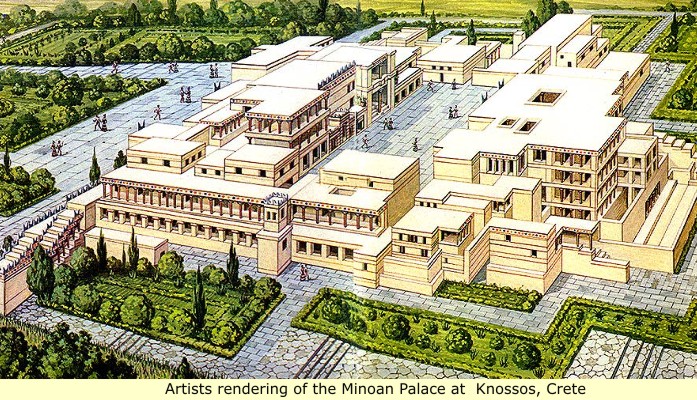 |
Some of these storerooms contained dozens of huge jars, called pithoi, which were used to store olive oil. According to some estimates, 60,000 gallons of olive oil could be put in these, which is also a testament to the Minoan's wealth. While there is no archaeological evidence of a labyrinth, the palace itself, must have seemed like a maze of corridors, staircases and rooms, to the new arrivals from the Central Asian plains. This is probably where the legend of the labyrinth began.
Please visit the "Additional Material Area" for many more photographs of each civilization, and related material <Click> |
| < Back | Home | Next > |


