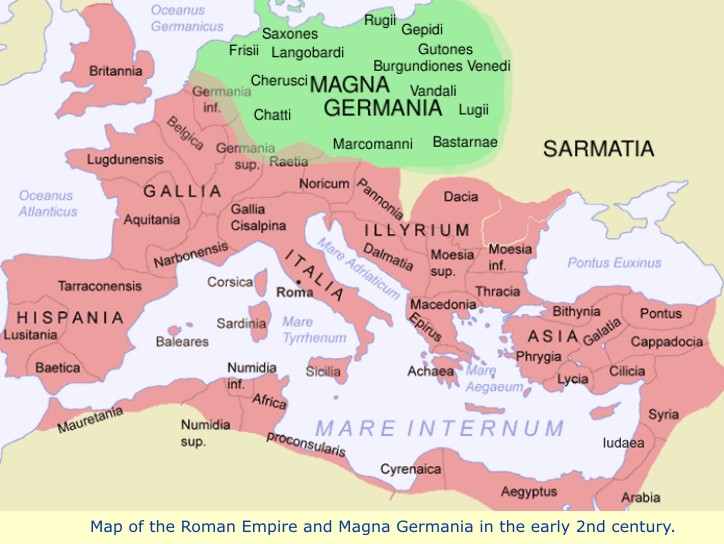
1. Germany is separated from the Galli, the Rhæti, and Pannonii, by the rivers Rhine and Danube; mountain ranges, or the fear which each feels for the other, divide it from the Sarmatæ and Daci. Elsewhere ocean girds it, embracing broad peninsulas and islands of unexplored extent, where certain tribes and kingdoms are newly known to us, revealed by war. The Rhine springs from a precipitous and inaccessible height of the Rhætian Alps, bends slightly westward, and mingles with the Northern Ocean. The Danube pours down from the gradual and gently rising slope of Mount Abnoba, and visits many nations, to force its way at last through six channels into the Pontus; a seventh mouth is lost in marshes.
2. The Germans themselves I should regard as aboriginal, and not mixed at all with other races through immigration or intercourse. For, in former times, it was not by land but on shipboard that those who sought to emigrate would arrive; and the boundless and, so to speak, hostile ocean beyond us, is seldom entered by a sail from our world. And, beside the perils of rough and unknown seas, who would leave Asia, or Africa, or Italy for Germany, with its wild country, its inclement skies, its sullen manners and aspect, unless indeed it were his home? In their ancient songs, their only way of remembering or recording the past, they celebrate an earth-born god, Tuisco, and his son Mannus, as the origin of their race, as their founders. To Mannus they assign three sons, from whose names, they say, the coast tribes are called Ingævones; those of the interior, Herminones; all the rest, Istævones. Some, with the freedom of conjecture permitted by antiquity, assert that the god had several descendants, and the nation several appellations, as Marsi, Gambrivii, Suevi, Vandilii, and that these are genuine old names. The name Germany, on the other hand, they say, is modern and newly introduced, from the fact that the tribes which first crossed the Rhine and drove out the Gauls, and are now called Tungrians, were then called Germans. Thus what was the name of a tribe, and not of a race, gradually prevailed, till all called themselves by this self-invented name of Germans, which the conquerors had first employed to inspire terror.
|
3. They say that Hercules, too, once visited them; and when going into battle, they sing of him first of all heroes. They have also those songs of theirs, by the recital of which ("baritus," they call it), they rouse their courage, while from the note they augur the result of the approaching conflict. For, as their line shouts, they inspire or feel alarm. It is not so much an articulate sound, as a general cry of valour. They aim chiefly at a harsh note and a confused roar, putting their shields to their mouth, so that, by reverberation, it may swell into a fuller and deeper sound. Ulysses, too, is believed by some, in his long legendary wanderings, to have found his way into this ocean, and, having visited German soil, to have founded and named the town of Asciburgium, which stands on the bank of the Rhine, and is to this day inhabited. They even say that an altar dedicated to Ulysses, with the addition of the name of his father, Laertes, was formerly discovered on this same spot, and that certain monuments and tombs, with Greek inscriptions, still exist on the borders of Germany and Rhætia. These statements I have no intention of sustaining by proofs, or of refuting; every one may believe or disbelieve them as he feels inclined.
4. For my own part, I agree with those who think that the tribes of Germany are free from all taint of intermarriages with foreign nations, and that they appear as a distinct, unmixed race, like none but themselves. Hence, too, the same physical peculiarities throughout so vast a population. All have fierce blue eyes, red hair, huge frames, fit only for a sudden exertion. They are less able to bear laborious work. Heat and thirst they cannot in the least endure; to cold and hunger their climate and their soil inure them.
5. Their country, though somewhat various in appearance yet generally either bristles with forests or reeks with swamps; it is more rainy on the side of Gaul, bleaker on that of Noricum and Pannonia. It is productive of grain, but unfavourable to fruit-bearing trees; it is rich in flocks and herds, but these are for the most part undersized, and even the cattle have not their usual beauty or noble head. It is number that is chiefly valued; they are in fact the most highly prized, indeed the only riches of the people. Silver and gold the gods have refused to them, whether in kindness or in anger I cannot say. I would not, however, affirm that no vein of German soil produces gold or silver, for who has ever made a search? They care but little to possess or use them. You may see among them vessels of silver, which have been presented to their envoys and chieftains, held as cheap as those of clay. The border population, however, value gold and silver for their commercial utility, and are familiar with, and show preference for, some of our coins. The tribes of the interior use the simpler and more ancient practice of the barter of commodities. They like the old and well-known money, coins milled, or showing a two-horse chariot. They likewise prefer silver to gold, not from any special liking, but because a large number of silver pieces is more convenient for use among dealers in cheap and common articles.
6. Even iron is not plentiful with them, as we infer from the character of their weapons. But few use swords or long lances. They carry a spear (framea is their name for it), with a narrow and short head, but so sharp and easy to wield that the same weapon serves, according to circumstances, for close or distant conflict. As for the horse-soldier, he is satisfied with a shield and spear; the foot-soldiers also scatter showers of missiles, each man having several and hurling them to an immense distance, and being naked or lightly clad with a little cloak. There is no display about their equipment: their shields alone are marked with very choice colours. A few only have corslets, and just one or two here and there a metal or leathern helmet. Their horses are remarkable neither for beauty nor for fleetness. Nor are they taught various evolutions after our fashion, but are driven straight forward, or so as to make one wheel to the right in such a compact body that none is left behind another. On the whole, one would say that their chief strength is in their infantry, which fights along with the cavalry; admirably adapted to the action of the latter is the swiftness of certain foot-soldiers, who are picked from the entire youth of their country, and stationed in front of the line. Their number is fixed,--a hundred from each canton; and from this they take their name among their countrymen, so that what was originally a mere number has now become a title of distinction. Their line of battle is drawn up in a wedge-like formation. To give ground, provided you return to the attack, is considered prudence rather than cowardice. The bodies of their slain they carry off even in indecisive engagements. To abandon your shield is the basest of crimes; nor may a man thus disgraced be present at the sacred rites, or enter their council; many, indeed, after escaping from battle, have ended their infamy with the halter.
7. They choose their kings by birth, their generals for merit. These kings have not unlimited or arbitrary power, and the generals do more by example than by authority. If they are energetic, if they are conspicuous, if they fight in the front, they lead because they are admired. But to reprimand, to imprison, even to flog, is permitted to the priests alone, and that not as a punishment, or at the general's bidding, but, as it were, by the mandate of the god whom they believe to inspire the warrior. They also carry with them into battle certain figures and images taken from their sacred groves. And what most stimulates their courage is, that their squadrons or battalions, instead of being formed by chance or by a fortuitous gathering, are composed of families and clans. Close by them, too, are those dearest to them, so that they hear the shrieks of women, the cries of infants. They are to every man the most sacred witnesses of his bravery--they are his most generous applauders. The soldier brings his wounds to mother and wife, who shrink not from counting or even demanding them and who administer both food and encouragement to the combatants.
8. Tradition says that armies already wavering and giving way have been rallied by women who, with earnest entreaties and bosoms laid bare, have vividly represented the horrors of captivity, which the Germans fear with such extreme dread on behalf of their women, that the strongest tie by which a state can be bound is the being required to give, among the number of hostages, maidens of noble birth. They even believe that the sex has a certain sanctity and prescience, and they do not despise their counsels, or make light of their answers. In Vespasian's days we saw Veleda, long regarded by many as a divinity. In former times, too, they venerated Aurinia, and many other women, but not with servile flatteries, or with sham deification.
9. Mercury is the deity whom they chiefly worship, and on certain days they deem it right to sacrifice to him even with human victims. Hercules and Mars they appease with more lawful offerings. Some of the Suevi also sacrifice to Isis. Of the occasion and origin of this foreign rite I have discovered nothing, but that the image, which is fashioned like a light galley, indicates an imported worship. The Germans, however, do not consider it consistent with the grandeur of celestial beings to confine the gods within walls, or to liken them to the form of any human countenance. They consecrate woods and groves, and they apply the names of deities to the abstraction which they see only in spiritual worship.
10. Augury and divination by lot no people practise more diligently. The use of the lots is simple. A little bough is lopped off a fruit-bearing tree, and cut into small pieces; these are distinguished by certain marks, and thrown carelessly and at random over a white garment. In public questions the priest of the particular state, in private the father of the family, invokes the gods, and, with his eyes towards heaven, takes up each piece three times, and finds in them a meaning according to the mark previously impressed on them. If they prove unfavourable, there is no further consultation that day about the matter; if they sanction it, the confirmation of augury is still required. For they are also familiar with the practice of consulting the notes and the flight of birds. It is peculiar to this people to seek omens and monitions from horses. Kept at the public expense, in these same woods and groves, are white horses, pure from the taint of earthly labour; these are yoked to a sacred car, and accompanied by the priest and the king, or chief of the tribe, who note their neighings and snortings. No species of augury is more trusted, not only by the people and by the nobility, but also by the priests, who regard themselves as the ministers of the gods, and the horses as acquainted with their will. They have also another method of observing auspices, by which they seek to learn the result of an important war. Having taken, by whatever means, a prisoner from the tribe with whom they are at war, they pit him against a picked man of their own tribe, each combatant using the weapons of their country. The victory of the one or the other is accepted as an indication of the issue.
11. About minor matters the chiefs deliberate, about the more important the whole tribe. Yet even when the final decision rests with the people, the affair is always thoroughly discussed by the chiefs. They assemble, except in the case of a sudden emergency, on certain fixed days, either at new or at full moon; for this they consider the most auspicious season for the transaction of business. Instead of reckoning by days as we do, they reckon by nights, and in this manner fix both their ordinary and their legal appointments. Night they regard as bringing on day. Their freedom has this disadvantage, that they do not meet simultaneously or as they are bidden, but two or three days are wasted in the delays of assembling. When the multitude think proper, they it down armed. Silence is proclaimed by the priests, who have on these occasions the right of keeping order. Then the king or the chief, according to age, birth, distinction in war, or eloquence, is heard, more because he has influence to persuade than because he has power to command. If his sentiments displease them, they reject them with murmurs; if they are satisfied, they brandish their spears. The most complimentary form of assent is to express approbation with their weapons.
12. In their councils an accusation may be preferred or a capital crime prosecuted. Penalties are distinguished ac-cording to the offence. Traitors and deserters are hanged on trees; the coward, the unwarlike, the man stained with abominable vices, is plunged into the mire of the morass, with a hurdle put over him. This distinction in punishment means that crime, they think, ought, in being punished, to be exposed, while infamy ought to be buried out of sight. Lighter offences, too, have penalties proportioned to them; he who is convicted, is fined in a certain number of horses or of cattle. Half of the fine is paid to the king or to the state, half to the person whose wrongs are avenged and to his relatives. In these same councils they also elect the chief magistrates, who administer law in the cantons and the towns. Each of these has a hundred associates chosen from the people, who support him with their advice and influence.
13. They transact no public or private business without being armed. It is not, however, usual for anyone to wear arms till the state has recognised his power to use them. Then in the presence of the council one of the chiefs, or the young man's father, or some kinsman, equips him with a shield and a spear. These arms are what the "toga" is with us, the first honour with which youth is invested. Up to this time he is regarded as a member of a household, afterwards as a member of the commonwealth. Very noble birth or great services rendered by the father secure for lads the rank of a chief; such lads attach themselves to men of mature strength and of long approved valour. It is no shame to be seen among a chief's followers. Even in his escort there are gradations of rank, dependent on the choice of the man to whom they are attached. These followers vie keenly with each other as to who shall rank first with his chief, the chiefs as to who shall have the most numerous and the bravest followers. It is an honour as well as a source of strength to be thus always surrounded by a large body of picked youths; it is an ornament in peace and a defence in war. And not only in his own tribe but also in the neighbouring states it is the renown and glory of a chief to be distinguished for. the number and valour of his followers, for such a man is courted by embassies, is honoured with presents, and the very prestige of his name often settles a war.
14. When they go into battle, it is a disgrace for the chief to be surpassed in valour, a disgrace for his followers not to equal the valour of the chief. And it is an infamy and a reproach for life to have survived the chief, and returned from the field. To defend, to protect him, to ascribe one's own brave deeds to his renown, is the height of loyalty. The chief fights for victory; his vassals fight for their chief. If their native state sinks into the sloth of prolonged peace and repose, many of its noble youths voluntarily seek those tribes which are waging some war, both because inaction is odious to their race, and because they win renown more readily in the midst of peril, and cannot maintain a numerous following except by violence and war. Indeed, men look to the liberality of their chief for their war-horse and their blood-stained and victorious lance. Feasts and entertainments, which, though inelegant, are plentifully furnished, are their only pay. The means of this bounty come from war and rapine. Nor are they as easily persuaded to plough the earth and to wait for the year's produce as to challenge an enemy and earn the honour of wounds. Nay, they actually think it tame and stupid to acquire by the sweat of toil what they might win by their blood.
15. Whenever they are not fighting, they pass much of their time in the chase, and still more in idleness, giving themselves up to sleep and to feasting, the bravest and the most warlike doing nothing, and surrendering the management of the household, of the home, and of the land, to the women, the old men, and all the weakest members of the family. They themselves lie buried in sloth, a strange combination in their nature that the same men should be so fond of idleness, so averse to peace. It is the custom of the states to bestow by voluntary and individual contribution on the chiefs a present of cattle or of grain, which, while accepted as a compliment, supplies their wants. They are particularly delighted by gifts from neighbouring tribes, which are sent not only by individuals but also by the state, such as choice steeds, heavy armour, trappings, and neck-chains. We have now taught them to accept money also.
16. It is well known that the nations of Germany have no cities, and that they do not even tolerate closely contiguous dwellings. They live scattered and apart, just as a spring, a meadow, or a wood has attracted them. Their villages they do not arrange in our fashion, with the buildings connected and joined together, but every person surrounds his dwelling with an open space, either as a precaution against the disasters of fire, or because they do not know how to build. No use is made by them of stone or tile; they employ timber for all purposes, rude masses without ornament or attractiveness. Some parts of their buildings they stain more carefully with a clay so clear and bright that it resembles painting, or a coloured design. They are wont also to dig out subterranean caves, and pile on them great heaps of dung, as a shelter from winter and as a receptacle for the year's produce, for by such places they mitigate the rigour of the cold. And should an enemy approach, he lays waste the open country, while what is hidden and buried is either not known to exist, or else escapes him from the very fact that it has to be searched for.
17. They all wrap themselves in a cloak which is fastened with a clasp, or, if this is not forthcoming, with a thorn, leaving the rest of their persons bare. They pass whole days on the hearth by the fire. The wealthiest are distinguished by a dress which is not flowing, like that of the Sarmatæ and Parthi, but is tight, and exhibits each limb. They also wear the skins of wild beasts; the tribes on the Rhine and Danube in a careless fashion, those of the interior with more elegance, as not obtaining other clothing by commerce. These select certain animals, the hides of which they strip off and vary them with the spotted skins of beasts, the produce of the outer ocean, and of seas unknown to us. The women have the same dress as the men, except that they generally wrap themselves in linen garments, which they embroider with purple, and do not lengthen out the upper part of their clothing into sleeves. The upper and lower arm is thus bare, and the nearest part of the bosom is also exposed.
18. Their marriage code, however, is strict, and indeed no part of their manners is more praiseworthy. Almost alone among barbarians they are content with one wife, except a very few among them, and these not from sensuality, but because their noble birth procures for them many offers of alliance. The wife does not bring a dower to the husband, but the husband to the wife. The parents and relatives are present, and pass judgment on the marriage-gifts, gifts not meant to suit a woman's taste, nor such as a bride would deck herself with, but oxen, a caparisoned steed, a shield, a lance, and a sword. With these presents the wife is espoused, and she herself in her turn brings her husband a gift of arms. This they count their strongest bond of union, these their sacred mysteries, these their gods of marriage. Lest the woman should think herself to stand apart from aspirations after noble deeds and from the perils of war, she is reminded by the ceremony which inaugurates marriage that she is her husband's partner in toil and danger, destined to suffer and to dare with him alike both in peace and in war. The yoked oxen, the harnessed steed, the gift of arms, proclaim this fact. She must live and die with the feeling that she is receiving what she must hand down to her children neither tarnished nor depreciated, what future daughters-in-law may receive, and may be so passed on to her grand-children.
19. Thus with their virtue protected they live uncorrupted by the allurements of public shows or the stimulant of feastings. Clandestine correspondence is equally unknown to men and women. Very rare for so numerous a population is adultery, the punishment for which is prompt, and in the husband's power. Having cut off the hair of the adulteress and stripped her naked, he expels her from the house in the presence of her kinsfolk, and then flogs her through the whole village. The loss of chastity meets with no indulgence; neither beauty, youth, nor wealth will procure the culprit a husband. No one in Germany laughs at vice, nor do they call it the fashion to corrupt and to be corrupted. Still better is the condition of those states in which only maidens are given in marriage, and where the hopes and expectations of a bride are then finally terminated. They receive one husband, as having one body and one life, that they may have no thoughts beyond, no further-reaching desires, that they may love not so much the husband as the married state. To limit the number of their children or to destroy any of their subsequent offspring is accounted infamous, and good habits are here more effectual than good laws elsewhere.
20. In every household the children, naked and filthy, grow up with those stout frames and limbs which we so much admire. Every mother suckles her own offspring, and never entrusts it to servants and nurses. The master is not distinguished from the slave by being brought up with greater delicacy. Both live amid the same flocks and lie on the same ground till the freeborn are distinguished by age and recognised by merit. The young men marry late, and their vigour is thus unimpaired. Nor are the maidens hurried into marriage; the same age and a similar stature is required; well-matched and vigorous they wed, and the offspring reproduce the strength of the parents. Sister's sons are held in as much esteem by their uncles as by their fathers; indeed, some regard the relation as even more sacred and binding, and prefer it in receiving hostages, thinking thus to secure a stronger hold on the affections and a wider bond for the family. But every man's own children are his heirs and successors, and there are no wills. Should there be no issue, the next in succession to the property are his brothers and his uncles on either side. The more relatives he has, the more numerous his connections, the more honoured is his old age; nor are there any advantages in childlessness.
21. It is a duty among them to adopt the feuds as well as the friendships of a father or a kinsman. These feuds are not implacable; even homicide is expiated by the payment of a certain number of cattle and of sheep, and the satisfaction is accepted by the entire family, greatly to the advantage of the state, since feuds are dangerous in proportion to a people's freedom. No nation indulges more profusely in entertainments and hospitality. To exclude any human being from their roof is thought impious; every German, according to his means, receives his guest with a well-furnished table. When his supplies are exhausted, he who was but now the host becomes the guide and companion to further hospitality, and without invitation they go to the next house. It matters not; they are entertained with like cordiality. No one distinguishes between an acquaintance and a stranger, as regards the rights of hospitality. It is usual to give the departing guest whatever he may ask for, and a present in return is asked with as little hesitation. They are greatly charmed with gifts, but they expect no return for what they give, nor feel any obligation for what they receive.
22. On waking from sleep, which they generally prolong to a late hour of the day, they take a bath, oftenest of warm water, which suits a country where winter is the longest of the seasons. After their bath they take their meal, each having a separate seat and table of his own. Then they go armed to business, or no less often to their festal meetings. To pass an entire day and night in drinking disgraces no one. Their quarrels, as might be expected with intoxicated people, are seldom fought out with mere abuse, but commonly with wounds and bloodshed. Yet it is at their feasts that they generally consult on the reconciliation of enemies, on the forming of matrimonial alliances, on the choice of chiefs, finally even on peace and war, for they think that at no time is the mind more open to simplicity of purpose or more warmed to noble aspirations. A race without either natural or acquired cunning, they disclose their hidden thoughts in the freedom of the festivity. Thus the sentiments of all having been discovered and laid bare, the discussion is renewed on the following day, and from each occasion its own peculiar advantage is derived. They deliberate when they have no power to dissemble; they resolve when error is impossible.
23. A liquor for drinking is made out of barley or other grain, and fermented into a certain resemblance to wine. The dwellers on the river-bank also buy wine. Their food is of a simple kind, consisting of wild-fruit, fresh game, and curdled milk. They satisfy their hunger without elaborate preparation and without delicacies. In quenching their thirst they are not equally moderate. If you indulge their love of drinking by supplying them with as much as they desire, they will be overcome by their own vices as easily as by the arms of an enemy.
24. One and the same kind of spectacle is always exhibited at every gathering. Naked youths who practise the sport bound in the dance amid swords and lances that threaten their lives. Experience gives them skill, and skill again gives grace; profit or pay are out of the question; however reckless their pastime, its reward is the pleasure of the spectators. Strangely enough they make games of hazard a serious occupation even when sober, and so venturesome are they about gaining or losing, that, when every other resource has failed, on the last and final throw they stake the freedom of their own persons. The loser goes into voluntary slavery; though the younger and stronger, he suffers himself to be bound and sold. Such is their stubborn persistency in a bad practice; they themselves call it honour. Slaves of this kind the owners part with in the way of commerce, and also to relieve themselves from the scandal of such a victory.
25. The other slaves are not employed after our manner with distinct domestic duties assigned to them, but each one has the management of a house and home of his own. The master requires from the slave a certain quantity of grain, of cattle, and of clothing, as he would from a tenant, and this is the limit of subjection. All other household functions are discharged by the wife and children. To strike a slave or to punish him with bonds or with hard labour is a rare occurrence. They often kill them, not in enforcing strict discipline, but on the impulse of passion, as they would an enemy, only it is done with impunity. The freedmen do not rank much above slaves, and are seldom. of any weight in the family, never in the state, with the exception of those tribes which are ruled by kings. There indeed they rise above the freedborn and the noble; elsewhere the inferiority of the freedman marks the freedom of the state.
26. Of lending money on interest and increasing it by compound interest they know nothing,--a more effectual safeguard than if it were prohibited. Land proportioned to the number of inhabitants is occupied by the whole community in turn, and afterwards divided among them according to rank. A wide expanse of plains makes the partition easy. They till fresh fields every year, and they have still more land than enough; with the richness and extent of their soil, they do not laboriously exert themselves in planting orchards, inclosing meadows, and watering gardens. Corn is the only produce required from the earth; hence even the year itself is not divided by them into as many seasons as with us. Winter, spring, and summer have both a meaning and a name; the name and blessings of autumn are alike unknown.
27. In their funerals there is no pomp; they simply observe the custom of burning the bodies of illustrious men with certain kinds of wood. They do not heap garments or spices on the funeral pile. The arms of the dead man and in some cases his horse are consigned to the fire. A turf mound forms the tomb. Monuments with their lofty elaborate splendour they reject as oppressive to the dead. Tears and lamentations they soon dismiss; grief and sorrow but slowly. It is thought becoming for women to bewail, for men to remember, the dead. Such on the whole is the account which I have received of the origin and manners of the entire German people. I will now touch on the institutions and religious rites of the separate tribes, pointing out how far they differ, and also what nations have migrated from Germany into Gaul.
28. That highest authority, the great Julius, informs us that Gaul was once more powerful than Germany. Consequently we may believe that Gauls even crossed over into Germany. For what a trifling obstacle would a river be to the various tribes, as they grew in strength and wished to possess in exchange settlements which were still open to all, and not partitioned among powerful monarchies! Accordingly the country between the Hercynian forest and the rivers Rhine and Moenus, and that which lies beyond, was occupied respectively by the Helvetii and Boii, both tribes of Gaul. The name Boiemum still survives, marking the old tradition of the place, though the population has been changed. Whether however the Aravisci migrated into Pannonia from the Osi, a German race, or whether the Osi came from the Aravisci into Germany, as both nations still retain he same language, institutions, and customs, is a doubtful matter; for as they were once equally poor and equally free, either bank had the same attractions, the same drawbacks. The Treveri and Nervii are even eager in their claims of a German origin, thinking that the glory of this descent distinguishes them from the uniform level of Gallic effeminacy. The Rhine bank itself is occupied by tribes unquestionably German,--the Vangiones, the Triboci, and the Nemetes. Nor do even the Ubii, though they have earned the distinction of being a Roman colony, and prefer to be called Agrippinenses, from the name of their founder, blush to own their origin. Having crossed the sea in former days, and given proof of their allegiance, they were settled on the Rhine-bank itself, as those who might guard it but need not be watched.
29. Foremost among all these nations in valour, the Batavi occupy an island within the Rhine and but a small portion of the bank. Formerly a tribe of the Chatti, they were forced by internal dissension to migrate to their present settlements and there become a part of the Roman Empire. They yet retain the honourable badge of an ancient alliance; for they are not insulted by tribute, nor ground down by the tax-gatherer. Free from the usual burdens and contributions, and set apart for fighting purposes, like a magazine of arms, we reserve them for our wars. The subjection of the Mattiaci is of the same character. For the greatness of the Roman people has spread reverence for our empire beyond the Rhine and the old boundaries. Thus this nation, whose settlements and territories are on their own side of the river, are yet in sentiment and purpose one with us; in all other respects they resemble the Batavi, except that they still gain from the soil and climate of their native land a keener vigour. I should not reckon among the German tribes the cultivators of the tithe-lands, although they are settled on the further side of the Rhine and Danube. Reckless adventurers from Gaul, emboldened by want, occupied this land of questionable ownership. After a while, our frontier having been advanced, and our military positions pushed forward, it was regarded as a remote nook of our empire and a part of a Roman province.
30. Beyond them are the Chatti, whose settlements begin at the Hercynian forest, where the country is not so open and marshy as in the other cantons into which Germany stretches. They are found where there are hills, and with them grow less frequent, for the Hercynian forest keeps close till it has seen the last of its native Chatti. Hardy frames, close-knit limbs, fierce countenances, and a peculiarly vigorous courage, mark the tribe. For Germans, they have much intelligence and sagacity; they promote their picked men to power, and obey those whom they promote; they keep their ranks, note their opportunities, check their impulses, portion out the day, intrench themselves by night, regard fortune as a doubtful, valour as an unfailing, resource; and what is most unusual, and only given to systematic discipline, they rely more on the general than on the army. Their whole strength is in their infantry, which, in addition to its arms, is laden with iron tools and provisions. Other tribes you see going to battle, the Chatti to a campaign. Seldom do they engage in mere raids and casual encounters. It is indeed the peculiarity of a cavalry force quickly to win and as quickly to yield a victory. Fleetness and timidity go together; deliberateness is more akin to steady courage.
31. A practice, rare among the other German tribes, and simply characteristic of individual prowess, has become general among the Chatti, of letting the hair and beard grow as soon as they have attained manhood, and not till they have slain a foe laying aside that peculiar aspect which devotes and pledges them to valour. Over the spoiled and bleeding enemy they show their faces once more; then, and not till then, proclaiming that they have discharged the obligations of their birth, and proved themselves worthy of their country and of their parents. The coward and the unwarlike remain unshorn. The bravest of them also wear an iron ring (which otherwise is a mark of disgrace among the people) until they have released themselves by the slaughter of a foe. Most of the Chatti delight in these fashions. Even hoary-headed men are distinguished by them, and are thus conspicuous alike to enemies and to fellow-countrymen. To begin the battle always rests with them; they form the first line, an unusual spectacle. Nor even in peace do they assume a more civilised aspect. They have no home or land or occupation; they are supported by whomsoever they visit, as lavish of the property of others as they are regardless of their own, till at length the feebleness of age makes them unequal to so stern a valour.
32. Next to the Chatti on the Rhine, which has now a well-defined channel, and serves as a boundary, dwell the Usipii and Tencteri. The latter, besides the more usual military distinctions, particularly excel in the organisation of cavalry, and the Chatti are not more famous for their foot-soldiers than are the Tencteri for their horsemen. What their forefathers originated, posterity maintain. This supplies sport to their children, rivalry to their youths: even the aged keep it up. Horses are bequeathed along with the slaves, the dwelling-house, and the usual rights of inheritance; they go to the son, not to the eldest, as does the other property, but to the most warlike and courageous.
33. After the Tencteri came, in former days, the Bructeri; but the general account now is, that the Chamavi and Angrivarii entered their settlements, drove them out and utterly exterminated them with the common help of the neighbouring tribes, either from hatred of their tyranny, or from the attractions of plunder, or from heaven's favourable regard for us. It did not even grudge us the spectacle of the conflict. More than sixty thousand fell, not beneath the Roman arms and weapons, but, grander far, before our delighted eyes. May the tribes, I pray, ever retain if not love for us, at least hatred for each other; for while the destinies of empire hurry us on, fortune can give no greater boon than discord among our foes.
34. The Angrivarii and Chamavi are bounded in the rear by the Dulgubini and Chasuarii, and other tribes not equally famous. Towards the river are the Frisii, distinguished as the Greater and Lesser Frisii, according to their strength. Both these tribes, as far as the ocean, are skirted by the Rhine, and their territory also embraces vast lakes which Roman fleets have navigated. We have even ventured on the ocean itself in these parts. Pillars of Hercules, so rumour commonly says, still exist; whether Hercules really visited the country, or whether we have agreed to ascribe every work of grandeur, wherever met with, to his renown. Drusus Germanicus indeed did not lack daring; but the ocean barred the explorer's access to itself and to Hercules. Subsequently no one has made the attempt, and it has been thought more pious and reverential to believe in the actions of the gods than to inquire.
35. Thus far we have taken note of Western Germany. Northwards the country takes a vast sweep. First comes the tribe of the Chauci, which, beginning at the Frisian settlements, and occupying a part of the coast, stretches along the frontier of all the tribes which I have enumerated, till it reaches with a bend as far as the Chatti. This vast extent of country is not merely possessed, but densely peopled, by the Chauci, the noblest of the German races, a nation who would maintain their greatness by righteous dealing. Without ambition, without lawless violence, they live peaceful and secluded, never provoking a war or injuring others by rapine and robbery. Indeed, the crowning proof of their valour and their strength is, that they keep up their superiority without harm to others. Yet all have their weapons in readiness, and an army if necessary, with a multitude of men and horses; and even while at peace they have the same renown of valour.
36. Dwelling on one side of the Chauci and Chatti, the Cherusci long cherished, unassailed, an excessive and enervating love of peace. This was more pleasant than safe, for to be peaceful is self-deception among lawless and powerful neighbours. Where the strong hand decides, moderation and justice are terms applied only to the more powerful; and so the Cherusci, ever reputed good and just, are now called cowards and fools, while in the case of the victorious Chatti success has been identified with prudence. The downfall of the Cherusci brought with it also that of the Fosi, a neighbouring tribe, which shared equally in their disasters, though they had been inferior to them in prosperous days.
37. In the same remote corner of Germany, bordering on the ocean dwell the Cimbri, a now insignificant tribe, but of great renown. Of their ancient glory widespread traces yet remain; on both sides of the Rhine are encampments of vast extent, and by their circuit you may even now measure the warlike strength of the tribe, and find evidence of that mighty emigration. Rome was in her 640th year when we first heard of the Cimbrian invader in the consulship of Cæcilius Metellus and Papirius Carbo, from which time to the second consulship of the Emperor Trajan we have to reckon about 210 years. So long have we been in conquering Germany. In the space of this long epoch many losses have been sustained on both sides. Neither Samnite nor Carthaginian, neither Spain nor Gaul, not even the Parthians, have given us more frequent warnings. German independence truly is fiercer than the despotism of an Arsaces. What else, indeed, can the East taunt us with but the slaughter of Crassus, when it has itself lost Pacorus, and been crushed under a Ventidius? But Germans, by routing or making prisoners of Carbo, Cassius, Scaurus Aurelius, Servilius Cæpio, and Marcus Manlius, deprived the Roman people of five consular armies, and they robbed even a Cæsar of Varus and his three legions. Not without loss to us were they discomfited by Marius in Italy, by the great Julius in Gaul, and by Drusus, Nero, and Germanicus, on their own ground. Soon after, the mighty menaces of Caius Cæsar were turned into a jest. Then came a lull, until on the occasion of our discords and the civil war, they stormed the winter camp of our legions, and even designed the conquest of Gaul. Again were they driven back; and in recent times we have celebrated triumphs rather than won conquests over them.
38. I must now speak of the Suevi, who are not one nation as are the Chatti and Tencteri, for they occupy the greater part of Germany, and have hitherto been divided into separate tribes with names of their own, though they are called by the general designation of "Suevi." A national peculiarity with them is to twist their hair back, and fasten it in a knot This distinguishes the Suevi from the other Germans, as it also does their own freeborn from their slaves. With other tribes, either from some connection with the Suevic race, or, as often happens, from imitation, the practice is an occasional one, and restricted to youth. The Suevi, till their heads are grey, affect the fashion of drawing back their unkempt locks, and often they are knotted on the very top of the head. The chiefs have a more elaborate style; so much do they study appearance, but in perfect innocence, not with any thoughts of love-making; but arranging their hair when they go to battle, to make themselves tall and terrible, they adorn themselves, so to speak, for the eyes of the foe.
39. The Semnones give themselves out to be the most ancient and renowned branch of the Suevi. Their antiquity is strongly attested by their religion. At a stated period, all the tribes of the same race assemble by their representatives in a grove consecrated by the auguries of their forefathers, and by immemorial associations of terror. Here, having publicly slaughtered a human victim, they celebrate the horrible beginning of their barbarous rite. Reverence also in other ways is paid to the grove. No one enters it except bound with a chain, as an inferior acknowledging the might of the local divinity. If he chance to fall, it is not lawful for him to be lifted up, or to rise to his feet; he must crawl out along the ground. All this superstition implies the belief that from this spot the nation took its origin, that here dwells the supreme and all-ruling deity, to whom all else is subject and obedient. The fortunate lot of the Semnones strengthens this belief; a hundred cantons are in their occupation, and the vastness of their community makes them regard themselves as the head of the Suevic race.
40. To the Langobardi, on the contrary, their scanty numbers are a distinction. Though surrounded by a host of most powerful tribes, they are safe, not by submitting, but by daring the perils of war. Next come the Reudigni, the Aviones, the Anglii, the Varini, the Eudoses, the Suardones, and Nuithones who are fenced in by rivers or forests. None of these tribes have any noteworthy feature, except their common worship of Ertha, or mother-Earth, and their belief that she interposes in human affairs, and visits the nations in her car. In an island of the ocean there is a sacred grove, and within it a consecrated chariot, covered over with a garment. Only one priest is permitted to touch it. He can perceive the presence of the goddess in this sacred recess, and walks by her side with the utmost reverence as she is drawn along by heifers. It is a season of rejoicing, and festivity reigns wherever she deigns to go and be received. They do not go to battle or wear arms; every weapon is under lock; peace and quiet are known and welcomed only at these times, till the goddess, weary of human intercourse, is at length restored by the same priest to her temple. Afterwards the car, the vestments, and, if you like to believe it, the divinity herself, are purified in a secret lake. Slaves perform the rite, who are instantly swallowed up by its waters. Hence arises a mysterious terror and a pious ignorance concerning the nature of that which is seen only by men doomed to die. This branch indeed of the Suevi stretches into the remoter regions of Germany.
41. Nearer to us is the state of the Hermunduri (I shall follow the course of the Danube as I did before that of the Rhine), a people loyal to Rome. Consequently they, alone of the Germans, trade not merely on the banks of the river, but far inland, and in the most flourishing colony of the province of Rætia. Everywhere they are allowed to pass without a guard; and while to the other tribes we display only our arms and our camps, to them we have thrown open our houses and country-seats, which they do not covet. It is in their lands that the Elbe takes its rise, a famous river known to us in past days; now we only hear of it.
42. The Narisci border on the Hermunduri, and then follow the Marcomanni and Quadi. The Marcomanni stand first in strength and renown, and their very territory, from which the Boii were driven in a former age, was won by valour. Nor are the Narisci and Quadi inferior to them. This I may call the frontier of Germany, so far as it is completed by the Danube. The Marcomanni and Quadi have, up to our time, been ruled by kings of their own nation, descended from the noble stock of Maroboduus and Tudrus. They now submit even to foreigners; but the strength and power of the monarch depend on Roman influence. He is occasionally supported by our arms, more frequently by our money, and his authority is none the less.
43. Behind them the Marsigni, Gotini, Osi, and Buri, close in the rear of the Marcomanni and Quadi. Of these, the Marsigni and Buri, in their language and manner of life, resemble the Suevi. The Gotini and Osi are proved by their respective Gallic and Pannonian tongues, as well as by the fact of their enduring tribute, not to be Germans. Tribute is imposed on them as aliens, partly by the Sarmatæ, partly by the Quadi. The Gotini, to complete their degradation, actually work iron mines. All these nations occupy but little of the plain country, dwelling in forests and on mountain-tops. For Suevia is divided and cut in half by a continuous mountain-range, beyond which live a multitude of tribes. The name of Ligii, spread as it is among many states, is the most widely extended. It will be enough to mention the most powerful, which are the Harii, the Helvecones, the Manimi, the Helisii and the Nahanarvali. Among these last is shown a grove of immemorial sanctity. A priest in female attire has the charge of it. But the deities are described in Roman language as Castor and Pollux. Such, indeed, are the attributes of the divinity, the name being Alcis. They have no images, or, indeed, any vestige of foreign superstition, but it is as brothers and as youths that the deities are worshipped. The Harii, besides being superior in strength to the tribes just enumerated, savage as they are, make the most of their natural ferocity by the help of art and opportunity. Their shields are black, their bodies dyed. They choose dark nights for battle, and, by the dread and gloomy aspect of their death-like host, strike terror into the foe, who can never confront their strange and almost infernal appearance. For in all battles it is the eye which is first vanquished.
44. Beyond the Ligii are the Gothones, who are ruled by kings, a little more strictly than the other German tribes, but not as yet inconsistently with freedom. Immediately adjoining them, further from the coast, are the Rugii and Lemovii, the badge of all these tribes being the round shield, the short sword, and servile submission to their kings. And now begin the states of the Suiones, situated on the Ocean itself, and these, besides men and arms, are powerful in ships. The form of their vessels is peculiar in this respect, that a prow at either extremity acts as a forepart, always ready for running into shore. They are not worked by sails, nor have they a row of oars attached to their sides; but, as on some rivers, the apparatus of rowing is unfixed, and shifted from side to side as circumstances require. And they likewise honour wealth, and so a single ruler holds sway with no restrictions, and with no uncertain claim to obedience. Arms are not with them, as with the other Germans, at the general disposal, but are in the charge of a keeper, who is actually a slave; for the ocean forbids the sudden inroad of enemies, and, besides, an idle multitude of armed men is easily demoralized. And indeed it is by no means the policy of a monarch to place either a nobleman, a freeborn citizen, or even a freedman, at the head of an armed force.
45. Beyond the Suiones is another sea, sluggish and almost motionless, which, we may certainly infer, girdles and surrounds the world, from the fact that the last radiance of the setting sun lingers on till sunrise, with a brightness sufficient to dim the light of the stars. Even the very sound of his rising, as popular belief adds, may be heard, and the forms of gods and the glory round his head may be seen. Only thus far (and here rumour seems truth) does the world extend. At this point the Suevic sea, on its eastern shore, washes the tribes of the Æstii, whose rites and fashions and style of dress are those of the Suevi, while their language is more like the British. They worship the mother of the gods, and wear as a religious symbol the device of a wild boar. This serves as armour, and as a universal defence, rendering the votary of the goddess safe even amidst enemies. They often use clubs, iron weapons but seldom. They are more patient in cultivating corn and other produce than might be expected from the general indolence of the Germans. But they also search the deep, and are the only people who gather amber (which they call "glesum"), in the shallows, and also on the shore itself. Barbarians as they are they have not investigated or discovered what natural cause or process produces it. Nay, it even lay amid the sea's other refuse, till our luxury gave it a name. To them it is utterly useless; they gather it in its raw state, bring it to us in shapeless lumps, and marvel at the price which they receive. It is however a juice from trees, as you may infer from the fact that there are often seen shining through it, reptiles, and even winged insects, which, having become entangled in the fluid, are gradually enclosed in the substance as it hardens. I am therefore inclined to think that the islands and countries of the West, like the remote recesses of the East, where frankincense and balsam exude, contain fruitful woods and groves; that these productions, acted on by the near rays of the sun, glide in a liquid state into the adjacent sea, and are thrown up by the force of storms on the opposite shores. If you test the composition of amber by applying fire, it burns like pinewood, and sends forth a rich and fragrant flame; it is soon softened into something like pitch or resin. Closely bordering on the Suiones are the tribes of the Sitones, which, resembling them in all else, differ only in being ruled by a woman. So low have they fallen, not merely from freedom, but even from slavery itself. Here Suevia ends.
46. As to the tribes of the Peucini, Veneti, and Fenni, I am in doubt whether I should class them with the Germans or the Sarmatæ, although indeed the Peucini called by some Bastarnæ, are like Germans in their language, mode of life, and in the permanence of their settlements. They all live in filth and sloth, and by the intermarriages of the chiefs they are becoming in some degree debased into a resemblance to the Sarmatæ. The Veneti have borrowed largely from the Sarmatian character; in their plundering expeditions they roam over the whole extent of forest and mountain between the Peucini and Fenni. They are however to be rather referred to the German race, for they have fixed habitations, carry shields, and delight in strength and fleetness of foot, thus presenting a complete contrast to the Sarmatæ, who live in waggons and on horseback. The Fenni are strangely beastlike and squalidly poor; neither arms nor homes have they; their food is herbs, their clothing skins, their bed the earth. They trust wholly to their arrows, which, for want of iron, are pointed with bone. The men and the women are alike supplied by the chase; for the latter are always present, and demand a share of the prey. The little children have no shelter from wild beasts and storms but a covering of interlaced boughs. Such are the homes of the young, such the resting place of the old. Yet they count this greater happiness than groaning over field-labour, toiling at building, and poising the fortunes of themselves and others between hope and fear. Heedless of men, heedless of gods, they have attained that hardest of results, the not needing so much as a wish. All else is fabulous, as that the Hellusii and Oxiones have the faces and expressions of men, with the bodies and limbs of wild beasts. All this is unauthenticated, and I shall leave it open.
1. To bequeath to posterity a record of the deeds and characters of distinguished men is an ancient practice which even the present age, careless as it is of its own sons, has not abandoned whenever some great and conspicuous excellence has conquered and risen superior to that failing, common to petty and to great states, blindness and hostility to goodness. But in days gone by, as there was a greater inclination and a more open path to the achievement of memorable actions, so the man of highest genius was led by the simple reward of a good conscience to hand on without partiality or self-seeking the remembrance of greatness. Many too thought that to write their own lives showed the confidence of integrity rather than presumption. Of Rutilius and Scaurus no one doubted the honesty or questioned the motives. So true is it that merit is best appreciated by the age in which it thrives most easily. But in these days, I, who have to record the life of one who has passed away, must crave an indulgence, which I should not have had to ask had I only to inveigh against an age so cruel, so hostile to all virtue.
2. We have read that the panegyrics pronounced by Arulenus Rusticus on Rictus Thrasea, and by Herennius Senecio on Priscus Helvidius, were made capital crimes, that not only their persons but their very books were objects of rage, and that the triumvirs were commissioned to burn in the forum those works of splendid genius. They fancied, forsooth; that in that fire the voice of the Roman people, the freedom of the Senate, and the conscience of the human race were perishing, while at the same time they banished the teachers of philosophy, and exiled every noble pursuit, that nothing good might anywhere confront them. Certainly we showed a magnificent example of patience; as a former age had witnessed the extreme of liberty, so we witnessed the extreme of servitude, when the informer robbed us of the interchange of speech and hearing. We should have lost memory as well as voice, had it been as easy to forget as to keep silence.
3. Now at last our spirit is returning. And yet, though at the dawn of a most happy age Nerva Cæsar blended things once irreconcilable, sovereignty and freedom, though Nerva Trajan is now daily augmenting the prosperity of the time, and though the public safety has not only our hopes and good wishes, but has also the certain pledge of their fulfillment, still, from the necessary condition of human frailty, the remedy works less quickly than the disease. As our bodies grow but slowly, perish in a moment, so it is easier to crush than to revive genius and its pursuits. Besides, the charm of indolence steals over us, and the idleness which at first we loathed we afterwards love. What if during those fifteen years, a large portion of human life, many were cut off by ordinary casualties, and the ablest fell victims to the Emperor's rage, if a few of us survive, I may almost say, not only others but our ownselves, survive, though there have been taken from the midst of life those many years which brought the young in dumb silence to old age, and the old almost to the very verge and end of existence! Yet we shall not regret that we have told, though in language unskilful and unadorned, the story of past servitude, and borne our testimony to present happiness. Meanwhile this book, intended to do honour to Agricola, my father-in-law, will, as an expression of filial regard, be commended, or at least excused.
4. Cnæus Julius Agricola was born at the ancient and famous colony of Forum Julii. Each of his grandfathers was an Imperial procurator, that is, of the highest equestrian rank. His father, Julius Græcinus, a member of the Senatorian order, and distinguished for his pursuit of eloquence and philosophy, earned for himself by these very merits the displeasure of Caius Cæsar. He was ordered to impeach Marcus Silanus, and because he refused was put to death. His mother was Julia Procilla, a lady of singular virtue. Brought up by her side with fond affection, he passed his boyhood and youth in the cultivation of every worthy attainment. He was guarded from the enticements of the profligate not only by his own good and straightforward character, but also by having, when quite a child, for the scene and guide of his studies, Massilia, a place where refinement and provincial frugality were blended and happily combined. I remember that he used to tell us how in his early youth he would have imbibed a keener love of philosophy than became a Roman and a senator, had not his mother's good sense checked his excited and ardent spirit. It was the case of a lofty and aspiring soul craving with more eagerness than caution the beauty and splendour of great and glorious renown. But it was soon mellowed by reason and experience, and he retained from his learning that most difficult of lessons--moderation.
5. He served his military apprenticeship in Britain to the satisfaction of Suetonius Paullinus, a painstaking and judicious officer, who, to test his merits, selected him to share his tent. Without the recklessness with which young men often make the profession of arms a mere pastime, and without indolence, he never availed himself of his tribune's rank or his inexperience to procure enjoyment or to escape from duty. He sought to make himself acquainted with the province and known to the army; he would learn from the skilful, and keep pace with the bravest, would attempt nothing for display, would avoid nothing from fear, and would be at once careful and vigilant. Never indeed had Britain been more excited, or in a more critical condition. Veteran soldiers had been massacred, colonies burnt, armies cut off. The struggle was then for safety; it was soon to be for victory. And though all this was conducted under the leadership and direction of another, though the final issue and the glory of having won back the province belonged to the general, yet skill, experience, and ambition were acquired by the young officer. His soul too was penetrated with the desire of warlike renown, a sentiment unwelcome to an age which put a sinister construction on eminent merit, and made glory as perilous as infamy.
6. From Britain he went to Rome, to go through the regular course of office, and there allied himself with Domitia Decidiana, a lady of illustrious birth. The marriage was one which gave a man ambitious of advancement distinction and support. They lived in singular harmony, through their mutual affection and preference of each other to self. However, the good wife deserves the greater praise, just as the bad incurs a heavier censure. Appointed Quæstor, the ballot gave him Asia for his province, Salvius Titianus for his proconsul. Neither the one nor the other corrupted him, though the province was rich and an easy prey to the wrongdoer, while the proconsul, a man inclined to every species of greed, was ready by all manner of indulgence to purchase a mutual concealment of guilt.
A daughter was there added to his family to be his stay and comfort, for shortly after he lost the son that had before been born to him. The year between his quæstorship and tribunate, as well as the year of the tribunate itself, he passed in retirement and inaction, for he knew those times of Nero when indolence stood for wisdom. His prætorship was passed in the same consistent quietude, for the usual judicial functions did not fall to his lot. The games and the pageantry of his office he ordered according to the mean between strictness and profusion, avoiding extravagance, but not missing distinction. He was afterwards appointed by Galba to draw up an account of the temple offerings, and his searching scrutiny relieved the conscience of the state from the burden of all sacrileges but those committed by Nero.
7. The following year inflicted a terrible blow on his affections and his fortunes. Otho's fleet, while cruising idly about, cruelly ravaged Intemelii, a district of Liguria; his mother, who was living here on her own estate, was murdered. The estate itself and a large part of her patrimony were plundered. This was indeed the occasion of the crime. Agricola, who instantly set out to discharge the duties of affection, was overtaken by the tidings that Vespasian was aiming at the throne. He at once joined his party. Vespasian's early policy, and the government of Rome were directed by Mucianus, for Domitian was a mere youth, and from his father's elevation sought only the opportunities of indulgence. Agricola, having been sent by Mucianus to conduct â levy of troops, and having done his work with integrity and energy, was appointed to command the 10th Legion, which had been slow to take the new oath of allegiance, and the retiring officer of which was reported to be acting disloyally. It was a trying and formidable charge for even officers of consular rank, and the late prætorian officer, perhaps from his own disposition, perhaps from that of the soldiers, was powerless to restrain them. Chosen thus at once to supersede and to punish, Agricola, with a singular moderation, wished it to be thought that he had found rather than made an obedient soldiery.
8. Britain was then under Vettius Bolanus, who governed more mildly than suited so turbulent a province. Agricola moderated his energy and restrained his ardour, that he might not grow too important, for he had learnt to obey, and understood well how to combine expediency with honour. Soon afterwards Britain received for its governor a man of consular rank, Petilius Cerialis. Agricola's merits had now room for display. Cerialis let him share at first indeed only the toils and dangers, but before long the glory of war, often by way of trial putting him in command of part of the army, and sometimes, on the strength of the result, of larger forces. Never to enhance his own renown did Agricola boast of his exploits; he always referred his success, as though he were but an instrument, to his general and director. Thus by his valour in obeying orders and by his modesty of speech he escaped jealousy without losing distinction.
9. As he was returning from the command of the legion, Vespasian admitted him into the patrician order, and then gave him the province of Aquitania, a preeminently splendid appointment both from the importance of its duties and the prospect of the consulate to which the Emperor destined him. Many think the genius of the soldier wants subtlety, because military law, which is summary and blunt, and apt to appeal to the sword, finds no exercise for the refinements of the forum. Yet Agricola, from his natural good sense, though called to act among civilians, did his work with ease and correctness. And, besides, the times of business and relaxation were kept distinct. When his public and judicial duties required it, he was dignified, thoughtful, austere, and yet often merciful; when business was done with, he wore no longer the official character. He was altogether without harshness, pride, or the greed of gain. With a most rare felicity, his good nature did not weaken his authority, nor his strictness the attachment of his friends. To speak of uprightness and purity in such a man would be an insult to his virtues. Fame itself, of which even good men are often weakly fond, he did not seek by an ostentation of virtue or by artifice. He avoided rivalry with his colleagues, contention with his procurator, thinking such victories no honour and defeat disgrace. For somewhat less than three years he was kept in his governorship, and was then recalled with an immediate prospect of the consulate. A general belief went with him that the province of Britain was to be his, not because he had himself hinted it, but because he seemed worthy of it. Public opinion is not always mistaken; sometimes even it chooses the right man. He was consul, and I but a youth, when he betrothed to me his daughter, a maiden even then of noble promise. After his consulate he gave her to me in marriage, and was then at once appointed to the government of Britain, with the addition of the sacred office of the pontificate.
10. The geography and inhabitants of Britain, already described by many writers, I will speak of, not that my research and ability may be compared with theirs, but because the country was then for the first time thoroughly subdued. And so matters, which as being still not accurately known my predecessors embellished with their eloquence, shall now be related on the evidence of facts.
Britain, the largest of the islands which Roman geography includes, is so situated that it faces Germany on the east, Spain on the west; on the south it is even within sight of Gaul; its northern extremities, which have no shores opposite to them, are beaten by the waves of a vast open sea. The form of the entire country has been compared by Livy and Fabius Rusticus, the most graphic among ancient and modern historians, to an oblong shield or battle-axe. And this no doubt is its shape without Caledonia, so that it has become the popular description of the whole island. There is, however, a large and irregular tract of land which juts out from its furthest shores, tapering off in a wedge-like form. Round these coasts of remotest ocean the Roman fleet then for the first time sailed, ascertained that Britain is an island, and simultaneously discovered and conquered what are called the Orcades, islands hitherto unknown. Thule too was descried in the distance, which as yet had been hidden by the snows of winter. Those waters, they say, are sluggish, and yield with difficulty to the oar, and are not even raised by the wind as other seas. The reason, I suppose, is that lands and mountains, which are the cause and origin of storms, are here comparatively rare, and also that the vast depths of that unbroken expanse are more slowly set in motion. But to investigate the nature of the ocean and the tides is no part of the present work, and many writers have discussed the subject. I would simply add, that nowhere has the sea a wider dominion, that it has many currents running in every direction, that it does not merely flow and ebb within the limits of the shore, but penetrates and winds far inland, and finds a home among hills and mountains as though in its own domain.
11. Who were the original inhabitants of Britain, whether they were indigenous or foreign, is, as usual among barbarians, little known. Their physical characteristics are various, and from these conclusions may be drawn. The red hair and large limbs of the inhabitants of Caledonia point clearly to a German origin. The dark complexion of the Silures, their usually curly hair, and the fact that Spain is the opposite shore to them, are an evidence that Iberians of a former date crossed over and occupied these parts. Those who are nearest to the Gauls are also like them, either from the permanent influence of original descent, or, because in countries which run out so far to meet each other, climate has produced similar physical qualities. But a general survey inclines me to believe that the Gauls established themselves in an island so near to them. Their religious belief may be traced in the strongly-marked British superstition. The language differs but little; there is the same boldness in challenging danger, and, when it is near, the same timidity in shrinking from it. The Britons, however, exhibit more spirit, as being a people whom a long peace has not yet enervated. Indeed we have understood that even the Gauls were once renowned in war; but, after a while, sloth following on ease crept over them, and they lost their courage along with their freedom. This too has happened to the long-conquered tribes of Britain; the rest are still what the Gauls once were.
12. Their strength is in infantry. Some tribes fight also with the chariot. The higher in rank is the charioteer; the dependants fight. They were once ruled by kings, but are now divided under chieftains into factions and parties. Our greatest advantage in coping with tribes so powerful is that they do not act in concert. Seldom is it that two or three states meet together to ward off a common danger. Thus, while they fight singly, all are conquered. Their sky is obscured by continual rain and cloud. Severity of cold is unknown. The days exceed in length those of our part of the world; the nights are bright, and in the extreme north so short that between sunlight and dawn you can perceive but a slight distinction. It is said that, if there are no clouds in the way, the splendour of the sun can be seen throughout the night, and that he does not rise and set, but only crosses the heavens. The truth is, that the low shadow thrown from the flat extremities of the earth's surface does not raise the darkness to any height, and the night thus fails to reach the sky and stars.
With the exception of the olive and vine, and plants which usually grow in warmer climates, the soil will yield, and even abundantly, all ordinary produce. It ripens indeed slowly, but is of rapid growth, the cause in each case being the same, namely, the excessive moisture of the soil and of the atmosphere. Britain contains gold and silver and other metals, as the prize of conquest. The ocean, too, produces pearls, but of a dusky and bluish hue. Some think that those who collect them have not the requisite skill, as in the Red Sea the living and breathing pearl is torn from the rocks, while in Britain they are gathered just as they are thrown up. I could myself more readily believe that the natural properties of the pearls are in fault than our keenness for gain.
13. The Britons themselves bear cheerfully the conscription, the taxes, and the other burdens imposed on, them by the Empire, if there be no oppression. Of this they are impatient; they are reduced to subjection, not as yet to slavery The deified Julius, the very first Roman who entered Britain with an army, though by a successful engagement he struck terror into the inhabitants and gained possession of the coast: must be regarded as having indicated rather than transmitted the acquisition to future generations. Then came the civil wars, and the arms of our leaders were turned against their country, and even when there was peace, there was a long neglect of Britain. This Augustus spoke of as policy. Tiberius as an inherited maxim. That Caius Cæsar meditated an invasion of Britain is perfectly clear, but his purposes, rapidly formed, were easily changed, and his vast attempts on Germany had failed. Claudius was the first to renew the attempt, and conveyed over into the island some legions and auxiliaries, choosing Vespasian to share with him the campaign, whose approaching elevation had this beginning. Several tribes were subdued and kings made prisoners, and destiny learnt to know its favourite.
14. Aulus Plautius was the first governor of consular rank, and Ostorius Scapula the next. Both were famous soldiers, and by degrees the nearest portions of Britain were brought into the condition of a province, and a colony of veterans was also introduced. Some of the states were given to king Cogidumnus, who lived down to our day a most faithful ally. So was maintained the ancient and long-recognised practice of the Roman people, which seeks to secure among the instruments of dominion even kings themselves. Soon after, Didius Gallus consolidated the conquests of his predecessors, and advanced a very few positions into parts more remote, to gain the credit of having enlarged the sphere of government. Didius was succeeded by Veranius, who died within the year. Then Suetonius Paullinus enjoyed success for two years; he subdued several tribes and strengthened our military posts. Thus encouraged, he made an attempt on the island of Mona, as a place from which the rebels drew reinforcements; but in doing this he left his rear open to attack.
15. Relieved from apprehension by the legate's absence, the Britons dwelt much among themselves on the miseries of subjection, compared their wrongs, and exaggerated them in the discussion. "All we get by patience," they said, "is that heavier demands are exacted from us, as from men who will readily submit. A single king once ruled us; now two are set over us; a legate to tyrannise over our lives, a procurator to tyrannise over our property. Their quarrels and their harmony are alike ruinous to their subjects. The centurions of the one, the slaves of the other, combine violence with insult. Nothing is now safe from their avarice, nothing from their lust. In war it is the strong who plunders; now, it is for the most part by cowards and poltroons that our homes are rifled, our children torn from us, the conscription enforced, as though it were for our country alone that we could not die. For, after all, what a mere handful of soldiers has crossed over, if we Britons look at our own numbers. Germany did thus actually shake off the yoke, and yet its defence was a river, not the ocean. With us, fatherland, wives, parents, are the motives to war; with them, only greed and profligacy. They will surely fly, as did the now deified Julius, if once we emulate the valour of our sires. Let us not be panicstricken at the result of one or two engagements. The miserable have more fury and greater resolution. Now even the gods are beginning to pity us, for they are keeping away the Roman general, and detaining his army far from us in another island. We have already taken the hardest step; we are deliberating. And indeed, in all such designs, to dare is less perilous than to be detected."
16. Rousing each other by this and like language, under the leadership of Boudicea, a woman of kingly descent (for they admit no distinction of sex in their royal successions), they all rose in arms. They fell upon our troops, which were scattered on garrison duty, stormed the forts, and burst into the colony itself, the head-quarters, as they thought, of tyranny. In their rage and their triumph, they spared no variety of a barbarian's cruelty. Had not Paullinus on hearing of the outbreak in the province rendered prompt succour, Britain would have been lost. By one successful engagement, he brought it back to its former obedience, though many, troubled by the conscious guilt of rebellion and by particular dread of the legate, still clung to their arms. Excellent as he was in other respects, his policy to the conquered was arrogant, and exhibited the cruelty of one who was avenging private wrongs. Accordingly Petronius Turpilianus was sent out to initiate a milder rule. A stranger to the enemy's misdeeds and so more accessible to their penitence, he put an end to old troubles, and, attempting nothing more, handed the province over to Trebellius Maximus. Trebellius, who was somewhat indolent, and never ventured on a campaign, controlled the province by a certain courtesy in his administration. Even the barbarians now learnt to excuse many attractive vices, and the occurrence of the civil war gave a good pretext for inaction. But we were sorely troubled with mutiny, as troops habituated to service grew demoralised by idleness. Trebellius, who had escaped the soldiers' fury by flying and hiding himself, governed henceforth on sufferance, a disgraced and humbled man. It was a kind of bargain; the soldiers had their licence, the general had his life; and so the mutiny cost no bloodshed. Nor did Vettius Bolanus, during the continuance of the civil wars, trouble Britain with discipline. There was the same inaction with respect to the enemy, and similar unruliness in the camp, only Bolanus, an upright man, whom no misdeeds made odious, had secured affection in default of the power of control.
17. When however Vespasian had restored to unity Britain as well as the rest of the world, in the presence of great generals and renowned armies the enemy's hopes were crushed. They were at once panic-stricken by the attack of Petilius Cerialis on the state of the Brigantes, said to be the most prosperous in the entire province. There were many battles, some by no means bloodless, and his conquests, or at least his wars, embraced a large part of the territory of the Brigantes. Indeed he would have altogether thrown into the shade the activity and renown of any other successor; but Julius Frontinus was equal to the burden, a great man as far as greatness was then possible, who subdued by his arms the powerful and warlike tribe of the Silures, surmounting the difficulties of the country as well as the valour of the enemy.
18. Such was the state of Britain, and such were the vicissitudes of the war, which Agricola found on his crossing over about midsummer. Our soldiers made it a pretext for carlessness, as if all fighting was over, and the enemy were biding their time. The Ordovices, shortly before Agricola's arrival, had destroyed nearly the whole of a squadron of allied cavalry quartered in their territory. Such a beginning raised the hopes of the country, and all who wished for war approved the precedent, and anxiously watched the temper of the new governor. Meanwhile Agricola, though summer was past and the detachments were scattered throughout the province, though the soldiers' confident anticipation of inaction for that year would be a source of delay and difficulty in beginning a campaign, and most advisers thought it best simply to watch all weak points, resolved to face the peril. He collected a force of veterans and a small body of auxiliaries; then as the Ordovices would not venture to descend into the plain, he put himself in front of the ranks to inspire all with the same courage against a common danger, and led his troops up a hill. The tribe was all but exterminated.
Well aware that he must follow up the prestige of his arms, and that in proportion to his first success would be the terror of the other tribes, he formed the design of subjugating the island of Mona, from the occupation of which Paullinus had been recalled, as I have already related, by the rebellion of the entire province. But, as his plans were not matured, he had no fleet. The skill and resolution of the general accomplished the passage. With some picked men of the auxiliaries, disencumbered of all baggage, who knew the shallows and had that national experience in swimming which enables the Britons to take care not only of themselves but of their arms and horses, he delivered so unexpected an attack that the astonished enemy who were looking for a fleet, a naval armament, and an assault by sea, thought that to such assailants nothing could be formidable or invincible. And so, peace having been sued for and the island given up, Agricola became great and famous as one who, when entering on his province, a time which others spend in vain display and a round of ceremonies, chose rather toil and danger. Nor did he use his success for self-glorification, or apply the name of campaigns and victories to the repression of a conquered people. He did not even describe his achievements in a laurelled letter. Yet by thus disguising his renown he really increased it, for men inferred the grandeur of his aspirations from his silence about services so great.
19. Next, with thorough insight into the feelings of his province, and taught also, by the experience of others, that little is gained by conquest if followed by oppression, he determined to root out the causes of war. Beginning first with himself and his dependants, he kept his household under restraint, a thing as hard to many as ruling a province. He transacted no public business through freedmen or slaves; no private leanings, no recommendations or entreaties of friends, moved him in the selection of centurions and soldiers, but it was ever the best man whom he thought most trustworthy. He knew everything, but did not always act on his knowledge. Trifling errors he treated with leniency, serious offences with severity. Nor was it always punishment, but far oftener penitence, which satisfied him. He preferred to give office and power to men who would not transgress, rather than have to condemn a transgressor. He lightened the exaction of corn and tribute by an equal distribution of the burden, while he got rid of those contrivances for gain which were more intolerable than the tribute itself. Hitherto the people had been compelled to endure the farce of waiting by the closed granary and of purchasing corn unnecessarily and raising it to a fictitious price. Difficult by-roads and distant places were fixed for them, so that states with a winter-camp close to them had to carry corn to remote and inaccessible parts of the country, until what was within the reach of all became a source of profit to the few.
20. Agricola, by the repression of these abuses in his very first year of office, restored to peace its good name, when, from either the indifference or the harshness of his predecessors, it had come to be as much dreaded as war. When, however, summer came, assembling his forces, he continually showed himself in the ranks, praised good discipline, and kept the stragglers in order. He would himself choose the position of the camp, himself explore the estuaries and forests. Meanwhile he would allow the enemy no rest, laying waste his territory with sudden incursions, and, having sufficiently alarmed him, would then by forbearance display the allurements of peace. In consequence, many states, which up to that time had been independent, gave hostages, and laid aside their animosities; garrisons and forts were established among them with a skill and diligence with which no newly-acquired part of Britain had before been treated.
20. Haec primo statim anno comprimendo egregiam famam paci circumdedit, quae vel incuria vel intolerantia priorum haud minus quam bellum timebatur. Sed ubi aestas advenit, contracto exercitu multus in agmine, laudare modestiam, disiectos coercere; loca castris ipse capere, aestuaria ac silvas ipse praetemptare; et nihil interim apud hostis quietum pati, quo minus subitis excursibus popularetur; atque ubi satis terruerat, parcendo rursus invitamenta pacis ostentare. Quibus rebus multae civitates, quae in illum diem ex aequo egerant, datis obsidibus iram posuere et praesidiis castellisque circumdatae, et tanta ratione curaque, ut nulla ante Britanniae nova pars [pariter] inlacessita transierit.
21. The following winter passed without disturbance, and was employed in salutary measures. For, to accustom to rest and repose through the charms of luxury a population scattered and barbarous and therefore inclined to war, Agricola gave private encouragement and public aid to the building of temples, courts of justice and dwelling-houses, praising the energetic, and reproving the indolent. Thus an honourable rivalry took the place of compulsion. He likewise provided a liberal education for the sons of the chiefs, and showed such a preference for the natural powers of the Britons over the industry of the Gauls that they who lately disdained the tongue of Rome now coveted its eloquence. Hence, too, a liking sprang up for our style of dress, and the "toga" became fashionable. Step by step they were led to things which dispose to vice, the lounge, the bath, the elegant banquet. All this in their ignorance, they called civilization, when it was but a part of their servitude.
21. Sequens hiems saluberrimis consiliis absumpta. Namque ut homines dispersi ac rudes eoque in bella faciles quieti et otio per voluptates adsuescerent, hortari privatim, adiuvare publice, ut templa fora domos extruerent, laudando promptos, castigando segnis: ita honoris aemulatio pro necessitate erat. Iam vero principum filios liberalibus artibus erudire, et ingenia Britannorum studiis Gallorum anteferre, ut qui modo linguam Romanam abnuebant, eloquentiam concupiscerent. Inde etiam habitus nostri honor et frequens toga; paulatimque discessum ad delenimenta vitiorum, porticus et balinea et conviviorum elegantiam. Idque apud imperitos humanitas vocabatur, cum pars servitutis esset.
22. The third year of his campaigns opened up new tribes, our ravages on the native population being carried as far as the Taus, an estuary so called. This struck such terror into the enemy that he did not dare to attack our army, harassed though it was by violent storms; and there was even time for the erection of forts. It was noted by experienced officers that no general had ever shown more judgment in choosing suitable positions, and that not a single fort established by Agricola was either stormed by the enemy or abandoned by capitulation or flight. Sorties were continually made; for these positions were secured from protracted siege by a year's supply. So winter brought with it no alarms, and each garrison could hold its own, as the baffled and despairing enemy, who had been accustomed often to repair his summer losses by winter successes, found himself repelled alike both in summer and winter.
Never did Agricola in a greedy spirit appropriate the achievements of others; the centurion and the prefect both found in him an impartial witness of their every action. Some persons used to say that he was too harsh in his reproofs, and that he was as severe to the bad as he was gentle to the good. But his displeasure left nothing behind it; reserve and silence in him were not to be dreaded. He thought it better to show anger than to cherish hatred.
23. The fourth summer he employed in securing what he had overrun. Had the valour of our armies and the renown of the Roman name permitted it, a limit to our conquests might have been found in Britain itself. Clota and Bodotria, estuaries which the tides of two opposite seas carry far back into the country, are separated by but a narrow strip of land. This Agricola then began to defend with a line of forts, and, as all the country to the south was now occupied, the enemy were pushed into what might be called another island.
24. In the fifth year of the war Agricola, himself in the leading ship, crossed the Clota, and subdued in a series of victories tribes hitherto unknown. In that part of Britain which looks towards Ireland, he posted some troops, hoping for fresh conquests rather than fearing attack, inasmuch as Ireland, being between Britain and Spain and conveniently situated for the seas round Gaul, might have been the means of connecting with great mutual benefit the most powerful parts of the empire. Its extent is small when compared with Britain, but exceeds the islands of our seas. In soil and climate, in the disposition, temper, and habits of its population, it differs but little from Britain. We know most of its harbours and approaches, and that through the intercourse of commerce. One of the petty kings of the nation, driven out by internal faction, had been received by Agricola, who detained him under the semblance of friendship till he could make use of him. I have often heard him say that a single legion with a few auxiliaries could conquer and occupy Ireland, and that it would have a salutary effect on Britain for the Roman arms to be seen everywhere, and for freedom, so to speak, to be banished from its sight.
25. In the summer in which he entered on the sixth year of his office, his operations embraced the states beyond Bodotria, and, as he dreaded a general movement among the remoter tribes, as well as the perils which would beset an invading army, he explored the harbours with a fleet, which, at first employed by him as an integral part of his force, continued to accompany him. The spectacle of war thus pushed on at once by sea and land was imposing; while often infantry, cavalry, and marines, mingled in the same encampment and joyously sharing the same meals, would dwell on their own achievements and adventures, comparing, with a soldier's boastfulness, at one time the deep recesses of the forest and the mountain with the dangers of waves and storms, or, at another, battles by land with victories over the ocean. The Britons too, as we learnt from the prisoners, were confounded by the sight of a fleet, as if, now that their inmost seas were penetrated, the conquered had their last refuge closed against them. The tribes inhabiting Caledonia flew to arms, and with great preparations, made greater by the rumours which always exaggerate the unknown, themselves advanced to attack our fortresses, and thus, challenging a conflict, inspired us with alarm. To retreat south of the Bodotria, and to retire rather than to be driven out, was the advice of timid pretenders to prudence, when Agricola learnt that the enemy's attack would be made with more than one army. Fearing that their superior numbers and their knowledge of the country might enable them to hem him in, he too distributed his forces into three divisions, and so advanced.
26. This becoming known to the enemy, they suddenly changed their plan, and with their whole force attacked by night the ninth Legion, as being the weakest, and cutting down the sentries, who were asleep or panic-stricken, they broke into the camp. And now the battle was raging within the camp itself, when Agricola, who had learnt from his scouts the enemy's line of march and had kept close on his track, ordered the most active soldiers of his cavalry and infantry to attack the rear of the assailants, while the entire army were shortly to raise a shout. Soon his standards glittered in the light of daybreak. A double peril thus alarmed the Britons, while the courage of the Romans revived; and feeling sure of safety, they now fought for glory. In their turn they rushed to the attack, and there was a furious conflict within the narrow passages of the gates till the enemy were routed. Both armies did their utmost, the one for the honour of having given aid, the other for that of not having needed support. Had not the flying enemy been sheltered by morasses and forests, this victory would have ended the war.
27. Knowing this, and elated by their glory, our army exclaimed that nothing could resist their valour--that they must penetrate the recesses of Caledonia, and at length after an unbroken succession of battles, discover the furthest limits of Britain. Those who but now were cautious and prudent, became after the event eager and boastful. It is the singularly unfair peculiarity of war that the credit of success is claimed by all, while a disaster is attributed to one alone. But the Britons thinking themselves baffled, not so much by our valour as by our general's skilful use of an opportunity, abated nothing of their arrogant demeanour, arming their youth, removing their wives and children to a place of safety, and assembling together to ratify, with sacred rites, a confederacy of all their states. Thus, with angry feelings on both sides, the combatants parted.
28. The same summer a Usipian cohort, which had been levied in Germany and transported into Britain, ventured on a great and memorable exploit. Having killed a centurion and some soldiers, who, to impart military discipline, had been incorporated with their ranks and were employed at once to instruct and command them, they embarked on board three swift galleys with pilots pressed into their service. Under the direction of one of them--for two of the three they suspected and consequently put to death--they sailed past the coast in the strangest way before any rumour about them was in circulation. After a while, dispersing in search of water and provisions, they encountered many of the Britons, who sought to defend their property. Often victorious, though now and then beaten, they were at last reduced to such an extremity of want as to be compelled to eat, at first, the feeblest of their number, and then victims selected by lot. Having sailed round Britain and lost their vessels from not knowing how to manage them, they were looked upon as pirates and were intercepted, first by the Suevi and then by the Frisii. Some who were sold as slaves in the way of trade, and were brought through the process of barter as far as our side of the Rhine, gained notoriety by the disclosure of this extraordinary adventure.
29. Early in the summer Agricola sustained a domestic affliction in the loss of a son born a year before, a calamity which he endured, neither with the ostentatious fortitude displayed by many brave men, nor, on the other hand, with womanish tears and grief. In his sorrow he found one source of relief in war. Having sent on a fleet, which by its ravages at various points might cause a vague and wide-spread alarm, he advanced with a lightly equipped force, including in its ranks some Britons of remarkable bravery, whose fidelity had been tried through years of peace, as far as the Grampian mountains, which the enemy had already occupied. For the Britons, indeed, in no way cowed by the result of the late engagement, had made up their minds to be either avenged or enslaved, and convinced at length that a common danger must be averted by union, had, by embassies and treaties, summoned forth the whole strength of all their states. More than 30,000 armed men were now to be seen, and still there were pressing in all the youth of the country, with all whose old age was yet hale and vigorous, men renowned in war and bearing each decorations of his own. Meanwhile, among the many leaders, one superior to the rest in valour and in birth, Galgacus by name, is said to have thus harangued the multitude gathered around him and clamouring for battle:--
30. "Whenever I consider the origin of this war and the necessities of our position, I have a sure confidence that this day, and this union of yours, will be the beginning of freedom to the whole of Britain. To all of us slavery is a thing unknown; there are no lands beyond us, and even the sea is not safe, menaced as we are by a Roman fleet. And thus in war and battle, in which the brave find glory, even the coward will find safety. Former contests, in which, with varying fortune, the Romans were resisted, still left in us a last hope of succour, inasmuch as being the most renowned nation of Britain, dwelling in the very heart of the country, and out of sight of the shores of the conquered, we could keep even our eyes unpolluted by the contagion of slavery To us who dwell on the uttermost confines of the earth and of freedom, this remote sanctuary of Britain's glory has up to this time been a defence. Now, however, the furthest limits of Britain are thrown open, and the unknown always passes for the marvellous. But there are no tribes beyond us, nothing indeed but waves and rocks, and the yet more terrible Romans, from whose oppression escape is vainly sought by obedience and submission. Robbers of the world, having by their universal plunder exhausted the land, they rifle the deep. If the enemy be rich, they are rapacious; if he be poor, they lust for dominion; neither the east nor the west has been able to satisfy them. Alone among men they covet with equal eagerness poverty and riches. To robbery, slaughter, plunder, they give the lying name of empire; they make a solitude and call it peace.
31. "Nature has willed that every man's children and kindred should be his dearest objects. Yet these are torn from us by conscriptions to be slaves elsewhere. Our wives and our sisters, even though they may escape violation from the enemy, are dishonoured under the names of friendship and hospitality. Our goods and fortunes they collect for their tribute, our harvests for their granaries. Our very hands and bodies, under the lash and in the midst of insult, are worn down by the toil of clearing forests and morasses. Creatures born to slavery are sold once for all, and are, moreover, fed by their masters; but Britain is daily purchasing, is daily feeding, her own enslaved people. And as in a household the last comer among the slaves is always the butt of his companions, so we in a world long used to slavery, as the newest and the most contemptible, are marked out for destruction. We have neither fruitful plains, nor mines, nor harbours, for the working of which we may be spared. Valour, too, and high spirit in subjects, are offensive to rulers; besides, remoteness and seclusion, while they give safety, provoke suspicion. Since then you cannot hope for quarter, take courage, I beseech you, whether it be safety or renown that you hold most precious. Under a woman's leadership the Brigantes were able to burn a colony, to storm a camp, and had not success ended in supineness, might have thrown off the yoke. Let us, then, a fresh and unconquered people, never likely to abuse our freedom, show forthwith at the very first onset what heroes Caledonia has in reserve.
32. "Do you suppose that the Romans will be as brave in war as they are licentious in peace? To our strifes and discords they owe their fame, and they turn the errors of an enemy to the renown of their own army, an army which, composed as it is of every variety of nations, is held together by success and will be broken up by disaster. These Gauls and Germans, and, I blush to say, these numerous Britons, who, though they lend their lives to support a stranger's rule, have been its enemies longer than its subjects, you cannot imagine to be bound by fidelity and affection. Fear and terror there certainly are, feeble bonds of attachment; remove them, and those who have ceased to fear will begin to hate. All the incentives to victory are on our side. The Romans have no wives to kindle their courage; no parents to taunt them with flight; many have either no country or one far away. Few in number, dismayed by their ignorance, looking around upon a sky, a sea, and forests which are all unfamiliar to them; hemmed in, as it were, and enmeshed, the Gods have delivered them into our hands. Be not frightened by idle display, by the glitter of gold and of silver, which can neither protect nor wound. In the very ranks of the enemy we shall find our own forces. Britons will acknowledge their own cause; Gauls will remember past freedom; the other Germans will abandon them, as but lately did the Usipii. Behind them there is nothing to dread.. The forts are ungarrisoned; the colonies in the hands of aged men; what with disloyal subjects and oppressive rulers, the towns are ill-affected and rife with discord. On the one side you have a general and an army; on the other, tribute, the mines, and all the other penalties of an enslaved people. Whether you endure these for ever, or instantly avenge them, this field is to decide. Think, therefore, as you advance to battle, at once of your ancestors and of your posterity."
33. They received his speech with enthusiasm, and as is usual among barbarians, with songs, shouts and discordant cries. And now was seen the assembling of troops and the gleam of arms, as the boldest warriors stepped to the fro, As the line was forming, Agricola, who, though his troop were in high spirits and could scarcely be kept within the entrenchments, still thought it right to encourage them, spoke as follows--
"Comrades, this is the eighth year since, thanks to the greatness and good fortune of Rome and to your own loyalty and energy, you conquered Britain. In our many campaigns and battles, whether courage in meeting the foe, or toil and endurance in struggling, I may say, against nature herself, have been needed, I have ever been well satisfied with my soldiers, and you with your commander. And so you and I have passed beyond the limits reached by former armies or by former governors, and we now occupy the last confines of Britain, not merely in rumour and report, but with an actual encampment and armed force. Britain has been both discovered and subdued. Often on the march, when morasses, mountains, and rivers were wearing out your strength, did I hear our bravest men exclaim, 'When shall we have the enemy before us?--when shall we fight?' He is now here, driven from his lair, and your wishes and your valour have free scope, and everything favours the conqueror, everything is adverse to the vanquished. For as it is a great and glorious achievement, if we press on, to have accomplished so great a march, to have traversed forests and to have crossed estuaries, so, if we retire, our present most complete success will prove our greatest danger. We have not the same knowledge of the country or the same abundance of supplies, but we have arms in our hands, and in them we have everything. For myself I have long been convinced that neither for an army nor for a general is retreat safe. Better, too, is an honourable death than a life of shame, and safety and renown are for us to be found together. And it would be no inglorious end to perish on the extreme confines of earth and of nature.
34. "If unknown nations and an untried enemy confronted you, I should urge you on by the example of other armies. As it is, look back upon your former honours, question your own eyes. These are the men who last year under cover of darkness attacked a single legion, whom you routed by a shout. Of all the Britons these are the most confirmed runaways, and this is why they have survived so long. Just a when the huntsman penetrates the forest and the thicket, all the most courageous animals rush out upon him, while the timid and feeble are scared away by the very sound of his approach, so the bravest of the Britons have long since fallen; and the rest are a mere crowd of spiritless cowards. You have at last found them, not because they have stood their ground, but because they have been overtaken. Their desperate plight, and the extreme terror that paralyses them, have rivetted their line to this spot, that you might achieve in it a splendid and memorable victory. Put an end to campaigns; crown your fifty years' service with a glorious day; prove to your country that her armies could never have been fairly charged with protracting a war or with causing a rebellion."
35. While Agricola was yet speaking, the ardour of the soldiers was rising to its height, and the close of his speech was followed by a great outburst of enthusiasm. In a moment they flew to arms. He arrayed his eager and impetuous troops in such a manner that the auxiliary infantry, 8,000 in number, strengthened his centre, while 3,000 cavalry were posted on his wings. The legions were drawn up in front of the intrenched camp; his victory would be vastly more glorious if won without the loss of Roman blood, and he would have a reserve in case of repulse. The enemy, to make a formidable display, had posted himself on high ground; his van was on the plain, while the rest of his army rose in an arch-like form up the slope of a hill. The plain between resounded with the noise and with the rapid movements of chariots and cavalry. Agricola, fearing that from the enemy's superiority of force he would be simultaneously attacked in front and on the flanks, widened his ranks, and though his line was likely to be too extended, and several officers advised him to bring up the legions, yet, so sanguine was he, so resolute in meeting danger, he sent away his horse and took his stand on foot before the colours.
35. Et adloquente adhuc Agricola militum ardor eminebat, et finem orationis ingens alacritas consecuta est, statimque ad arma discursum. Instinctos ruentisque ita disposuit, ut peditum auxilia, quae octo milium erant, mediam aciem firmarent, equitum tria milia cornibus adfunderentur. Legiones pro vallo stetere, ingens victoriae decus citra Romanum sanguinem bellandi, et auxilium, si pellerentur. Britannorum acies in speciem simul ac terrorem editioribus locis constiterat ita, ut primum agmen in aequo, ceteri per adclive iugum conexi velut insurgerent; media campi covinnarius eques strepitu ac discursu complebat. Tum Agricola superante hostium multitudine veritus, ne in frontem simul et latera suorum pugnaretur, diductis ordinibus, quamquam porrectior acies futura erat et arcessendas plerique legiones admonebant, promptior in spem et firmus adversis, dimisso equo pedes ante vexilla constitit.
36. The action began with distant fighting. The Britons with equal steadiness and skill used their huge swords and small shields to avoid or to parry the missiles of our soldiers, while they themselves poured on us a dense shower of darts, till Agricola encouraged three Batavian and two Tungrian cohorts to bring matters to the decision of close fighting with swords. Such tactics were familiar to these veteran soldiers, but were embarrassing to an enemy armed with small bucklers and unwieldy weapons. The swords of the Britons are not pointed, and do not allow them to close with the foe, or to fight in the open field. No sooner did the Batavians begin to close with the enemy, to strike them with their shields, to disfigure their faces, and overthrowing the force on the plain to advance their line up the hill, than the other auxiliary cohorts joined with eager rivalry in cutting down all the nearest of the foe. Many were left behind half dead, some even unwounded, in the hurry of victory. Meantime the enemy's cavalry had fled, and the charioteers had mingled in the engagement of the infantry. But although these at first spread panic, they were soon impeded by the close array of our ranks and by the inequalities of the ground. The battle had anything but the appearance of a cavalry action, for men and horses were carried along in confusion together, while chariots, destitute of guidance, and terrified horses without drivers, dashed as panic urged them, sideways, or in direct collision against the ranks.
37. Those of the Britons who, having as yet taken no part in the engagement, occupied the hill-tops, and who without fear for themselves sat idly disdaining the smallness of our numbers, had begun gradually to descend and to hem in the rear of the victorious army, when Agricola, who feared this very movement, opposed their advance with four squadrons of cavalry held in reserve by him for any sudden emergencies of battle. Their repulse and rout was as severe as their onset had been furious. Thus the enemy's design recoiled on himself, and the cavalry which by the general's order had wheeled round from the van of the contending armies, attacked his rear. Then, indeed, the open plain presented an awful and hideous spectacle. Our men pursued, wounded, made prisoners of the fugitives only to slaughter them when others fell in their way. And now the enemy, as prompted by their various dispositions, fled in whole battalions with arms in their hands before a few pursuers, while some, who were unarmed, actually rushed to the front and gave themselves up to death. Everywhere there lay scattered arms, corpses, and mangled limbs, and the earth reeked with blood. Even the conquered now and then felt a touch of fury and of courage. On approaching the woods, they rallied, and its they knew the ground, they were able to pounce on the foremost and least cautious of the pursuers. Had not Agricola, who was present everywhere, ordered a force of strong and lightly-equipped cohorts, with some dismounted troopers for the denser parts of the forest, and a detachment of cavalry where it was not so thick, to scour the woods like a party of huntsmen, serious loss would have been sustained through the excessive confidence of our troops. When, however, the enemy saw that we again pursued them in firm and compact array, they fled no longer in masses as before, each looking for his comrade; but dispersing and avoiding one another, they sought the shelter of distant and pathless wilds. Night and weariness of bloodshed put an end to the pursuit. About 10,000 of the enemy were slain; on our side there fell 360 men, and among them Aulus Atticus, the commander of the cohort, whose youthful impetuosity and mettlesome steed had borne him into the midst of the enemy.
38. Elated by their victory and their booty, the conquerors passed a night of merriment. Meanwhile the Britons, wandering amidst the mingled wailings of men and women, were dragging off their wounded, calling to the unhurt, deserting their homes, and in their rage actually firing them, choosing places of concealment only instantly to abandon them. One moment they would take counsel together, the next, part company, while the sight of those who were dearest to them sometimes melted their hearts, but oftener roused their fury. It was an undoubted fact that some of them vented their rage on their wives and children, as if in pity for their lot. The following day showed more fully the extent of the calamity, for the silence of desolation reigned everywhere: the hills were forsaken, houses were smoking in the distance, and no one was seen by the scouts. These were despatched in all directions; and it having been ascertained that the track of the flying enemy was uncertain, and that there was no attempt at rallying, it being also impossible, as summer was now over, to extend the war, Agricola led back his army into the territory of the Boresti. He received hostages from them, and then ordered the commander of the fleet to sail round Britain. A force for this purpose was given him, which great panic everywhere preceded. Agricola himself, leading his infantry and cavalry by slow marches, so as to overawe the newly-conquered tribes by the very tardiness of his progress, brought them into winter-quarters, while the fleet with propitious breezes and great renown entered the harbour of Trutulium, to which it had returned after having coasted along the entire southern shore of the island.
39. Of this series of events, though not exaggerated in the despatches of Agricola by any boastfulness of language, Domitian heard, as was his wont, with joy in his face but anxiety in his heart. He felt conscious that all men laughed at his late mock triumph over Germany, for which there had been purchased from traders people whose dress and hair might be made to resemble those of captives, whereas now a real and splendid victory, with the destruction of thousands of the enemy, was being celebrated with just applause. It was, he thought, a very alarming thing for him that the name of a subject should be raised above that of the Emperor; it was to no purpose that he had driven into obscurity the pursuit of forensic eloquence and the graceful accomplishments of civil life, if another were to forestall the distinctions of war. To other glories he could more easily shut his eyes, but the greatness of a good general was a truly imperial quality. Harassed by these anxieties, and absorbed in an incommunicable trouble, a sure prognostic of some cruel purpose, he decided that it was best for the present to suspend his hatred until the freshness of Agricola's renown and his popularity with the army should begin to pass away.
40. For Agricola was still the governor of Britain. Accordingly the Emperor ordered that the usual triumphal decorations, the honour of a laurelled statue, and all that is commonly given in place of the triumphal procession, with the addition of many laudatory expressions, should be decreed in the senate, together with a hint to the effect that Agricola was to have the province of Syria, then vacant by the death of Atilius Rufus, a man of consular rank, and generally reserved for men of distinction. It was believed by many persons that one of the freedmen employed on confidential services was sent to Agricola, bearing a despatch in which Syria was offered him, and with instructions to deliver it should he be in Britain; that this freedman in crossing the straits met Agricola, and without even saluting him made his way back to Domitian; though I cannot say whether the story is true, or is only a fiction invented to suit the Emperor's character.
Meanwhile Agricola had handed over his province in peace and safety to his successor. And not to make his entrance into Rome conspicuous by the concourse of welcoming throngs, he avoided the attentions of his friends by entering the city at night, and at night too, according to orders, proceeded to the palace, where, having been received with a hurried embrace and without a word being spoken, he mingled in the crowd of courtiers. Anxious henceforth to temper the military renown, which annoys men of peace, with other merits, he studiously cultivated retirement and leisure, simple in dress, courteous in conversation, and never accompanied but by one or two friends, so that the many who commonly judge of great men by their external grandeur, after having seen and attentively surveyed him, asked the secret of a greatness which but few could explain.
41. During this time he was frequently accused before Domitian in his absence, and in his absence acquitted. The cause of his danger lay not in any crime, nor in any complaint of injury, but in a ruler who was the foe of virtue, in his own renown, and in that worst class of enemies--the men who praise. And then followed such days for the commonwealth as would not suffer Agricola to be forgotten; days when so many of our armies were lost in Moesia, Dacia, Germany, and Pannonia, through the rashness or cowardice of our generals, when so many of our officers were besieged and captured with so many of our auxiliaries, when it was no longer the boundaries of empire and the banks of rivers which were imperilled, but the winter-quarters of our legions and the possession of our territories. And so when disaster followed upon disaster, and the entire year was marked by destruction and slaughter, the voice of the people called Agricola to the command; for they all contrasted his vigour, firmness, and experience in war, with the inertness and timidity of other generals. This talk, it is quite certain, assailed the ears of the Emperor himself, while affection and loyalty in the best of his freedmen, malice and envy in the worst, kindled the anger of a prince ever inclined to evil. And so at once, by his own excellences and by the faults of others, Agricola was hurried headlong to a perilous elevation.
42. The year had now arrived in which the proconsulate of Asia or Africa was to fall to him by lot, and, as Civica had been lately murdered, Agricola did not want a warning, or Domitian a precedent. Persons well acquainted with the Emperor's feelings came to ask Agricola, as if on their own account, whether he would go. First they hinted their purpose by praises of tranquillity and leisure; then offered their services in procuring acceptance for his excuses; and at last, throwing off all disguise, brought him by entreaties and threats to Domitian. The Emperor, armed beforehand with hypocrisy, and assuming a haughty demeanour, listened to his prayer that he might be excused, and having granted his request allowed himself to be formally thanked, nor blushed to grant so sinister a favour. But the salary usually granted to a proconsul, and which he had himself given to some governors, he did not bestow on Agricola, either because he was offended at its not having been asked, or was warned by his conscience that he might be thought to have purchased the refusal which he had commanded. It is, indeed, human nature to hate the man whom you have injured; yet the Emperor, notwithstanding his irascible temper and an implacability proportioned to his reserve, was softened by the moderation and prudence of Agricola, who neither by a perverse obstinacy nor an idle parade of freedom challenged fame or provoked his fate. Let it be known to those whose habit it is to admire the disregard of authority, that there may be great men even under bad emperors, and that obedience and submission, when joined to activity and vigour, may attain a glory which most men reach only by a perilous career, utterly useless to the state, and closed by an ostentatious death.
43. The end of his life, a deplorable calamity to us and a grief to his friends, was regarded with concern even by strangers and those who knew him not. The common people and this busy population continually inquired at his house, and talked of him in public places and in private gatherings. No man when he heard of Agricola's death could either be glad or at once forget it. Men's sympathy was increased by a prevalent rumour that he was destroyed by poison. For myself, I have nothing which I should venture to state for fact. Certainly during the whole of his illness the Emperor's chief freedmen and confidential physicians came more frequently than is usual with a court which pays its visits by means of messengers. This was, perhaps, solicitude, perhaps espionage. Certain it is, that on the last day the very agonies of his dying moments were reported by a succession of couriers, and no one believed that there would be such haste about tidings which would be heard with regret. Yet in his manner and countenance the Emperor displayed some signs of sorrow, for he could now forget his enmity, and it was easier to conceal his joy than his fear. It was well known that on reading the will, in which he was named co-heir with Agricola's excellent wife and most dutiful daughter, he expressed delight, as if it had been a complimentary choice. So blinded and perverted was his mind by incessant flattery, that he did not know that it was only a bad Emperor whom a good father would make his heir.
44. Agricola was born on the 13th of June, in the third consulate of Caius Cæsar; he died on the 23rd of August, during the consulate of Collega and Priscus, being in the fifty-sixth year of his age. Should posterity wish to know something of his appearance, it was graceful rather than commanding. There was nothing formidable in his appearance; a gracious look predominated. One would easily believe him a good man, and willingly believe him to be great. As for himself, though taken from us in the prime of a vigorous manhood, yet, as far as glory is concerned, his life was of the longest. Those true blessings, indeed, which consist in virtue, he had fully attained; and on one who had reached the honours of a consulate and a triumph, what more had fortune to bestow? Immense wealth had no attractions for him, and wealth he had, even to splendour. As his daughter and his wife survived him, it may be thought that he was even fortunate--fortunate, in that while his honours had suffered no eclipse, while his fame was at its height, while his kindred and his friends still prospered, he escaped from the evil to come. For, though to survive until the dawn of this most happy age and to see a Trajan on the throne was what he would speculate upon in previsions and wishes confided to my ears, yet he had this mighty compensation for his premature death, that he was spared those later years during which Domitian, leaving now no interval or breathing space of time, but, as it were, with one continuous blow, drained the life-blood of the Commonwealth.
45. Agricola did not see the senate-house besieged, or the senate hemmed in by armed men, or so many of our consulars falling at one single massacre, or so many of Rome's noblest ladies exiles and fugitives. Carus Metius had as yet the distinction of but one victory, and the noisy counsels of Messalinus were not heard beyond the walls of Alba, and Massa Bæbius was then answering for his life. It was not long before our hands dragged Helvidius to prison, before we gazed on the dying looks of Manricus and Rusticus, before we were steeped in Senecio's innocent blood. Even Nero turned his eyes away, and did not gaze upon the atrocities which he ordered; with Domitian it was the chief part of our miseries to see and to be seen, to know that our sighs were being recorded, to have, ever ready to note the pallid looks of so many faces, that savage countenance reddened with the hue with which he defied shame.
Thou wast indeed fortunate, Agricola, not only in the splendour of thy life, but in the opportune moment of thy death. Thou submittedst to thy fate, so they tell us who were present to hear thy last words, with courage and cheerfulness, seeming to be doing all thou couldst to give thine Emperor full acquittal. As for me and thy daughter, besides all the bitterness of a father's loss, it increases our sorrow that it was not permitted us to watch over thy failing health, to comfort thy weakness, to satisfy ourselves with those looks, those embraces. Assuredly we should have received some precepts, some utterances to fix in our inmost hearts. This is the bitterness of our sorrow, this the smart of our wound, that from the circumstance of so long an absence thou wast lost to us four years before. Doubtless, best of fathers, with that most loving wife at thy side, all the dues of affection were abundantly paid thee, yet with too few tears thou wast laid to thy rest, and in the light of thy last day there was something for which thine eyes longed in vain.
46. If there is any dwelling-place for the spirits of the just; if, as the wise believe, noble souls do not perish with the body, rest thou in peace; and call us, thy family, from weak regrets and womanish laments to the contemplation of thy virtues, for which we must not weep nor beat the breast. Let us honour thee not so much with transitory praises as with our reverence, and, if our powers permit us, with our emulation. That will be true respect, that the true affection of thy nearest kin. This, too, is what I would enjoin on daughter and wife, to honour the memory of that father, that husband, by pondering in their hearts all his words and acts, by cherishing the features and lineaments of his character rather than those of his person. It is not that I would forbid the likenesses which are wrought in marble or in bronze; but as the faces of men, so all similitudes of the face are weak and perishable things, while the fashion of the soul is everlasting, such as may be expressed not in some foreign substance, or by the help of art, but in our own lives. Whatever we loved, whatever we admired in Agricola, survives, and will survive in the hearts of men, in the succession of the ages, in the fame that waits on noble deeds. Over many indeed, of those who have gone before, as over the inglorious and ignoble, the waves of oblivion will roll; Agricola, made known to posterity by history and tradition, will live for ever.