The language of the Western Roman Empire (27 B.C. - 476 A.D.) was Latin. |
|
|
 |
Update:Apologies for not explaining how eye color can be determined by DNA. Of course Genetics and a whole host of other things are explained in the Special Subjects Pages, but then again we don't want to overtax our readers. Under the heading of "Why reinvent the wheel" The U.S. Department of Health & Human Services - U.S. National Library of Medicine: has a reasonably race neutral (for Albinos) page on the subject - they still "IMPLY" lies. https://ghr.nlm.nih.gov/primer/traits/eyecolor
Is eye color determined by genetics?A person’s eye color results from pigmentation of a structure called the iris, which surrounds the small black hole in the center of the eye (the pupil) and helps control how much light can enter the eye. The color of the iris ranges on a continuum from very light blue to dark brown. Most of the time eye color is categorized as blue, green/hazel, or brown. Brown is the most frequent eye color worldwide. Lighter eye colors, such as blue and green, are found almost exclusively among people of European ancestry. Eye color is determined by variations in a person’s genes. Most of the genes associated with eye color are involved in the production, transport, or storage of a pigment called Melanin. Eye color is directly related to the amount and quality of Melanin in the front layers of the iris. People with brown eyes have a large amount of Melanin in the iris, while people with blue eyes have much less of this pigment. A particular region on chromosome 15 plays a major role in eye color. Within this region, there are two genes located very close together: OCA2 and HERC2. The protein produced from the OCA2 gene, known as the P protein, is involved in the maturation of melanosomes, which are cellular structures that produce and store Melanin. The P protein therefore plays a crucial role in the amount and quality of Melanin that is present in the iris. Several common variations (polymorphisms) in the OCA2 gene reduce the amount of functional P protein that is produced. Less P protein means that less Melanin is present in the iris, leading to blue eyes instead of brown in people with a polymorphism in this gene. A region of the nearby HERC2 gene known as intron 86 contains a segment of DNA that controls the activity (expression) of the OCA2 gene, turning it on or off as needed. At least one polymorphism in this area of the HERC2 gene has been shown to reduce the expression of OCA2, which leads to less Melanin in the iris and lighter-colored eyes. Several other genes play smaller roles in determining eye color. Some of these genes are also involved in skin and hair coloring. Genes with reported roles in eye color include ASIP, IRF4, SLC24A4, SLC24A5, SLC45A2, TPCN2, TYR, and TYRP1. The effects of these genes likely combine with those of OCA2 and HERC2 to produce a continuum of eye colors in different people. (THE ABOVE ARE ALL ALBINISM GENES!).
TYPES OF ALBINISM (There is currently seven identified).
Researchers used to think that eye color was determined by a single gene and followed a simple inheritance pattern in which brown eyes were dominant to blue eyes. Under this model, it was believed that parents who both had blue eyes could not have a child with brown eyes. However, later studies showed that this model was too simplistic. Although it is uncommon, parents with blue eyes can have children with brown eyes. The inheritance of eye color is more complex than originally suspected because multiple genes are involved. While a child’s eye color can often be predicted by the eye colors of his or her parents and other relatives, genetic variations sometimes produce unexpected results. Several disorders that affect eye color have been described. Ocular Albinism is characterized by severely reduced pigmentation of the iris, which causes very light-colored eyes and significant problems with vision. Another condition called Oculocutaneous Albinism affects the pigmentation of the skin and hair in addition to the eyes. Affected individuals tend to have very light-colored irises, fair skin, and white or light-colored hair. Both Ocular Albinism and Oculocutaneous Albinism result from mutations in genes involved in the production and storage of Melanin. Another condition called heterochromia is characterized by different-colored eyes in the same individual. Heterochromia can be caused by genetic changes or by a problem during eye development, or it can be acquired as a result of a disease or injury to the eye. End quote.
How it all WorksMelanin is the substance that makes Black People Black. All Earth's creatures who live in Sunshine, produce it in their bodies to protect them against the harmful effects of the Suns Rays. Creatures who don't produce Melanin are called Albinos: from Latin albus (White), from Spanish albo (White) - "Hence White People".
Even White Polar Bears have BLACK SKIN!
Though ALL White people were originally Black People, not all Black people with damaged color genes turn completely into White people. Sometimes ONLY their Eye-Color or Hair-Color, or Hair "Type" genes are effected (Straight hair is also recessive). In which case THIS is what happens to them.
Many people refuse to believe anything, unless it is accompanied byScientific Test Results, so here are the Scientific Test Results.
|
The Nonsense that White People are Cold Adapted HumansOne of the Albinos most outrageous lies is that they are “WHITE SKINNED” because they are a “COLD ADAPTED” People who EVOLVED light Skin to better absorb Sunlight for vitamin “D” synthesis. That is a ridiculous lie, and it is thoroughly and scientifically debunked Here: << Click here >> |
The Mediterranean Race
Before going on, let us revisit where we came from has far as historical Albino teachings are concerned. With their victory and ascension several hundred years ago, the Albinos realized that in order to have a viable human race of their own moving forward, they would need to have a newly created religion to call their own, and which they could write to serve their purposes, and a “Creation Myth” that would explain why they are so different from the rest of Humanity: {Answer from Wikipedia section titled “White People”}: White population = 850,000,000+ (which is about) 11.5% of the total world population. Mongols (Chinese, Japanese, Korean, etc.) 21%: The other 67.5% or 5.9 Billion are Blacks and non-European residing Mulattoes (think North Africa, the Middle East, Arabia, Brazil, Cuba, Puerto Rico, etc. (The world population is 7.5 - 7.7 billion). _________________________________________________Those numbers for whites may come as a shock to those used to Albino media, implying by what they allow us to see, that the world is just chock full of THEM. But no, there is and always was, very few of them. This is an excerpt from Benjamin Franklin’s 1751 essay: “America as a Land of Opportunity”. Quote - Which leads me to add one Remark: That the Number of purely white People in the World is proportionally very small. All Africa is black or tawny. Asia chiefly tawny. America (exclusive of the new Comers) wholly so. And in Europe, the Spaniards, Italians, French, Russians and Swedes, are generally of what we call a swarthy Complexion; as are the Germans also, the Saxons only excepted, who with the English, make the principal Body of White People on the Face of the Earth. I could wish their Numbers were increased. But of course Albino fertility was such that all they could add was millions of Mulattoes from the surviving Blacks that were not shipped off to slavery in the Americas. The lighter of which invariably wanted to be accepted as pure White, since that was the new ruling class. As an example: In Puerto Rico where the original people were the Black Taíno people: according to census figures: 76% of the population describe themselves as White. Click here for a link to Benjamin Franklin's 1751 essay: “America as a Land of Opportunity”. _________________________________________________
Of course as we all know, or should know by now, all European Whites originated in Asia. Specifically they are the Albinos of India's Dravidians, who moved further North after the "Out-of-Africa migrations, to avoid India's strong Sunlight, which can be deadly to Albinos. And who were the only Albinos stupid enough to breed amongst themselves, thereby cementing their weakness to the Sun and inability to Farm their own food below 40 degrees latitude - which of course necessitated their enslavement of all pigmented people they ran across in the lower latitudes. (The scientific study immediately following explains the path Africans took to finally settle Europe after the last - and lingering - Ice Age).
|
Which proves that the Eastern Roman Empire (the Byzantine) was Black, and by corollary, the Western Roman Empire also; is presented in the "Anatolia" section of this site.
The study also explains indirectly, why the Eastern Orthodox Catholic Church, which was not overcome by the Albino Turks from Asia until 1453, still presents it's Saints and other personages of honor as Black Skinned, while the Roman Catholic Church, which was overcome by the Albino Germanics from Central Asia much earlier, (476 A.D.), presents all related personages as White.
This dichotomy is demonstrated by portraits of people Sainted before the schism. Note the case of Saint Vladimir the Great, who was a prince of Novgorod, grand prince of Kiev, and ruler of Kievan Rus' from 980 to 1015. Vladimir's father was prince Sviatoslav of the Rurik dynasty. (In Russia as everywhere else, the original Monarchs were Blacks).
 |
 |
 |
The Great Schism (1054 A.D.) was the break of communion between what is now the Roman Catholic Church and the Eastern Orthodox church, which has lasted since the 11th century. THEY (Albinos) tell us that the irreconcilable issues were: The source of the Holy Spirit, whether leavened or unleavened bread should be used in the Eucharist, the Bishop of Rome's claim to universal jurisdiction, and the place of the See of Constantinople in relation to the Pentarchy.
But considering the great upheavals in Europe which were precipitated by the Mongols empting-out Asia of all of its Albinos, and chasing them into Black Europe: (the study establishes the truth that Europe was Black also): doesn't it seem more credible that the schism in the Catholic Church was really about RACE?
Adherents of the Orthodox Church are of course, themselves Albinos: just Slav’s instead of Germanic’s. So it really would be too much to expect them to depict some of their Black Saints with Negroid features, (Blacks of course have Caucasian, Mongol, and Negroid features). The fact that they depict them “Dark” shows that they are at least “Trying”.
Sometime during the 19th century, the Albino people decided to revise Mans history. In their new history: they (the Albinos) became the native peoples of Europe, and in a totally mindless example of intellectual Greed, they also declared that they were also the creators of mans original civilizations - including Egypt.
This revising of history lasted through the 19th. and twentieth centuries. Now in the 21st. century, some institutions are trying to undo that two centuries of lies (perhaps in an effort to lessen the shock of publications like this one). In this case, it is one of the formerly foremost purveyors of Albino lie History - National Geographic. In April of 2013, National Geographic published a study which "Admits" that Africans were the Original settlers of Europe. And Also "Admits" that MODERN Europeans are newcomers. But in "Normal" Albino lie fashion, they refuse to admit that modern Europeans are Central Asian Albinos. But because many people, including some Blacks, won't believe anything unless a White person says so, we include it in our presentation.
On the matter of credibility: On first reading, readers of these pages generally feel amazement, the concept of Blacks being the original settlers, and builders of the first civilizations everywhere, including Europe, is particularly unsettling to them. Both Black and White, because they were taught that there were no Blacks in Europe until the Romans brought them. Then some Blacks correctly say: Uh huh, I knew the Whites were lying, and then go on to enjoy their edification. But Whites remain incredulous, they say: this is simply Blacks with no accomplishments, trying to steal White accomplishment and history! They say, if this was true, my Teachers and Professors would have taught it to me. So either this is lies, or the information is so new that my Teachers and Professors don't know about it yet!
Well No, though it may be comforting to believe that your Teachers and Professors are of sufficient character that they would not lie to you, the facts do not support that conclusion. The fact is that European scientists had evidence, and knew from earlier that the 19th century, of the Black mans central role in settling and establishing civilization in Europe and everywhere else. The exhibits below attest to the fact that this knowledge was known over a hundred years ago. So either your Teachers and Professors are indeed liars, or they were very poorly educated.
 |
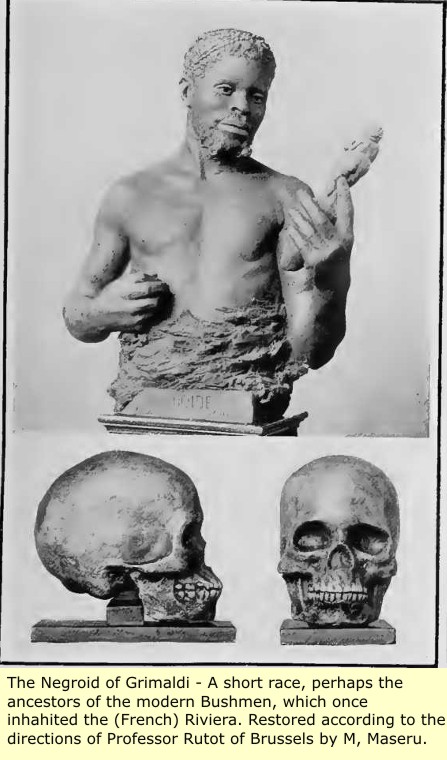
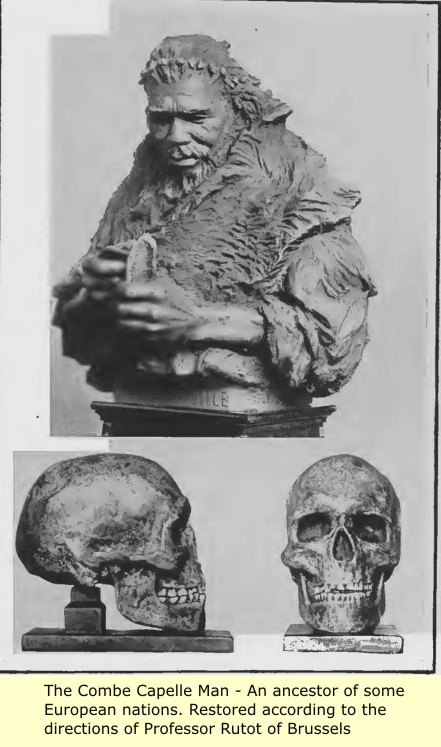
PREHISTORIC MAN AND HIS STORY.By Professor G. F. SCOTT ELLIOT, M.A., B.Sc., F.L.S., F.R.G.S. With Seventy Illustrations and Diagrams. Demy 8vo. 7/6 net. THE NEGROID OF GRIMALDI The Aurignacians found the Moustierian or Neander-thaler in France, and during all the changes sketched above, the former seem to have held their own in that country. After the Wurm Ice Age the Aurignacians modified their weapons and mode of life, and, after the theory which we have adopted, became the men of La Madeleine. These Aurignacians and their Magdalenian descendants pervaded all Central and Southern Europe. Their remains have also been discovered in Valetta (Malta), in Phoenicia (Nahr Antelias), and elsewhere, as we shall try to show later. But during this long period of time two other races also succeeded in entering France and Italy. These were a “ negroid,” perhaps pygmy, folk and the men of Solutrean. We have seen that the Aurignacian was originally an African, and if he traversed North Africa on his way from Egypt and Mesopotamia, it would have been a very remarkable fact if he had not come in contact with the African pygmy or his ancestors, for the Bushman, Wam-battu, and the other pygmies are the oldest African race known to us. The “ negroids ” discovered by Dr. Verneau in the Grotte du Grimaldi, though differing greatly from modern Bushmen, show that the Aurignacians were acquainted with a negroid stock, which may perhaps be assumed to be an ancestor of, or allied to, the pygmy. It is difficult to say exactly what was the relation between the Aurignacian and this “ negroid ” race. Moreover, since the discovery of this burial, characteristic skulls of the same negroid affinity have been found in Spain, in Brittany (of Neolithic date), at Sierra (not earlier than the thirteenth century), in Sardinia, at Ostorf, and perhaps in Caithness. |
 |
 |
 |
 |
 |
 |
 |
 |
 |
 |
 |
 |
 |
 |
 |
 |
Neolithic = 10,200 B.C. to 4,500 B.C. |
 |
 |
 |
At this time we do not know what the Invading Turks and Slavsdid to the Black people of Eastern Europe: after the destruction of theBlack Eastern Roman Empire (Byzantium) in 1453. |
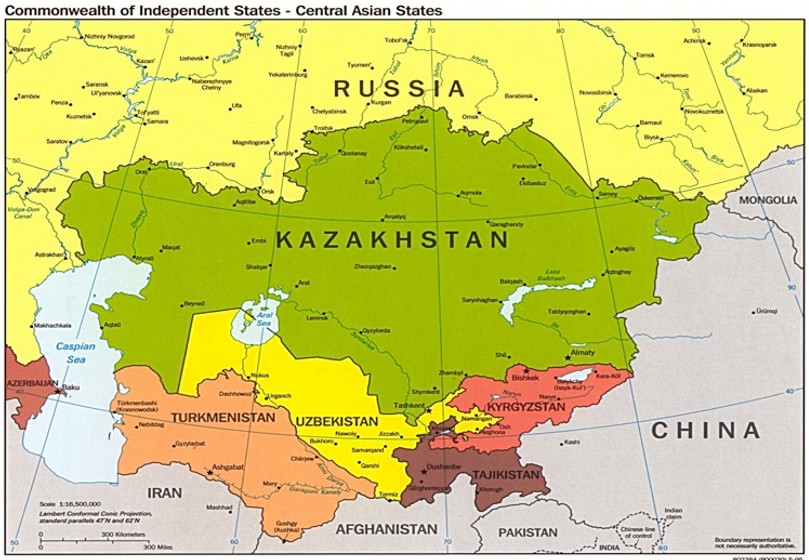 |
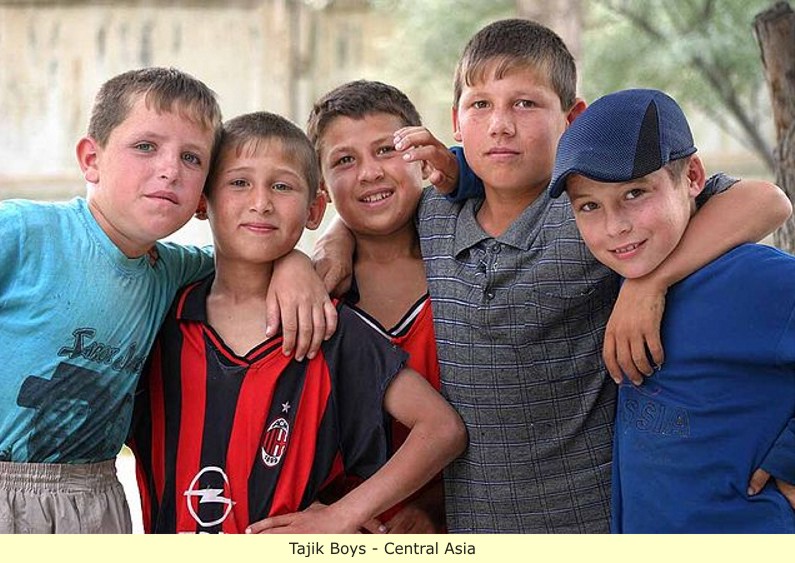
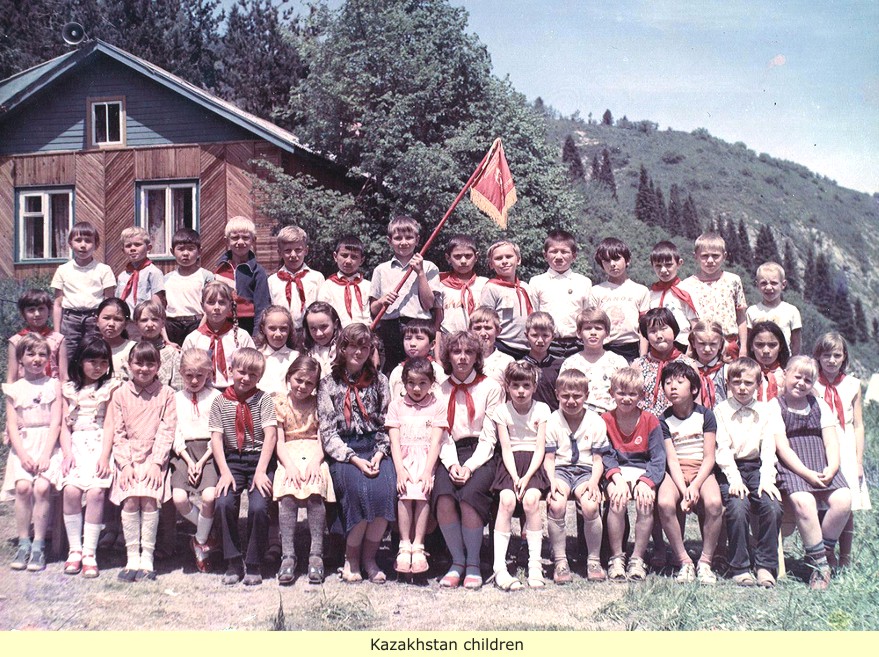
Note: we do understand that the average person - after a lifetime of the Albino lie that they (Albinos) are native to the Black Mans Ancient Home of Europe - finds this material hard to believe. So, under the heading of: "Strange Bedfellows" We have this quote from the "Race Experts" at "STORMFRONT:"Quote: Today's Central Asians are extensively mixed-race with both White and East Asian blood and the White element is older since the Whites were there first and are the indigenous people of Central Asia. |
 |
 |
 |
 |
Update 2014:Eureka! The Albinos have finally admitted where they come from!
As you ponder what this admission means, you might also consider what nonsense like this means: If you Google "Where do White people come From" the second result that you will get is this Livescience article; (the first result is Stormfront - go ahead and read it for a laugh). Why Did People Become White? QUOTE: Vitamin D plays an important role in bone growth and the body's natural protection against certain diseases, and the inability to absorb enough in areas of less-powerful sunlight would have decreased life expectancies in our African ancestors. The further north they trekked, the more vitamin D they needed and the lighter they got over the generations, due to natural selection. Also: While people of all skin types have the ability to produce the same amount of vitamin D in their systems, “highly pigmented (Black) people will need to stay in the sun around 6 times longer than light people in order to synthesize the same amount of vitamin D,” Juzeniene said, and a lack of the vitamin — something occurring among many American children right now, partly because they don't get out much — can make humans more susceptible to everything from heart disease to internal cancers. That is of course "Pure" lie: In the last century, cases of Rickets (often caused by lack of Vitamin D) was epidemic in Europe and North America. So much so, that they had to start adding Vitamin D in the manufacture of their Milk, Cereals, Cheeses, and such. This was NOT done for Blacks - who don't need it, it was done for Albino people, who desperately needed it. THE REASON FOR SUCH RIDICULOUS STATEMENTS AND LIES IS THIS: If Africans went into Europe circa 45,000 B.C. and STAYED Black. Then modern Europeans MUST have ALWAYS been WHITE! See: the section "Indus Valley-2" and other pages for the history of Europeans. |
HOWEVER! Just as one group of Albino people had decided to admit that they came from Central Asia, and had ALWAYS been White, and thus derived from Dravidian Albinos. Other groups were pressing ahead with new lies to buttress European claims of being Black Africans who turned White because of Vitamin D deficiency. But these new claims have a twist, one would suppose to keep up with the times.
The "Supposed" New research is reported by YahooNews.com from LiveScience. Link to the on-line Newsstory
And the Daily Mail U.K. online. Link to the on-line Newsstory
Nature - International weekly Journal of science (no comment) also carried the story. Link to on-line Newsstory
The LiveScience Headline says: 7,000-Year-Old Human Bones Suggest New Date for Light-Skin Gene
And the Daily Mail U.K. Headline says: Light skin in Europeans stems from ONE 10,000-year-old ancestor who lived between India and the Middle East, claims study
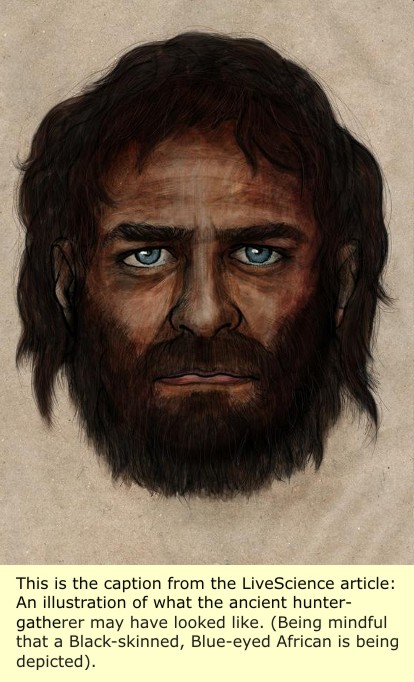
The reason for these nonsensical proclamations is THIS, as summed up by LiveScience:
 |
 |
This drawing depicting a "Dark White Man" is of course the typical Albino falsification of history and science. The fact is that YOU CAN NOT do a Forensic Facial Reconstruction by "DRAWING" it! Making a facial reconstruction can "ONLY" be done by a doctor of physical and forensic anthropology with extensive training in anatomy (both medical and artistic). These facial reproductions draw on the science behind the morphology (shape) of the face as well as a knowledge of materials. Reconstructions start with a SKULL (or mold) and includes laboriously using "shaped" clay to fill-in for Muscles and tissue (including skin) on the skull until it is complete. Only after this process is complete, can you see what the individual might have looked like.
 |
. Hunter-gatherers, some of them blue-eyed, who came from Africa more than 40,000 years ago
They would have looked like THIS:
. Middle Eastern farmers who migrated west much more recently
They would have looked like THIS:
. A mysterious population whose range may have spanned northern Europe and Siberia
We have no idea who that could be, unless they are talking about "Modern" Europeans AFTER they had migrated from Central Asia.
The La Brana skeleton's haplogroup was reported as Mtdna U5: (the same as 12,700 year old Cheddar Man in England, and some in the 3,000 year old Lichtenstein Cave in Lower Saxony, Germany).
 |
 |
The Albinos always lie, Just as the Albinos were lying BEFORE with their first mock-up of Cheddar Man man which showed him as an Albino, they are lying again with their assertion that Cheddar Man had "Straight Hair and Blue Eyes": these two attributes were falsely added to indicate some commonality with European Albinos. Note the list of Genes below which the scientists looked at. None of them are indicators of STRAIGHT HAIR OR BLUE EYES! Though Blue eyes and Blonde hair are COMMON with (OCA2 - Oculocutaneous albinism type 2), Cheddar man is negative for them. Btw - ALL of the genes they looked at were "Oculocutaneous Albinism" genes. That is how scientists know whether or not a Skeleton is Black or White: Simply put, if they are NOT Albino: {i.e. they do not have those Albino mutations}, then they are Black (White people are merely the Albinos of Black people). Note also the lying nonsense about Vitamin D, and People in the Arctic being Pale. Those lies are debunked below. |
Dienekes reports the Y-haplogroup as Y-dna C6. That however is not confirmed, but if true, it relates La Brana in Spain to Australian aborigines, the Lani and Dani people of Western New Guinea (100% & 92%), as well as many other Pacific Islanders and Asians.
NOTABLE QUOTE FROM THE STUDY:
Pigmentation genes in the Mesolithic genome. The SNPs around the two diagnostic variants (red arrows) in these two genes were analysed. The resulting haplotype comprises neighbouring SNPs that are also absent in modern Europeans (CEU) (n5=112) but present in Yorubans (YRI) (n5=113). This pattern confirms that the La Brana 1 sample is older than the positive-selection event in these regions.
[The Yoruba people are an ethnic group of southwestern Nigeria and southern Benin in West Africa].
 |
 |
Egyptians, Sumerians, Mohenjo-daroans, Harappans, and Cretans, Elamites, and Nubians, were literate 3,000 years, 4,000 years, who knows how many thousands of years, before the world ever heard of Greeks or Romans. And there is ample evidence of their literacy.Yet there is not one single entry: describing any of the people of their times, whether it be friends, foes, or invaders: or even more incredulously, there is not one single entry describing invading Whites in any of their literature.Contrast that with Greek and Roman writings, in which these NEWLY literate people, after suffering through the "Dark ages" caused by the Albinos invasion, describe EVERYTHING and EVERYONE - except themselves!These discrepancies are of course, not accidental, nor for lack of material. Hopefully, the White man has simply withheld this material, and not destroyed it.
On a related matter:We the lied-to and oppressed, often comfort ourselves by believing that things are getting better, and perhaps in some ways that is so. But in regards to the Albinos trying to steal Black history, well, in that regard things are definitely getting worst! It comes as a shock to some, that the current, and very false assertion by the Albinos that they are native to Europe, is NEW! Surprisingly, Albino scholars of only a hundred years ago, freely admitted that Albinos MOVED into Europe, and were NOT native to those lands. While they were in error on other things, some even correctly identified the Albino homeland as Central Asia. Please note this example: The North American ReviewThe North American Review (NAR) was the first literary magazine in the United States. Founded in Boston in 1815 by journalist Nathan Hale and others, it was published continuously until 1940.
Please note this entry from:The North American Review Volume 0139 Issue 334 (Sept 1884)
MORE!
ANCIENT TYPES OF MAN
The Uganda Protectorate (1902) by Harry Johnston. CHAPTER XIV Remains which have been found in Sicily, in Sardinia, and the Pyrenees (France), including a curious little statuette fashioned by men of the Stone Age discovered in the last-named locality, hint at the possibility of men of this Pygmy Negro type having spread over part of Europe: it has been even hinted by more than one anthropologist of authority that a Dwarf negroid race may have, at one time, existed in Northern Europe, and by an exaggeration in legend and story of their peculiar habits—habits strangely recalling the characteristics of the little Dwarf people of the Congo of the present day—have given rise to the stories of kobolds, elves, sprites, gnomes, and fairies.
MAN'S PLACE IN NATURE AND OTHER ANTHROPOLOGICAL ESSAYS
In order to neglect no point respecting the form of this fossil skull, we may observe that, from the first, the elongated and narrow form of the forehead attracted our attention. In fact, the slight elevation of the frontal, its narrowness, and the form of the orbit, approximate it more nearly to the cranium of an Ethiopian than to that of a European.
CIVILIZATION OR BARBARISM: AN AUTHENTIC ANTHROPOLOGY The Grimaldi Negroids have left their numerous traces all over Europe and Asia, from the Iberian Peninsula to Lake Baykal in Siberia, passing through France, Austria, the Crimea, and the Basin of Don, etc. In these last two regions, the late Soviet Professor Mikhail Gerasimov, a scholar of rare objectivity, identified the Negroid type from skulls found in the Middle Mousterian period. |
 |
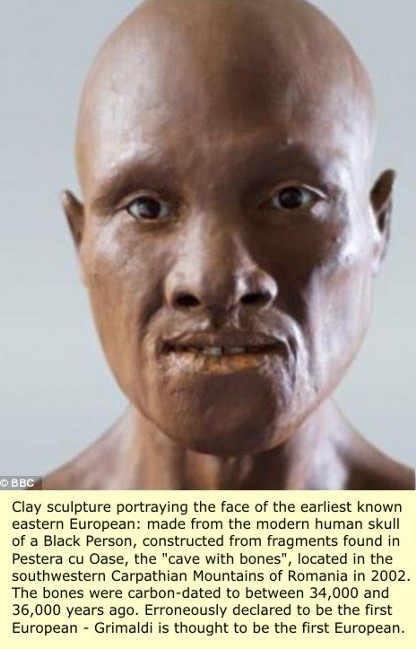 |
A subsequent DNA study by David Reich & Svante Pääbo titled: "An early modern human from Romania with a recent Neanderthal ancestor:" Terms the specimen "Oase-1" and re-dates it to 37,000–42,000-years-old. Oase-1 belongs to the Y-dna haplogroup F, which is carried by most males in Eurasia today. The Mtdna = N. Study quote: We then find that the Oase 1 individual shares equally as many alleles with early Europeans, as with present-day East Asians and Native Americans. |
Realizing that many people still cling to the myth that White people were the original inhabitants of Europe; there are many links to scientific studies, scattered throughout this site, which definitively prove that belief false - simply click on the link to read the study. (On some pages the studies are printed at the bottom of the page). In this sites pages we provide true history - as best as it is known, supported by authentic artifacts.
 |
The following are excerpts from the book “MYTHS OF CRETE & PRE-HELLENIC EUROPE By DONALD A. MACKENZIE” (1917). Like all White writers of history, he struggles to tell Black history, without actually mentioning Black people. As an example “Pre-Hellenic” actually means “Pre-Whites” as the Hellenes were the first of the White Central Asians to reach Western Europe. But since many of his factual observations are accurate, we begin with these excerpts from his book.
 Quote: It is only within recent years that the necessary archaeological data have been available which enables students of ancient civilization to draw with some degree of confidence that Crete was the birthplace of Aegean civilization, which radiated in the pre-Hellenic times throughout Europe. Although it has been demonstrated that the Cretan leaven was in existence and at work at the dawn of the Egyptian Dynastic Age, and when the Sumerians were achieving their earliest triumphs in the Tigro-Euphratean valley, we are still confronted with the problem of remote origin.
The earliest settlers in Crete had, as their artifacts demonstrate, already obtained a comparatively high degree of Neolithic culture. Houses were built of stone as well as of wattles daubed with clay, a sea trade was in existence, for obsidian was imported from Melos, and a section of the community had adopted the agricultural mode of life.
The earliest settlement of people at Knossos has been assigned to about 10,000 B.C, an approximate dating which is based on the evidence of the archaeological strata. But the earliest traces of an artistic culture in Europe belong to a still more remote age. Although during the vast periods of the Neolithic, or Late Stone Age, there existed savage communities, just as happens to be the case at the present day in various parts of the world, there were also, as in Crete, Egypt, and Babylonia, refined and progressive peoples who were already "heirs of all the Ages". The Ages when ancient Europe passed through stages of climatic oscillations of such pronounced character that the remains of mankind are found in strata yielding alternately tropical, temperate, and Arctic flora and fauna. The period in question, the lengthiest in the history of civilization, is the archaeological Paleolithic, or Early Stone Age.
Towards its close, for which the minimum dating is 20,000 B.C., there existed in Europe at least two peoples, whose cultures are referred to as Aurignacian and Magdalenian. A stage called Azilian links the Palæolithic with the Neolithic Age, and the continuity of culture from the earliest times is now generally regarded as an established fact. The story of Cretan civilization may constitute, as has been said, the first chapter of European history. But the "Introduction" is derived from the Paleolithic Age, before and during the Fourth Glacial Epoch of the geologists.
The links with Crete are so close and suggestive that writers like Angelo Mosso have expressed the belief in the Neolithic and Cretan origin of Aurignacian and Magdalenian art. But the geologists have established beyond a shadow of doubt that the civilization of which this art is an eloquent expression must be assigned to the latter part of the Pleistocene period, when the reindeer roamed through the valleys of France. Those ancient Paleolithic hunters were skilled artists and carvers of bone and ivory. They painted and engraved on cave roofs the figures of animals with a realism and freedom which were never surpassed in Greece.
They also carved ivory female figurines in the round which are worthy of comparison with similar artistic products of Egypt, and not always to their disadvantage. "The resemblances", writes Mosso, "between the most ancient female figures in France and the Neolithic figures of Crete and Egypt are very striking." Among the rock pictures of women he sees "the girdle and the Egyptian mode of hairdressing". Describing a Paleolithic painting, he writes: "The women's hair flows down upon their shoulders like that of the Minoan women; the bosom is uncovered and the breasts much developed. The triangular shape of the heads indicates a hood or a kind of mitre. Two of them wear a bracelet on the upper arm near the elbow, and all have a very slender waist, with the body shaped like an hour-glass." He also comments in another instance on the skirts, which were also characteristic of Crete. Comparisons between the Cretan frescoes and the Paleolithic cave-paintings of Spain and France have likewise been made by the Abbé Breuil, Don Juan Cabre Aguila, and other Continental archeologists.
Myths of Crete and Pre-Hellenic Europe, by Donald A. Mackenzie (1917): continued.
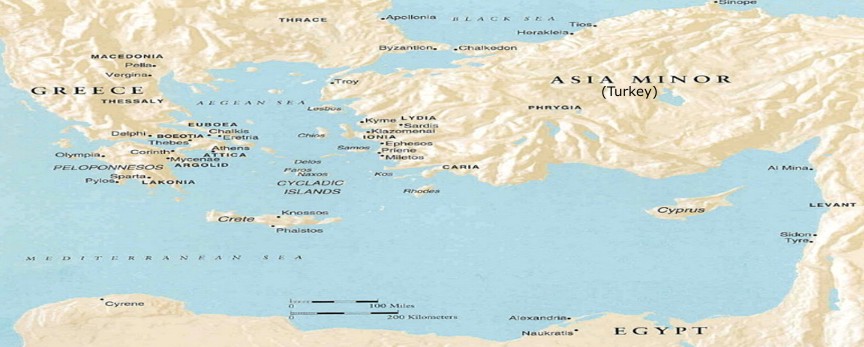
THE influence of Ægean culture, which assumed its specific character in Crete, extended as far distant as Troad, that strip of north-western Anatolian coastland which came under the sway of the Trojans. In the Early Minoan period Crete was in contact with Egypt on the one hand and with Hissarlik (Troy) and the Cyclades on the other--pupil of the former, teacher of the latter. It is possible that Troy's earliest connection with Crete goes back to the Neolithic Period, for finds have been made in the stratum of the first city of flakes and small artifacts of obsidian. This highly-prized stone was probably carried over the sea from Melos rather than along an overland trade route from Sinai.
It would appear that there was a certain amount of regular shipping traffic on the Ægean Sea in Neolithic times. Crete, as we have seen, imported obsidian from Melos long before the introduction of metal working. The beginnings of the trade can be traced at Magasa, where the flakes were found to be associated with an extremely crude pottery of great antiquity, and it was well developed apparently during the later stage of Neolithic culture, to which the obsidian knives from Knossos are assigned.
The early peoples who reached Crete probably came by way of the Cyclades, either from the Anatolian or Grecian coasts. Before they accomplished this feat, the art of navigation must have advanced considerably. If it is held, on the other hand, that they passed direct oversea from Cyprus or Libya, we must conclude that they were skilled mariners who possessed well-equipped vessels and were quite capable of conducting a sea traffic from the very beginning. Perhaps when the Cretan inscriptions can be read some light will be thrown on this aspect of the problem.


Traffic by the sea, as well as by the land routes, must have been greatly stimulated after the knowledge of how to work metals became widespread. Ships could then be constructed more stoutly and with greater celerity, and must consequently have increased in number. Pharaoh Sneferu's order for a new fleet of forty odd vessels to convey timber from Phœnicia is an interesting example of the manner in which ambitious monarchs might strive for mercantile supremacy. No doubt it was in consequence of the growing competition that experienced seafarers made voyages of exploration and opened up new routes in all directions. Malta, as we have seen, received obsidian from Melos; it also imported jade, which probably came from Anatolia. Jade was carried as well to Sicily, and as the Cretans imported liparite from the Lipari islands, after they had established a connection with Egypt, it was probably by them that jade objects were distributed westward.
Whence was the bronze obtained by the Cretans? Was it from Egypt or Anatolia? Both Crete and Troy were able soon after the dawn of their Bronze Ages to import silver, which during the Old Kingdom Period was rarer than gold in Egypt. The silver may have come from the same region as tin. One possible source of supplies of silver was Cilicia, where silver mines are still worked; the other was Spain, in which country evidence has been forthcoming of early commercial relations with Crete.
But although copper could be found in Crete, the tin, as has been indicated, had to be imported. "By the beginning of the Bronze Age", writes Dr. Mackenzie in this connection, "the valley of the Rhone must have played a dominant role of communication between the great world of the Mediterranean and the north; by that time it was probably already the high continental trade route towards the tin mines of Britain." Angelo Mosso also favours the hypothesis that Crete's early supplies came from England. "We know the road", he says, "followed by the caravans bringing English tin through France to the mouth of the Rhone at the end of the Neolithic period, while no trace of any trade in tin has so far been discovered in the East." Mosso's reference to the "East" applies to "the mountains of China where tin is found".
 |
Although archæologists are less inclined nowadays than they were a generation ago to believe in the existence of Neolithic trade-routes which extended from the borders of China to Brittany, or to connect certain races with relics of similar character found in widely separated districts, there can be little doubt regarding the existence of commercial relations between different cultural areas. The introduction of metal appears to have done much to stimulate international trade. In the Early Bronze Age the influence of the Ægean, which may have "inspired every stage of culture" at Hissarlik, as Mr. Hogarth suggests, appears to have penetrated Thrace. Evidence has been forthcoming that two main trade-routes crossed Germany, one from the head of the Adriatic, and the other from the lower Danube valley. It has been suggested that some of the amber found in Crete came down these trade routes from the Baltic. France was similarly crossed by the Rhone valley trade-route, down which, in time, tin from Cornwall was carried. That the Cretans were the earliest seafarers to come into direct touch with these routes is suggested by various interesting links of evidence. The most remarkable are the Egyptian glass beads found in South Germany, and the Egyptian blue-glaze beads taken from ancient graves on Salisbury Plain, which will be dealt with in a later chapter, as they are connected with the Late Minoan Period.
Certain Continental archæologists incline to the belief that not only Crete but even Egypt was in direct touch with Western Europe at an extremely remote period. Summarizing their views, Angelo Mosso writes: "The vases found at Amerejo in Spain have the characteristic form of the Egyptian vases of the close of the Neolithic Age. The resemblance of the Egyptian idols with those of Crete and the Continent is an established fact; the burial sites are similar; the flat copper axes of Egypt cannot be distinguished from those of the Continent; the evolution of art in Southern France and in Spain went on during the Neolithic Age, and we know that navigation was general on the Mediterranean in the times preceding the introduction of copper-all these data give good reason to suppose that the pre-Dynastic Egyptians had relations with the west which enabled them to procure cassiterite, which when mixed with copper rendered it harder. . . . We hope", he adds, "that new discoveries may throw light on the relations of Egypt with England." End quote.
For more on ancient Black Cave Art, and the customary accompanying Albino fakes << please click here >> |
 |
 |
The Aurignacian tool industry is characterized by worked bone or antler points with grooves cut in the bottom. Their flint tools include fine blades and bladelets struck from prepared cores rather than using crude flakes. The people of this culture also produced some of the earliest known cave art, such as the animal engravings at Aldène and the paintings at Chauvet cave in southern France. They also made pendants, bracelets and ivory beads, and three-dimensional figurines.
 |
Note-2: Most date the Cro-Magnons entry into Europe at 35,000 years ago, following Grimaldi by as much as 10,000 years. Also note that Cro-Magnon was NOT a Modern Human!
 |
 |
Note the hateful nature of the Albino researchers; though admitting that the Grimaldi were Homo-sapiens (modern Humans), they still referred to them as "Anthropoid" meaning - resembling a human being in form. This resentful, spiteful hatred, will cloud everything they do in regards to Human history, and the Black mans almost exclusive part in making and shaping it.
It is with Cro-Magnon that the Albino people get their chance to obfuscate history so as to make it appear that they were involved in the goings-on (they assign made-up pictures of Cro-Magnon as a White man - see the Homo-2 section. But notice that there is no claim that Cro-Magnon is a "Modern" human, but only so-called "Early" or Archaic Homo sapiens or prehistoric humans - everything but Modern Human. For to call them Modern Humans would be an outright and obvious lie. The Wiki article is total nonsense.
From Encyclopedia Britannica:
Cro-Magnon, population of early Homo sapiens dating from the Upper Paleolithic Period (c. 40,000 to c. 10,000 years ago) in Europe.
In 1868, in a shallow cave at Cro-Magnon near the town of Les Eyzies-de-Tayac in the Dordogne region of southwestern France, a number of obviously ancient human skeletons were found. The cave was investigated by the French geologist Édouard Lartet, who uncovered five archaeological layers. The human bones found in the topmost layer proved to be between 10,000 and 35,000 years old. The prehistoric humans revealed by this find were called Cro-Magnon and have since been considered, along with Neanderthals (H. neanderthalensis), to be representative of prehistoric humans.
Cro-Magnons were robustly built and powerful and are presumed to have been about 166 to 171 cm (about 5 feet 5 inches to 5 feet 7 inches) tall. The body was generally heavy and solid, apparently with strong musculature. The forehead was straight, with slight browridges, and the face short and wide. Cro-Magnons were the first humans (genus Homo) to have a prominent chin. The brain capacity was about 1,600 cc (100 cubic inches), somewhat larger than the average for modern humans.
Note: Neither Cro-magnon nor Neanderthal are in the direct linage of Modern Humans, who exclusively evolved in Africa. Our ancestors are Homo-Hablis and Homo-Erectus. Modern Humans first appeared about 400,000 years ago and are much OLDER than both Neanderthal and Cro-Magnon. Neanderthal and Cro-Magnon are thought to be Hybrid creatures produced by the cross-mating of Modern Humans and Homo-Erectus in the case of Neanderthal - Erectus still existed as late as 300,000 B.C. Similarly, Cro-Magnon is believed to be a Hybrid of Modern Man and Neanderthal.
Though Cro-Magnon is found all over Europe, Asia and the Mediterranean, The tendency now is to locate the origin of the Cro-Magnon type Humanoid in the Middle-east: as typified by the remains found at the Jebel Qafzeh and Skhul sites in what is now Israel. Though the inescapable logical conclusion, is that Cro-Magnon is the product of Modern man cross-breeding with Neanderthal. Like all the other theory's relating to early man, it has not yet been proven. But just as complex as the origin of Cro-Magnons, is the duration of Cro-Magnons. It appears that they only flourished during the Upper Paleolithic (old stone age 40,000 - 4,000 years ago).

Note: Since the writing of those books, similar figures made of ivory with the hooded female, have been found as far East as Mal'ta Siberia - See first photo above. These figures can be traced to the migrations of the first European - Grimaldi man. Click here for information on Grimaldi man >>>
Summarizing the above:
The preceding were scientific lies created by Albinos, and scientific truths uncovered to refute them, in the never-ending Albino efforts to hide their true origins and diseased condition (Albinism).
As regarding modern skin color: the simple fact is that as the Central Asian Albinos came into Europe, some Black men were having sex with the females, (no doubt why some Albino men seem to have a natural resentment towards Black men). The results of those copulations were Mulatto offspring: but the color of subsequent offspring changed with the color of the participants as follows: First Generation: Assuming continued mating with ONLY Albinos. Second Generation: Third Generation: Fourth Generation: With each generation the original mulatto becomes lighter and lighter. But generally speaking, Quadroons are indistinguishable from everyday MODERN Albinos, because modern Albinos are in fact HIGHLY admixed already. (Remembering Tacitus's description of the Germanics being "Blue-eyed Redheads"), there is not that many of them left.
Note that only European Albinos do that! |
 |
Today, Black women still use this ancient hairstyle.
|
 |
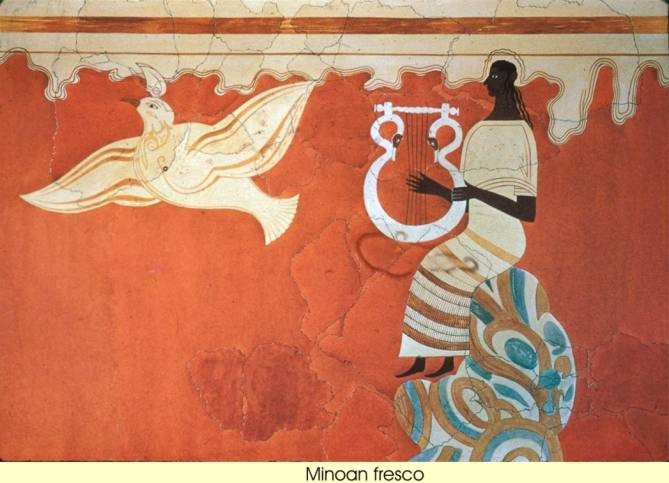
As with the other ancients, over time the Minoan's progressed to the point where they became master builders. One of their great achievements was the aqueduct’s that brought fresh water from the mountains to their capital "Knossos", which was many miles away. These aqueducts supplied the water for some of the worlds first "flush" toilets as well as other uses. At the peak of Minoan civilization, paved roads and multistoried townhouses were prominent. Archaeological evidence suggests that Minoan society was remarkably peaceful: their towns had no fortifications.
 |
 |
 |
 |
Please note: Modern White people have absolutely nothing to do with the following history. Though they are also Whites from central Asia (Albinos actually), just like the first Whites in Europe (who came circa 1,200 B.C.), they came at a much later date: circa 200 - 800 (A.D.). These modern people are the Germanics and Slavs, who were chased into Europe by the Huns of Asia. The last of these people, the Turks, were chased into the west by the Mongolians of Genghis Khan. Please see the Etruria-1 and Eastern Europe sections on the main menu for the history and genesis of those people.
Those modern Albinos who will acknowledge the ancient Blacks of Europe, encourage us to believe that the ancients were wiped-out, and the remaining absorbed by the Germanics, when they sacked Rome in 476. Romulus Augustus, the last Emperor of the Western Roman Empire, was deposed by Odoacer, a Germanic chieftain. In the East, the Byzantine end came when on April 2, 1453, Turkic Sultan Mehmed's army of some 80,000 men and large numbers of irregulars laid siege to the city of Constantinople. Despite a desperate last-ditch defense of the city by the massively outnumbered Christian forces, Constantinople finally fell to the Ottomans after a two-month siege on 29 May 1453. The last Byzantine Emperor, Constantine XI Palaiologos (though Byzantines were originally Greeks, by then, Slavs had made significant inroads), was last seen casting off his imperial regalia and throwing himself into hand-to-hand combat after the walls of the city were taken.
What the Albinos are trying to hide, is that Black rule in Europe lasted well after the medieval, and was only broken by the race wars, disguised by Albino historians as religious wars, of the 1600s. In continental Europe, these were primarily the thirty years wars. In Britain there were many separate wars.
Note: As our knowledge increases we find more White lies as relates to ethnicity: The Franks and Frisians were native Black people. Undoubtedly in the future, we will find more White lies.
Germanic countries - Great Britain, Netherlands, Germany, Austria, Switzerland, Belgium, France, Spain, portugal, Scandinavians (Denmark, Sweden, Finland, Norway, Iceland, Faroe Islanders, not Sami).
The Slavs
Slavic peoples are classified geographically and linguistically into West Slavic (including Czechs, Kashubians, Moravians, Poles, Silesians, Slovaks and Sorbs), East Slavic (including Belarusians, Russians, Rusyns and Ukrainians), and South Slavic (including Bosniaks, Bulgarians, Croats, Macedonians, Montenegrins, Serbs and Slovenes).
Slavic countries - Russia, Ukraine, Poland, Greece, Hungary, Macedonia, Albania, Azerbaijan, Belarus, Bosnia and Herzegovina, Bulgaria, Croatia, Czech Republic, Hungary, Georgia, Kosovo, Moldova, Montenegro, Romania, Serbia, Slovakia, Slovenia, Estonia, Latvia, Lithuania.
Italy - mixed Slav/Germanic
Greece - Mixed, mostly Slav
Armenia - mixed Slav/Turk
Algeria - mixed Berber/Germanic
Tunisia - mixed Germanic/Berber
The Turks
Turkic peoples - Göktürks, Seljuks, Khazars (Jews), Mughals, Azerbaijani, Bashkir, Chuvash, Kazakh, Kyrgyz, Tatar, Uighur, Uzbek, and Sakha, Hephthalites.
Turkic Countries - Turkey, Azerbaijan, Kazakhstan, Kyrgyzstan, Turkmenistan, Uzbekistan, Northern Cyprus (Turkish Republic of Northern Cyprus).
Countries with large populations of ethnic Turks and Turkic culture:
Turkey, Egypt, Iran, Libya, Iraq, Jordan, Kuwait, Lebanon, Oman, Qatar, Saudi Arabia, Syria, United Arab Emirates, Yemen, Bahrain.
The lineage of the Ancient Greeks is always a source of controversy. In the Histories of Herodotus, he clearly identifies the lineage of each major Greek tribe. These books are considered one of the seminal works of history in Western literature. Written from the 450s to the 420s B.C, in the Ionic dialect of classical Greek. Here we have excerpted quotes from Herodotus Histories to clearly ethnically define each tribe of the ancient Greeks.
Click here for Herodotus Quotes concerning Greek Ethnicity >>> |
Note: from the link above, we know that the Hellenes were NOT Whites, they just accepted Whites into their midst. Herodotus refers to the Whites as Barbarians, but if we used that term, it would be confusing to those who know the Hellenes as Whites. Since the Hellenes and others, came to be at least part White, we will continue to use Hellene.
 |
The Early Cycladic culture developed on parallel lines to the Early Minoan. Thanks to obsidian from Melos, marble from many islands, and local sources of gold, silver, and copper, the Cycladic islanders rapidly became prosperous. As in Crete, the Early Bronze Age merged without incident into the Middle Bronze Age.
The Early Cycladic period is celebrated principally for its statuettes and vases carved from the brilliant coarse-crystalled marble of these islands. The statuettes, mostly of goddesses, are among the finest products of the Greek Bronze Age. They owe their charm to the extreme simplification of bodily forms. The typical “Cycladic idol” is a naked female, lying with her head back, her arms crossed over her breasts. These figures vary in size from a few inches to more than six feet in length.
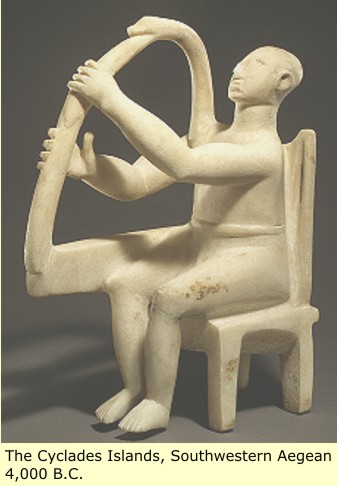

Mainland Greece probably received some of its Bronze Age settlers from the Cyclades, but the two cultures soon diverged. A prosperous era arose about 2,500 B.C, and lasted until about 2,200. Sculpture was overshadowed by pottery, metalwork, and architecture among the early arts. During the Middle Cycladic period, the Cyclades suffered a diminution in prosperity and seem to have become politically subordinate to Crete. Two waves of peoples seem to have descended on the Greek mainland, one about 2,200 B.C, and the other about 2,000 BC. They destroyed much and for long contributed little to Greece's artistic heritage. The pottery of this period, however, is of high quality.
Cyprus is the mythical birthplace of Aphrodite, Adonis and home to King Cinyras, Teucer and Pygmalion. The earliest confirmed site of human activity is Aetokremnos, situated on the south coast, indicating that hunter-gatherers were active on the island from around 10,000 B.C, with settled, village communities dating from 8,200 B.C. The arrival of the first human’s correlates with the extinction of the dwarf hippos and dwarf elephants, the skulls of which gave rise to the Cyclops myth.

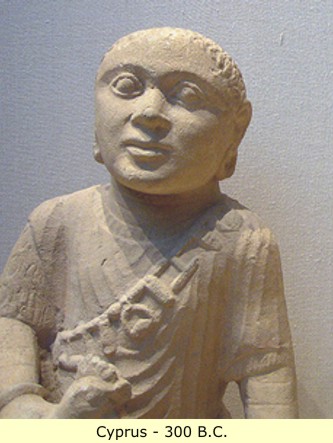
Water wells discovered by archaeologists in western Cyprus, are believed to be among the oldest in the world, dated at 9,000 to 10,500 years old. They are said to demonstrate the sophistication of early settlers, and their heightened appreciation for the environment. Remains of an eight months old cat, were discovered buried with its human owner, at a separate Neolithic site in Cyprus. The grave is estimated to be 9,500 years old, predating ancient Egyptian civilization and pushing back the earliest known feline-human association significantly.
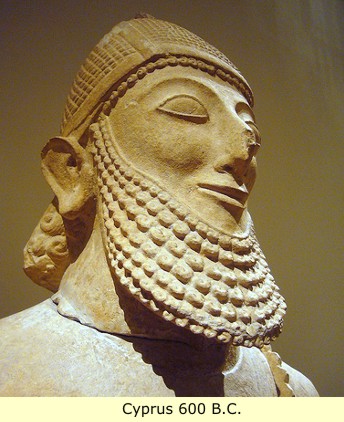

There were several fluxes of population and settlement, as well as newcomers to the island during the Neolithic age, although earthquakes caused the infrastructure to fail around 3,800 B.C. Several waves of incoming peoples followed, including some from Asia minor which strengthened the metal working crafts on the island. Although finds from this time are rare, those finds are of high quality. Later, the Bronze Age was heralded by the arrival of more Anatolians who came to the island around 2,400 B.C.
 |
 |
In the Early Cypriot, the only surviving sculptures are a series of steatite cruciform figures of a mother goddess (3,000–2,500 B.C.), stylized in much the same way as contemporary Cycladic idols, from which they may have been derived.
The Middle Cypriot period was a development of the Early Cypriot. As on the mainland, no important art apart from pottery has survived.
THE VANISHING EVIDENCE OF CLASSICAL AFRICAN CIVILIZATIONS
by Prof. Manu Ampim
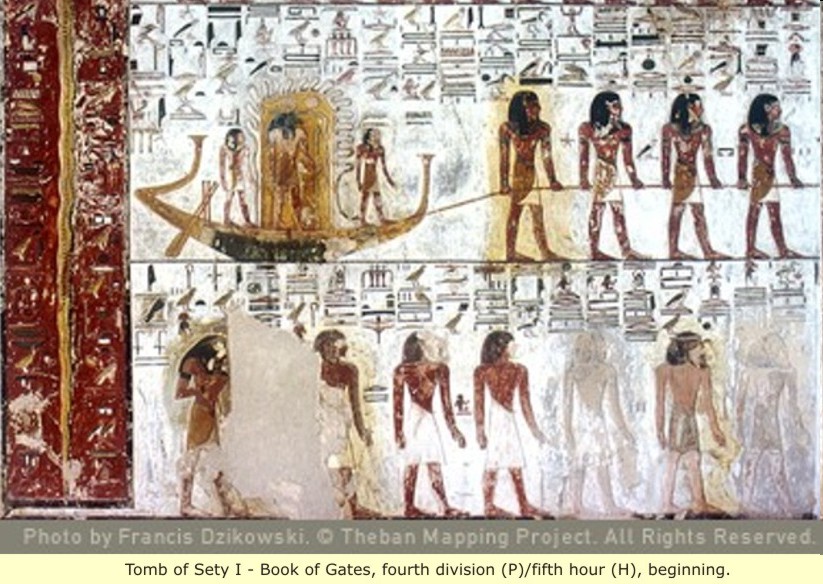
The widespread damage to the temple images has allowed Egyptologists to argue from such sources as the temple evidence that ancient Egypt was a multi-racial society and therefore belongs to the world’s heritage and not necessarily to African history. There are probably about a million tourists each year who visit Egypt and Nubia, and they get a totally false view of the identity of the builders of these great civilizations, largely because the evidence of the builders’ Black origin is disappearing. This vanishing evidence has enabled dishonest Egyptologists and tour guides to misrepresent the identity of the founders and builders of ancient Egypt by selectively pointing out the “non-African” images on the walls. Actually, the images which appear to look “non-African” have undergone a racial make-over and look nothing like they did originally. These images have been crudely recarved by European and Arab conspirators who work hard to eliminate all traces of African facial features. Only through exhaustive first-hand research can one demonstrate from the surviving on-site temple evidence that ancient Egypt was a Black civilization.
The altering of Black (African) facial features and the lightening of the skin colors of painted reliefs inside the tombs are central aspects of the conspiracy to destroy the memory of classical African civilizations. The two main conspirator groups carrying out these acts are European and American research teams, and local government workers. Throughout Egypt and Nubia, the tomb images have suffered different levels of decay and destruction. In places such as Giza the tombs are closed as there is little left to see; in Tell Amarna the tomb carvings are in an advanced state of decay; in El Kab and Aswan many of the images have been systematically defaced; and in Beni Hassan only 4 of the 39 tombs are open because the rest are badly damaged. The only major location which has escaped serious tomb damage is Sakkara, but this may not remain true in the future because the conspirators’ work is not complete, until they have destroyed or defaced all the evidence of classical African civilizations.
The problem of deterioration of the Kings Valley (KV) tombs has led to a growing international movement to build replica tombs and close the original structures. The tomb replication project will likely be implemented in the future. Under this plan, the popular tombs which have suffered irreparable damage, such as the tomb of Tutankhamen, will be permanently closed to the public. Once they are closed, the only persons who will have access to the original KV tombs will be Egyptian government officials and workers, and “qualified” researchers. The completion of this tomb replication project will be a major step in further erasing the memory of a Black Egypt. These replica tombs, with the lightened colors and remade facial features, will graphically demonstrate that the evidence of classical African civilizations is vanishing. This of course, holds true for the Minoan and all other Black civilizations.
 |
 |
 |
 |
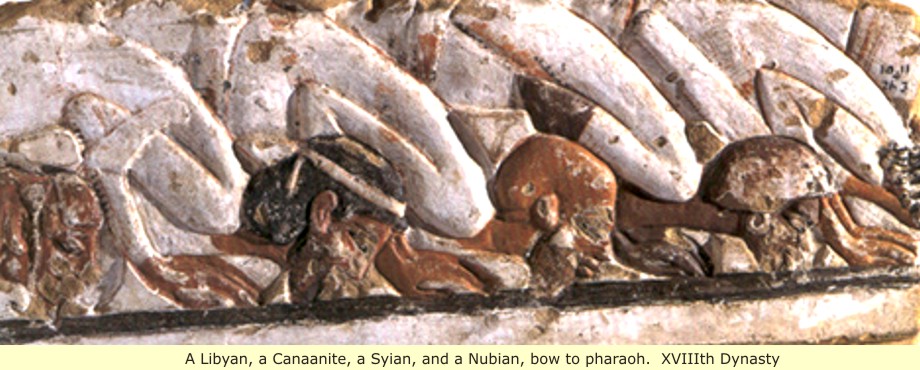
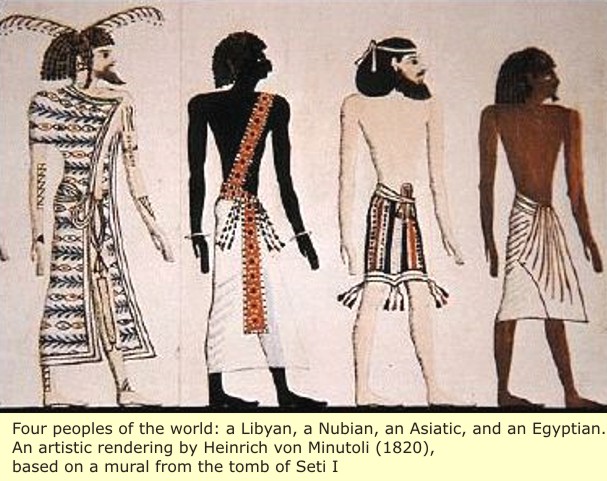
(Note the Libyan and Asiatic are depicted as White)
 |
 |
 |
 |
Note on the coloration of Minoan females.As we shall see in the summation of Albino falsification techniques at the end of this Minoan/Greek section: the Albino "Restorers" simply penciled in facial outlines in areas of White background where the original material had disintegrated away. In this way, they were able to falsely, and with lying intent, imply that Minoan's - at least some - were Albinos, just like the restorers. The Albinos teach us that many ancient cultures sometimes painted their females a lighter color. From their teachings, we assume that the contrast has some social or religious function, note the Egyptian art below. |
 |
Above: the boy (with side lock), like his father, is painted brown. The daughter (note vagina slit), like her mother, is "NOT" painted. But is that really the case? Without having the statue for close analysis, we can't say for sure, but knowing the degenerate lying nature of the Albino people, couldn't they just simply have stripped the paint off of the females? After all, how strange would it be that the males were painted, and the females were left in bare stone. Egyptians respected females, and their art - that is not likely. Note above on the mothers right knee, there appears to be a residual speck of colored paint. |
The historical fact is that Whites did not reach Greece and Southern Europe, from their homelands in Central Asia, until about 1,200 B.C. Therefore there were no White women present in Crete, to be painted by the Minoan's. But as one would expect when the Albinos have complete control of historical materials, they make-up things, and create fakes to support their bogus history. As we know, these late comers to civilization have been on a mission for the last few centuries to obliterate Blacks from history, and falsely insert themselves. A White woman, Cathy Gere, in her book "Knossos and the Prophets of Modernism" exposes this most typical Albino behavior. A review of the book follows.
 |
The New York Review of Books
Knossos: Fakes, Facts, and Mystery
by Mary Beard, August 13, 2009 Issue
The masterpieces of Minoan art are not what they seem. The vivid frescoes that once decorated the walls of the prehistoric palace at Knossos in Crete are now the main attraction of the Archaeological Museum in the modern city of Heraklion, a few miles from the site of Knossos. Dating from the early or mid-second millennium BC, they are some of the most famous icons of ancient European culture, reproduced on countless postcards and posters, T-shirts and refrigerator magnets: the magnificent young “prince” with his floral crown, walking through a field of lilies; the five blue dolphins patrolling their underwater world between minnows and sea urchins; the three “ladies in blue” (a favorite Minoan color) with their curling black hair, low-cut dresses, and gesticulating hands, as if they have been caught in mid-conversation. The prehistoric world they evoke seems in some ways distant and strange—yet, at the same time, reassuringly recognizable and almost modern.
The truth is that these famous icons are largely modern. As any sharp-eyed visitor to the Heraklion museum can spot, what survives of the original paintings amounts in most cases to no more than a few square inches. The rest is more or less imaginative reconstruction, commissioned in the first half of the twentieth century by Sir Arthur Evans, the British excavator of the palace of Knossos (and the man who coined the term “Minoan” for this prehistoric Cretan civilization, after the mythical King Minos who is said to have held the throne there). As a general rule of thumb, the more famous the image now is, the less of it is actually ancient.
 |
Most of the dolphin fresco was painted by the Dutch artist, architect, and restorer Piet de Jong, who was employed by Evans in the 1920s (and whose watercolors and drawings of archaeological finds in Athens, Knossos, and elsewhere were featured in a 2006 exhibition at the Benaki Museum in Athens, curated by John Papadopoulos). The “Prince of the Lilies” is an earlier restoration, from 1905, by the Swiss artist Émile Gilliéron (see illustration on page 60). In this case it is far from certain that the original fragments—a small piece of the head and crown (but not the face), part of the torso, and a piece of thigh—ever belonged to the same painting.
 |
The records of the original excavation suggest that they were found in the same general area of the ancient palace, but not particularly close together. And despite Gilliéron’s best efforts, the resulting “prince” (there is, of course, no evidence beyond the so-called “crown” for his royal status) is anatomically very awkward; his torso and head apparently face in different directions. The history of the “ladies in blue” is even more complicated. This painting was first recreated by Gilliéron after the discovery of a few fragments in the early years of the twentieth century, but that restoration was itself badly damaged in an earthquake …
 |
For reasons known only to European Albinos, they stubbornly cling to the notion that the Basque people of France and Spain are somehow relics of ancient original White Europeans - NOTHING COULD BE FARTHER FROM THE TRUTH!
Autosomal genetic studies confirm that Basques have a very close relationship with other Europeans, especially with rest of Spaniards, who have a common genetic identity of over 70% with Basques. However, a study done in May, 2010 has shown homogeneity of Spanish and French Basques, and confirmed their genomic distinctiveness from other European populations. (BECAUSE OF INBREEDING)!
Finally, several ancient DNA samples have been recovered and amplified from Palaeolithic sites in the Basque region. The collection of mtDNA haplogroups sampled there differed significantly compared to their modern frequencies, leading the authors to conclude that there is "discontinuity" between ancient and modern Basques. (Meaning that they have NOTHING to do with the Black people who originally lived there)!
Thus, while Basques (like all Europeans) harbour some very archaic lineages (such as mtDNA Hg U8a), they are not of "undiluted Palaeolithic ancestry", nor are they ancestral to large parts of western Europe. Rather, their genetic distinctiveness is a result of centuries of low population size, genetic drift and endogamy (inbreeding through restrictive marriage).
The principal conclusion is that the male Basques living today have rather recent roots of less than four thousand years, contrary to legend that proposes they lived some 30,000 years ago. Despite the ancient language, it is very likely that the present day Basques represent a rather recent Iberian population, in terms of DNA genealogy.
Many studies are cited to support the Wiki article, among them the following link, and the Ellen Levy-Coffman study below.
DNA genealogy, mutation rates, and some historical evidence written in the Y- chromosome. A Klyosov. J Genetic Genealogy 5 (2): 217-256; 2009.
http://www.jogg.info/52/files/Klyosov2.pdf
ANTHROPOLOGY C. Loring Brace *, Noriko Seguchi Conrad B. Quintyn , Sherry C. Fox , A. Russell Nelson , Sotiris K. Manolis , and Pan Qifeng * Museum of Anthropology, University of Michigan, Ann Arbor, MI 48109; Department of Anthropology, University of Montana, Missoula, MT 59812; Department of Anthropology, University of Pennsylvania, Bloomsburg, PA 17815-1301; Weiner Laboratory, The American School of Classical Studies at Athens, GR-106 76 Athens, Greece; || Museum of Anthropology, University of Michigan, Ann Arbor, MI 48109; ** Faculty of Biology, National and Kapodistrian University of Athens, GR-157 81 Athens, Greece; and Institute of Archaeology, Chinese Academy of Social Sciences, Beijing 100710, People's Republic of China Communicated by Kent V. Flannery, University of Michigan, Ann Arbor, MI, November 11, 2005 (received for review September 20, 2005) Many human craniofacial dimensions are largely of neutral adaptive significance, and an analysis of their variation can serve as an indication of the extent to which any given population is genetically related to or differs from any other. When 24 craniofacial measurements of a series of human populations are used to generate neighbor-joining dendrograms, it is no surprise that all modern European groups, ranging all of the way from Scandinavia to eastern Europe and throughout the Mediterranean to the Middle East, show that they are closely related to each other. The surprise is that the Neolithic peoples of Europe and their Bronze Age successors are not closely related to the modern inhabitants, although the prehistoric/modern ties are somewhat more apparent in southern Europe. It is a further surprise that the Epipalaeolithic Natufian of Israel from whom the Neolithic realm was assumed to arise has a clear link to Sub-Saharan Africa. Basques and Canary Islanders are clearly associated with modern Europeans. When canonical variates are plotted, neither sample ties in with Cro-Magnon as was once suggested. The data treated here support the idea that the Neolithic moved out of the Near East into the circum-Mediterranean areas and Europe by a process of demic diffusion but that subsequently the in situ residents of those areas, derived from the Late Pleistocene inhabitants, absorbed both the agricultural life way and the people who had brought it. |
We Are Not Our Ancestors: Evidence for Discontinuity between Prehistoric and Modern Europeansby Ellen Levy-Coffman The model of European genetic ancestry has recently shifted away from the Neolithic diffusion model towards an emphasis on autochthonous Paleolithic origins. However, this new paradigm utilizes genetic reconstructions based primarily on contemporary populations and, furthermore, is often promoted without regard to the findings of ancient DNA studies. These ancient DNA studies indicate that contemporary European ancestry is not a living fossil of the Paleolithic maternal deme ; rather, demographic events during the Neolithic and post-Neolithic periods appear to have had substantial impact on the European genetic record. In addition, evolutionary processes, including genetic drift, adaptive selection and disease susceptibility, may have altered the patterns of maternal lineage frequency and distribution in existing populations. As a result, the genetic history of Europe has undergone significant transformation over time , resulting in genetic discontinuity between modern-day Europeans and their ancient maternal forbearers. Received: August 17, 2006; Accepted October 20, 2006 Address for correspondence: Ellen Coffman, Ellenlevy66 (at) yahoo.com
The body of the study is of course too long for this page, and has been removed. For the complete text Click Here >>> Link for the pdf of the Levy study BasqueQuote: Moreover, the researchers noted that the Basque are unique among European populations due to their extremely high rate of consanguinity. Basque social and cultural traditions continue to promote consanguinity. The genetic impact of such inbreeding has yet to fully explored by geneticists, but the high frequency of inherited disorders among the Basque, including Coagulation Deficiences (Factor XI) and Mutation F508 (Cystic Fibrosis Gene), support the suggestion that drift, inbreeding, and a small population size maintained over many generations, as opposed to significant retention of Paleolithic genetic ancestry, best explains the present genetic makeup of the Basque (Alonso 2005; Bauduer 2005). Consanguinity = Incest
Conclusion: Why We Are Not Our Ancestors The ancient DNA studies present a picture of genetic break or “discontinuity” between ancient and modern-day European maternal histories. This evidence indicates that modern-day mtDNA haplogroup frequencies and distributions should not be considered living fossils of Europe's Paleolithic past. Currently, the genetic picture presented by the aDNA studies is based exclusively on mitochondrial DNA results. This form of DNA, unlike that of the Y chromosome, is generally preserved in a form that allows for testing of ancient remains. However, the Y chromosome genetic picture of Europe may also have undergone significant change similar to that impacting the ancient maternal lineages. The ancient DNA results provide a cautionary framework for geneticists in their reconstruction of the distribution and frequency of ancient European Y chromosome lineages. Modern-day Europeans cannot accurately be used as genetic proxies for their prehistoric counterparts. These findings stand in stark contrast to the model presented by many DNA studies of an undisturbed genetic link between contemporary and Paleolithic European groups. Yet evidence of such genetic continuity is sparse, even among populations such as the Basque. More problematically, it contradicts the findings of the ancient DNA studies. These studies indicate that populations have indeed changed dramatically over time, with some ancient lineages suffering reductions and even extinctions from the European gene pool. Extinction appears to be the fate suffered by the Etruscans maternal lineages. Many other ancient groups appear to have suffered a similar fate, the continuity of their genetic lineages extinguished for future generations. Only the archaeological record remains a testament to their existence. Certain genetic lineages, like mtDNA haplogroup H, came to dominate the genetic landscape over time. The contemporary European genetic picture is thus a reflection of these complex demographic and evolutionary processes, changing and adapting until it is no longer a mere reflection of its genetic past, but a new and constantly evolving population. |
Please visit the "Additional Material Area" for many more photographs of each civilization, and related material <Click> |
| < Back | Home | Next > |