
Mexico and Central America
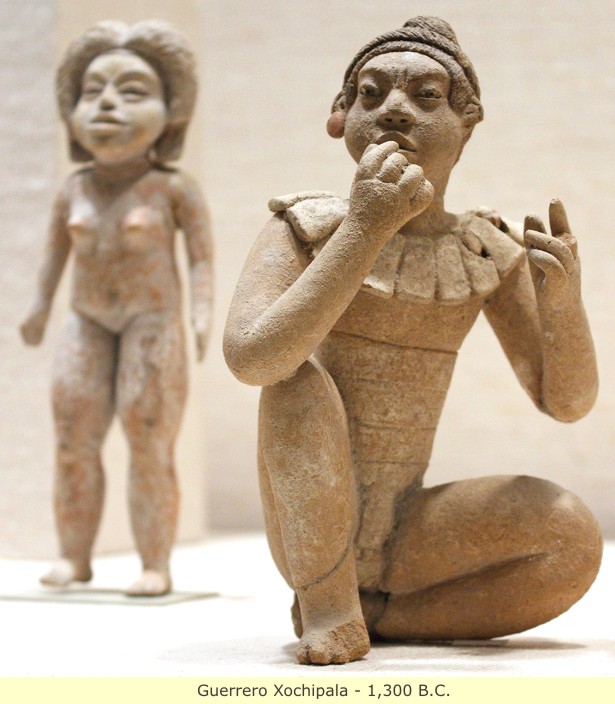
The circumstances of Olmec decline, whether by military defeat, cultural exhaustion or environmental catastrophe is unknown, however evidence does suggest a violent end. What is known, is that Olmec cultural traits and technology were embraced, and carried forward by the Amerindian peoples in Mesoamerica and South America. The most prominent Olmec technology carried forward was building construction, especially Pyramid building. All of the later major American Indian cultures (south of the United States), engaged in Pyramid building. Pottery and metallurgy were also important Olmec contributions to the Americas.
 |
 |
 |
 |
 |
 |
 |
 |
 |
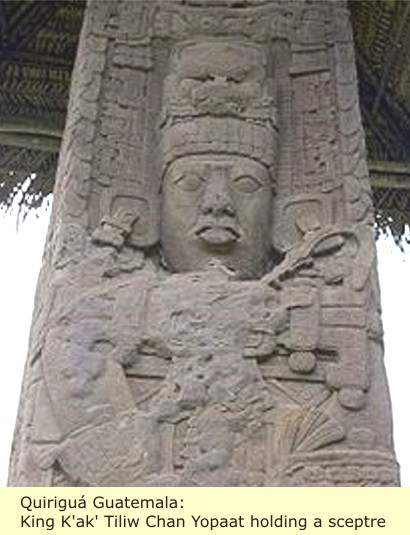
Kaminaljuyu is a site of the early Maya civilization that was primarily occupied from 1500 B.C. to 1200 A.D. Kaminaljuyu has been described as one of the greatest of all archaeological sites in the New World. The known parts of Kaminaljuyu lie on a broad plain beneath roughly the western third of modern Guatemala City. First significant settlement dates to the Arévalo phase, ca. 1100-1000 B.C, with indications of dense populations no later than ca. 700 B.C. By the end of the Las Charcas culture (1000-700 B.C.) Kaminaljuyu was developing religious and civic institutions. Scattered Las Charcas remains throughout the Valley of Guatemala mark a major occupation of the area at sites such as El Naranjo; at this latter site, as well as at El Portón some 50 kilometers to the north and Takalik Abaj, 130 kilometers to the west in the lower piedmont plain, uncarved upright shaft stones called stelae, mark the first appearance of a cult of time-reckoning, which became one of the bases for the institution of Maya kingship. The architecture of Middle Preclassic structures consisted of hardened adobe bricks that served later, as foundations for raised platforms and pyramidal temples.


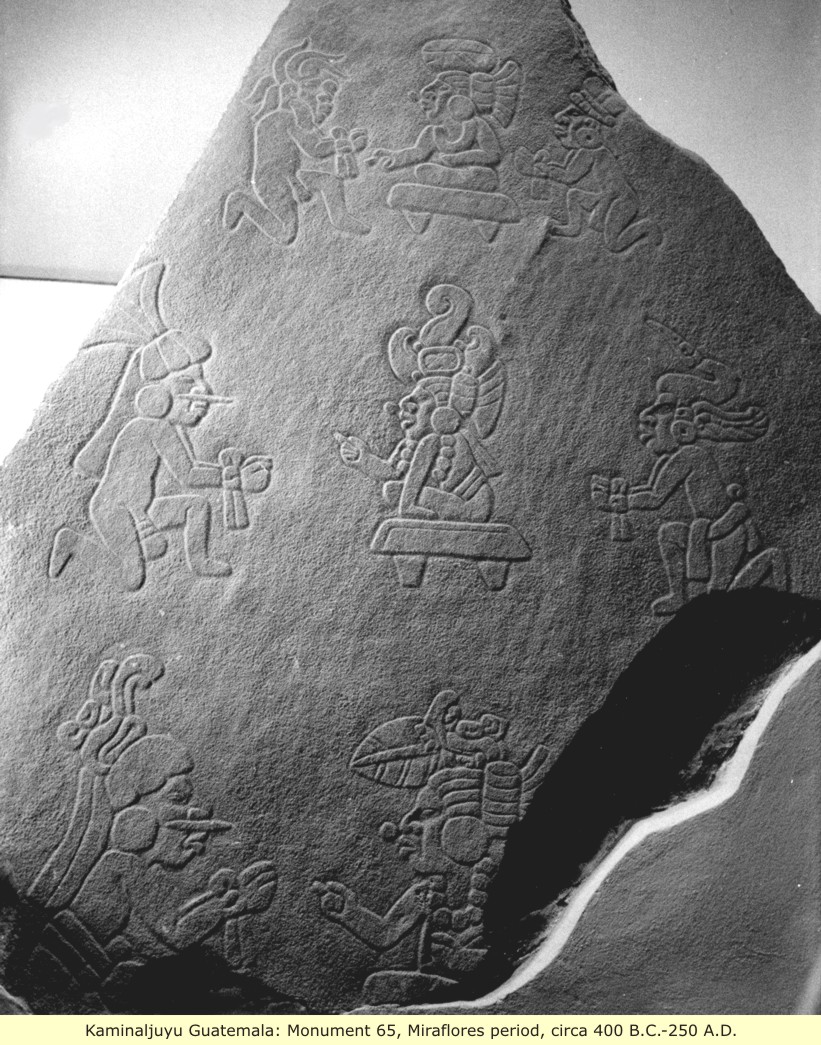 |
Excavations indicate that from early in the Middle Preclassic period the community was large enough to produce heavy refuse deposits. Cotton was grown as well as maize; palaeobotanical research also has identified anonas, avocados, cacao, black beans, palm nuts, plums, and sapodilla (zapote blanco). Arboriculture developed - with groves of crop trees grown in terraces down to the edges of great ravines. Specialists practiced loom-weaving and were expert potters. Large-scale workshops for obsidian tool-making were spread around the ancient city. Religious practices that would later be further developed throughout Mesoamerica were elaborating during the early Middle Preclassic at Kaminaljuyu, including the erection of mounds to serve as substructures for small shrines or funerary/administrative temples, the development of a complex pantheon of deities - probably based on some primordial mythology and cosmology of which the Popol Vuh represents a fragment - and euhemerism, an incensario and stela cult, and warfare to procure captives for royal sacrifice.

 |
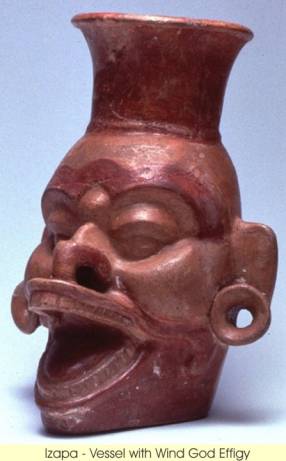
Neither the Olmec civilization, nor the Olmec people, died off suddenly. There was a gradual process of one ascending and the other descending. Though fundamentally Olmec, the Izapan civilization is a clear example of a midpoint between the Olmec and the Classic Maya {the next great civilization}, in time and cultural content. For the following early Maya traits are found there: the stele–altar complex, long-lipped deities, hieroglyphic writing and Long Count dates on some monuments, U-shaped motifs, and painted reliefs.


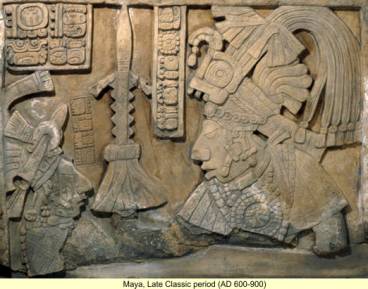
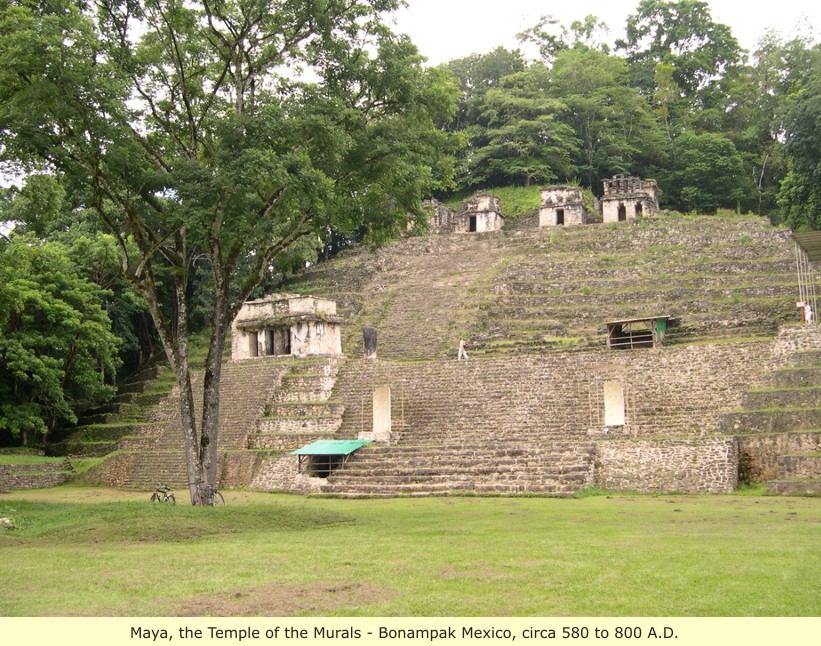
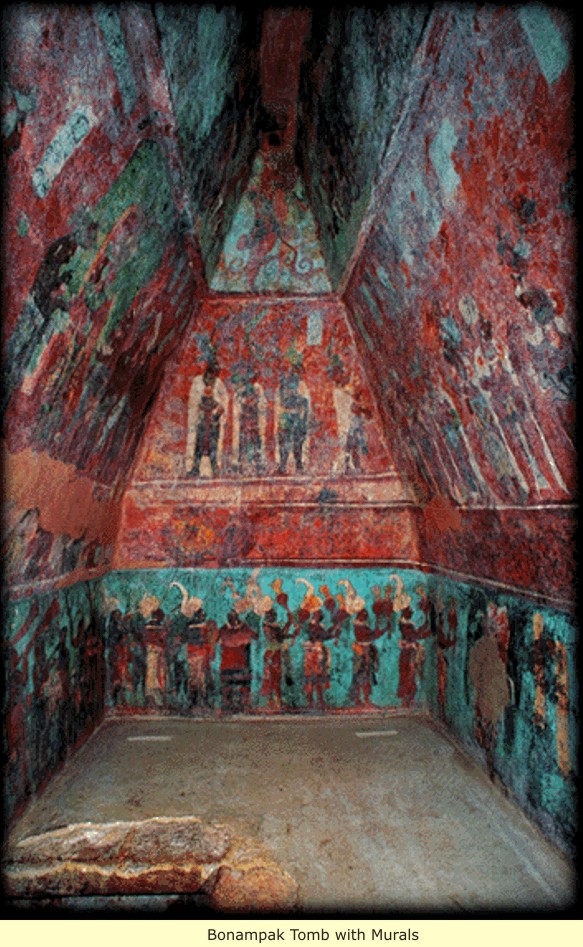
The Maya were the first of the Amerindian people to gain hegemony in MesoAmerica {Mexico and Central America}. From as early as 1500 B.C, the Maya people had settled in villages and were practicing agriculture based on the cultivation of corn (maize), beans, and squash. They also began to build ceremonial centers, and by 200 A.D, these had developed into cities containing temples, pyramids, palaces, plazas, and courts for playing ball. There was also a system of hieroglyphic writing and highly sophisticated calendar and astronomical systems. At this point it is not known how much of this was uniquely Mayan, and how much was taken directly from the Olmec.
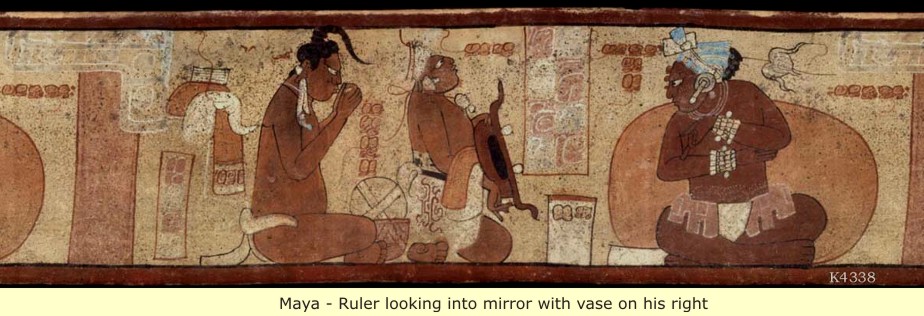
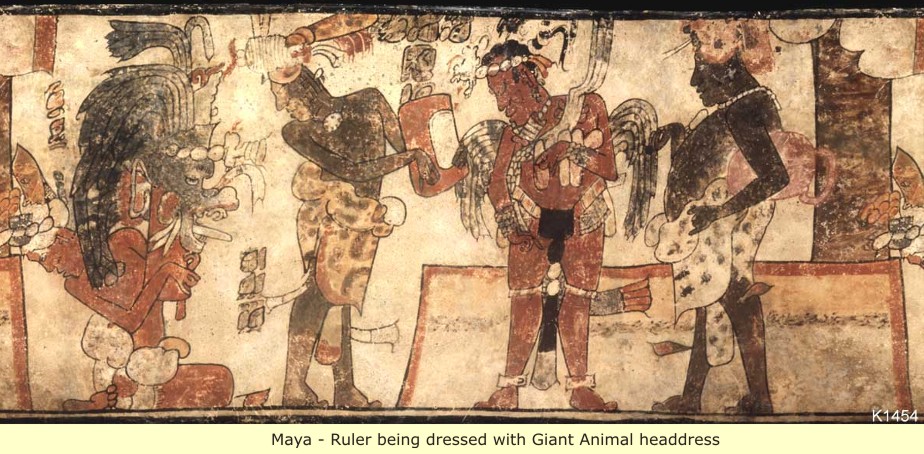
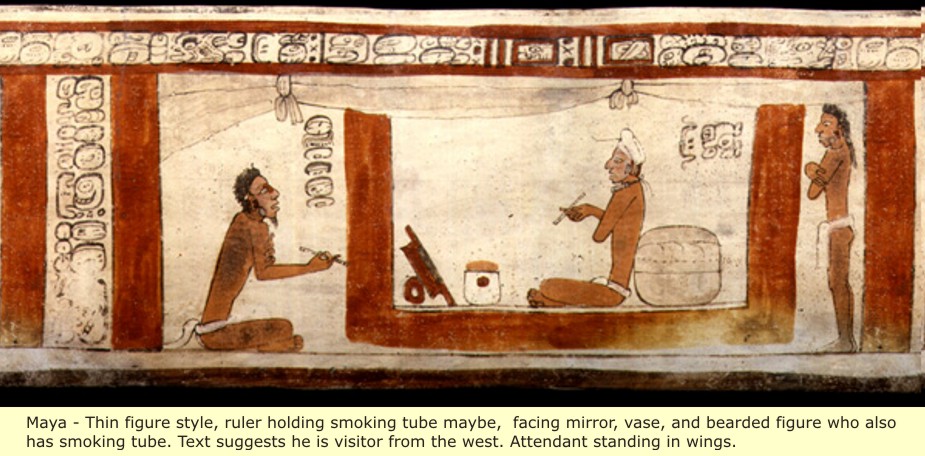
Mayan hieroglyphs often depict the histories of Mayan rulers who waged war on rival Mayan cities and took their aristocrats captive. These captives were then tortured, mutilated, and sacrificed to the Mayan gods.
 |
 |
 |
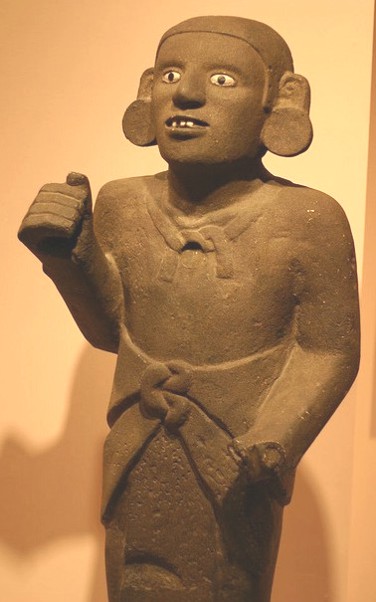
Torture and human sacrifice were fundamental religious rituals of Mayan society; they were thought to guarantee fertility, demonstrate piety, and propitiate the gods, and if such practices were neglected, cosmic disorder and chaos were thought to result. The drawing of human blood was thought to nourish the gods and was thus necessary to achieve contact with them; hence the Mayan rulers, as the intermediaries between the Mayan people and the gods, had to undergo ritual bloodletting and self-torture.
 |
 |
 |
 |
 |
 |
 |
 |
 |
 |
 |
 |
 |
Above is one panel of the oldest known Maya mural, discovered in 2001 at the ancient Maya city of San Bartolo in the lowlands of northeastern Guatemala. The mural tells the story of creation, the mythology of kingship, and the divine right of a king. The first part of the mural shows the establishment of order in the world. The world is propped up by trees with roots leading to the underworld and branches holding up the sky. Four deities, who are representations of the maize god's son, provide a blood sacrifice and a unique offering before each tree.
The story starts with the deity above, who is patron of kings, standing in water. He's running a large spear through his own penis, letting blood. Each additional panel depicts rituals and sacrifice culminating in the crowning of the king.
The Maya however, were not only interested in ritual and sacrifice: In mathematics, positional notation and the use of the zero represented a pinnacle of intellectual achievement. Mayan astronomy underlay a complex calendar system involving an accurately determined solar year (18 months of 20 days, plus an unlucky 5-day period), a sacred year of 260 days (13 cycles of 20 named days), and a variety of longer cycles culminating in the Long Count, based on a zero date in 3114 BC. Mayan astronomers compiled precise tables of positions for the Moon and Venus and were able to predict solar eclipses.
 |
Science 11 May 2012: Ancient Maya Astronomical Tables from Xultun, Guatemala - William A. Saturno, David Stuart, Anthony F. Aveni, Franco Rossi.
Maya astronomical tables are recognized in bark-paper books from the Late Postclassic period (1300 to 1521 C.E.), but Classic period (200 to 900 C.E.) precursors have not been found. In 2011, a small painted room was excavated at the extensive ancient Maya ruins of Xultun, Guatemala, dating to the early 9th century C.E. The walls and ceiling of the room are painted with several human figures. Two walls also display a large number of delicate black, red, and incised hieroglyphs. Many of these hieroglyphs are calendrical in nature and relate astronomical computations, including at least two tables concerning the movement of the Moon, and perhaps Mars and Venus. These apparently represent early astronomical tables and may shed light on the later books.
 |
 |
 |
 |
 |
The next culture to arise was that of Teotihuacán, it was the most important and largest city of pre-Aztec central Mexico, located about 30 miles northeast of modern Mexico City. At its height (about 500 A.D.), it encompassed some 20 square miles and supported a population estimated at 200,000 people, making it at the time, one of the largest cities in the world. Their language is unknown, their ethnicity appears to be Olmec.
 |
 |
 |
Unfortunately no ancient Teotihuacano texts are known to exist, but the city is occasionally referred to in the texts of Maya monuments, these show that Teotihuacan nobility traveled to and married with the families of local rulers as far away as Honduras.
 |


 |
Maya hieroglyphs mention a “Spearthrower Owl”, apparently an Emperor of Teotihuacan, who reigned for over 60 years and apparently imposed his relatives as kings of the cities of Tikal and Uaxactun, which were cities in Guatemala. The city also had large numbers of merchants, many of whom had immigrated there from great distances. The priest-Emperor who governed the city also staged grand religious pageants and ceremonies that often involved human sacrifices.


The next great culture was that of the Zapotec, their capital city of Monte Albán, was built over a period of 2,000 years, starting at about 900 B.C. Though their early art shows Olmec influence, there can be little doubt that the people of Monte Albán were Zapotec. Who during Classic times had the opportunity to develop their civilization, unaffected by the major troubles that disturbed Teotihuacán and the Maya at the close of the Early Classic period.


 |
Then came the Mixtec people, who flourished between 1200 A.D, and 1521 A.D. They were contemporaneous with the Aztecs but managed to retain their independence. Their homeland was a mountainous region in Oaxaca, southern Mexico, known as the Mixteca. They also came to dominate areas of Oaxaca previously under the control of the Zapotec civilization, notably the city of Monte Albán. The Mixtecs were renowned for their skilled work with gold and turquoise mosaic, many of them were employed as artisans by Aztec kings.
 |
 |
 |
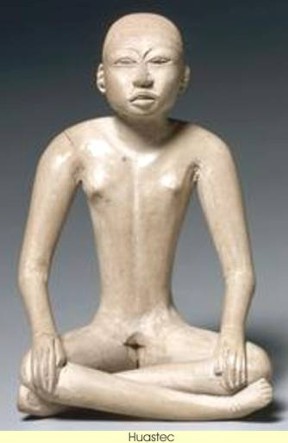
Next are the Huastec, they are thought to date back to approximately 1000 B.C, however their most productive period is usually considered to be the Post-Classic era, between the fall of Teotihuacan and the rise of the Aztec Empire. They constructed temples on step-pyramids, carved independent standing sculptures, and produced elaborately painted pottery. The Huastec were unusual for being the only highly advanced people, who built cities, yet usually wore no clothing.

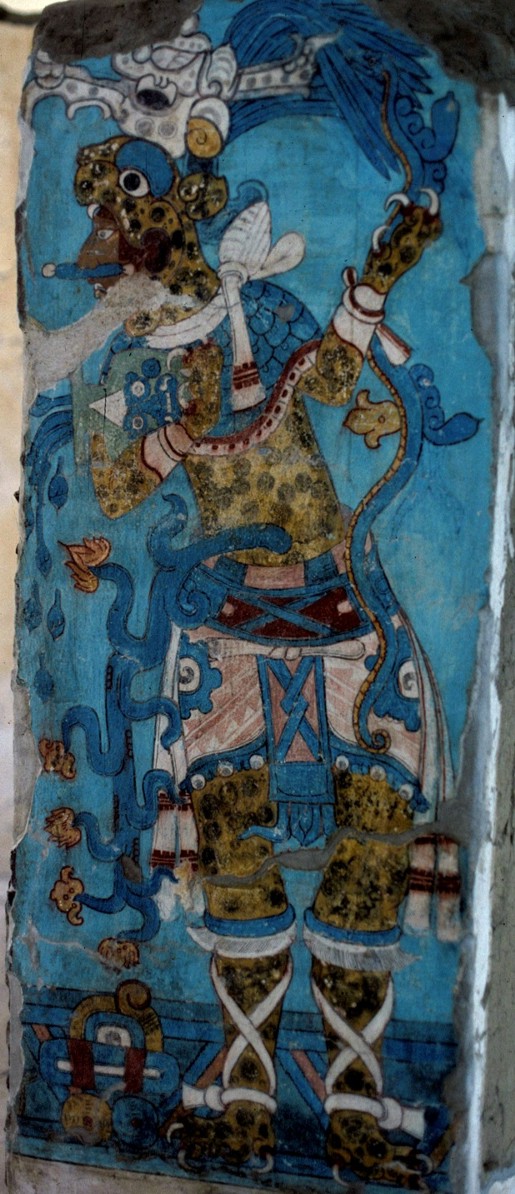
Cacaxtla is the name of a Late Classic to Epiclassic (600-900 A.D.) city in the Puebla Valley, Tlaxcala, Mexico. At its height, Cacaxtla had a population of about 10,000 Olmeca-Xicalanca people. Cacaxtla conquered Cholulu in the 7th century A.D, and became the capital of the valley, blending Nahua, Mixtecs and Chochopolocans, until they in turn were overthrown by the Toltecs.
Nearby Xochitecatl, unlike other contemporary sites, appears to have been a purely ceremonial center for a population dispersed through the surrounding countryside rather than the center of an urban area.
 |
 |
 |
Then there were the Toltecs, who dominated much of central Mexico around 1200 A.D. Their language “Nahuatl”, was also spoken by the Aztecs. They were a militaristic nomadic people, and they or their ancestors may have sacked the city of Teotihuacan in 750 A.D.
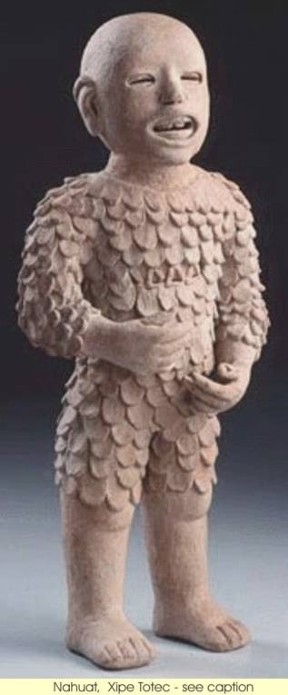

Above, and to the right, we have a priest wearing the skin of a sacrificed victim. A living human, clothed in a sacrificial victim's skin, (this is clearly visible around the mouth and wrists). This type of image is among the most awesome and most disturbing ever created by Mesoamerican artists. It expresses the deeply held belief that death is necessary to life. Accordingly, such figures were associated with fertility, rain, and the springtime renewal of the earth's vegetation. Perhaps the wearer, upon shedding the skin, was perceived as a sprout, emerging from a withered husk. Such figures also had military meanings.
The Tlaxcalteca were originally a conglomeration of three distinct ethnic groups who spoke Nahuatl, Otomi and Pinome, respectively. Eventually, the Nahuatl speakers became the dominant ethnic group. Despite early attempts by the Mexica, the Tlaxcalteca were never conquered by the Aztec Triple Alliance. The Aztecs allowed them to maintain their independence so that they could participate in the xochiyaoyatl (flower wars) with them, which provided victims for the Aztec rituals requiring human sacrifice.
The Tlaxcaltecas served as allies to Hernán Cortés and his fellow Spanish conquistadors, and were instrumental in the invasion of Tenochtitlan, capital of the Aztec empire: and helping the Spanish reach the Valley of Anahuac, they provided most of the invasion force.
Due to their alliance with the Spanish Crown in the conquest of Mexico, the Tlaxcalteca enjoyed some privileges among the indigenous peoples of Mexico, including the right to carry firearms, ride horses, hold noble title and to rule their settlements autonomously. The Tlaxcalteca were also instrumental in the establishment of a number of settlements in Northern Mexico (including parts of present-day southeastern Texas), where conquest of local tribes by the Spaniards had proved unfruitful. They were taken to areas inhabited by nomadic bellicose tribes (known as the Chichimeca) to serve as examples for the local indigenous groups of model subjects of the Spanish Crown, and to work in mines and haciendas. The Tlaxcaltec colonies in the Chichimeca included settlements in the modern states of San Luis Potosí, Zacatecas, Durango, Coahuila, Nuevo León — Nueva Tlaxcala de Nuestra Señora de Guadalupe de Horcasistas, today known as Guadalupe, and Santiago de las Sabinas, today known as Sabinas Hidalgo — and Jalisco (Villa de Nueva Tlaxcala de Quiahuistlán, today known as Colotlán).
Because the Tlaxcalans allied themselves with the Spanish to defeat the Aztecs, they were rewarded with concessions from the Spanish that allowed the territory to remain mostly intact throughout 300 years of colonial period. After Mexican Independence, Tlaxcala was declared a federal territory, until 1857 when it was admitted as a state of the federation.

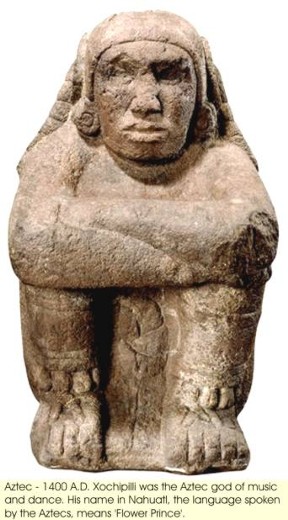
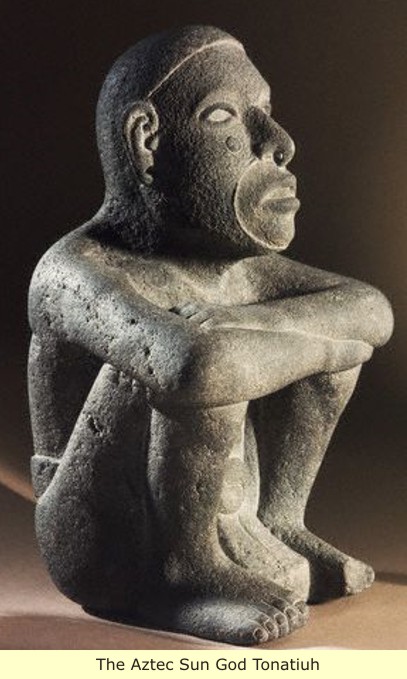
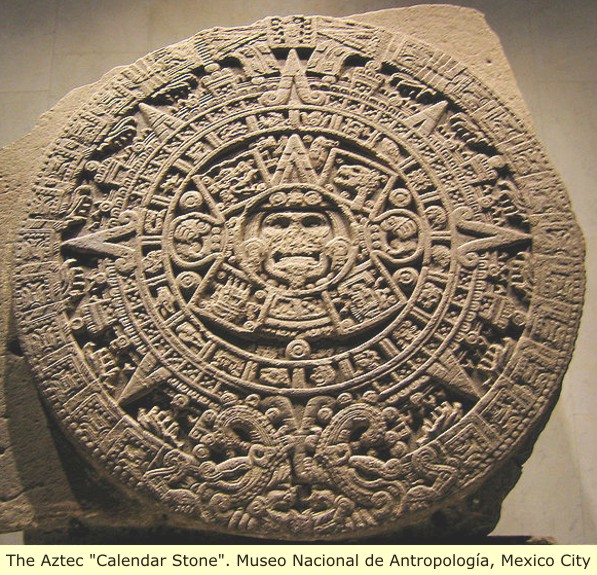
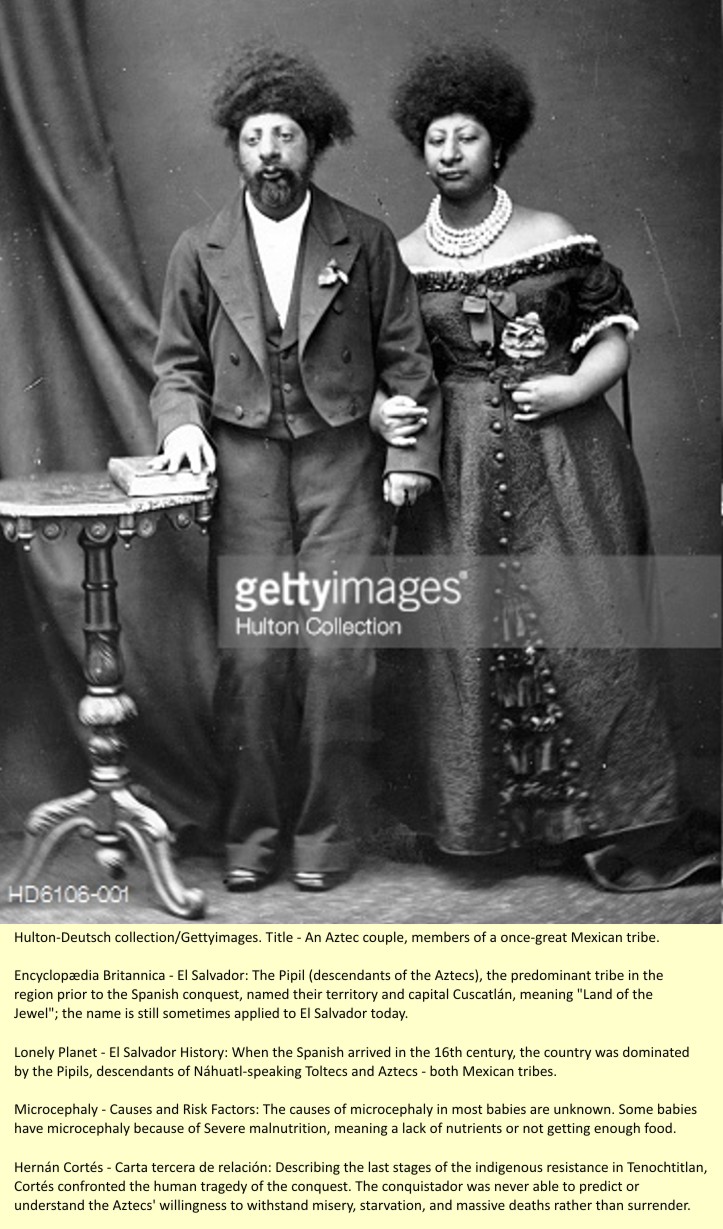
The last of the great MesoAmerican cultures were the Aztec, they were a Nahuatl-speaking people, who in the 15th and early 16th centuries, ruled a large empire in what is now central and southern Mexico. The Aztec are so-called from the word Aztlán (“White Land”), an allusion to their place of origin, possibly in northern Mexico. They were also called the "Tenochca" from a mythical ancestor "Tenoch" and the "Mexica" probably from Metzliapán (“Moon Lake”), the mystical name for Lake Texcoco. From “Tenochca” was derived the name of their great city, Tenochtitlán; and from “Mexica” came the name for the city that succeeded the Aztec capital, and the surrounding valley. This name was applied later to the whole Mexican nation.
 |
 |
 |


 |
 |
By 1492 A.D, Europeans (the Spaniards), had discovered the "New World" (smile: it had a 100 million people)
Christopher Columbus, had earlier landed in the Caribbean, and had set in motion the killing, looting and subjugation of the Arawak and Caribe indians that he had found there. This precipitated the mass influx of Europeans, (mostly at this time from Spain and Portugal), who all had the same thing in mind, plundering and looting.
 |
 |
 |
Now enters Hernando Cortes: After several years as a gentleman farmer on the Caribbean island of Hispaniola (now Haiti and the Dominican republic). Hernando Cortes (a Spaniard), now felt the desire for adventure and booty, accordingly he joined the military expedition of Diego de Velazquez, which was bent on capturing Cuba. After that victory, Cortes became the mayor of Santiago Cuba, and married the sister-in-law of Velazquez. In 1518, Velazquez gave Cortes permission to form a small force of about 550 men, with a fleet of eleven ships, to conduct an exploration of Mexico.
In 1519 Cortez landed in Mexico, the first great cities that Cortes encountered, were the cities of the Totonacs, he first went to Cempoala, (population about 80,000). Here they told Cortes of the great and rich Empire of the Aztec people further inland, {and it is here at this time that Cortes is offered twenty young women as his slaves, one of them is an Aztec maiden, later to be known as Malinche, she will serve as his interpreter with the Aztec}.
"La Malinche" Slave, interpreter, secretary, mistress, and mother of the first "Mexican", their son "Don Mahin Cortes", her very name still stirs up controversy. Many Mexicans continue to revile the woman called Doña Marina by the Spaniards and La Malinche by the Aztecs, labeling her a traitor and harlot for her role as the alter ego of Hernando Cortes as he conquered Mexico. Her ability to communicate also enabled the Spaniards to introduce Christianity. Herself a convert and baptized Marina, she was an advocate for her new faith.
Her story, is one that causes great consternation to the non-European people of Mexico. There is however, no room to go into it here.
 Likewise, there is no room to go in-depth into the relationship between the Aztec people, and the people that they maintained Hegemony over. Suffice to say, that the Aztec required the people that they had conquered, to participate in what were called, “Flowery Wars”. These were mock battles, where the Aztec, after symbolically capturing an enemy (who would be un-injured), would then have an un-blemished candidate, for sacrifice to their gods.
Needless to say, the tribes saw Cortez and his cannon as a god-sent. Each tribe raised its army, and rallied to Cortez, (these numbered in the many tens of thousands). Of course the tribes would quickly come to regret this, after the Aztec had been defeated.
Next Cortez encountered the Tlaxcalans, they also joined. And on they went to confront the Aztec. In Tenochtitlan Montezuma hears of the pale invaders. He considers Cortés to be Quetzacoatl, the great god who left Mexico many years before, on a raft of snakes, vowing to return. And who, according to legend, had taught them about agriculture and government and whose return they were to welcome with great ceremony. Believing the Spanish to be descendants of the god Quetzalcoatl, Montezuma tries to persuade them to leave by offering rich gifts.
Also knowing of this Aztec myth (probably from Malinche) Cortes exploits the Aztec myth of a pale skinned, bearded god-king named Quetzalcoatl as he approaches Tenochtitlan. Montezuma made an attempt to stop Cortes, but his defenses lacked unity and tenacity both because of the Quetzalcoatl legend, which dictated that his people welcome the return of the "white god," and the fear generated by the sight of Spanish horses and firearms, which the Aztecs had never seen before. As a result of their quandary, as well as the the tactic used by the Spanish conquistadors and their allies of actually killing their enemies in battle as opposed to capturing them for sacrifice. By the time the Aztecs had caught on and changed their tactics, it was too late. Cortes quickly defeated their army and on November 18, 1519, Cortes entered the Aztec capital and imprisoned Montezuma. Later, after seeing that Montezuma had no value as a hostage, he was later killed.
Note the Black soldier with Cortes |
 |
| The above is of course typical of White "Fantasy History". Click here for more on the Aztec: Click >>> |
Conquest of the AmericasDid it really come about because of a local Race War? |
The Aztec continued to battle for quite a bit longer, but the die was already cast, with all of the other tribes against them, the Aztec cause was hopeless. Of course after the Aztec were defeated, the Spanish turned on the tribes, and one by one they were defeated and enslaved. Then the plundering and looting, which had already begun, could proceed in ernest. The subsequent killing, slavery and disease would destroy over 75% of the population, and bring an end to the MesoAmerican cultures and most of their people.
King Ferdinand's letter to the Taino/Arawak IndiansBelow is a letter, which King Ferdinand sent along with Columbus on his second voyage to Haiti. It was to be communicated to the Taino/Arawak Indians. It is a fascinating document. The King wants the Indians to acknowledge the Christian religion and God, and to accept the authority of the King of Spain. The letter..
The late Pope gave these islands and mainland of the ocean and the contents hereof to the above-mentioned King and Queen, as is certified in writing and you may see the documents if you should so desire. Therefore, Their Highnesses are lords and masters of this land; they were acknowledged as such when this notice was posted, and were and are being served willingly and without resistance; then, their religious envoys were acknowledged and obeyed without delay, and all subjects unconditionally and of their own free will became Christians and thus they remain. Their Highnesses received their allegiance with joy and benignity and decreed that they be treated in this spirit like good and loyal vassals and you are under the obligation to do the same. Therefore, we request that you understand this text, deliberate on its contents within a reasonable time, and recognize the Church and its highest priest, the Pope, as rulers of the universe, and in their name the King and Queen of Spain as rulers of this land, allowing the religious fathers to preach our holy Faith to you. You own compliance as a duty to the King and we in his name will receive you with love and charity, respecting your freedom and that of your wives and sons and your rights of possession and we shall not compel you to baptism unless you, informed of the Truth, wish to convert to our holy Catholic Faith as almost all your neighbors have done in other islands, in exchange for which Their Highnesses bestow many privileges and exemptions upon you. Should you fail to comply, or delay maliciously in so doing, we assure you that with the help of God we shall use force against you, declaring war upon you from all sides and with all possible means, and we shall bind you to the yoke of the Church and of Their Highnesses; we shall enslave your persons, wives and sons, sell you or dispose of you as the King sees fit; we shall seize your possessions and harm you as much as we can as disobedient and resisting vassals. And we declare you guilty of resulting deaths and injuries, exempting Their Highnesses of such guilt as well as ourselves and the gentlemen who accompany us. We hereby request that legal signatures be affixed to this text and pray those present to bear witness for us, etc. |
 |
 |
Banquet of ChestnutsThe Banquet of Chestnuts, known more properly as the Ballet of Chestnuts, refers to a fête in Rome, and particularly to a supper held in the Papal Palace by Don Cesare Borgia, son of Pope Alexander VI on October 30, 1501. An account of the banquet is preserved in a Latin diary by Protonotary Apostolic and Master of Ceremonies Johann Burchard (it is entitled Liber Notarum). The banquet was given in Cesare's apartments in the Palazzo Apostolico. Fifty prostitutes or courtesans were in attendance for the entertainment of the banquet guests. After the food was eaten, lamp stands holding lighted candles were placed on the floor and chestnuts strewn about. The clothes of the courtesans were auctioned; then the prostitutes and the guests crawled naked among the lamp stands to pick up the chestnuts. Immediately following the spectacle, members of the clergy and other party guests together engaged with the prostitutes in sexual activity. According to Burchard, "prizes were offered--silken doublets, pairs of shoes, hats and other garments--for those men who were most successful with the prostitutes". According to William Manchester, "Servants kept score of each man's orgasms, for the pope greatly admired virility and measured a man's machismo by his ejaculative capacity." Another source states that Pope Alexander VI was actually there and himself suggested the scorekeeping method. Manchester also refers to the use of sex toys; Burchard, however, makes no reference to this in his account of the banquet.
|
 |
 |
Charles oversaw the Spanish colonization of the Americas, including the conquest of both the Aztec Empire and the Inca Empire. Uncomfortable with how his viceroys were governing the Americas vis-à-vis the Native Americans, Charles consulted figures such as Francisco de Vitoria and Bartolomé de las Casas on the morality of colonization. Though always at war, Charles was essentially a lover of peace, and all his wars were virtually defensive. "Not greedy of territory", wrote Marcantonio Contarini in 1536, "but most greedy of peace and quiet." Charles retired in 1556. The Habsburg Monarchy passed to Charles' younger brother Ferdinand, whereas the Spanish Empire was inherited by his son Philip II. |
Mexico's 2nd President and First (and only) Black President - Vicente Guerrero (10 August 1782 – 14 February 1831)
He was a major military leader during Mexico's war For Independence and as president ended slavery in his nation on September 15, 1829 (In office
1 April 1829 – 17 December 1829).
(Posthumous 1850 portraits - he was probably not so mulatto)
 |
 |
 |
His Proclamation:
The President of the United States of Mexico, know ye: That desiring to celebrate in the year of 1829 the anniversary of our independence with an act of justice and national beneficence, which might result in the benefit and support of a good, so highly to be appreciated, which might cement more and more the public tranquility, which might reinstate an unfortunate part of its inhabitants in the sacred rights which nature gave them, and which the nation protects by wise and just laws, in conformance with the 30th article of the constitutive act, in which the use of extraordinary powers are ceded to me,
I have thought it proper to decree:
1st. Slavery is abolished in the republic.
2nd. Consequently, those who have been until now considered slaves are free.
3rd. When the circumstances of the treasury may permit, the owners of the slaves will be indemnified in the mode that the laws may provide.
And in order that every part of this decree may be fully complied with, let it be printed, published, and circulated. Given at the Federal Palace of Mexico, the 15th of September, 1829. Vicente Guerrero to José María Bocanegra. However, Guerrero immediately received strong warnings from Texas, where most of the slaveholders were located, of "serious inconvenience apprehended by the execution of the decree of the 15th of September last, on the subject of abolition of slavery in that department and the fatal results to be expected, prejudicial to the tranquility and even to the political existence of the state." Thus, scarcely two months later, Guerrero sent a note dated 20 November communicating to the governor and military garrisons of Texas that the Texas slaves would remain enslaved.
 |
Guerrero received permission from Congress to take the field to combat the rebels. Later, the military garrison of Mexico City joined the Plan de Jalapa against Guerrero and installed an executive triumvirate of Pedro Vélez, Lucas Alamán and Luis de Quintanar. Guerrero hoped to come back to power, but Bustamante captured him through bribery and had him executed. After his death, Mexicans loyal to Guerrero revolted, driving Bustamante from his presidency and forcing him to flee for his life. Picaluga, a former friend of Guerrero, who conspired with Bustamante to capture Guerrero, was executed. Honors were conferred on surviving members of Guerrero's family, and a pension was paid to his widow. In 1842, Vicente Guerrero's body was returned to Mexico City and interred there.
Throughout the pages of Realhistoryww we have cautioned our readers that Albinos are degenerate liars on issues of Race, and their Near-Albino Mulattoes are sometimes even worst, because they are trying to elevate their "Believed" status (who but an Albino, or near Albino, would WANT to be an Albino?), to Same-as-White status, while at the same time ingratiating themselves to full Albinos (perhaps "making the best of a bad situation" is apropos). Of course the Albinos greatest impediment is his weakness to Sunlight. Which is of course why they needed to Enslave "Normal" (Pigmented) people to do their farming and other "Outside" work for them, (if they wanted to eat, and not starve, that is).
Mississippi quote: Our position is thoroughly identified with the institution of slavery—the greatest material interest of the world. Its labor supplies the product which constitutes by far the largest and most important portions of commerce of the earth. These products are peculiar to the climate verging on the tropical regions, and by an “imperious” (meaning power or authority without justification; one arrogant and domineering), law of nature, none but the "BLACK RACE" can bear exposure to the Tropical Sun: (today they claim to be the most pious Americans, “The Good, God Fearing People”. Yet they call the supposed works of God “imperious”??) . These products have become necessities of the world, and a blow at slavery is a blow at commerce and civilization. That blow has been long aimed at the institution, and was at the point of reaching its consummation. There was no choice left us but submission to the mandates of abolition, or a dissolution of the Union, whose principles had been subverted to work out our ruin.
Thus it is with this knowledge and understanding that we must vet and scrutinize the Clinical and Theoretical studies of Albinos. Since there is no telling when Blacks will have the "Wherewithal" to do their own studies, we had best get good at vetting Albino studies like the one below.
But before we get to the study, let us get a few things straight. First, we have said that Albinos lie, but we have not made clear "Why" Albinos lie. First and foremost, Albinos do not like it that each of them are merely the product of a Black Man and a Black Woman who had defective Melanin producing genes. Even though most European Albinos have Albino parents today (due to breeding among themselves in Central Asia): somewhere in time, they started out with Black Parents. Another reason is that Albinos took over the world less that 500 years ago, so they are still trying to cement their Fake history of the World. Thus admitting that original Americans were Black Negroid's and Black Mongoloids puts to lie their Fake history of Albino everyone, everywhere. Central to their stupid, delusional, lie history; is that All Blacks in the Americas are the result of the importation of African Slaves to the Americas. The problem for their lie history is that it's easily provable that Mexico and the United States actually imported few African Slaves. (See chart below).
 |
 |
 |
 |
 |
Admixture and population structure in Mexican-Mestizos based on paternal lineages.
 |
 |
 |
 |
 |
 |
Notes:
Guatemala is not a part of Mexico - it just happen to be in the list for Spanish Mainland Americas.
New Spain - Written by the Editors of Encyclopaedia Britannica
Viceroyalty of New Spain, the first of the four viceroyalties that Spain created to govern its conquered lands in the New World. Established in 1535, it initially included all land north of the Isthmus of Panama under Spanish control. This later came to include upper and lower California, the area that is now the central and southwestern portion of the United States, and territory eastward along the Gulf of Mexico to Florida. The Viceroyalty of New Spain was also charged with governing Spain’s Caribbean possessions. Later, in 1565, the newly conquered Philippines were placed under the jurisdiction of New Spain.
Remembering that this study was done in 2012, perhaps before the lies of commercial genome testing companies was documented: so as a service to the authors of this study; NO!!! SNPs and STRs CANNOT establish where people came from. Here at Realhistoryww we provide many exhibits to prove that they lie. Among them, we have one of our own pages debunking the claims of Ancestry DNA companies: Click here>>. And for those who don't feel that we are authoritative enough for them, we have a "60 Minutes" program titled "Rebuilding the Family Tree:" A CBS News expose of the "Wildly" false claims of Genetic Testers. Click here: >>>
(We just started, and already we know that these Albinos lie).
 |
(No idiot authors, R* in NOT a European haplogroup; and YAP is NOT exclusively African).
Haplogroup R (Y-DNA) -
From Wikipedia, the free encyclopedia
Possible time of origin about 27,000 years BP.
Possible place of origin possibly Central Asia, Siberia, or South Asia.
Haplogroup R, or R-M207, is a Y-chromosome DNA haplogroup. It is both numerous and widespread amongst modern populations. Some descendant subclades have been found since pre-history in Europe, Central Asia and South Asia. Others have long been present, at lower levels, in parts of West Asia and Africa. Some authorities have also suggested, more controversially, that R-M207 has long been present among Native Americans in North America – a theory that has not yet been widely accepted.
Haplogroup DE (YAP) -
From Wikipedia, the free encyclopedia
Possible time of origin 70,000-75,000 or already 141,000 years split between CF and DE, ca. 73,100 years ago, or ca. 76,000 years ago
Possible place of origin Africa or Eurasia,
Ancestor CT,
Descendants E, D:
Defining mutations M1/YAP, M145 = P205, M203, P144, P153, P165, P167, P183
Haplogroup DE is a human Y-chromosome DNA haplogroup. It is defined by the single nucleotide polymorphism (SNP) mutations, or UEPs, M1(YAP), M145(P205), M203, P144, P153, P165, P167, P183. DE is unique because it is distributed in several geographically distinct clusters. An immediate subclade, haplogroup D (also known as D-CTS3946), is mainly found in Eastern Asia, parts of Central Asia, and the Andaman Islands, but also sporadically in West Africa and West Asia. The other immediate subclade, haplogroup E, is common in Africa, and to a lesser extent the Middle East and Europe.
 |
 |
| Note that above, YAP was used as an indicator of Africans: but YAP is a part of haplogroup E*, so how can haplogroup E1b1b1 now be an indicator of Europeans? Albinos make it up as they go! |
 |
| Above: YAP and haplogroup E* are indicators of European ancestry, now they use it as proof of AFRICAN ancestry. Though it is true that Blacks and their Albinos have the same haplogroups, those haplogroups cannot be used to exclude one or the other. They SHARE the genes! |
 |
 |
 |
| As discussed in the Columbus "Special Subject Page", Black Europeans were indeed a part of Columbus's crew. |
 |
 |
Considering the errors and lies of this study, some must wonder WHY we featured it. Two reasons: first it gave us a good opportunity to highlight what the degenerate Racists do under the guise of science and education.
And two, it is one of the few studies that mention the wealth of genetic types (Haplogroups) found in Mexico. These are the Y-dna haplogroups so-far found in Mexico: O, C, C3, R, R1a1, R1b1, E1b1b1, FH, G, J, K, P, Q, Q1a3a. Looking at AB only: Quote from Wikipedia: Haplogroup A is the NRY macrohaplogroup from which all modern paternal haplogroups descend. It is sparsely distributed in Africa, being concentrated among Khoisan populations in the southwest, (the genetically OLDEST Humans) and Nilotic populations toward the northeast in the Nile Valley (The Ancient Egyptians).
Some might now enjoy reading this Realhistory page and seeing what other people around the World share these same haplogroups with Mexicans, and realize just how much about Mexico that the Albinos and their near-mulattoes are hiding. Click here: >>>
 |
The term "North America" is sometimes used to refer only to Mexico, Canada, the United States, and Greenland.
The creators of the database have not made clear what their definition of "Mainland North America" is.
Note that the REAL Black population of the United States is around 100 million, (See results of the 2008 election):
Then note that whatever it is, they couldn't possibly come from less than a HALF A MILLION AFRICANS (see above - 365,713)!!!
Nowhere is the lies and falsifications of the Albinos more apparent than with the descendants of the Maya, in their old Homeland in what is now the country of Belize (formerly British Honduras). The Spanish imported only 1,023 African Slaves into Maya-land - and as it happened, they were isolated from the Native people. To properly show what happened in the Maya Homeland, we have created a Special Subject Page titled "Belize." Click here for the Belize page: >>>
 |
Now lets go down to South America, and see what is happening there.
Please visit the "Additional Material Area" for many more photographs of each civilization, and related material <Click> |
| < Back | Home | Next > |
 In the name of King Ferdinand and Juana, his daughter, Queen of Castile and Leon, etc., conquerors of barbarian nations, we notify you as best we can that our Lord God Eternal created Heaven and earth and a man and woman from whom we all descend for all times and all over the world. In the 5,000 years since creation the multitude of these generations caused men to divide and establish kingdoms in various parts of the world, among whom God chose St. Peter as leader of mankind, regardless of their law, sect or belief. He seated St. Peter in Rome as the best place from which to rule the world but he allowed him to establish his seat in all parts of the world and rule all people, whether Christians, Moors, Jews, Gentiles or any other sect. He was named Pope, which means admirable and greatest father, governor of all men. Those who lived at that time obeyed St. Peter as Lord and superior King of the universe, and so did their descendants obey his successors and so on to the end of time.