|
Babylonian Empire |
Assyrian Empire |
Achaemenid Persian Empire |
Alexanders Empire |
Seleucid Empire |
Parthian Empire |
Sassanian Persian Empire |
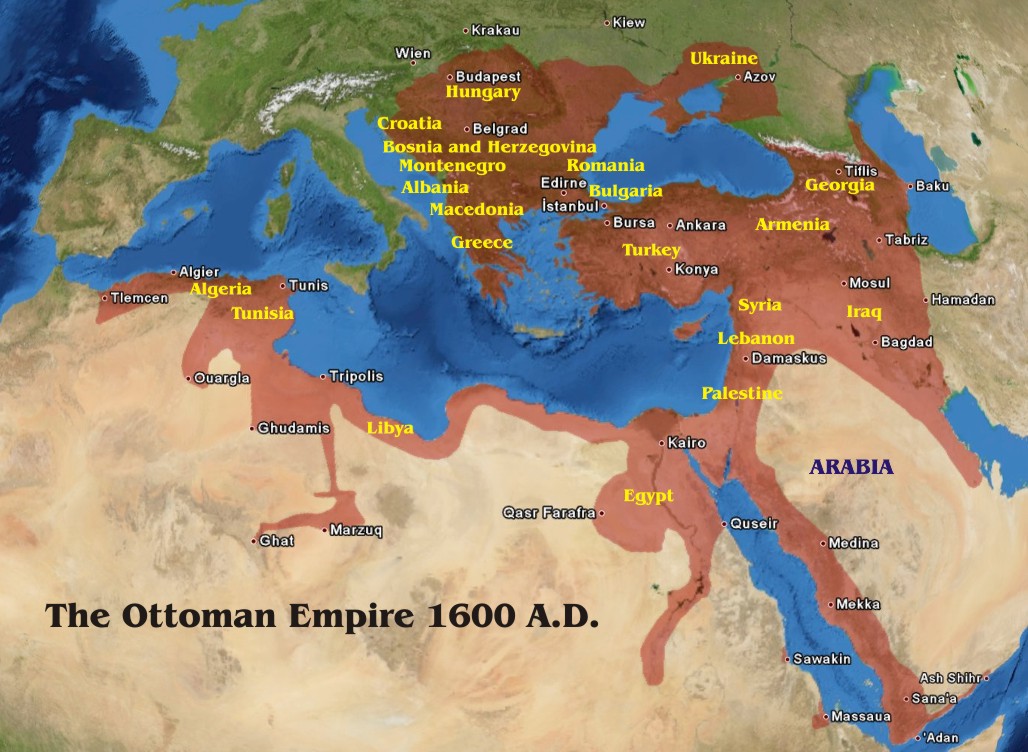
Ottoman Empire |
|
|
|
|
|
|
|
|
|
Ancient Man and His First Civilizations
Elam-2
Modern Iran
The Assyrians
Assyrian sculpture - From Wikipedia
Assyrian sculpture is the sculpture of the ancient Assyrian states,
especially the Neo-Assyrian Empire of 911 to 612 BC, which ruled modern
Iraq, Syria, and much of Iran. It forms a phase of the art of
Mesopotamia, differing in particular because of its much greater use of
stone and gypsum alabaster for large sculpture. Much the best-known
works are the huge lamassu guarding entrance ways, and Assyrian palace
reliefs on thin slabs of alabaster, which were originally painted, at
least in part, and fixed on the wall all-round the main rooms of
palaces. Most of these are in museums in Europe or America, following a
hectic period of excavations from 1842 to 1855, which took Assyrian art
from being almost completely unknown to being the subject of several
best-selling books, and imitated in political cartoons.
REMEMBERING
THAT THE CURRENT NON-BLACK PEOPLE OF EGYPT AND THE SURROUNDING
COUNTRIES HAVE NO DIRECT CONNECTION TO THOSE ANCIENT CULTURES (They are
for the most part Turks and Turk Mulattoes).
THIS IS WHAT THEY DO WHEN THEY GET ANGRY WITH THE RULING ELITES OF THEIR OWN KIND, WHO USE BLACK ART AS A TOURIST DRAW.
The
palace reliefs contain scenes in low relief which glorify the king,
showing him at war, hunting, and fulfilling other kingly roles. Many
works left in situ, or in museums local to their findspots, have been deliberately destroyed in the recent occupation of the area by ISIS,
the pace of destruction reportedly increasing in late 2016, with the
Mosul offensive. Other surviving types of art include many cylinder
seals, a few rock reliefs, reliefs and statues from temples, bronze
relief strips used on large doors, and small quantities of metalwork.
The Nimrud ivories, an important group of small plaques which decorated
furniture, were found in a palace storeroom near reliefs, but they came
from around the Mediterranean, with relatively few made locally in an
Assyrian style. |
The Middle Elamite period
After two centuries for which sources reveal
nothing, the Middle Elamite period opened with the rise to power of the
Anzanite dynasty, their homeland probably lay in the mountains
northeast of Khuzestan. Political expansion under the fourth king of
this line "Khumbannumena" (1285 B.C.) proceeded along, and his
successes were commemorated by his assumption of the title “Expander of
the Empire.”


He was succeeded by his son Untash-Gal, a contemporary of
Shalmaneser I of Assyria (1274- B.C.). Untash founded the city of Dur
Untash (modern Chogha Zanbil). In the years immediately following
Untash-Gal, Elam increasingly found itself in real or potential
conflict with the rising power of Assyria. Tukulti-Ninurta I of Assyria
(1244 B.C.) campaigned in the mountains north of Elam. The Elamites
under Kidin-Khutran, second king after Untash-Gal, countered with a
successful and devastating raid on Babylonia. In the end however,
Assyrian power seems to have been too great. Assyrian king
Tukulti-Ninurta managed to expand Assyrian control well into Elamite
territory, King Kidin-Khutran faded into obscurity, and the Anzanite
dynasty came to an end.
After a short period of dynastic troubles, the second half
of the Middle Elamite period opened with the reign of King
Shutruk-Nahhunte (1160 B.C.). Two equally powerful and two less
impressive kings followed this founder of a new dynasty; their capital
was probably Susa. In this period Elam became one of the great military
powers of the Middle East. The door was opened for them when Assyrian
king Tukulti-Ninurta died about 1208 B.C, and Assyria fell into a
period of internal weakness and dynastic conflict.
Elam was quick to take advantage of this situation by
campaigning extensively in the Diyala River area and into the very
heart of Mesopotamia. Shutruk-Nahhunte captured Babylon and carried off
to Susa the stele on which was inscribed the famous law code of
Hammurabi. Shilkhak-In-Shushinak, brother and successor of
Shutruk-Nahhunte's eldest son, Kutir-Nahhunte, still anxious to take
advantage of Assyrian weakness, campaigned as far north as the area of
modern Kirkuk.
In Babylonia however, the 2nd dynasty of Isin led a
native revolt against the Elamites, and Elamite power in central
Mesopotamia was eventually broken. The Elamite military empire began to
shrink rapidly. Nebuchadrezzar I of Babylon (1,124 B.C.) attacked Elam
and was just barely beaten off. A second Babylonian attack succeeded,
however, and the whole of Elam was apparently overrun, ending the
Middle Elamite period.
The Neo-Elamite period

A long period of darkness separates the Middle and
Neo-Elamite periods. In 742 B.C. a certain Huban-nugash is mentioned as
king in Elam. The land appears to have been divided into separate
principalities, with the central power fairly weak. The next 100 years
witnessed the constant attempts of the Elamites, usually in alliance
with Babylon, to thwart the constant pressure of Assyrian expansion. At
times they were successful with this policy, both militarily and
diplomatically, but on the whole, they were forced to give way to
increasing Assyrian power. Local Elamite dynastic troubles were from
time to time compounded by both Assyrian and Babylonian interference.
All the while, the Assyrian army whittled away at
Elamite power and influence in Luristan. In time these internal and
external pressures resulted in the near total collapse of any
meaningful central authority in Elam. In a series of campaigns between
692 and 639 B.C, in an effort to clean up a political and diplomatic
mess that had become a chronic headache for the Assyrians,
Ashurbanipal's armies utterly destroyed Susa, pulling down buildings,
looting, and sowing the land of Elam with salt.
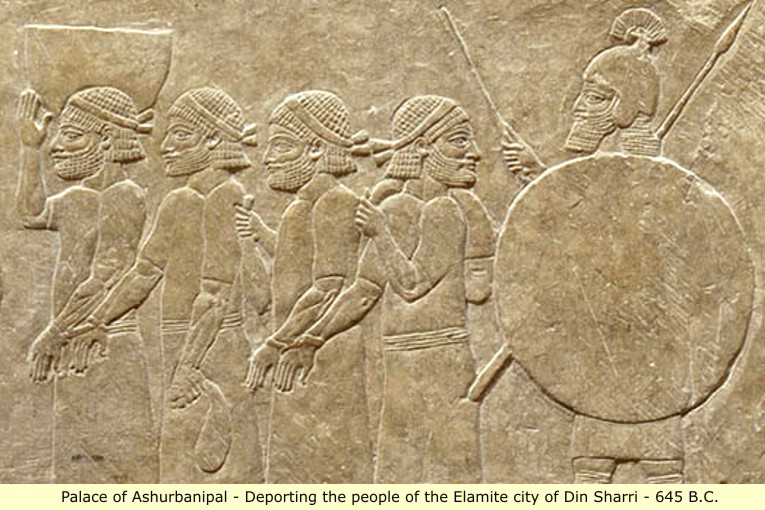
Palace of Ashurbanipal, c. 660-650 B.C.
Scenes depicting the aftermath of the Battle of Til-Tuba in Elam.
Incomplete limestone wall panel relief: Elamites are shown
in the upper register. Prisoners being flayed alive are shown in the
second register. Prisoners being tortured in front of ambassadors are
shown in the third register. A row of guards form the fourth register.
A chariot and spare horses form the fifth register and chariots and
soldiers marching along the River Ulai in which float bodies of men and
horses and chariots, in the sixth register. The relief bears a
cuneiform inscription.
Archaeologist Austen Henry Layard's (1817-1894) description of the scene depicting the aftermath of the Battle of Til-Tuba:
'On the opposite side of the lion-entrance were also three slabs,
but better preserved than those I have just described. They formed part
of the same subject, which had evidently been carried round the four
walls of the chamber. They represented the triumph of the Assyrian
king, and, like the battle scenes, were divided by horizontal lines
into several bands or friezes. The monarch stood in his chariot,
surrounded by his body-guard. Unfortunately his face, with those of the
charioteer and the eunuch bearing the parasol, had been purposely
defaced, like that of Sennacherib on his monuments, probably when the
united armies of the Medes and Babylonians destroyed the palace. The
royal robes were profusely adorned with rosettes and fringes; the
attendant eunuch was dressed in a chequered garment resembling a Scotch
plaid....
In front of the chariot were two warriors or guards in embroidered
robes and greaves. Their long hair was bound by a fillet, whose
tasselled ends fell loose behind. They were preceded by two remarkable
figures, both eunuchs, and probably intended for portraits of some
well-known officers of the royal household. One was old and corpulent:
his forehead was high and ample; his nose curved and small, and his
chin round and double. The wrinkles of the brow, the shaggy eyebrows,
and the bloated cheeks, with the stubble beard peculiar to beings of
his class, were very faithfully represented. His short hair was tied
with a fillet. His companion was younger, and had not the same marked
features. He carried before him a square object resembling a closed box
or book, perhaps a clay tablet containing some decree or register, such
as were discovered in the ruins. Both wore long plain shirts, and round
their waists a simple cord, in which was fixed a whip, probably a sign
of their office....
Above the royal chariot was a row of trees, and beneath a procession
of mace-bearers and led horses, richly caparisoned. A lower compartment
contained a curious ground plan of a city. ... Its position between two
rivers well agrees with that of existing ruins generally believed to
mark its site. The smaller stream would be the Shapour, and the larger
the Eulocus or river of Dizful. The city was surrounded by a wall, with
equidistant towers and gateways. The houses were flat roofed, and some
had one tower or upper chamber, and others two. They had no windows,
and their doors were square.... Outside the walls were groves of palms
and other trees, and a kind of suburb of houses scattered amongst the
gardens is around Baghdad and Busrah. On the river bank stood two forts
with towers, one raised on an artificial mound. Near the large river,
at the bottom of the slab, was either a pond in the midst of palm
trees, or the source of a rivulet which fell into the main stream.
 |
The adjoining slab was divided into eight bands or friezes, by
parallel lines, and the next slab into seven. On both were represented
the Assyrian army returning from its victorious campaign, and bringing
to the king the captives and the spoil. The prisoners, who were
probably considered rather rebels to his authority than enemies, were
being cruelly tortured in his presence. The principal group was that of
the eunuch general, or Tartan, leading a chief or prince of the
conquered people. With one hand he grasped his captive by the wrist,
and raised in the other a long and massy spear. At his back was hung a
quiver and bow, and an embossed belt encircled his mailed vest. The
prisoner wore a simple robe falling to his ankles, and a knotted fillet
round his head. Above him was an inscription unfortunately much
mutilated. It appears to have declared that he was one of the sons or
chiefs of the Susianian monarch, defeated and slain in battle near the
district of Madaktu....
 |
Before the captive prince were gathered a number of the Susianians,
probably the subjects of the slaughtered king, who had come to
surrender the Assyrian general, for they still carried their arms, and
were not led by the victorious warriors. Some of them knelt, some bowed
to the ground, and others, stretched at full length, rubbed their heads
in the dust, all signs of grief and submission still practised in the
East. They were followed by a led horse, and by a cart drawn by a mule,
resembling those represented in the battle scenes. Another Tartan of
the Assyrian army, holding his war-horse and carrying his spear, also
received the homage of the conquered Susianians. The Assyrian generals
were welcomed by bands of men and women, dancing, singing, and playing
on instruments of music....
 |
The musicians were accompanied by six women and nine boys and girls
of different ages, singing and clapping their hands to the measure. The
first were distinguished by various head-dresses. Some wore their hair
in long ringlets, some platted or braided, and others confined in a
net. One held her hands to her throat, as the Arab and Persian women
still do when they make those shrill and vibrating sounds peculiar to
the vocal music of the East. The whole scene, indeed, was curiously
illustrative of modern Eastern customs. The musicians portrayed in the
bas-relief were probably of that class of public performers who appear
in Turkey and Egypt at marriages, and on other occasions of rejoicing.
 |
 |
Behind the two Assyrian generals were cavalry, chariots, led horses,
and armed warriors, forming two friezes of considerable beauty, no less
remarkable for the delicacy of the execution than for the very spirited
and correct delineation of the animals. A long line of warriors, some
bearing maces, bows, spears, and shields, and other crossing their
hands before them in the common Eastern attitude of respect, formed a
frieze across the centre of the slabs. They were the attendants and
body-guard of the king, and were represented of different heights,
being probably picked men formed into companies or regiments according
to their size and strength. They walked in front of a row of trees.
 |
Above the Assyrian warriors were the captives and their
torturers. The former differed in costume from the Susianian
fighting-men represented in the adjoining bas-reliefs. They were
distinguished by the smallness of their stature, and by a very marked
Jewish countenance - a sharp, hooked nose, short bushy beard, and long
narrow eyes. Could they have belonged to the Hebrew tribes which were
carried away from Samaria and Jerusalem, and placed by Shalmaneser,
Sennacherib, or Essarhaddon, as colonists in the distant regions of
Elam, and who, having become powerful in their new settlements, had
revolted against their Assyrian rulers, and were once again subdued?
They wore a kind of conical cap, to which were attached two or more
tails or ribands, an inner garment reaching a little below the knee, an
outer fringed robe falling down the back to the ankles, and boots
turned up at the toes and laced in front. Comment:
a very marked Jewish countenance - a sharp, hooked nose???? Assyrian
relief's are in "PROFILE" all the noses look pretty much the SAME!
Don't know what Layard's game was, but as is typical with Albinos, they
often feel their work incomplete without some lie.
 |
A band hanging over their shoulders ended in a tassel. Some in iron
fetters were being led before the king, for judgment or pardon. Others
had been condemned to the torture, and were already in the hands of the
executioners. Two were stretched naked at full length on the ground,
and whilst their limbs were held apart by pegs and cords they were
being flayed alive. Beneath them were other unfortunate victims
undergoing abominable punishments. The brains of one were apparently
being beaten out with an iron mace, whilst an officer held him by the
beard. A torturer was wrenching the tongue out of the mouth of a second
wretch who had been pinioned to the ground. The bleeding heads of the
slain were tied round the necks of the living who seemed reserved for
still more barbarous tortures.
 |
The only spoil represented in these bas-reliefs as carried away by
the Assyrians consisted of horses and bundles of precious woods. At the
top of each slab was a frieze of warriors drawn up in array, and at the
bottom a broad river filled with those killed in the fight, and horses,
mules, chariots, carts, bows, and quivers.
The Medes
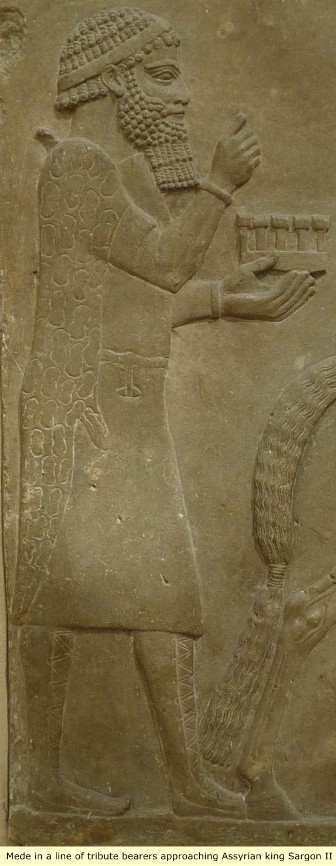
By the mid-9th century B.C, two new groups of people
appear in Elam, these are the Medes (Mada) and the Persians (Parsua).
Of the two, the Medes were the more widespread, and from an Assyrian
point of view, the more important group. The Medes were fierce warriors
and skilled horse breeders. They were at first organized as independent
tribes, however this changed under the tribal chief Deioces, he
succeeded in uniting all of the Medes tribes into the kingdom of Media.
The Persians (Parsua) continued their migration southward into an area
of southwestern Elam that we now call Fars, and made that their home.
Who were the Medes and Persians?
As is always the case with the ancient Black
civilizations, Whites have spent their time producing falsehood and
nonsense, in an attempt to make them appear to be White people, thus
they have spent no time in trying to ascertain their true origin. So to
this late date, there is still no clear understanding of where the
Medes and Persians came from. So then, let us investigate.
The Persians and Medes are first mentioned in the
records of Assyrian king Shalmaneser III (859 – 824 B.C.). In these
records, Parsuwash (along with Matai of Median) are first mentioned as
inhabiting the area of Lake Urmia, which is a salt lake in northwestern
Iran, near Iran's border with Turkey, (Lake Matianus is an old name for
Lake Urmia. It was the center of the Mannaean Kingdom). The exact
identity of the Parsuwash is yet to be determined, but from a
linguistic viewpoint the word matches Old Persian pārsa.
Note: though the Persians and Medes would later form a
unified people, they did not begin as such, they were originally
separate kingdoms.
Approximately 250 years previous, the "Sea People" a
conglomeration of Mediterranean warriors and their families seeking new
homes, invaded Egypt.
The "Sea People" included: The Peleset and
Tjeker (Minoans) of Crete, they would later be known as the
“Philistines” after they had settled in Southern Canaan. Over time,
this area became known by a form of their name “Palestine”. The Lukka
who may have come from the Lycian region of Anatolia, The Ekwesh and
Denen who seem to be identified with the original (Black) Greeks, The
Shardana (Sherden) who may be associated with Sardinia, The Teresh
(Tursha or Tyrshenoi), the Tyrrhenians - the Greek name for the
Etruscans, and The Shekelesh (Sicilians?).
After being turned away in defeat by Egyptian king Rameses
III, the Sea Peoples invaded Anatolia. There they are reported to have
destroyed the central Anatolian Hittite Empire and settled there.
There is just a few problems with that scenario:
There never really was such a thing as a Hittite Empire. The
name "Hittite" comes from an entry in the King James Bible (1611 A.D.),
and for some unknown reason, White people decided to give this name to
what was undoubtedly a Hattic kingdom in Anatolia. Then there is the
fact that we cannot identify what was the new kingdom that the Sea
Peoples formed. There is no doubt that the Sea Peoples DID displace
some native Anatolian people. Who exactly they were, and where they
went to is another unknown. There is the logical possibility that
"Some" Sea People remained in Anatolia and settled there, and perhaps
"Some" continued eastward. There is circumstantial evidence to support
this scenario, and it all points to the Persians as being part of the
Sea Peoples who continued on into Elam.
Quotes from the Histories of Herodotus, circa 440 B.C. will be used to support this scenario.
The Colchians:
According to the Greeks, Colchis was a fabulously wealthy land
situated on the mysterious periphery of the heroic world. Here in the
sacred grove of the war god Ares, King Aeëtes hung the Golden Fleece
until it was seized by Jason and the Argonauts. Colchis was also the
land where the mythological Prometheus was punished by being chained to
a mountain while an eagle ate at his liver for revealing to humanity
the secret of fire. Amazons also were said to be from Colchis. The main
mythical characters from Colchis are Aeëtes, Medea, Absyrtus,
Chalciope, Circe, Eidyia, Pasiphaë. (Medea was the daughter of King
Aeëtes of Colchis, niece of Circe, granddaughter of the sun god Helios,
and later wife to the hero Jason, with whom she had two children,
Mermeros and Pheres).
Book 4 - MELPOMENE
[4.37] The Persians inhabit a country upon the southern or
Erythraean sea (The Persian Gulf); above them, to the north, are the
Medes; beyond the Medes, the Saspirians; beyond them, the Colchians,
reaching to the northern sea (the Black Sea), into which the Phasis
empties itself. These four nations fill the whole space from one sea to
the other.
Book 2 - EUTERPE
[2.104] There can be no doubt that the Colchians are an
Egyptian race. Before I heard any mention of the fact from others, I
had remarked it myself. After the thought had struck me, I made
inquiries on the subject both in Colchis and in Egypt, and I found that
the Colchians had a more distinct recollection of the Egyptians, than
the Egyptians had of them. Still the Egyptians said that they believed
the Colchians to be descended from the army of Sesostris. My own
conjectures were founded, first, on the fact that they are
black-skinned and have woolly hair, which certainly amounts to but
little, since several other nations are so too; but further and more
especially, on the circumstance that the Colchians, the Egyptians, and
the Ethiopians, are the only nations who have practiced circumcision
from the earliest times.
[2.105] I will add a further proof to the identity of the
Egyptians and the Colchians. These two nations weave their linen in
exactly the same way, and this is a way entirely unknown to the rest of
the world; they also in their whole mode of life and in their language
resemble one another. The Colchian linen is called by the Greeks
Sardinian, while that which comes from Egypt is known as Egyptian.
The Medes:
Book 7 - POLYMNIA
[7.62] The Medes had exactly the same equipment as the Persians; and
indeed the dress common to both is not so much Persian as Median. They
had for commander Tigranes, of the race of the Achaemenids. These
Medes were called anciently by all people Aryans; but when Media, the
Colchian, came to them from Athens, they changed their name. Such is
the account which they themselves give.
Note: It appears that the Medes were once a Colchian people
called Aryans, who then took the name of their new Colchian ruler
Media.
PERSIAN INSCRIPTIONS MENTIONING ARYANS
Darius the Great's, Behistun Inscription
70. (4.88-92.) Darius the King says: By the favor of Ahuramazda this
is the inscription which I made. Besides, it was in Aryan, and on clay
tablets and on parchment it was composed. Besides, a sculptured figure
of myself I made. Besides, I made my lineage. And it was inscribed and
was read off before me. Afterwards this inscription I sent off
everywhere among the provinces. The people unitedly worked upon it.
Inscriptions on south face of steep ridge north of Persepolis
2. (8-15.) I am Darius the Great King, King of Kings, King of
countries containing all kinds of men, King in this great earth far and
wide, son of Hystaspes, an Achaemenian, a Persian, son of a Persian, an
Aryan, having Aryan lineage.
Note: Aryan and Arian is used interchangeably depending on
translator. However it is preferable to reserve Aryan for the Persians
and Arian for the White central Asian people.
The Persians:
The people of Argos (Greece) and the Persians share the same linage.
Book 7 - POLYMNIA
[7.150] Such is the account which is given of these matters by the
Argives themselves. There is another story, which is told generally
through Greece, of a different tenor. Xerxes, it is said,
before he set forth on his expedition against Greece, sent a herald to
Argos, who on his arrival spoke as follows: "Men of Argos, King Xerxes
speaks thus to you. We Persians deem that the Perses from whom we
descend was the child of Perseus the son of Danae, and of Andromeda the
daughter of Cepheus. Hereby it would seem that we come of your
stock and lineage. So then it neither befits us to make war upon those
from whom we spring; nor can it be right for you to fight, on behalf of
others, against us. Your place is to keep quiet and hold yourself
aloof. Only let matters proceed as I wish, and there is no people whom
I shall have in higher esteem than you."
Certain cultural practices also connect Persians to Anatolia.
The ancient Anatolian Burial Practice of de-fleshing the
body, and then placing the bones in a container for burial (Catal Huyuk
circa 7,500 B.C.): is unique and practiced by only two later cultures.
Principal among them are the Persians of the Zoroastrian religion.
Their practice was to place the body where it may be eaten by
scavenging birds and animals or weathered to its bare bones, and then
placed in a container for burial.
In Bombay India, the Parsis (as the Indian descendants of
the Persian refugees from the Arab/Turk invasion are called) maintain
“towers of silence” which are high circular towers. The dead are
carried to the top, and funeral servants place them on stone beds
surrounding a central pit. After the hovering vultures have stripped
the flesh from the bones, the bones are gathered and placed into the
central pit.
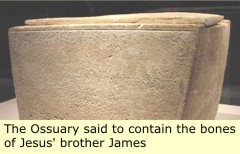
The Hebrews - Around two thousand years ago, during the time
that Jesus Christ lived, Hebrew burial tradition shifted to include a
secondary burial in Ossuaries. This burial practice involved collecting
the deceased’s bones after the flesh had been left to decompose and
desiccate, and then placing them inside an Ossuary. The Ossuary was
then placed into a loculus – a type of satchel. (Jesus' body was placed
in a cave to be de-fleshed).
These precise burial practices are unique to those mentioned
people, and to no other people of the world. Logically then, the
question must be asked: are they related? It is no stretch to connect
the Hebrews with the ancient Anatolians:
From the time of the ancient Sumerians, the Hebrews
(formally called Amorites), were known to be a nomadic people
inhabiting the area formed by the conjunction of the borders of modern
day Turkey, Syria, and Iraq. The Bible suggests that the city of Harran
(which is in the center of that area) is in the homeland of the
Hebrews, and referrers to it by name. (Ancient Harran is located just north of the modern Syrian/Turkish border).
Egyptians, Greeks, Anatolians, and Persians also share the use of Sphinx's (Human Headed Lions), as mythical creatures.
The Eurasian's

At the same time, beginning as early as the 9th
century B.C, and with ever increasing impact in the next two centuries.
Groups of nomadic White warriors entered western Iran from the Eurasian
plains. These were the Scythians, the Parthian's, the Parni, the
Arian's and others. Dominant among these groups were the Scythians.
Over time, the Scythians allied themselves with the Assyrians, and the
Scythians and Assyrians together, conquered the Medes of the Caspian
Sea area. However the Medes were later able to regroup and drive the
Scythians out of western Asia and back into the Eurasian Steppes.
Herodotus reports, how under the king
"Cyaxares" of Media (625 B.C.), the Scythians were overthrown when
their kings were induced at a supper party to get so drunk, that they
were then easily slain by the Medes.
After this victory, King Cyaxares reorganized the
Median army into specialized units built around spearmen, archers, and
cavalry. The unified and reorganized Mede army was now a match for the
Assyrians. The Medes attacked one of the important Assyrian border
cities named "Arrapkha" in 615 B.C, and then surrounded the Assyrian
capital of "Nineveh" in 614 B.C.
But they were unable to capture Nineveh, and instead
successfully stormed the Assyrian religious capital of Ashur. Later, an
alliance between Babylon and the Medes was sealed by the marriage of
Cyaxares' granddaughter, to Nebuchadrezzar II, the son of Babylonian
King "Nabopolassar", this in 612 B.C.
Then the attack on the Assyrian capital of Nineveh
was renewed, and the city fell in late August of that year. The
Babylonians and the Medes, together pursued the fleeing Assyrians
westward into Syria. Assyrian appeals to Egypt for help came to naught,
and the last Assyrian ruler, Ashur-uballit II, disappeared from history
in 609 B.C. The spoils and territories of the Assyrian Empire, were
then split-up between The Babylonians and the Medes.
Please visit the "Additional Material Area" for many more photographs of each civilization, and related material <Click> |