
Ancient Egypt |
Nubia |
Assyrian Empire |
Persian Empire |
Middle East |
Alexanders Empire |
Ottoman Empire |
So now in Persia, a new Persian dynasty, the "Sassanians" have ascended. Thus begins a series of great wars against the Romans, because these two great empires were of equal strength, it was not possible for either side to gain decisive victory. So for year after year, the battles raged, and the two sides became weaker and weaker.
|
 |
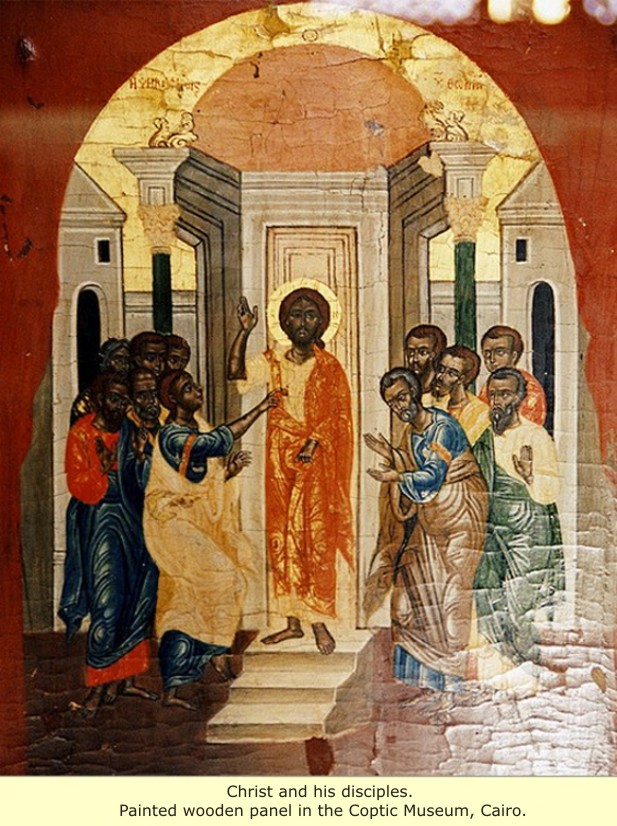
The "Coptic period" is an informal designation for Late Antiquity in Egypt, an era defined by the religious shifts in Egyptian culture to Coptic Christianity from paganism until the Muslim conquest of Egypt. It began in about the 3rd century, and depending on sources and usage, lasted until either around the noticeable decline of Christianity in Egypt, in the 9th century, or to the arrival of Islam in the 7th century. Although the term is widely utilized in popular discourse, its use in academia is generally avoided due to its imprecise nature, whereas "Late Antiquity" or "Byzantine Egypt" can be defined on chronological grounds. A remarkable number of Coptic textiles survive today, due to the Coptic custom of burying them with the dead, and to the aridity of Egyptian graves. The textiles are commonly linen or wool and use the colors red, blue, yellow, green, purple, black and brown.
 |
 |
 |
 |
 |
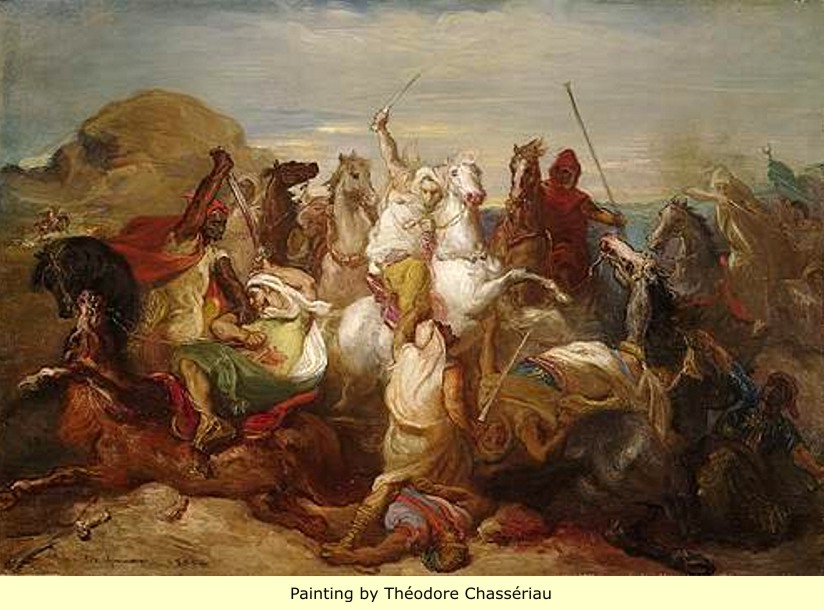
After for so long battling each other, the Persians and the Romans had little hope of defeating the Arab forces that came sweeping in from the south. The exact nature of these "Early" Arab forces is not well understood: for certainly it seems unlikely that sparsely populated Arabia, could on it's own, field an army large enough to defeat the combined forces of the Sassanian and Roman Empires: even less so, because the desert Bedouins had rejected Islam, and would not be conquered for some time to come. Later occurrences of course, make it obvious that Turks and Greeks were the dominant elements. These non-Arab troops would later be given the status and rights of Arabs. The painting below probably accurately depicts what the early Muslim armies looked like.
 |
In 627 A.D, the Prophet Mohammed, the founder of Islam, caused letters to be written to several rulers, including letters to the governor of Alexandria and the Viceroy of Egypt. {No guarantee on the accuracy of this letter}.
In the Name of Allâh, the Most Beneficent, the Most Merciful.
From Muhammad slave of Allâh and His Messenger to Muqawqas, vicegerent of Egypt.
Peace be upon him who follows true guidance. Thereafter, I invite you to accept Islam. Therefore, if you want security, accept Islam. If you accept Islam, Allâh, the Sublime, shall reward you doubly. But if you refuse to do so, you will bear the burden of the transgression of all the Copts.
There is controversy as to exactly who the Copt's are, though certainly NOT native Egyptian, they may perhaps be a combination of Greek and Levant Christians from the time of the Ptolemy's.
Native Egyptians, who had not governed themselves for almost 1,200 years, had no say in the matter. They were totally at the mercy of officials, bureaucrats and an elite class, that was of foreign blood. Who of course, had their own interest to think about, their home was now Egypt. The Egypt of the Pharaoh's was a long lost memory, save for the statues and monuments that they left behind. The Egypt they knew was the Egypt of their own making, and they had no desire to be uprooted.
Then as now, the portion of Egypt's population that is native Egyptian is a mystery. Though we know that there were massive influxes of Greeks, Romans, Turks and others, there is no data available as to what percentage of the population they comprised. One line of thought is that native Egyptians were forced south into what is now Sudan, {then Nubia}. This theory has to be given credence if for no other reason, than simply because it explains Egypt's acceptance of foreign rule for so long, cross-breeding of course, being another element. Logically it seems safe to assume, that if there had still been a sizable Egyptian element to the population, they would have had long ago reestablished their own governance, 1,200 years is a very long time.
 |
Accordingly, in about 639-640 A.D, after much maneuvering and many intrigues, a treaty was signed by Roman representatives and Arab representatives, which called for the total withdrawal of Roman soldiers, it also stipulated certain monies to be paid to the Arabs. After occupying Egypt, Arabs forces later spread out over Northern Africa, the Middle-East, Eastern Europe and Western Asia.
The following post "Arab invasion history", though speaking of Egypt, may be considered typical of North Africa and the middle East.
The Prophet Muhammad, had made Medina his capital, and it was there that he died. Leadership then fell to Abu Bakr (632-634), Muhammad's father-in-law and the first of the four orthodox Caliphs, or temporal leaders of the Muslims. Umar followed him (634-644) and organized the governmental administration of captured provinces. The third caliph was Uthman (644-656), under whose administration the compilation of the Quran was accomplished.
An aspirant to the caliphate was Ali, Muhammad's cousin and son-in-law. Upon the murder of Uthman, Ali became caliph (656-661). After a civil war with other aspirants to the caliphate, Ali moved his capital to Kufa Iraq, and was later assassinated at Al Kufah. Ali's followers established the first of Islam's dissident sects, the Shia (from Shiat Ali "party of Ali"). Those before and after Ali's succession remained the orthodox of Islam; they are called Sunnis - from the word sunnia meaning orthodox.
("Muslim" is an Arabic word meaning "submitter" (to God)).
: as presented by Worldatlas.com
The Twelve Imams, together with Prophet Mohammed and his daughter Fatimah al-Zahra, make up the fourteen infallible according to the Shia Islam faith. They are seen as divinely guided leaders and are the holiest people in Islam Religion. They are known as Ahlulbayt meaning the people of the household and the first five of the twelve imams are particularly significant, and they are Prophet Muhammad, Imam Ali, Fatima al-Zahra, Imam Hassan, and Imam Husayn. These holy people helped Prophet Mohammed and guided the Muslim community after the death of the prophet. The other nine Imams continued to guide the community and in particular through scholarship and divine guidance. All Muslims respect the twelve imams because they were divinely ordained and their knowledge and piety are considered exemplary.
 |
 |
 |
 |
The twelve Imams, and their respective lifespans, are comprised by Ali ibn Abu Talib (600-661 CE), Hasan ibn Ali (625-670 CE), Husayn ibn Ali (626-680 CE), Ali ibn Husayn (658-712 CE), Muhammad Ibn Ali (677-732 CE), Ja’far ibn Muhammad (702-765 CE), Musa ibn Ja’far (744-749 CE), Ali ibn Musa (765-817 CE), Muhammad ibn Ali (810-835 CE), Ali Ibn Muhammad (827-868 CE), Hasan ibn Ali ibn Muhammad (846-874 CE), and Muhammad ibn al-Hassan (Born 869 CE). Many Shia Muslims believe the last of these 12 successors to Muhammad, Muhammad ibn Hasan al-Mahdī, will reappear as the ultimate humankind savior alongside Isa to fulfill their mission to bring peace and justice to the world.
Ali was a cousin of Muhammad, and later his son-in-law through Fatima, and the forthrightly guided Caliph. Born to a powerful Sheikh of the Quaraysh, Ali grew to become the most influential and powerful successor of Muhammad. He and Muhammad grew up as brothers, and when the latter received the divine call, he willingly joined him in defending the newly formed faith. Ali fought persecution by the Quaraysh, and when the Muslim migrated to Medina, Ali went with them. In the battle of Badr, Ali took the forefront to fight for what he believed was right and brought victory to Muslim and earned him Muhammad’s favor, approval, and acceptance so as to marry Fatima, Muhammad’s only surviving child. He proved his prowess in the battle and after the death of Muhammad, his right to the caliphate led the historical split in Islam into Sunni and Shia. The Sunni Muslims assassinated him in 661.
The Quraysh were a mercantile Arab tribe that historically inhabited and controlled Mecca and its Ka'bah. The Islamic prophet Muhammad was born into the Hashemite clan of this tribe. Despite this, many of the Qurayshi tribe staunchly opposed Muhammad.
Quraysh: also spelled Kuraish, or Koreish, were the ruling tribe of Mecca at the time of the birth of the Prophet Muhammad. There were 10 main clans, the names of some of which gained great lustre through their members’ status in early Islām. These included Hāshim, the clan of the Prophet himself; Zuhra - that of his mother; and Taim and Adī - the clans of the first and second caliphs, Abū Bakr and ʿUmar I, respectively; and the Umayya, the clan of the third caliph, ʿUthmān, and his relatives, the dynasty of the Umayyad caliphs. Britannica.
 |
The Shia Muslims believe in the Twelver caliphates and that Muhammad
is the Mahdi, the ultimate savior of humankind. They also believe Islam
will rule the world and during the reign justice and righteousness will
fill the earth. The belief in Mahdi gave Shia Muslims identity. The
Shiites believe that none of the twelve died a natural death. They were
either assassinated or poisoned for being a legal threat to the rule of
the caliphate. Down the history line, the Shiites fought for
recognition, and acceptance by their fellow Muslims. The history of the
Twelve is based on revolutionary violence, an art the Shia Muslims had
to master to survive. The twelve Imams rebuked assassination or
plotting revolution unless they were defending their faith. These Imams
make up the foundation rock supporting the Shia faith.
Shia constitute about 10% of all Muslims, and globally their population is estimated at between 154 and 200 million.
Shia Muslims are in the majority in Iran, Iraq, Bahrain, Azerbaijan and, according to some estimates, Yemen. There are also large Shia communities in Afghanistan, India, Kuwait, Lebanon, Pakistan, Qatar, Syria, Turkey, Saudi Arabia and the UAE.
WHO IS WHO IN MODERN EGYPT
 |
|
 |
 |
 |
 |
The Umayyad dynasty: After Ali's murder in 661, Muawiyah - the governor of Syria, (Syria - the Greek name for the region that connected three continents), and a kinsman of Uthman, and also a member of the Quraysh lineage of the Prophet - proclaimed himself caliph and established his capital in Damascus, Syria.
Muawiyah cultivated the goodwill of Christian Syrians by recruiting them for his army at double pay, appointing Christians to many high offices, and by appointing his son by his Christian wife as his successor. {Since the time of Alexander, Greeks had built many cities in Syria and had become the dominate element of the population. By virtue of the Roman occupation, most had become Christians. The province of Syria included the modern elements of Palestine, Lebanon, Jordan and Syria}.
Mamluk (Arabic: mamlūk
(singular), mamālīk (plural), meaning "property": also transliterated
as mamlouk, mamluq, mamluke, mameluk, mameluke, mamaluke or marmeluke;
is an Arabic designation for slaves. The term is most commonly used to
refer to Muslim slave soldiers and Muslim rulers of slave origin.
(Historically it has come to mean "Exclusively" TURKIC SLAVE SOLDIER).
The Syrian army became the basis of Umayyad strength, enabling the bypassing of Arab tribal rivalries. It was under Umayyad Caliph Umar II (reigned 717-720), that these discontented mawali (non-Arab Muslims) were placed on the same footing with all other Muslims, without respect to nationality. This decree allowed Greeks, Turks and other Eurasians to fully assimilate into the Muslim brotherhood.
The Abbasid dynasty: Later the mawali became involved with the Hashimiyah, a religious/political sect that denied the legitimacy of Umayyad rule. In 749 the Hashimiyah, proclaimed as caliph Abu al-'Abbas as-Saffah, who thereby became first Caliph of the 'Abbasid dynasty. The Abbasid dynasty would rule over Islam for approximately the next 500 years. The Abbasids were descended from an uncle of Muhammad and were cousins to the ruling Umayyad dynasty. The Abbasids established the caliphate in the new city of Baghdad. The strength of the Abbasid dynasty was its Turkish troops.
The Tulunid dynasty: It was during the rule of Abbasid caliph Harun ar-Rashid (ruled 786-809), that the caliphs began assigning Egypt to Turks rather than to Arabs. The first Turkish dynasty was that of Ibn Tulun who entered Egypt in 868.
The Ikhshidid dynasty: 935 A.D. ushered in the Ikhshidid dynasty of Muhammad ibn Tughj, a Turk from Uzbekistan in Central Asia.
The Ikhshidid dynasty was usurped by their Abyssinian slave tutor named Kafur, he ruled Egypt with the caliphate's sanction.
The Fatimid Dynasty: When Kafur died in 968, the Fatimids (a contending force for the Caliphate), took advantage of the disorder in Egypt to attack, the attack was successful and led to the occupation of Egypt by a Berber army led by the Fatimid general Jawhar. The early Fatimids' reliance on Berber troops was soon replaced by the importation of Turkish, Sudanese, and Arab contingents. By the time of their decline however, the Fatimid army was under the leadership of Eurasian Armenian generals, (not Aramaean).
The Ayyubid dynasty: In 1169 The Turkish governor of Syria sent an army lead by Saladin (a Kurd born in Tikrit Iraq), to occupy Egypt.
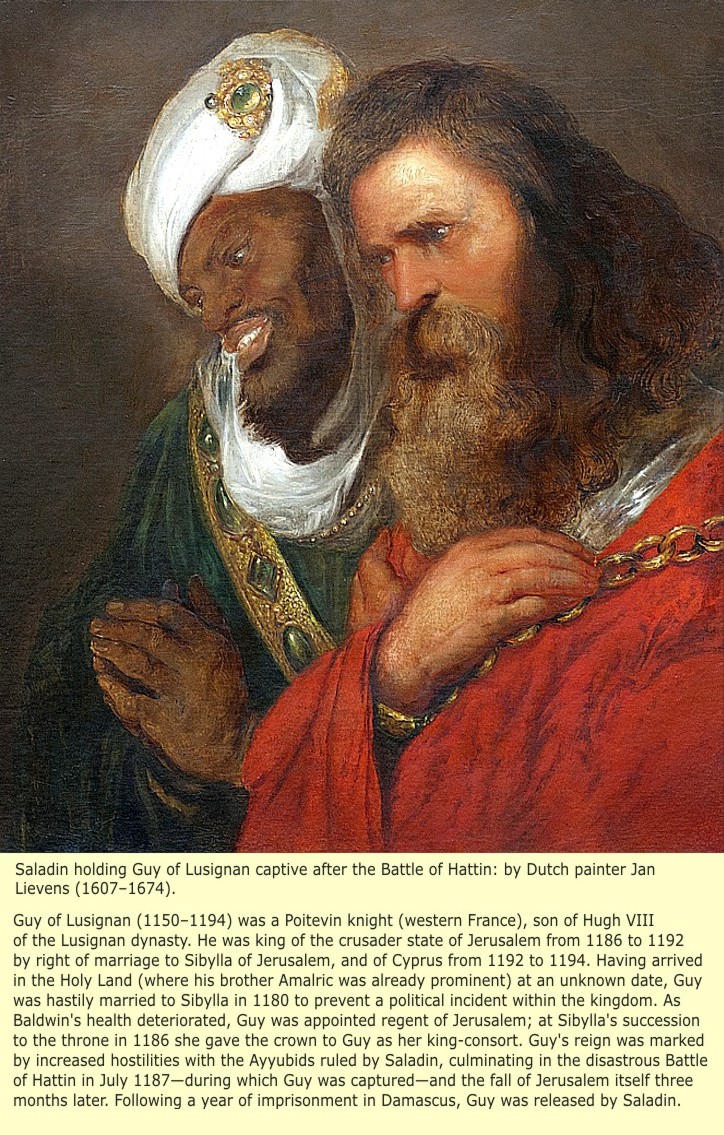 |
Saladin, (born 1137/38, Tikrīt, Mesopotamia [now in Iraq] — died March 4, 1193, Damascus [now in Syria]), Muslim sultan of Egypt, Syria, Yemen, and Palestine, founder of the Ayyūbid dynasty, and the most famous of Muslim heroes. In wars against the Christian Crusaders, he achieved great success with the capture of Jerusalem (October 2, 1187), ending its nearly nine decades of occupation by the Franks.
Saladin was born into a prominent Kurdish family. On the night of his birth, his father, Najm al-Dīn Ayyūb, gathered his family and moved to Aleppo, there entering the service of ʿImad al-Dīn Zangī ibn Aq Sonqur, the powerful Turkish governor in northern Syria. Growing up in Baʿlbek and Damascus, Saladin was apparently an undistinguished youth, with a greater taste for religious studies than military training.
His formal career began when he joined the staff of his uncle Asad al-Dīn Shīrkūh, an important military commander under the emir Nūr al-Dīn, who was the son and successor of Zangī. During three military expeditions led by Shīrkūh into Egypt to prevent its falling to the Christian (Frankish) rulers of the Latin kingdom of Jerusalem, a complex, three-way struggle developed between Amalric I, the king of Jerusalem; Shāwar, the powerful vizier of the Egyptian Fātimid caliph; and Shīrkūh.
After Shīrkūh’s death and after ordering Shāwar’s assassination, Saladin in 1169 at the age of 31, was appointed both commander of the Syrian troops in Egypt and vizier of the Fātimid caliph there. His relatively quick rise to power must be attributed not only to the clannish nepotism of his Kurdish family but also to his own emerging talents. As vizier of Egypt, he received the title “king” (malik), although he was generally known as the sultan.
Saladin’s position was further enhanced when, in 1171, he abolished the weak and unpopular Shīʿite Fāṭimid caliphate, proclaiming a return to Sunni Islam in Egypt. Although he remained for a time theoretically a vassal of Nūr al-Dīn, that relationship ended with the Syrian emir’s death in 1174. Using his rich agricultural possessions in Egypt as a financial base, Saladin soon moved into Syria with a small but strictly disciplined army to claim the regency on behalf of the young son of his former suzerain.
Soon, however, he abandoned this claim, and from 1174 until 1186 he zealously pursued a goal of uniting, under his own standard, all the Muslim territories of Syria, northern Mesopotamia, Palestine, and Egypt. This he accomplished by skillful diplomacy backed when necessary by the swift and resolute use of military force. Gradually his reputation grew as a generous and virtuous but firm ruler, devoid of pretense, licentiousness, and cruelty. In contrast to the bitter dissension and intense rivalry that had up to then hampered the Muslims in their resistance to the Crusaders, Saladin’s singleness of purpose induced them to rearm both physically and spiritually.
Saladin’s every act was inspired by an intense and unwavering devotion to the idea of jihad, or holy war. It was an essential part of his policy to encourage the growth and spread of Muslim religious institutions. He courted their scholars and preachers, founded colleges and mosques for their use, and commissioned them to write edifying works, especially on the jihad itself. Through moral regeneration, which was a genuine part of his own way of life, he tried to re-create in his own realm some of the same zeal and enthusiasm that had proved so valuable to the first generations of Muslims when, five centuries before, they had conquered half the known world.
Saladin also succeeded in turning the military balance of power in his favor, by uniting and disciplining a great number of unruly forces than by employing new or improved military techniques. When at last, in 1187, he was able to throw his full strength into the struggle with the Latin Crusader kingdoms, his armies were their equals. On July 4, 1187, aided by his own military good sense and by a phenomenal lack of it on the part of his enemy, Saladin trapped and destroyed in one blow an exhausted and thirst-crazed army of Crusaders at Hattin, near Tiberias in northern Palestine. So great were the losses in the ranks of the Crusaders in this one battle that the Muslims were quickly able to overrun nearly the entire kingdom of Jerusalem. Acre, Toron, Beirut, Sidon, Nazareth, Caesarea, Nāblus, Jaffa (Yafo), and Ascalon (Ashqelon) fell within three months. But Saladin’s crowning achievement and the most disastrous blow to the whole Crusading movement came on October 2, 1187, when the city of Jerusalem, holy to both Muslim and Christian alike, surrendered to Saladin’s army after 88 years in the hands of the Franks.
Saladin planned to avenge the slaughter of Muslims in Jerusalem in 1099 by killing all Christians in the city, but he agreed to let them purchase their freedom provided that the Christian defenders left the Muslim inhabitants unmolested.
His sudden success, which in 1189 saw the Crusaders reduced to the occupation of only three cities, was, however, marred by his failure to capture Tyre, an almost impregnable coastal fortress to which the scattered Christian survivors of the recent battles flocked. It was to be the rallying point of the Latin counterattack. Most probably, Saladin did not anticipate the European reaction to his capture of Jerusalem, an event that deeply shocked the West and to which it responded with a new call for a Crusade. In addition to many great nobles and famous knights, this Crusade, the third, brought the kings of three countries into the struggle. The magnitude of the Christian effort and the lasting impression it made on contemporaries gave the name of Saladin, as their gallant and chivalrous enemy, an added lustre that his military victories alone could never confer on him.
The Crusade itself was long and exhausting, despite the obvious, though at times impulsive, military genius of Richard I (the Lion-Heart). Therein lies the greatest—but often unrecognized achievement of Saladin. With tired and unwilling feudal levies, committed to fight only a limited season each year, his indomitable will enabled him to fight the greatest champions of Christendom to a draw. The Crusaders retained little more than a precarious foothold on the Levantine coast, and when King Richard left the Middle East, in October 1192, the battle was over. Saladin withdrew to his capital at Damascus.
Soon the long campaigning seasons and the endless hours in the saddle caught up with him, and he died. While his relatives were already scrambling for pieces of the empire, his friends found that the most powerful and most generous ruler in the Muslim world had not left enough money to pay for his grave. Saladin’s family continued to rule over Egypt and neighbouring lands as the Ayyūbid dynasty, which succumbed to the Mamlūk (Turkish Slave Soldiers) dynasty in 1250.
The KurdsThe
progenitor of the Ayyubid dynasty was Najm ad-Din Ayyub bin Shadhi. He
belonged to a Kurdish tribe whose ancestors settled in the town of
Dvin, in northern Armenia. He belonged to the tribe of Rawadiya, itself
a branch of the Hadhabani tribe. The Rawadiya were the dominant Kurdish
group in the Dvin district. They were a member of the sedentary
political-military elite of the town. Circumstances became unfavorable
in Dvin when Turkish generals seized the town from its Kurdish prince.
Shadhi left for Iraq with his two sons Najm al-Din Ayyub and Asad
al-Din Shirkuh. He was welcomed by his friend Mujahed al-Din Bihruz—the
military governor of northern Mesopotamia under the Seljuks Turks — who
appointed Shadhi as the governor of Tikrit. The Hadhabani tribe was a large medieval Kurdish tribe divided into several groups, centered at Arbil, Ushnu and Urmia in central and north-eastern Kurdistan. Their dominion included surrounding areas of Maragha and Urmia to the east, Salmas to the north and parts of Arbil and Mosul to the west. About 10th century they gradually immigrated northward to the areas around lake Urmia with Ushnu as their summer capital. They ruled the area for a while but later split to a few branches who spread across Azerbaijan (at the time Turks still had not invaded Azerbaijan), and Caucasus. Saladin the renowned Muslim ruler was descendant of one of Hadhabani branches. Apparently
the "REAL" unmixed Kurds, may have been descendants of the
Sumerians/Akkadians/Assyrians, or perhaps even the Colchians or
Artaxiads of Armenia.
|
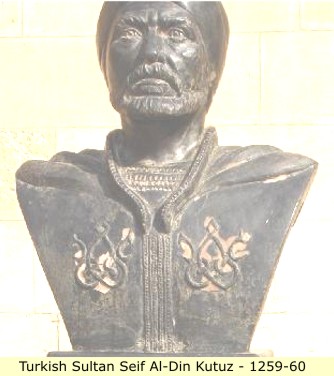
The Mamluk dynasty: In 1250 A.D. The Mamluks rebelled and established their own dynasty.
It is at this time that the genius of Egyptians shows itself again. As it is at this time that the Egyptians invent the first actual “Gun” which is first used by their Turkish Masters, the Mamluks, against the invading Mongols: at the battle of Ain Jalut in 1260 A.D. |
 |
In the beginning..The Turks and their neighbors, the Mongols
Genghis KhanIn 1218, Genghis Khan sent a trade mission to the Khwarezm-Shah, (dynasty of Turkic Mamluk origin who converted to Sunni Muslim): but at the town of Otrara (a Central Asian town that was located along the Silk Road near the current town of Karatau in Kazakhstan) the governor there, suspecting the Khan's ambassadors to be spies, confiscated their goods and executed them. Genghis Khan demanded reparations, which the Shah refused to pay. Genghis Khan then sent a second, purely diplomatic mission, they too were murdered. Genghis retaliated with a force of 200,000 men, launching a multi-pronged invasion, his guides were Muslim merchants from Transoxania. During the years 1220–21, Bukhara, Samarkand, Herat (all Central Asian cities), Tus (Susa), and Neyshabur (Persian cities) were razed, and the whole populations were slaughtered. (This represented the second wholesale slaughter of Black Persians, after the Arab conquest).
Il-Khanid dynasty The Il-Khanid dynasty was a Mongol dynasty that ruled in Iran from 1256 to 1335. Il-khan is Persian for “subordinate khan.” HülegüHülegü, a grandson of Genghis Khan, was given the task of capturing Persia/Iran by the paramount Mongol chieftain Möngke. Hülegü set out in about 1253 with a Mongol army of 130,000. He founded the Il-Khanid dynasty in 1256, and by 1258 he had captured Baghdad (Iraq) and all of Iran. The Il-Khans consolidated their position in Persia/Iran and reunited the region as a political and territorial entity after several centuries of fragmented rule by petty dynasties. During the reign of the Il-Khanid Mamūd Ghāzān (reigned 1295–1304), the Il-Khans lost all contact with the remaining Mongol chieftains of China. Mamūd Ghāzān himself embraced Sunni Islam, and his reign was a period of Persian/Iranian cultural renaissance in which such scholars as Rashīd al-Dīn flourished under his patronage. Ghāzān’s brother Öljeitü (reigned
1304–16) converted to Shīʿite Islam in 1310. Öljeitü’s conversion gave
rise to great unrest, and civil war was imminent when he died in 1316.
His son and successor, Abū Saʿīd (reigned 1317–35), reconverted to
Sunni Islam and thus averted war. However, during Abū Saʿīd’s reign,
factional disputes and internal disturbances continued and became
rampant. Abū Saʿīd died without leaving an heir, and with his death the
unity of the dynasty was fractured. Thereafter various Il-Khanid
princes ruled portions of the dynasty’s former territory until 1353. Siege of Baghdad (1258)The Siege of Baghdad, which lasted from January 29 until February 10, 1258, entailed the investment, capture, and sack of Baghdad, the capital of the Abbasid (Arab) Caliphate, by Ilkhanate Mongol forces and allied troops. The Mongols were under the command of Hulagu Khan (or Hulegu Khan), brother of the khagan Möngke Khan, who had intended to further extend his rule into Mesopotamia but not to directly overthrow the Caliphate. Möngke, however, had instructed Hulagu to attack Baghdad if the Caliph Al-Musta'sim refused Mongol demands for his continued submission to the khagan and the payment of tribute in the form of military support for Mongol forces in Iran. Hulagu began his campaign in Iran with several offensives against (Turkic) Nizari groups, including the Assassins, who lost their stronghold of Alamut.
_____________________________________________
The current Aga Khan is a business magnate with British citizenship, racehorse owner and breeder. He has held this position of Imam, under the title of Aga Khan IV, since 11 July 1957, when, at the age of 20, he succeeded his grandfather, Sir Sultan Muhammad Shah Aga Khan III.
{Assassins is the common name used to refer to an Islamic sect formally known as the Nizari Ismailis. Often described as a secret order led by a mysterious "Old Man of the Mountain", the Nizari Ismailis formed in the late 11th century after a split within Ismailism – a branch of Shia Islam}. While "Assassins" typically refers to the entire sect, only a group of acolytes known as the fida'i actually engaged in conflict. Lacking their own army, the Nizari relied on these warriors to carry out espionage and assassinations of key enemy figures, and over the course of 300 years successfully killed two caliphs, and many viziers, sultans, and Crusader leaders.
_____________________________________________He then marched on Baghdad, demanding that Al-Musta'sim accede to the terms imposed by Möngke on the Abbasids. Although the Abbasids had failed to prepare for the invasion, the Caliph believed that Baghdad could not fall to invading forces and refused to surrender. Hulagu subsequently besieged the city, which surrendered after 12 days. During the next week, the Mongols sacked Baghdad, committing numerous atrocities and destroyed the Abbasids' vast libraries, including the House of Wisdom. The Mongols executed Al-Musta'sim and massacred many residents of the city, which was left greatly depopulated. The siege is considered to mark the end of the Islamic Golden Age, during which the caliphs had extended their rule from the Iberian Peninsula to Sindh, and which was also marked by many cultural achievements. Background Baghdad had for centuries been the capital of the Abbasid Caliphate, the third caliphate whose rulers were descendants of Abbas, an uncle of Muhammad. In 751, the Abbasids overthrew the Umayyads and moved the Caliph's seat from Damascus to Baghdad. At the city's peak, it was populated by approximately one million people and was defended by an army of 60,000 soldiers. By the middle of the 13th century, however, the power of the Abbasids had declined and Turkic and Mamluk warlords often held power over the Caliphs. Baghdad still retained much symbolic significance, however, and it remained a rich and cultured city. The Caliphs of the 12th and 13th centuries had begun to develop links with the expanding Mongol Empire in the east. Caliph an-Nasir li-dini'llah, who reigned from 1180–1225, may have attempted an alliance with Genghis Khan when Muhammad II of Khwarezm threatened to attack the Abbasids. It has been rumored that some Crusader captives were sent as tribute to the Mongol khagan. According to The Secret History of the Mongols, Genghis and his successor, Ögedei Khan, ordered their general Chormaqan to attack Baghdad. In 1236, Chormaqan led a division of the Mongol army to Irbil, which remained under Abbasid rule. Further raids on Irbil and other regions of the caliphate became nearly annual occurrences. Some raids were alleged to have reached Baghdad itself, but these Mongol incursions were not always successful, with Abbasid forces defeating the invaders in 1238 and 1245. Despite their successes, the Abbasids hoped to come to terms with the Mongols and by 1241 had adopted the practice of sending an annual tribute to the court of the khagan. Envoys from the Caliph were present at the coronation of Güyük Khan as khagan in 1246 and that of Möngke Khan in 1251. During his brief reign, Güyük insisted that the Caliph Al-Musta'sim fully submit to Mongol rule and come personally to Karakorum. Blame for the Caliph's refusal and for other resistance offered by the Abbasids to increased attempts by the Mongols to extend their power was placed by the khagans on Chormaqan's lieutenant and successor, Baiju.
In 1257, Möngke resolved to establish firm authority over Mesopotamia, Syria, and Iran. The khagan gave his brother, Hulagu, authority over a subordinate khanate and army, the Ilkhanate, and instructions to compel the submission of various Muslim states, including the caliphate. Though not seeking the overthrow of Al-Musta'sim, Möngke ordered Hulagu to destroy Baghdad if the Caliph refused his demands of personal submission to Hulagu and the payment of tribute in the form of a military detachment, which would reinforce Hulagu's army during its campaigns against Iranian Ismaili states.
Early campaigns Hulagu led his army first to Iran, where he successfully campaigned against the Lurs, the Bukhara, and the remnants of the Khwarezm-Shah dynasty. After subduing them, Hulagu directed his attention toward the Ismaili Assassins and their Grand Master, Imam 'Ala al-Din Muhammad, who had attempted the murder of both Möngke and Hulagu's friend and subordinate, Kitbuqa. Though Assassins failed in both attempts, Hulagu marched his army to their stronghold of Alamut, which he captured. The Mongols later executed the Assassins' Grand Master, Imam Rukn al-Dun Khurshah, who had briefly succeeded 'Ala al-Din Muhammad from 1255-1256.
After defeating the Assassins, Hulagu sent word to Al-Musta'sim, demanding his acquiescence to the terms imposed by Möngke. Al-Musta'sim refused, in large part due to the influence of his advisor and grand vizier, Ibn al-Alkami. Historians have ascribed various motives to al-Alkami's opposition to submission, including treachery and incompetence, and it appears that he lied to the Caliph about the severity of the invasion, assuring Al-Musta'sim that, if the capital of the caliphate was endangered by a Mongol army, the Islamic world would rush to its aid. Although he replied to Hulagu's demands
in a manner that the Mongol commander found menacing and offensive
enough to break off further negotiation, Al-Musta'sim neglected to
summon armies to reinforce the troops at his disposal in Baghdad. Nor
did he strengthen the city's walls. By January 11 the Mongols were
close to the city, establishing themselves on both banks of the Tigris
River so as to form a pincer around the city. Al-Musta'sim finally
decided to do battle with them and sent out a force of 20,000 cavalry
to attack the Mongols. The cavalry were decisively defeated by the
Mongols, whose sappers breached dikes along the Tigris River and
flooded the ground behind the Abbasid forces, trapping them. Siege of the city The Abbasid caliphate could supposedly call upon 50,000 soldiers for the defense of their capital, including the 20,000 cavalry under al-Musta'sim. However, hastily assembled these troops were poorly equipped and poorly disciplined. Although the caliph technically had the authority to summon soldiers from other Muslim empires to defend his realm, he either neglected to do so or lacked the ability to. His taunting opposition had lost him the loyalty of the Mamluks, and the Syrian emirs, who he supported, were busy preparing their own defenses.
Many historical accounts detailed the cruelties of the Mongol conquerors.
|
 |
 |
 |
The Ottoman dynasty: In 1516 A.D. the Ottoman Turks along with other Eastern European troops (Serbs and Bosnians), defeated the Mamluks.
Link: Napoleon in Egypt, or Egomaniac on the Loose - University of Illinois

Muhammad Ali (Pasha): In March 1803 the British were evacuated in accordance with the Peace of Amiens. But the Ottomans, determined to reassert their control over Egypt remained, establishing their power through a viceroy and an occupying army of Albanians. The Albanians later mutinied and installed their own leader as acting viceroy. When he was assassinated shortly afterward, the command of the Albanians passed to his lieutenant, Muhammad Ali. The dynasty that he established would rule Egypt and Sudan until the Egyptian Revolution of 1952.
In Arabia, the domination of Mecca and Medina by puritanical Wahhabi Muslims was a serious embarrassment to the Ottoman sultan, who was the titular overlord of the Arabian territory of the Hejaz and the leading Muslim sovereign. At the invitation of Sultan Mahmud II (1808-39), Muhammad Ali sent an expedition to Arabia that between 1811 and 1813 expelled the Wahhabis from the Hejaz. In a further campaign (1816-18), Ibrahim Pasha, the viceroy's eldest son, defeated the Wahhabis in their homeland of Najd, and brought central Arabia under Albanian control.
In 1820-21 Muhammad Ali sent an expedition up the Nile and conquered much of what is now the northern Sudan. By so doing, he made himself master of one of the principal channels of the slave trade, and began an African Empire that was to be expanded under his successors. The conquest of the Sudan was intended to provide recruits. But the slaves, encamped at Aswan, died wholesale, and Muhammad Ali had to look elsewhere for his troops. In 1823 he took to conscripting Egyptian peasants for the rank and file of his new army. On the other hand, the officers were mostly Turkish Ottomans, while the director of the whole enterprise, Sulayman Pasha (Colonel Sève), was a former French officer. The conscription was brutally administered.
In 1882 the British once again invaded and occupied Egypt. This occupation was to last until the end of WWI. After which, Egypt became a protectorate of Britain.
From the Brooklyn Museums Lantern Slide Collection
Egypt - Arabian Horse and man from Sais, Cairo |
 |
Egypt - Bisharin Man, Assuan/Aswan |
 |
Egypt - Donkey and Cart, Kasr-el-Nil |
 |
For more pictures of Egypt 1882: similar Algerian pictures, as well as erotic Picture Post Cards from North Africa, for the same period: Click here >>> |
 |
Gerard Leachman
Brevet Lieut. Colonel Gerard E. Leachman CIE DSO (1880 – 1920), was a British soldier and spy who travelled extensively in Arabia.
Leachman was commissioned into the Royal Sussex Regiment and served in India and in the Boer War. He spent most of his career as a political officer and spy in Iraq, where he was instrumental in pacifying warring tribes to bring stability to the new country. Leachman also made various expeditions further south into Arabia, where he contacted Ibn Sa’ud on behalf of the British government. He travelled as a naturalist of the Royal Geographical Society, but was in fact a British agent. With his skill at riding a camel, Leachman was easily able to pass as Bedouin and often travelled incognito.
Leachman’s first major expedition South into the Arabian Peninsula was in 1909, during which he was involved in a ferocious battle between the Anaiza and Shammar tribes near Ha’il. In 1912 Leachman made a second expedition with the intention of crossing the Rub Al Khali, but was refused permission by Ibn Sa’ud when he reached Riyadh and instead went to Hasa. He was the first Briton to be received by Ibn Sa’ud in his home city.
In December, 1915, during the Siege of Kut, the British commanding officer, Major General Charles Townshend, ordered Leachman to save the British cavalry by breaking out and riding south. This he did and the cavalry were the only British unit to escape before the fall of the city to the Ottomans.
Leachman was close to Gertrude Bell‘s friend Fahd Bey and
fought with the Muntafiq tribal federation. After the war, he was made
first military governor of Kurdistan. He was murdered by Sheikh Dhari,
a tribal leader, near Fallujah (Iraq) on August 12, 1920.
 |
Clash of Loyalties aka The Great Question) is a 1983 Iraqi film focusing on the formation of Iraq out of Mesopotamia in the aftermath of the First World War. The film was financed by Saddam Hussain, filmed in Iraq (mainly at the Baghdad Film Studios in Baghdad's Mansour neighbourhood and on location at the Tigris-Euphrates marshlands, Babylon and Kut) at the height of the Iran–Iraq War and starred Oliver Reed as Gerard Leachman.
 |
 |
 |
 |

In 1922 Egypt was granted limited independence, and on March 15, the Sultan Ahmad Fuad, son of the Turkish Khedive (Viceroy), Ismail Pasha, became King Fuad I of Egypt.
On Feb.1,1958, Egypt and Syria proclaimed the two countries to be the United "Arab" Republic (U.A.R.). The union ended on Sept. 28, 1961, when Syria, following a military coup, declared itself independent of Egypt. Despite the dissolution of the union, Egypt retained the name United Arab Republic until Sept. 2, 1971, when it took its current name the "Arab Republic of Egypt".
Egyptian King and Ruler listThe ancient Egyptian Kinglist is very fluid, as new attestations for previously unknown kings or Queens are discovered (such as newfound Serekhs or Cartouches), the list is updated. Chronological dates are educated guesses.
|
Abbasid Rulers (governors operating under the authority of foreign Caliphs)
Non-Abbasid Rulers Yazid Ibn Abdullah al-Tourki (856-867 AD) Tulunids Ahmad B. Tulan (Ibn Tulan)(868-884 AD) Abbasid Rulers (Note: Some rulers such as Abu Mansour Tekin ruled more than once) Eissa al-Noushari (905-910 AD)
Fatimid Rulers Gawhar El-Sakali (969-973AD) Aziz Emad Eddin (1192-1198AD)
Sultan Ezz Eddin Aybak (1250-1257)
|
Circassian (Burgi) Mamlukes Sultan Zaher Barqooq (1382-1399) Ottoman RulersKhayer Pasha (1517-22) |
Turks Rule Black Lands!
In
these pages, we have made every effort to clearly say, and prove, that
the White, and White-like, rulers and ruling elite in the former lands
of Black civilizations, are not who they claim to be. Specifically;
those of Egypt are NOT Egyptians, those of North Africa are NOT
Berbers, those of Arabia are NOT Arabs, those of Palestine are NOT
Hebrews, those of Lebanon are NOT Phoenicians, those of Iraq are NOT
Mesopotamian's, those of Iran are NOT Persians or Elamites, those of
Turkey are NOT Anatolians - THEY ARE ALL CENTRAL ASIAN TURKS!
That said with the understanding that in earlier times, Greeks and Romans settled in these areas: and in North Africa, they were followed by Alan's, Vandals, and Goths. And also in the 19th. century, French and Italians invaded, and settled in North Africa. And with the understanding that when the Turks of the Ottoman Empire, relinquished hegemony over those lands after WW I, they and the European powers, merely handed control over to local Turk elites. But understanding that our say-so, and proofs, may be insufficient for some: We quote the eminent François Auguste Ferdinand Mariette (1821 – 1881) French scholar, Archaeologist, Egyptologist, and the founder of the Egyptian Museum in Cairo. We quote from his book: "OUTLINES OF ANCIENT EGYPTIAN HISTORY" TRANSLATED AND EDITED, WITH NOTES, BY MARY BRODRICK CHARLES SCRIBNER'S SONS, NEW YORK, 1892 Page 28 Click here for link to Online Book Here he is discussing the origins of the Hyksos:Quote: "How often do we see in Eastern monarchies and even in European states a difference of origin between the ruling class, to which the royal family belongs, and the mass of the people! We need not leave Western Asia and Egypt; we find there Turks ruling over nations to the race of which they do not belong, although they have adopted their religion. In the same way as the Turks of Baghdad, who are Finns, now reign over Semites, Turanian kings may have led into Egypt and governed a population of mixed origin where the Semitic element was prevalent. If we consider the mixing up of races which took place in Mesopotamia in remote ages, the invasions which the country had to suffer, the repeated conflicts of which it was the theatre, there is nothing extraordinary that populations coming out of this land should have presented a variety of races and origins."
|
Please visit the "Additional Material Area" for many more photographs of each civilization, and related material <Click> |
|
NOT OUT OF AFRICA
Professor Mary Lefkowitz, Professor in the Humanities at Wellesley College Massachusetts is a Jewish woman from New York. It's been 28 years (1996) since her "Not Out of Africa" book was published, and we are amazed at the number of Black people who still don't know that it is PURE NONSENSE with her accusing Blacks of doing exactly what Albinos routinely do concerning history. AND WE DON'T LEGISLATE AGAINST TEACHING ALBINO CHILDREN ABOUT ALBINO ANCIENT HISTORY - THERE IS NONE! But Hey Gov. Ron DeSantis - sooner or later your Albino Children will learn the truth, what will you do then? In "Not Out of Africa" the Professor said that she "comprehensively" exposes how Afrocentrism became an excuse to teach myth as history."
As you can see she/they (Albinos) placed a picture of what they supposed was a WHITE GREEK man on the cover to show us what the REAL creators of Civilization looked like in "THEIR FANTASY'S" (we hope you can detect that it is a PLASTIC bust). Of course most Greeks were Black as were most people in ancient Europe, even after the Sea Peoples exodus. (We assume that you know that Africans started settling Europe after the "Last Ice Age" from about c.45,000 B.C.). If not, we cover it here in many different pages. Amazon review capsule: Not Out of Africa has sparked widespread debate over the teaching of revisionist history in schools and colleges. Was Socrates black? Did Aristotle steal his ideas from the library in Alexandria? Do we owe the underlying tenets of our democratic civilization to the Africans? Mary Lefkowitz explains why politically motivated histories of the ancient world are being written and shows how Afrocentrist claims blatantly contradict the historical evidence. Not Out of Africa is an important book that protects and argues for the necessity of historical truths and standards in cultural education. In other words, Mary is asking: “Who are you going to believe, me or your own lying eyes?” By Chico Marx - Jewish actor. From the Robert T. Carroll (a PhD) Book review quote: What is offensive about Afrocentrism is not that its advocates assert such things as that Socrates and Cleopatra were black Africans or that Aristotle stole his ideas from the library at Alexandria when he visited Egypt. What is offensive is not that they claim that the ancient Greeks took everything they are known for from the Egyptians, and that those Egyptians were black Africans. What is offensive is that these claims are put forth as articles of faith. Any challenge to them is seen as racist. CAN YOU BELIEVE THAT AT THIS "LATE" DATE, ALBINOS STILL BELIEVE THAT EGYPTIANS WERE WHITE?? Continue: What is offensive is that these claims are not based on scholarly research, evidence and argument from evidence. Nor are they based on a sincere desire to discover historical truth. They are based on unsubstantiated opinions of mythmakers and fiction writers. They are based on the possibility they are true. They are based on a desire for them to be true. They are based on a preconceived notion that white scholars have conspired from time immemorial to repress the truth that everything good about Western civilization came out of Black Africa. They are based on the desire to give African-American children self-esteem and pride. By Robert T. Carroll, November 27, 1996 OUR ANSWER IS QUITE SIMPLE: "A picture is worth a thousand words." That adage is believed to stem from an article by Fred R. Barnard in an advertising trade journal of 1921 promoting the use of images in advertisements". THAT IS WHY Realhistoryww has thousands of photos of Real ancient People and Real ancient Artifacts with written documents to back them up. Unlike Albino bullshit which they assume you will believe, just because they are ALL-KNOWING Albinos, or at least that is what you have been trained to believe. Quote: They are based on a preconceived notion that white scholars have conspired from time immemorial to repress the truth that everything good about Western civilization came out of Black Africa. Answer: YOU are Albinos, that is a disease; you are NOT normal nor natural, and you have NOT existed from time immemorial, your OWN scientists have set your time of existence at 6,000 - 12,000 years. Speaking to Blacks: Mary Lefkowitz is a Professor, Robert T. Carroll is a PhD, yet both of these "Ignoramuses" falsely believe that Albinos are native to Europe and that the Greeks, Romans, etc. were Albinos just like THEM - which of course is part of their nonsense history.
Was the above quote designed to give BLACKS: a desire to give African-American children self-esteem and pride - By Robert T. Carroll OR Albino children self-esteem and pride? The Smithsonian Institution is the world’s largest museum, education, and research complex, with 21 museums and the National Zoo—shaping the future by preserving heritage, discovering new knowledge, and sharing our resources with the world. The Institution was founded in 1846 with funds from the Englishman James Smithson (1765–1829) according to his wishes “under the name of the Smithsonian Institution, an establishment for the increase and diffusion of knowledge.” We continue to honor this mission and invite you to join us in our quest. People! The worlds greatest "EDUCATIONAL INSTITUTION" (he,he) wrote that nonsense below the little Albino girl putting on her Sun Block above, yet you still believe them?? In case you didn't know; CENTRAL ASIAN ALBINOS: Germanic's, Slavs, Turks, (who modern Albino liars call Greeks and Romans) entered Europe as ILLITERATE NOMADS; some as Slave Soldiers of Black Arabs called MAMLUKS! << See Wiki - The Migration Period >> |
| < Back | Home | Next > |


