Ancient Egypt |
Nubia |
Assyrian Empire |
Persian Empire |
Middle East |
Alexanders Empire |
Ottoman Empire |
When last we left Egypt, the Assyrians had expelled the Nubians from Egypt, and had taken control. But by now, the Assyrians themselves, are on the way to defeat by a coalition of Media and Babylon.
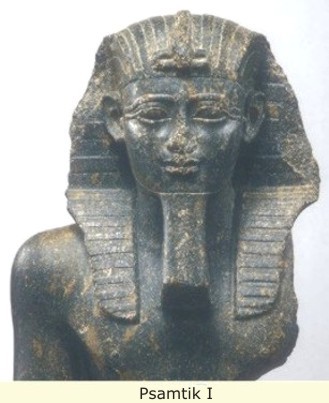
Upon the death of NeKau I (Necho) in 664, Psamtik I was recognized by his Assyrian overlords as King of Egypt, but this was a title at first without substance. He had rule over Memphis and Sais, but mostly the country was controlled by the old guard Egyptians and Libyan princes. He was tasked with the responsibilities of controlling not only the unruly princes and petty kings of the Delta, but also to reconcile with the power center at Thebes. Both Psamtik I, and his father NeKau I (Necho) of Sais, were originally involved with an intrigue associated with the Nubian ruler Taharqo against Assyria, but Psamtik was captured, held and indoctrinated by the Assyrians. Psamtik I was even given the Assyrian name, Nabu-shezibanni, before finally being returned to Egypt, where his father had assumed power in the Delta.
Working with Thebes turned out to be easier then he might have imagined, he was able to align himself with the daughter of a great Theaban nobleman named Mentuemhet. At that time, she held the title, "Adoratice of Amun (God's Wife of Amun). He was able to insert his own daughter Nitokris, as her successor. There can be no doubt, but that political considerations played a part in all this, for after all, Psamtik was himself half a Libyan, and the intense nationalism of the Egyptian natives found appeasement in this way. Moreover, Asiatics and Jews had poured into the country, the latter forming a colony at Elephantine where they were even permitted to build a temple to their god Yahu/ Jehovah. He was therefor able to effect both secular and religious ties that were to hold his growing presence in Egypt together, while he went after his Delta opponents.
In order to do this, he raised a conscript army, as well as employed the services of mercenaries, many of whom were Greek, including Carians. This involvement with foreign mercenaries, raises questions concerning the nature of their presence and their possible control within Egypt. Archaeological evidence suggests that sites such as Naukratis (an exclusively Greek town), among others, were established to facilitate this war, along with offering Egypt an increased commercial presence within the Mediterranean world. From Ramesside times Libyans and other Mediterranean peoples had contributed a substantial part to the armies on which the Egyptian monarchs relied; land had been bestowed upon them in return for their services.
The first Whites in AfricaEven
though those ancient Blacks with a written language, recorded
everything. There are no Egyptian sources which tell of the first
Black/White encounter in Egypt. If these writings still exist, they are
being withheld by Whites: For good reason, if there is an account of
the first Black/White encounter, the myth of White Egyptians could not
exist. Therefore, our only source for this first Greek/Egyptian
encounter, is the Greek historian Herodotus, in his book "The Persian
Wars" Written 440 B.C. (He says that these things were told to him by
the Egyptians). However, Herodotus is known to have been rather loose
with the truth. By the time of this account (664–610 B.C.), Whites had
been in Europe for at least 500 years, and had been marauding in the
Mediterranean for 400 years. Egyptians had a close relationship with
Cretans and Mycenaean's, and kept close tabs on the goings-on in the
north: therefore they would have known about the White invaders, as
soon as they arrived. Feeling that he was an injured man, and designing to avenge himself upon his persecutors, Psammetichus sent to the city of Buto, where there is an oracle of Latona, the most veracious of all the oracles of the Egyptians, and having inquired concerning means of vengeance, received for answer that "Vengeance would come from the sea, when brazen men should appear. Great was his incredulity when this answer arrived, for never, he thought, would brazen men arrive to be his helpers. However, not long afterwards certain Carians (Black Anatolians) and Ionians (Greeks), who had left their country (a colony in Anatolia), on a voyage of plunder, were carried by stress of weather to Egypt where they disembarked, all equipped in their brazen armour, and were seen by the natives, one of whom carried the tidings to Psammetichus, and, as he had never before seen men clad in brass, he reported that brazen men had come from the sea and were plundering the plain. Psammetichus, perceiving at once that the oracle was accomplished, made friendly advances to the strangers, and engaged them, by splendid promises, to enter into his service. He then, with their aid and that of the Egyptians who espoused his cause, attacked the eleven and vanquished them.
|
Psamtik also took as his principle wife Mehtemweskhet who was the daughter of Harsiese, High Priest at Heliopolis, further cementing his rule. To all appearances, Psamtik I had been a loyal subject of his Assyrian overlords, but as that empire's glories waned, Psamtik took his opportunity to break their hold, and in so doing became the absolute ruler of Egypt. During the remaining four decades of Psamtik I's rule, he continued to consolidate his power and bring the country under complete unity, something Egypt had really not seen in a number of years. He undertook a number of building projects, including fortresses in the Delta at Naukratis and Daphnae, as well as at Elephantine He also greatly expanded the Serapeum at Saqqara.
After consolidating Egypt militarily, Psamtik I was mostly concerned with keeping Egypt's sovereignty strong. There were expeditions into northern Nubia, probably to discourage any further ambitions of the Kushite kings. In the east, Babylon had become such an important power that the king actually formed an alliance with his old masters in Assyria in order to combat Babylon's growing menace. This alliance enabled Egypt to obtain control of the Canaanite coast. There were also actions required on the Libyan frontier, in order to combat the threat posed by the fugitive Delta princes. An Apis stele proves that Psamtik died after a reign of fifty-four years and was succeeded by his son Nekau II in 610 B.C.
 Nekau II (Necho II)
Nekau (II), who we know better as Necho, was either the 2nd or 3rd king of Egypt's 26th Dynasty depending on whether we allow the rule of a nominal king Nekau I at the beginning of the Dynasty. Nekau was his Birth name, and Necho is actually his Greek name, he probably ruled Egypt until about 595 B.C.
He continued the foreign involvement of his father, and Canaan once more became an Egyptian possession. In fact, much of Egypt's involvement in that area is found in the Biblical account of the Book of Kings. Initially things went well for Nekau II and we find the Egyptian forces campaigning east of the Euphrates river against the Chaldaeans. This allowed the Egyptians to establish themselves on the Euphrates for a short while, though apparently the Egyptians did not end up controlling anything. After defeating Josiah of Judah in 609 B.C. He then intervened in the kingdom of Israel and deposed Josiah's son Jehoahaz, replacing him with his brother Eliakim (Jehoiakim) (II Kings 23: 29-35). Afterwards, we are told that Jerusalem paid tribute to Egypt.
He also ruled part of Assyria at least as far as Carchemish. But this position was also soon lost, when in 605 B.C, the king suffered a catastrophic loss. The son of the Babylonian king Nabopolassar, was sent to deal with Assyria. This son was called Nebuchadrezzar, and he captured Carchemish from the Egyptians, and then pursued the fleeing Egyptian army as far as Hamath, where he apparently caught and overwhelmed them. Hence, this was followed by a retreat of the Egyptians to their eastern frontier at Gaza.
Nekau was a very foresighted individual, who's vision included a "Suez Canal, almost 2,500 years prior to the modern construction. He had a navigable canal dug, using some 12,000 workers, through the Wadi Tumilat between the Pelusiac branch of the Nile (where the great frontier fortress of Pelusium was located) and the Red Sea. He caused a great port city, Per-Temu-Tjeku ("the House of Atum of Tjeku", modern Tell el-Mashkuta) west of modern Ismailia to be built on the canal, and like Suez later; its fortunes were inevitably linked with this new waterway. The courageous attempt to link the Nile with the Red Sea by a canal had to be abandoned, but it is almost certain that Phoenician ships sent by him to circumnavigate Africa succeeded in doing so, returning in his third year. Greece was expanding her trading contacts and Nekau took the opportunity to recruit displaced Ionian Greeks for the Egyptian Navy. He also encouraged some Greek settlement in the Delta. When Nekau II died in 595 B.C, he left behind a son and three daughters. His son, Psamtik II, only ruled for a brief period.
 |
 |

king Wahibre succeeded his father, Psamtik II in February of 589 B.C, his troubles began after he had sent his Egyptian army to help the Libyan Berbers against the mixed-race Greek settlers of Cyrene. In the ensuing battle, the Egyptians were badly beaten, and upon the survivor's return to Egypt, civil war broke out. King Wahibre was blamed for the disaster, this resulted in a confrontation between the regular Egyptian army, and the Greek mercenaries in the Egyptian army.
The defeat at Cyrene, probably only provided an excuse for this revolt, because for some time, Egyptian soldiers had felt that Greek mercenaries were treated better than they, the native Egyptian army. When Wahibre sent his general “Ahmose”, to put down this revolt, Ahmose was instead implored by the Egyptians soldiers to be their leader, a plead which he accepted. There ensued a battle between the Greek mercenaries, under the command of king Wahibre, and the Egyptians under the command of Ahmose. Wahibre and the Greek mercenaries were defeated, and Ahmose became king Ahmose II .
The GreeksThere are no known images of the original Albino Greeks, circa 1,200 B.C. In Greece, as in the other areas that the Greeks invaded, they interbred with the local Blacks to a great extent: creating in large part, a "Mulatto" people. Our first images of these Greek mulattos comes a few years later, after the Persians had conquered Egypt, Anatolia, and a large part of Greece. These are from the palaces and tomb of the Persian King Darius the Great - reigned 522–486 B.C. These identifications are speculative, based on certain factors. A complete explanation can be found here: Click >>> Please note: Most modern Greeks and Anatolians, are NOT descended from these ancient people. Like most modern Europeans, they are descended from later arriving Germanics, Slavs, and Turks, circa 200-600 A.D. As the modern name of Anatolia (Turkey) suggests, Turkish blood predominates there, as well as in North Africa, the Middle East, and Arabia.
|
 Ahmose II (Amasis)
Ahmose II who was probably the 5th ruler of Egypt during the 26th Dynasty, has been called the last great Egyptian Pharaoh. This is because the rule of his son, Psamtik III, was very short lived, and in fact even in the last days of Ahmose' life, the Persians were already advancing on Egypt. They were the overwhelming power of the region, and would control Egypt up until Alexander the Great 's conquest of Egypt, and the ensuing Greek rulers. After his son “Psamtik III”, never again would an Egyptian rule Egypt, even unto today.
By this late date in Pharaonic history, Wahibres' army was mostly made up of Aegean mercenaries. The two armies met somewhere in the north-west Egyptian Delta in about January or February of 570 B.C, and Apries was forced to retreat. However, this did not give Ahmose complete control of Egypt. Wahibre's apparent retreat was only as far south as Memphis and he continued to control southern Egypt, while Ahmose established himself at Sais in Northern Egypt. Yet Wahibre was not content with this, and aided by his Greek troops, once again marched on Ahmoses’ in October of 570 B.C, where he was once again defeated by his former general. With this defeat, Wahibre could only find safety abroad, and he eventually turned up in the court of Nebuchadnezzar of Babylon. Now Ahmose took control of a united Egypt.
This was complete when sometime between October 19th and December 9th of 570 B.C, Thebes submitted to his reign. Yet poor Wahibre was not yet finished. In March of 567, he again marched on Egypt at the head of a Babylonian army, but once again, Ahmose defeated him, this time capturing the former king. It seems that Ahmose allowed Wahibre to live for a short time, however because we find Herodotus telling us that:
The Egyptians complained that he did wrong by maintaining a man who was the greatest enemy both to them and (Amasis), therefore he delivered Apries to the people, who strangled him.
Apparently, Ahmose still held some respect for his former ruler, because he buried Wahibre with kingly honors in the royal necropolis at Sais. This may very well be explained if indeed Ahmose was married to Wahibres' daughter. However, various sources differ somewhat on these events. Now as the ruler of all Egypt, Ahmose took on the traditional role of builder, and is attested to by quarry inscriptions at Tura and Elephantine and with building projects at Memphis including two granite colossi and a temple of Isis Philae Elephantine, Edfu Sohag, Abydos Koptos, Karnak and any number of Delta sites, including his tomb at Sais. While we have never discovered this tomb, again Herodotus steps in to describe it for us: (It is) a great cloistered building of stone, decorated with pillars carved in the imitation of palm-trees, and other costly ornaments. Within the cloister is a chamber with double doors, and behind the doors stands the sepulchre."
This was really a very prosperous time for Egypt. We are told that agriculture, always the backbone of Egypt, met a spectacular level of success, and Herodotus again tells us that the number of inhabited cities in Egypt reached as high as 20,000. After consolidating his power, Ahmose was apparently somewhat weary of the Greeks, who had been around since the beginning of the Dynasty, and of course, fought against him on the side of Wahibre. Psamtik I had encouraged the Greek merchants in the city of Naukratis, and Ahmose consolidated them in that area only.
This made for easier control of these merchants, and created a lucrative income for the crown in the form of taxes. Prior to Wahibres' defeat, the Greek mercenaries were established in camps between Babastis and the sea on the Pelusiac branch of the Nile, where Herodotus tells us they had remained for over a century. Apparently, he first moved them to Memphis, where he could keep an eye on things. But, Ahmose was not willing to push the Greeks too far because he needed their alliance against the expanding threat of the Persians, as well as an attempted invasion by the Chaldaeans.
Apparently after their unsuccessful invasion, he formed an alliance with the Chaldaeans, Croesus of Lydia, and Sparta. Unfortunately, the Persians destroyed the alliance by first capturing Lydia in 546 and then the Chaldaeans. So instead, he cultivated his relationship with the Aegean world, extending his foreign relationships to include Cyprus. He is said to have even financed the rebuilding of the temple of Apollo at Delphi, after its destruction in 548 B.C. According to archaeological records, he probably even allowed the Greek soldiers to return to their old mercenary camps.
Regrettably, for all his efforts, the Persians would eventually prove too ambitious to stop. By the time of Ahmoses’ death after a long reign of some 44 years, the Persians had long ago conquered Babylon, and were already at the frontiers of Egypt. His son was eventually captured by the Persians, and Herodotus tells us that the Persian ruler Cambyses, had Ahmose's mummy exhumed and:
"subjected to every indignity, such as lashing with whips and the plucking of its hairs, until the executioners were weary. At last, as the corpse had been embalmed and would not fall to pieces under the blows, Cambyses ordered it burnt"
 |
Egyptian King and Ruler listThe ancient Egyptian Kinglist is very fluid, as new attestations for previously unknown kings or Queens are discovered (such as newfound Serekhs or Cartouches), the list is updated. Chronological dates are educated guesses.
|
26th Dynasty
|
Please visit the "Additional Material Area" for many more photographs of each civilization, and related material <Click> |
|
NOT OUT OF AFRICA
Professor Mary Lefkowitz, Professor in the Humanities at Wellesley College Massachusetts is a Jewish woman from New York. It's been 28 years (1996) since her "Not Out of Africa" book was published, and we are amazed at the number of Black people who still don't know that it is PURE NONSENSE with her accusing Blacks of doing exactly what Albinos routinely do concerning history. AND WE DON'T LEGISLATE AGAINST TEACHING ALBINO CHILDREN ABOUT ALBINO ANCIENT HISTORY - THERE IS NONE! But Hey Gov. Ron DeSantis - sooner or later your Albino Children will learn the truth, what will you do then? In "Not Out of Africa" the Professor said that she "comprehensively" exposes how Afrocentrism became an excuse to teach myth as history."
As you can see she/they (Albinos) placed a picture of what they supposed was a WHITE GREEK man on the cover to show us what the REAL creators of Civilization looked like in "THEIR FANTASY'S" (we hope you can detect that it is a PLASTIC bust). Of course most Greeks were Black as were most people in ancient Europe, even after the Sea Peoples exodus. (We assume that you know that Africans started settling Europe after the "Last Ice Age" from about c.45,000 B.C.). If not, we cover it here in many different pages. Amazon review capsule: Not Out of Africa has sparked widespread debate over the teaching of revisionist history in schools and colleges. Was Socrates black? Did Aristotle steal his ideas from the library in Alexandria? Do we owe the underlying tenets of our democratic civilization to the Africans? Mary Lefkowitz explains why politically motivated histories of the ancient world are being written and shows how Afrocentrist claims blatantly contradict the historical evidence. Not Out of Africa is an important book that protects and argues for the necessity of historical truths and standards in cultural education. In other words, Mary is asking: “Who are you going to believe, me or your own lying eyes?” By Chico Marx - Jewish actor. From the Robert T. Carroll (a PhD) Book review quote: What is offensive about Afrocentrism is not that its advocates assert such things as that Socrates and Cleopatra were black Africans or that Aristotle stole his ideas from the library at Alexandria when he visited Egypt. What is offensive is not that they claim that the ancient Greeks took everything they are known for from the Egyptians, and that those Egyptians were black Africans. What is offensive is that these claims are put forth as articles of faith. Any challenge to them is seen as racist. CAN YOU BELIEVE THAT AT THIS "LATE" DATE, ALBINOS STILL BELIEVE THAT EGYPTIANS WERE WHITE?? Continue: What is offensive is that these claims are not based on scholarly research, evidence and argument from evidence. Nor are they based on a sincere desire to discover historical truth. They are based on unsubstantiated opinions of mythmakers and fiction writers. They are based on the possibility they are true. They are based on a desire for them to be true. They are based on a preconceived notion that white scholars have conspired from time immemorial to repress the truth that everything good about Western civilization came out of Black Africa. They are based on the desire to give African-American children self-esteem and pride. By Robert T. Carroll, November 27, 1996 OUR ANSWER IS QUITE SIMPLE: "A picture is worth a thousand words." That adage is believed to stem from an article by Fred R. Barnard in an advertising trade journal of 1921 promoting the use of images in advertisements". THAT IS WHY Realhistoryww has thousands of photos of Real ancient People and Real ancient Artifacts with written documents to back them up. Unlike Albino bullshit which they assume you will believe, just because they are ALL-KNOWING Albinos, or at least that is what you have been trained to believe. Quote: They are based on a preconceived notion that white scholars have conspired from time immemorial to repress the truth that everything good about Western civilization came out of Black Africa. Answer: YOU are Albinos, that is a disease; you are NOT normal nor natural, and you have NOT existed from time immemorial, your OWN scientists have set your time of existence at 6,000 - 12,000 years. Speaking to Blacks: Mary Lefkowitz is a Professor, Robert T. Carroll is a PhD, yet both of these "Ignoramuses" falsely believe that Albinos are native to Europe and that the Greeks, Romans, etc. were Albinos just like THEM - which of course is part of their nonsense history.
Was the above quote designed to give BLACKS: a desire to give African-American children self-esteem and pride - By Robert T. Carroll OR Albino children self-esteem and pride? The Smithsonian Institution is the world’s largest museum, education, and research complex, with 21 museums and the National Zoo—shaping the future by preserving heritage, discovering new knowledge, and sharing our resources with the world. The Institution was founded in 1846 with funds from the Englishman James Smithson (1765–1829) according to his wishes “under the name of the Smithsonian Institution, an establishment for the increase and diffusion of knowledge.” We continue to honor this mission and invite you to join us in our quest. People! The worlds greatest "EDUCATIONAL INSTITUTION" (he,he) wrote that nonsense below the little Albino girl putting on her Sun Block above, yet you still believe them?? In case you didn't know; CENTRAL ASIAN ALBINOS: Germanic's, Slavs, Turks, (who modern Albino liars call Greeks and Romans) entered Europe as ILLITERATE NOMADS; some as Slave Soldiers of Black Arabs called MAMLUKS! << See Wiki - The Migration Period >> |
| < Back | Home | Next > |


