
Ancient Egypt |
Nubia |
Assyrian Empire |
Persian Empire |
Middle East |
Alexanders Empire |
Ottoman Empire |
When last we left Egypt, the 12th dynasty which was a period of great prosperity was ending.
It didn't last long, by the time of "Neferusobek", she was the eighth ruler of the 12th Dynasty ( 1763-1759 B.C.), it was over. The scenario went like this: It seems that "Amenemhet IV" The seventh king of the 12th Dynasty, (who was probably the son of Amenemhet III, the 6th. king), was old when he assumed the throne, due to his father Amenemhet III's long reign.
He had no male heir, so it seems that a family feud broke out, from which Sebeknofru (his sister), emerged the winner. The exact nature of her reign is unknown, however this would be the second time in Egyptian history that a woman succeeded in establishing herself as 'King of Upper and Lower Egypt'. This was so abnormal a situation, that it had to once again bring disaster. After Sebeknofru, (as after Queen Nitocris of the 6th dynasty), there followed a succession of kings none of whose reigns exceeded three years. For Whatever cause, the glorious Middle Kingdom had finally broken down.
There had been a big building boom in Egypt during the 12th dynasty. Many temples were built and much other construction work was done. This created a need for more workers, and many of the workers that answered the call, were the highly skilled workers of Mesopotamia. Prominent among these, would be the Amorites, (who are now out of work). They are known in Egypt as "Hapiru" (one who sells his services), this word Hapiru will later become "Hebrew". The large-scale immigration of these foreigners into the Nile Valley during the Middle Kingdom, eventually spelled the end of the Middle Kingdom in Egypt.
The 12th dynasty turned over to be the 13th dynasty, and at the same point started the so called Second Intermediate Period, a period that still has many problems unsolved and bears many theories among scholars. The first two kings were sons of the last male monarch of the former dynasty - Amenemhet IV. During the whole dynasty the residence was at the capital Itj-tawy and a common belief frequently published is that after half the dynasty their kings were forced to move south, but no evidence confirms this theory. Their authority reached north to Bubastis and the borders do not seem to have been changed over the years to the parallel dynasty 14 that controlled the rest of the delta.
 |
 |
 |
14th Dynasty 1786-1603 B.C.
 Nehesy
Nehesy left documents where he states that he is the son of a pharaoh, but curiously he doesn't say who his father was, which possibly indicates that his statement isn't true. One theory advocates that his father might have been an Egyptian civil servant or a military commander who usurped royal rule in the delta. His throne name of Aa-seh-Re means: "Great in Council is Re". In the Turin Canon he is listed as the first pharaoh of the dynasty, but a great gap in the papyrus indicates a row of about five kings who probably ruled before him. Estimations have been made indicating that these had a rather long reigns compared with most of later kings, which makes the time when Nehesy was in charge to have occurred around the year 1705 B.C. The damaged Turin papyrus can't give him more than half a year in office. His name Nehesy meant "Nubian" in the Egyptian language and may indicate his origin and background, since soldiers from the south by tradition were a great part of the Egyptian military forces.
These two dynasties seem to have been getting along quite well but a
very big question is how the entries in the Turin Canon should be
explained. The number of kings are so many that estimations (and to
some extent entries in the canon) points to an average reign of 1.5
years for the first couple of dozen rulers of dynasty 13. If this is a
historical fact, a political situation of unusual type must have been
present. A possible explanation is that the real power came from the
rich and influential classes who gave office to marionette-kings and
sacked them when they felt like it. Both dynasties 13 and 14 seem to
have this short-reign syndrome for most of their duration and they
closed after about 150 years in existence, when the Hyksos dynasty
began.
 |
 |
 |
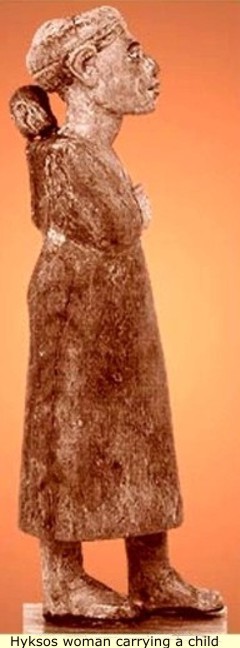
Because these foreigners had maintained their identity as "Asiatic's" and had not become Egyptians, they felt empowered to establish their own communities and live by their own laws. Eventually, as their numbers increased, they challenged the power of the Egyptian monarchy itself, and Egypt fell into disarray. We do not known exactly how the "Hyksos" took northern Egypt, but took it they did. The middle and last part of the Second Intermediate Period (15th-17th dynastys) saw northern Egypt ruled by these foreign kings for hundreds of years.
During this time, Egypt was never under the control of a single monarch, but consisted largely of independent states under a variety of kings. The Egyptians called the foreign kings of northern Egypt - Heka-Khaswt - there is argument as to whether this translates to "Shepherd Kings" or "Rulers of the Foreign Lands." The Greeks later perverted this word to Hyksos. It might be of interest to note that in Sumer, the king was known in their hymns and poems as "the good Shepherd".
This second intermediate period, lasted for hundreds of years, until king "Tao" of Thebes took to battle in order to re-unify Egypt. After he fell in battle, his son Kamose carried on. King Kamose's throne name, Wadj-kheper-re means: "Flourishing is the Manifestation of Re". As Kamose picked up the battle-axe from his father, in the war against the Hyksos, he tried to motivate the Egyptian people to break the status quo, but it was a hard task, their fighting spirit wasn't high. The Hyksos had apparently been good neighbors, they had incorporated Egyptian gods into their religious pantheon, and had many commercial agreements with Egyptians in upper Egypt. They were people who had lived in Egypt for hundreds of years, and aside from their desire to build their nation with the Pharaohs land, were in all other ways tolerable.
In order to hold-off the oncoming Egyptian army, the old Hyksos king, "Apepi I" tried to make an alliance with the Nubians (people south of Egypt), and engage King Kamose in a two-front war, but it didn't work out as planned. Instead the Nubians joined forces with Kamose and headed north to expel the Hyksos. However, all Egyptians did not support expulsion of the Hyksos, and these people were treated as traitors.
| The Egyptian war of re-unification was supposedly prompted by a provocative letter sent to King Tao by the Hyksos King Apepi I. Click here for an account of the Egyptians thinking on the matter. Click >>> |
 |
 |
 As
the battles raged, the Hyksos were eventually forced to barricade
themselves in their city of Avaris. Here they were besieged, but
managed to hold out. Kamose, not wishing to maintain a protracted
siege, offered a compromise. Whereby if the Hyksos would leave
peacefully, they could take all of their possessions and receive safe
conduct out of Egypt. This the Hyksos accepted, and they gathered up
all of their possessions, (and all of the Egyptians possessions that
they could), and left Egypt.
As
the battles raged, the Hyksos were eventually forced to barricade
themselves in their city of Avaris. Here they were besieged, but
managed to hold out. Kamose, not wishing to maintain a protracted
siege, offered a compromise. Whereby if the Hyksos would leave
peacefully, they could take all of their possessions and receive safe
conduct out of Egypt. This the Hyksos accepted, and they gathered up
all of their possessions, (and all of the Egyptians possessions that
they could), and left Egypt.
Finally the Hyksos were expelled, (they went into Canaan - Biblical Exodus?). Subsequently though, a rebellion by unhappy quarry workers, encouraged the Hyksos to return to Egypt.
Here we are quoting Josephus Flavius from his book, Against Apion, where he is quoting passages concerning the Hyksos from Manetho's Aegyptiaca. Josephus is a Hebrew traitor named Joseph, who upon going over to the Romans, was made a General and given the title Josephus Flavius. He subsequently commanded Roman troops in putting down the Hebrew rebellion. {Not all Hebrews, especially the wealthy, objected to Roman rule}. Josephus's writing is generally considered to be "self-serving", but since he is quoting Manetho, we will use it.
"Those sent to work in the quarries lived miserably for a long while, and the king was asked to set apart the city Avaris, which the Hyksos had left, for their habitation and protection; and he granted them their wish.
But when these men had entered it, and found it suitable for a revolt, they chose a ruler from among the priests of Heliopolis, whose name was Osarsiph (Moses). They swore an oath that they would obey him in all things. The first laws he gave them were that they should not worship the Egyptian gods, nor should they abstain from any of the sacred animals that the Egyptians held in the highest esteem, but could kill them, and that they should not ally themselves to any but those that were of their conspiracy.
After making such laws as these, and others contrary to Egyptian customs, he ordered that the many hands at their service to be employed in building walls around the city and prepare for a war with king Ahmose. He colluded with the other priests, and those that were polluted as well, (apparently many of the quarry workers were Lepers), and sent ambassadors to those Hyksos expelled by Kamose to Jerusalem, informing them of his own affairs, and of the state of those others that had been treated so shamefully, and desired that they would come united to his assistance in this war against Egypt.
He also promised their return to their ancient city and land of Avaris, and plentiful support for their people; that he would protect them and fight for them if need be, and that the land would easily be subdued. The Hyksos were delighted with his message, and assembled two hundred thousand men. Shortly they arrived at Avaris.
This account goes on to tell of the Pharaohs sojourn to Nubia and his return 13 years later.
In any event, by now it was the reign of Kamose's son "Ahmose I", and he offered no compromise. On his stella, Ahmose I proclaims that he chased the Hyksos out of Egypt, and as far east as the Euphrates river.
The Egyptian historian "Manetho" (305–282 B.C.), writes about this expulsion: "And it was also reported that the priest, who ordained their polity and their laws, was by birth of Heliopolis, and his name was Osarsiph from Osyris, who was the god of Heliopolis; but that when he was gone over to these people, his name was changed, and he was called Moses".
Kamose's son, "Ahmose I" probably became ruler of Egypt around 1550 B.C. He was about the age of 10 when he came to the throne, and he ruled for a period of about 25 years.
Click here for details on the Hyksos Dynasty: plus the writings of Manetho and Josephus Flavius. <Click>> |
The Roman historian Cornelius Tacitus (56-118 A.D.) had these thoughts on the origins of the Hebrews. |
This is in the context of Titus Caesar, who had been selected by his father to complete the subjugation of Judaea (70 A.D.)Tacitus: History Book 52. As I am about to relate the last days of a famous city, it seems appropriate to throw some light on its origin. Some say that the Jews were fugitives from the island of Crete, who settled on the nearest coast of Africa about the time when Saturn was driven from his throne by the power of Jupiter. Evidence of this is sought in the name. There is a famous mountain in Crete called Ida; the neighbouring tribe, the Idaei, came to be called Judaei by a barbarous lengthening of the national name. Others assert that in the reign of Isis the overflowing population of Egypt, led by Hierosolymus and Judas, discharged itself into the neighbouring countries. Many, again, say that they were a race of Ethiopian origin, who in the time of king Cepheus were driven by fear and hatred of their neighbours to seek a new dwelling-place. Others describe them as an Assyrian horde who, not having sufficient territory, took possession of part of Egypt, and founded cities of their own in what is called the Hebrew country, lying on the borders of Syria. Others, again, assign a very distinguished origin to the Jews, alleging that they were the Solymi, a nation celebrated in the poems of Homer, who called the city which they founded Hierosolyma after their own name. 3. Most writers, however, agree in stating that once a disease, which horribly disfigured the body, broke out over Egypt; that king Bocchoris, seeking a remedy, consulted the oracle of Hammon, and was bidden to cleanse his realm, and to convey into some foreign land this race detested by the gods. The people, who had been collected after diligent search, finding themselves left in a desert, sat for the most part in a stupor of grief, till one of the exiles, Moyses by name, warned them not to look for any relief from God or man, forsaken as they were of both, but to trust to themselves, taking for their heaven-sent leader that man who should first help them to be quit of their present misery. They agreed, and in utter ignorance began to advance at random. Nothing, however, distressed them so much as the scarcity of water, and they had sunk ready to perish in all directions over the plain, when a herd of wild asses was seen to retire from their pasture to a rock shaded by trees. Moyses followed them, and, guided by the appearance of a grassy spot, discovered an abundant spring of water. This furnished relief. After a continuous journey for six days, on the seventh they possessed themselves of a country, from which they expelled the inhabitants, and in which they founded a city and a temple.
|
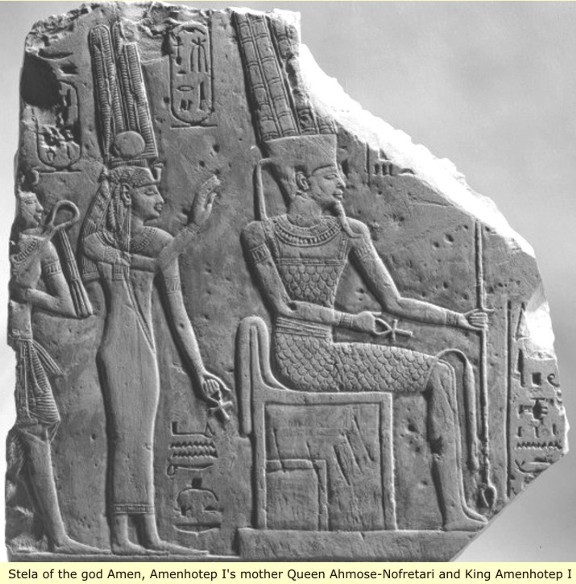
Amenhotep I, the son of Ahmose I and Queen
Ahmose Nefretiri, was the second king of the 18th Dynasty. He may have
ascended to the throne at a relatively young age, for an elder brother
had been designated as heir only about five years earlier. He may have
even served a brief co-regency with his father, however. He evidently
carried on many of the practices of his father, and his mother
certainly played an important part in his reign, acting as God's Wife
of Amun. Amenhotep I may have been married to his sister, (Ahmose-)
Merytamun, who was a God's Wife of Amun.
 |
 |
 |
Isn't it amazing how the face on the painting, and the relief, look nothing like this statue? |
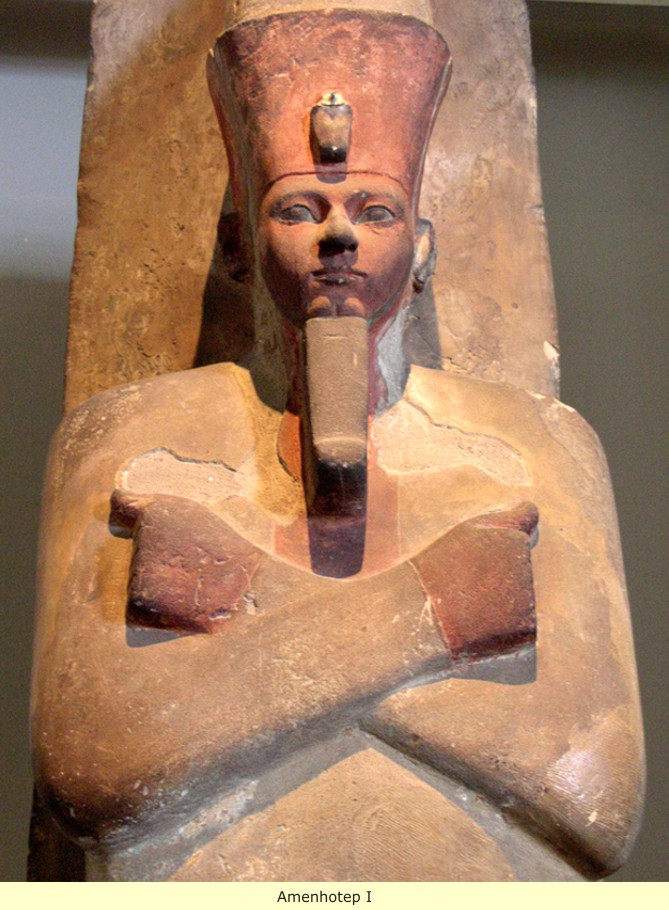 |
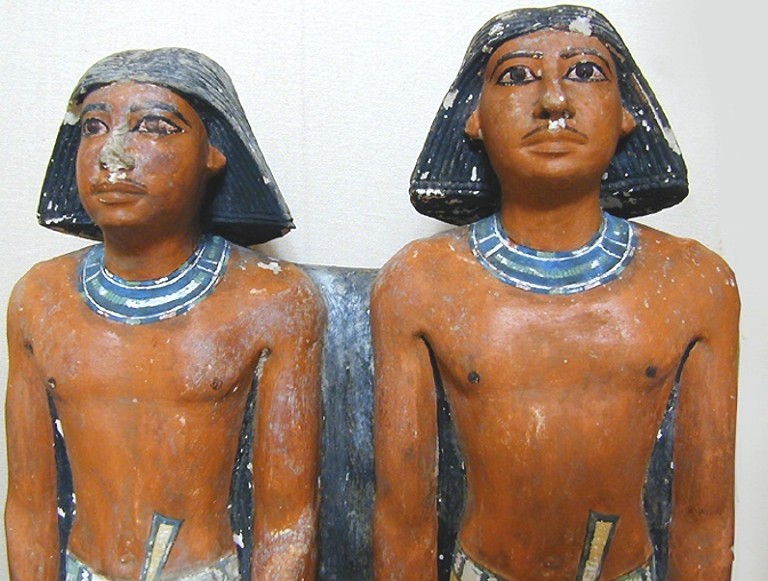
| Why it's as if people were changing the statue faces to look a certain way. Even statues of the SAME king can look completely different. Very strange, but of course we know that neither the Europeans, nor the Turks, would ever do anything like that. (Tongue firmly in cheek). |

The third king of the 18th Dynasty may have been a commoner by birth and a military man by training. We do not know his fathers name, but his mother was Semiseneb, a rather common name during the Second Intermediate Period and the early 18th Dynasty. He had married Ahmose, who may have been a sister of Amenhotep I and daughter of Ahmose I and Queen Ahmose Nefertary (who still held the title, "God's Wife of Amun during her grandson's rule) and thus legitimized his rule. However, others have suggested that Ahmose was in fact Tuthmosis I's own sister. He may have also served as a co-regent under Amenhotep I, and was most certainly an important military commander under his predecessor.
 |

Tuthmosis II might never have ruled Egypt but
for the early death of Wadjmose and Amenmose, the eldest sons of
Tuthmosis I, leaving him as the only heir. He became the fourth ruler
of Egypt's 18th Dynasty. He was apparently the oldest son of
Mutnefert, a minor royal queen of Tuthmosis I who was herself the
sister of Tuthmosis I's principal queen, Ahmose. In order to strengthen
his position and legitimize his rule, he married Hatshepsut, the eldest
daughter of Tuthmosis I, and Queen Ahmose. She was very possibly older
then Tuthmosis II.
During this period, Hatshepsut also carried the title, "God's Wife of Amun", a position she may have had even before the death of Tuthmosis I. Hatshepsut would have been both Tuthmosis II's half sister and cousin. In the light of history she became a much better known pharaoh then her husband. We believe that Tuthmosis II had only one son by a harem girl named Isis (or Iset). However, Tuthmosis III would have to wait to rule Egypt, until after Hatshepsut death. Tuthmosis II must have realized the ambitions of his wife, because he attempted to foster the ascent of his son to the throne by naming his son as his successor before he died. But upon Tuthmosis II's death, his son was still very young, so Hatshepsut took advantage of the situation by at first naming herself as regent, and then taking on the full regalia of the pharaoh.
He may have also had as many as two daughters by Hatshepsut. We are fairly sure one of them was named Neferure and another possible daughter named Neferubity. We know that Tuthmosis II was a physically weak person, and many Egyptologists speculate that even during his rule, Hatshepsut may have been the real power behind the throne. We believe that Tuthmosis II (Born of the God Thoth) which was his birth name, ruled for about fourteen years before dying in his early thirties. However, recent scholars wish to have his rule shortened to three years.
 |
Hatshepsut, the fifth ruler of the 18th Dynasty was the
daughter of Thutmose I and Queen Ahmose. As was common in royal
families, she married her half-brother, Thutmose II who had a son,
Thutmose III by a minor wife. When Thutmose II died in 1479 B.C. his
son, Thutmose III, was appointed heir. However, Hatshepsut was
appointed regent due to the boy's young age. They ruled jointly until
1473 B.C. when she declared herself pharaoh. Dressed in men’s attire,
Hatshepsut administered affairs of the nation, with the full support of
the high priest of Amun “Hapuseneb” and other officials. When she built
her magnificent temple at Deir el Bahari in Thebes, she made
reliefs of her divine birth as the daughter of Amun. Hatshepsut
disappeared in 1458 B.C, when Thutmose III, wishing to reclaim the
throne, led a revolt. Thutmose III had her shrines, statues and reliefs
mutilated.
 |
 |
Senenmut was the Grand Vizier, or First Minister, of Pharaoh Hatshepsut of Egypt. He was her confidant, and some say lover (perhaps father of Neferure). He was a tutor to her daughter, the Princess Neferure, and was her favorite advisor. He even occupied a space on one of the walls of the Pharaoh's mortuary temple. Senenmut was the son of Ramose and Hat-Nefer, a humble family from the city of Armant. He held over eighty titles as an Egyptian official, and began his service to the royal family of Egypt during the reign of Pharaoh Thutmose II, Hatshepsut's husband and half-brother. By the end of Hatshepsut's reign, Senenmut (also called Senmut) was out of favor with Pharaoh, and it is not known where he is buried.
 Tuthmosis III
By the second year of the young king's rule, Hatshepsut
had usurped her stepson's position and so inscriptions and other art
began to show her with all the regalia of kingship, even down to the
official royal false beard. Yet, at the same time, she did little to
really diminish Tuthmosis' rule, dating her own rule by his regnal
years, and representing him frequently upon her monuments. It is likely
that Tuthmosis III, was lucky to have survived her rule, though there
is some debate on this issue. He obviously stayed well in the
background, and perhaps even demonstrated some amount of cunning in
order to simply keep his life. Because
of the prowess he would later demonstrate on the battlefield, we assume
he probably spent much of Hatshepsut's rule in a military position. To
an extent, they did rule together, he in a foreign military position,
and her taking care of the homeland.
When Hatshepsut finally died, outliving her powerful ministers, Tuthmosis III was at last able to truly inherit the throne of Egypt, and in doing so, proved to be a very able ruler. Interestingly, it was not until the last years of his reign that he demonstrated what seems to have been some anger toward his stepmother. He did this by destroying as much of her memory as possible. Her images were expunged from monuments throughout Egypt. This is obvious to most visitors of Egypt because one of the most effected monuments was her temple at Deir el-Bahari today a primary tourist site. There, Tuthmosis III destroyed her reliefs and smashed numerous statues into a quarry just in front of the temple. He even went so far as to attack the tombs of her courtiers. Yet if this was over the frustration of his youth when she ruled, why did he wait until such a late date to begin the destruction? In any event, Tuthmosis III became a great pharaoh in his own right, and has been referred to as the Napoleon of ancient Egypt (by the Egyptologists, James Henry Breasted).
Perhaps Tuthmosis IIIs great reputation is due to the fact that his battles were recorded in great detail by the archivist, royal scribe, and army commander, Thanuny. These battles were recorded on the inside walls surrounding the granite sanctuary at Karnak and inscriptions on Thanuny's tomb on the west bank. They state that, "I recorded the victories he won in every land, putting them into writing according to the facts". Referred to as the Annals, the inscriptions were done during Tuthmosis' 42nd year as pharaoh, and describe both the battles and the booty that was taken. These events were recorded at Karnak because Tuthmosis's army marched under the banner of the god, Amun and Amun's temples and estates would largely be the beneficiary of the spoils of Tuthmosis' wars.
 |
 |
 |
 |
 |
 Amenhotep II
Amenhotep was the son of Tuthmosis III, with
whom he may have served a short co-regency of about two years. His
mother was probably Merytra, a daughter of Huy, who was a divine
adoratrice of Amun and Atum and chief of choristers for Ra. He is
generally acknowledged to have taken care of his military duties early
on, thereafter establishing a peaceful and prosperous reign, suitable
for fairly extensive expansion of temple monuments.
This King apparently had finally made peace with these former foes the Mitanni or Nahrin. In fact, an addition at the end of the Memphis stele records that the chiefs of Nahrin, Hatti and Sangar (Babylon) arrived before the king bearing gifts and requesting offering gifts (hetepu) in exchange, as well as asking for the breath of life.
Furthermore, we also learn that Amenhotep II at least asked for the hand of the daughter of Mitannian king, Artatama I in marriage. By the end of Amenhotep II's reign, the Mitanni who had been so recently a vile enemy of Egypt, were being portrayed as a close friend. After these initial campaigns, the remainder of Amenhotep II's long reign was characterized by peace in the Two Lands, including Nubia where his father had already settled matters during his reign.
This allowed Amenhotep to aggressively pursue a building
program that left his mark at nearly all the major sites where his
father had worked. Some of these projects may have even been initiated
during his co-regency with his father, for at Amada in Lower Nubia,
which was dedicated to Amun and Ra-Horakhty - both celebrated equally -
and at Karnak, he participated in his father's elimination of all
vestiges of his hated stepmother, Hatshepsut.
Tuthmosis IV (1419 - 1386 B.C.) was the 8th
Pharaoh of Egypt's 18th Dynasty. Tuthmosis IV is probably most
famous for his Dream Stele, which can still be found today between the
paws of the great Sphinx at Giza. Dreams were important in ancient
Egypt and were considered to be divine predictions of the future.
In Tuthmosis IV's Dream Stele, he tells us that, while out on a hunting trip, he fell asleep in the shadow of the Sphinx (or apparently, the shadow of the Sphinx's head, for the monument was apparently buried in sand at the time). In the young prince's sleep, Re-Harakhte, the sun god embodied in the Sphinx, came to him in a dream and promised that if he would clear away the sand that engulfed the monument, Tuthmosis would become king of Egypt.
 |
 |
 |
He was supposedly the son of Amenhotep II by his wife Tiaa, but Egyptologists speculate that, because of the wording on the 'Dream Stele', his claim on the Egyptian throne might not be legitimate. In fact, other evidence supports this contention. His father, Amenhotep II, never recognized Tuthmosis as a co-regent, or announced any intent for Thutmosis to succeed him.
 |
We know that Tuthmosis IV was probably married to Mutemwiya, who produced his heir to the throne, Amenhotep III, though he never acknowledged her as either a major or minor queen. It is possible, though now doubted by some, that she was the daughter of the Mitannian king Artatama, who sent his daughter to the Egyptian court as part of a diplomatic exchange. Other of his wives included Merytra, who we believe later changed her name to Tiaa (same as his mother's name) and a non-royal wife, Nefertiry. He probably also married one of his sisters named Iaret.
Egyptian King and Ruler listThe ancient Egyptian Kinglist is very fluid, as new attestations for previously unknown kings or Queens are discovered (such as newfound Serekhs or Cartouches), the list is updated. Chronological dates are educated guesses.
|
Neferusobek (Sobekkare) 1763 - 1759
SECOND INTERMEDIATE PERIOD13th Dynasty
|
16th Dynasty
17th Dynasty
NEW KINGDOM18th Dynasty
Amenhotep III (Nebmaatre) 1382 - 1344
|
Picture below: Not part of the story - just something interesting to think about.
 |
Now lets see how all this is playing out in Canaan.
Please visit the "Additional Material Area" for many more photographs of each civilization, and related material <Click> |
|
NOT OUT OF AFRICA
Professor Mary Lefkowitz, Professor in the Humanities at Wellesley College Massachusetts is a Jewish woman from New York. It's been 28 years (1996) since her "Not Out of Africa" book was published, and we are amazed at the number of Black people who still don't know that it is PURE NONSENSE with her accusing Blacks of doing exactly what Albinos routinely do concerning history. AND WE DON'T LEGISLATE AGAINST TEACHING ALBINO CHILDREN ABOUT ALBINO ANCIENT HISTORY - THERE IS NONE! But Hey Gov. Ron DeSantis - sooner or later your Albino Children will learn the truth, what will you do then? In "Not Out of Africa" the Professor said that she "comprehensively" exposes how Afrocentrism became an excuse to teach myth as history."
As you can see she/they (Albinos) placed a picture of what they supposed was a WHITE GREEK man on the cover to show us what the REAL creators of Civilization looked like in "THEIR FANTASY'S" (we hope you can detect that it is a PLASTIC bust). Of course most Greeks were Black as were most people in ancient Europe, even after the Sea Peoples exodus. (We assume that you know that Africans started settling Europe after the "Last Ice Age" from about c.45,000 B.C.). If not, we cover it here in many different pages. Amazon review capsule: Not Out of Africa has sparked widespread debate over the teaching of revisionist history in schools and colleges. Was Socrates black? Did Aristotle steal his ideas from the library in Alexandria? Do we owe the underlying tenets of our democratic civilization to the Africans? Mary Lefkowitz explains why politically motivated histories of the ancient world are being written and shows how Afrocentrist claims blatantly contradict the historical evidence. Not Out of Africa is an important book that protects and argues for the necessity of historical truths and standards in cultural education. In other words, Mary is asking: “Who are you going to believe, me or your own lying eyes?” By Chico Marx - Jewish actor. From the Robert T. Carroll (a PhD) Book review quote: What is offensive about Afrocentrism is not that its advocates assert such things as that Socrates and Cleopatra were black Africans or that Aristotle stole his ideas from the library at Alexandria when he visited Egypt. What is offensive is not that they claim that the ancient Greeks took everything they are known for from the Egyptians, and that those Egyptians were black Africans. What is offensive is that these claims are put forth as articles of faith. Any challenge to them is seen as racist. CAN YOU BELIEVE THAT AT THIS "LATE" DATE, ALBINOS STILL BELIEVE THAT EGYPTIANS WERE WHITE?? Continue: What is offensive is that these claims are not based on scholarly research, evidence and argument from evidence. Nor are they based on a sincere desire to discover historical truth. They are based on unsubstantiated opinions of mythmakers and fiction writers. They are based on the possibility they are true. They are based on a desire for them to be true. They are based on a preconceived notion that white scholars have conspired from time immemorial to repress the truth that everything good about Western civilization came out of Black Africa. They are based on the desire to give African-American children self-esteem and pride. By Robert T. Carroll, November 27, 1996 OUR ANSWER IS QUITE SIMPLE: "A picture is worth a thousand words." That adage is believed to stem from an article by Fred R. Barnard in an advertising trade journal of 1921 promoting the use of images in advertisements". THAT IS WHY Realhistoryww has thousands of photos of Real ancient People and Real ancient Artifacts with written documents to back them up. Unlike Albino bullshit which they assume you will believe, just because they are ALL-KNOWING Albinos, or at least that is what you have been trained to believe. Quote: They are based on a preconceived notion that white scholars have conspired from time immemorial to repress the truth that everything good about Western civilization came out of Black Africa. Answer: YOU are Albinos, that is a disease; you are NOT normal nor natural, and you have NOT existed from time immemorial, your OWN scientists have set your time of existence at 6,000 - 12,000 years. Speaking to Blacks: Mary Lefkowitz is a Professor, Robert T. Carroll is a PhD, yet both of these "Ignoramuses" falsely believe that Albinos are native to Europe and that the Greeks, Romans, etc. were Albinos just like THEM - which of course is part of their nonsense history.
Was the above quote designed to give BLACKS: a desire to give African-American children self-esteem and pride - By Robert T. Carroll OR Albino children self-esteem and pride? The Smithsonian Institution is the world’s largest museum, education, and research complex, with 21 museums and the National Zoo—shaping the future by preserving heritage, discovering new knowledge, and sharing our resources with the world. The Institution was founded in 1846 with funds from the Englishman James Smithson (1765–1829) according to his wishes “under the name of the Smithsonian Institution, an establishment for the increase and diffusion of knowledge.” We continue to honor this mission and invite you to join us in our quest. People! The worlds greatest "EDUCATIONAL INSTITUTION" (he,he) wrote that nonsense below the little Albino girl putting on her Sun Block above, yet you still believe them?? In case you didn't know; CENTRAL ASIAN ALBINOS: Germanic's, Slavs, Turks, (who modern Albino liars call Greeks and Romans) entered Europe as ILLITERATE NOMADS; some as Slave Soldiers of Black Arabs called MAMLUKS! << See Wiki - The Migration Period >> |
| < Back | Home | Next > |


