Modern Palestine-Israel-Lebanon
When last we left Canaan, Saul had just been anointed king.
Had events followed their normal course, the Canaanites, who still controlled the coast and the Plain of Esdraelon, might have regrouped and expelled the scattered and unorganized Hebrew clans. But before this could happen, there occured the great invasion of the "Sea Peoples", in the early decades of the 12th century B.C. {The forced exodus of the original Black inhabitants of Italy, Greece, and the Mediterranean Islands}.
| Click here for detail and more pictures of the Sea People <<Click>> |
The The Philistines
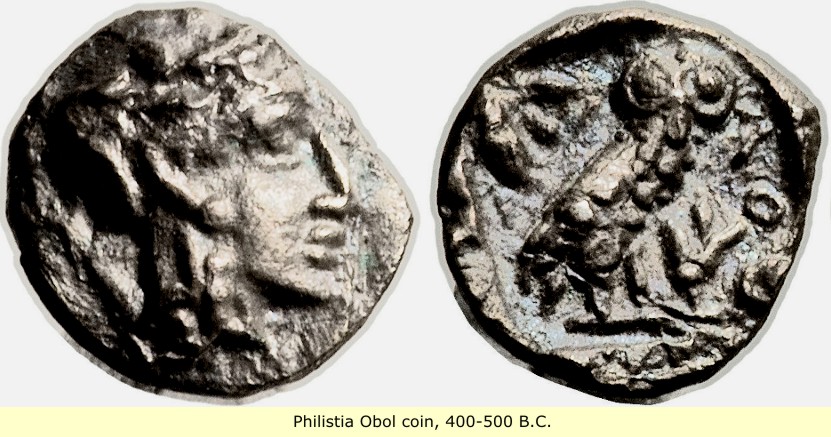
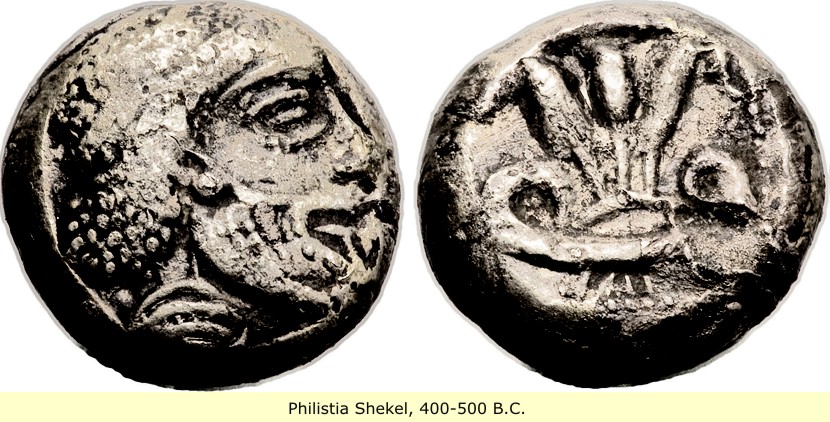
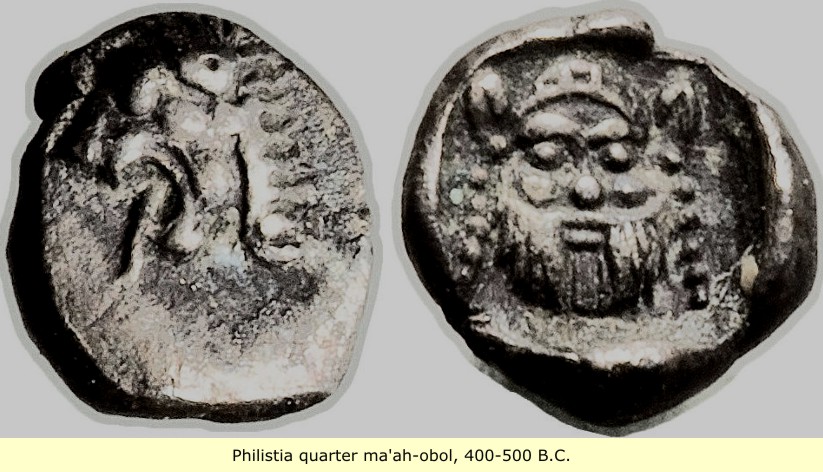
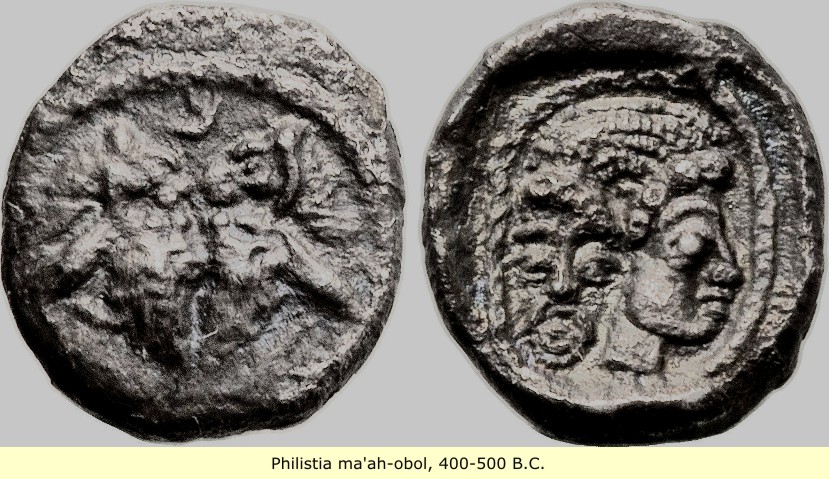
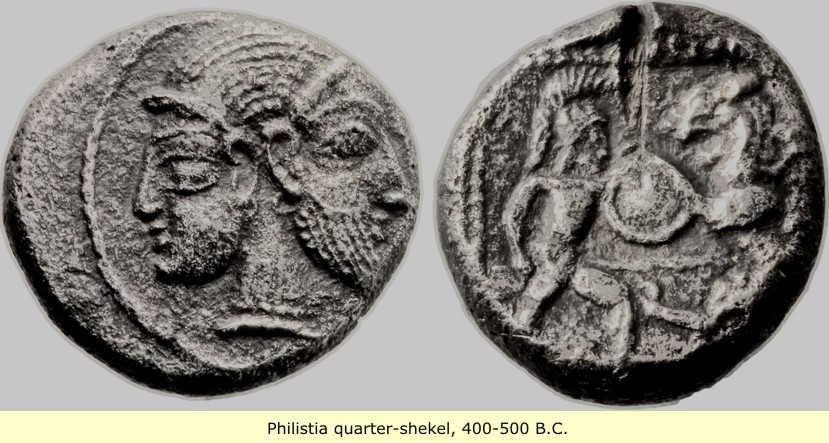
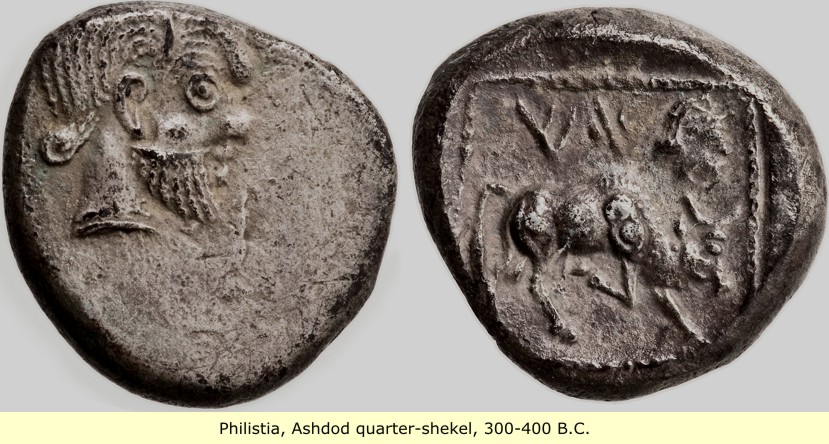
The Philistines are believed to have been Cretans who were a part of the "Sea Peoples" invasion of Egypt circa 1100 B.C. After Rameses III defeated them, he allowed them to settle in Canaan. They settled in the southern coastal plain of Canaan, but within 150 years after their settlement, they would conquer much of the region.
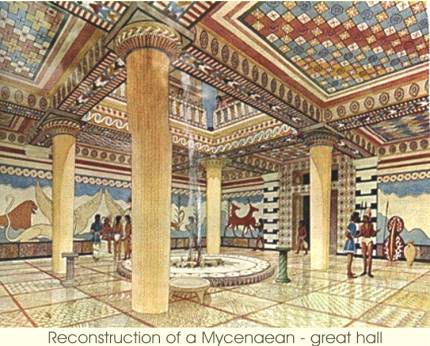
Before that; Cretans - along with Egyptians - built the first modern city in Greece, called Mycenae, which evolved into the Mycenaean civilization. The connection between Mycenaean culture and Philistine culture was made clearer by finds at the excavation of Ashdod, Ekron, Ashkelon, and more recently Gath, four of the five Philistine cities in Canaan. The fifth city is Gaza. Especially notable is the early Philistine pottery, a locally made version of the Aegean Mycenaean Late Helladic IIIC pottery, which is decorated in shades of brown and black. This later developed into the distinctive Philistine pottery of the Iron Age I, with black and red decorations on white slip known as Philistine Bichrome ware.
|
The Philistine cities lost their independence to Tiglath-Pileser III of Assyria by 732 B.C, revolts in following years were all crushed. They were subsequently absorbed into the Babylonian and Persian empires, and disappear as a distinct group by the late 5th century B.C.
 |
Biblically - The Philistines are known as the sworn enemies of Israel - of David and Goliath fame.
 |
Continued: Saul however, won substantial victories over the Philistines, Ammonites, and Amalekites, and for a time the Philistine advance was stopped. But Saul and his son Jonathan, were killed in a disastrous battle with the Philistines in central Palestine. Saul's successor David, a former aide (and also his son-in-law) who had previously fallen out of favor with him. At first took over only the rule of Judah in the south (1010 B.C.) and then all of Israel by (1000 B.C.).
 |
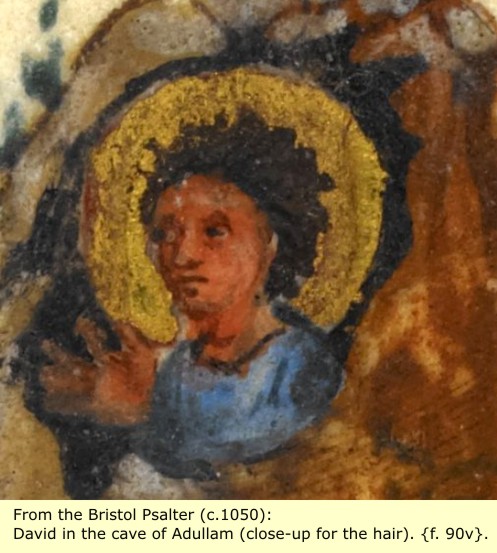
Through his superior military and administrative abilities, and political acumen, David was able to established unified rule over all of Israel. He cleared the territory of Philistines, and in the absence of any competing foreign power in the area, created his own petty empire over neighboring city-states and peoples. He established his capital in Jerusalem, which until then, had maintained its independence as a Canaanite city: wedged as it were, between the territories of Saul's Benjamin tribe and David's Judah tribe.
 |
 |
Meanwhile, three other peoples were east of the Jordan River: the Edomites in the south, the Moabites east of the Dead Sea, and the Ammonites on the edge of the Syrian Desert, east of Gilead. These people were considered by the Hebrews, to be fellow Hebrews (Amorites). They had established settled communities, even before the Hebrew invasion of Canaan. but they did not accept the Hebrew religion and remained polytheists.
 |
 |
 |
 |
 |
 |
 |
 |
A pause here for a curiosity: The name Israel - means "God Contented" in the Canaanite/Hebrew language. The God referred to, is the Canaanite God "El" not the Hebrew god Yahweh??
Under David's son "Solomon" (922 B.C.), Israel became a thriving commercial power; numerous impressive buildings were erected, including the magnificent Temple (the symbol of the religious and political unity of Israel); a large harem of foreign princesses was acquired for Solomon, these marriages served the purpose of sealing relations with other states. The country had been divided into 12 districts for administrative, supply, and taxation purposes.
But foreign cults that had been setup to serve the King's foreign wives - and foreign traders, now led to charges of idolatry and apostasy by religious conservatives. In the latter years of his reign, Solomon's unpopular policies, such as forced labor, led to internal discontent and rebellion. While externally the vassal cities of Damascus and Edom staged successful revolts against his rule.


By now Amorites that were Not part of Israel, seem to have formed a federated state called Aram/Arum, centered in north central Syria - these people came to be known as Aramaeans, Damascus and Edom being cities of Aram.
The central and northern tribes, called Israel in the restricted sense, were especially galled by the oppressive policies of Solomon, and soon after Solomon's death, the northern part - Israel - split off to become a separate kingdom. The united monarchy thus became the divided monarchy of Israel, with Israel (the northern kingdom) and Judah (the southern kingdom).
Jeroboam I, the first king of this "new" state of Israel, made his capital first, at Shechem, then at Tirzah. Recognizing the need for religious independence from Jerusalem, he set up official sanctuaries at Dan and Bethel - the two ends of his realm. This "new" Israel engaged in conflicts against Judah and sometimes fought jointly "with" Judah against foreign powers. At first there was great dynastic "instability" in the northern kingdom, until the ascension of king Omri ( 872 B.C.), one of its greatest kings. Under Omri an impressive building program was initiated at the capital. The kingdom of Moab was subjugated, and amicable relations were reestablished with Judah.
The events, names, and places mentioned in the Mesha Stele correspond to those mentioned in the Bible. For example, Mesha is recorded as the King of Moab in Kings 3:4: “Now Mesha king of Moab was a sheep breeder, and he had to deliver to the king of Israel 100,000 lambs and the wool of 100,000 rams.” Kemosh is mentioned in numerous places in the Bible as the national god of Moab (1 Kings 11:33, Numbers 21:29 etc...). The reign of Omri, King of Israel, is chronicled in 1 Kings 16[6], and the inscription records many places and territories (Nebo, Gad, ect...) that also appear in the Bible. Finally, 2 Kings 3 recounts a revolt by Mesha against Israel, to which Israel responded by allying with Judah and Edom to suppress the revolt:
“Now Mesha king of Moab was a sheep breeder, and he had to deliver to the king of Israel 100,000 lambs and the wool of 100,000 rams. But when Ahab died, the king of Moab rebelled against the king of Israel. So King Jehoram marched out of Samaria at that time and mustered all Israel. And he went and sent word to Jehoshaphat king of Judah, "The king of Moab has rebelled against me. Will you go with me to battle against Moab?" And he said, "I will go. I am as you are, my people as your people, my horses as your horses." Then he said, "By which way shall we march?" Jehoram answered, "By the way of the wilderness of Edom." So the king of Israel went with the king of Judah and the king of Edom…When the king of Moab saw that the battle was going against him, he took with him 700 swordsmen to break through, opposite the king of Edom, but they could not. Then he took his oldest son who was to reign in his place and offered him for a burnt offering on the wall. And there came great wrath against Israel. And they withdrew from him and returned to their own land.”
On the Mesha Stele, made to celebrate his victory, King Mesha gives this account:
 |
The Mesha Stele translationWritten in the Moabite language using the old Phoenician alphabet; which is "very close" to Standard Biblical Hebrew (circa 1,000-850 B.C.). I am Mesha, son of Kemosh [-yatti], the king of Moab, the Dibonite. My father ruled over Moab thirty years, and I ruled after my father. And I made this high place for Kemosh in Qarcho (or Qeriho, a sanctuary). […] because he has saved me from all kings, and because he has shown me to all my enemies. Omri was the king of Israel, and he oppressed Moab for many days, for Kemosh was angry with his land. And his son replaced him; and he said, "I will also oppress Moab." In my days he said so[…]. But I looked down on him and on his house. And Israel has been defeated; has been defeated forever, And Omri took possession of the whole land of Madaba, and he lived there in his days and half the days of his son: forty years. And Kemosh restored it in my days. And I built Baal Meon, and I built a water reservoir in it. And I built Qiryaten. And the men of Gad lived in the land of Atarot from ancient times; and the king of Israel built Atarot for himself. and I fought against the city and captured it. And I killed all the people of the city as a sacrifice for Kemosh and for Moab. And I brought back the fire-hearth of his uncle from there; and I brought it before Kemosh in Qerioit, and I settled the men of Sharon there, as well as the men of Maharit. And Kemosh said to me, "Go, take Nebo from Israel." And I went in the night and fought against it from the daybreak until midday, and I t ook it and I killed it all: seven thousand men and (male) aliens, and women and (female) aliens, and servant girls. Since for Ashtar Kemosh I banned it. And from there I took the vessels of Yahweh, and I brought them before Kemosh. And the king of Israel had built Jahaz, and he stayed there while he fought against me. And Kemosh drove him away from me. And I took from Moab two hundred men, all its division. And I led it up to Yahaz, And I took it in order to add it to Dibon. I have built Qarcho, the wall of the woods and the wall of the citadel. And I have built its gates; And I have built its towers. And I have built the house of the king; and I have made the double reservoir for the spring inside the city. And there was no cistern in the city of Qarcho, and I said to all the people, "Make yourselves a cistern at home." And I cut the moat for Qarcho by using prisoners of Israel. I have built Aroer, and I constructed the military road in Arnon. I have built Beth-Bamot, for it had been destroyed. I have built Bezer, for it lay in ruins. […] men of Dibon stood in battle formation, for all Dibon were in subjection. And I ruled [over the] hundreds in the towns which I have added to the land. And I have built Medeba and Beth-Diblaten and Beth-Baal-Meon, and I brought there .…flocks of the land. And Horonaim, there lived … Kemosh said to me, "Go down, fight against Hauranen." And I went down … and Kemosh restored it in my days … |
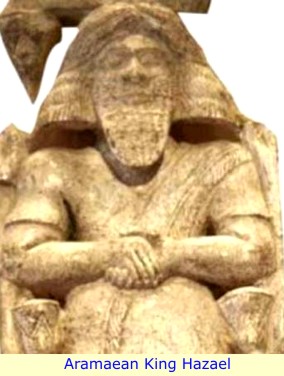
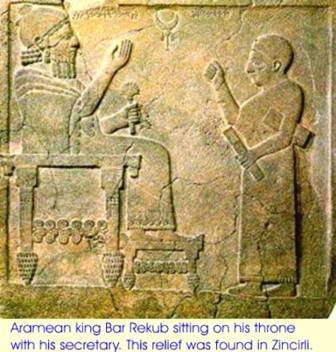
The Phoenician kingdom of Tyre, was made an ally through the marriage of Omri's son Ahab, to the Tyrian princess Jezebel. Later as king, Ahab (874–853 B.C.) fought off an attempt by Damascus, heading a coalition of kings, to take over Israel. Near the end of his reign, Ahab joined with Damascus (Aramaeans) and other neighboring states to fight off incursions by the great Assyrian Empire. Peaceful relations were cemented with Judah through the marriage of Ahab's daughter (or sister) Athaliah, to Jehoram, the son of the king of Judah. (not to be confused with Ahab's son, Jehoram of Israel).
Please visit the "Additional Material Area" for many more photographs of each civilization, and related material <Click> |
| < Back | Home | Next > |